




Communities Urgent Warning Ahead of Vale S.A.’s Annual Meeting: Stop Ongoing Abuses of People and Environment
As shareholders in Brazilian mining giant Vale S.A prepare to gather online for the company’s Annual General Meeting (AGM), communities from Brazil to Indonesia criticize the company’s track record on human rights and environmental stewardship. They also point to the almost $50 billion in mounting lawsuits against the company as a risk factor that should serve as a warning sign to investors.
Communities have tried to dialogue with investors to warn them of Vale’s refusal to adhere to higher mining safety standards, to implement measures to mitigate risks from their operations, and to adequately remedy the harms already caused by the company in Brazil and abroad. In 2024, communities and their international allies invited 79 investors to visit Brumadinho, Brazil, to see Vale’s impacts firsthand, however, none accepted the invitation.
Communities and civil society will participate in the AGM tomorrow and listen to the shareholders’ concerns and questions regarding Vale’s Management Report and Financial statements. They call on shareholders to work with impacted communities to take action on the risks raised during the meeting.
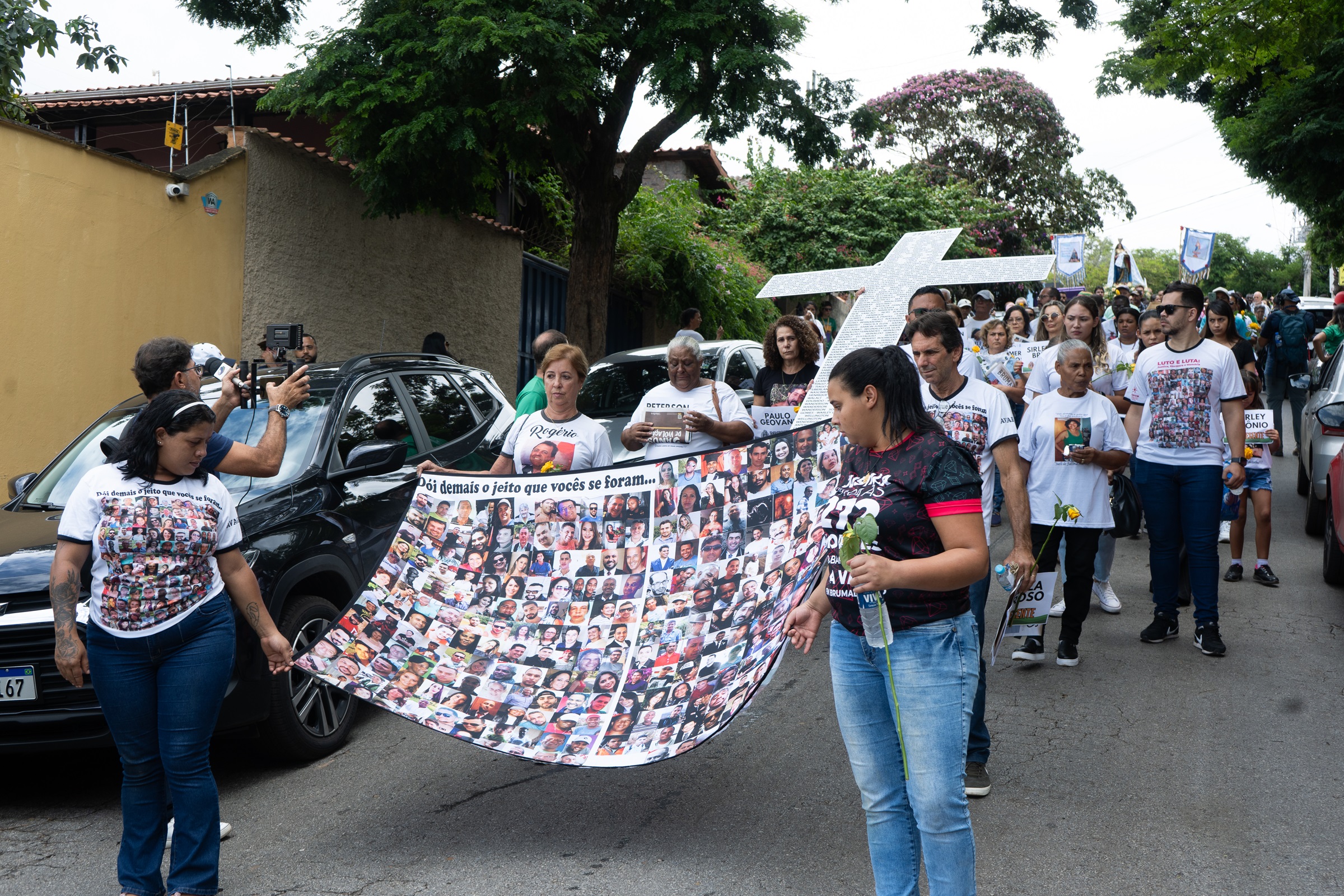
In the five years since the collapse of Vale’s tailings dam in Brumadinho, which killed 272 people and unleashed 12 million cubic meters of ore tailing into the surrounding areas, the company has focused on repairing its public image. Vale sells itself as a socially and environmentally responsible company, both in Brazil and abroad by claiming to have learned from the mistakes of the past, and by stating that it is committed to life, to nature and to international principles and standards of good practice and sustainability.
However, communities impacted by Vale’s operations around the globe tell a different story. Communities downstream from Vale’s mines continue to experience human rights abuses, environmental degradation, workers rights violations, and trauma as a result of Vale’s actions.
“Communities and other stakeholders are speaking up about the ongoing Vale’s social and environmental impacts, highlighting the contradictions between the narrative created by the company for investors and the reality on the ground. Investors must go beyond Vale’s reports to have a full picture and must take action to hold the company accountable for the past and ongoing damages,” said Fernanda Martins from the International Network of People Affected by Vale (AIAAV, in Portuguese), a network that brings together different stakeholders, including communities, NGOs, community-based associations, religious groups, workers, trade unionists, environmentalists, academics, and human rights defenders.
Brumadinho is not alone in facing these impacts in Brazil. Vale manages 27 mining dams currently operating under emergency protocols in the state of Minas Gerais, with 2 dams categorized as at imminent risk of rupture. As a result, hundreds of families have been uprooted from their homes and there are almost one thousand families still living in temporary rented accommodations, away from their relatives, neighbors, pets and livestock, with no land to carry out their subsistence farming. As families wait, Vale was fined 46 million dollars for failing the legal deadline to decommission all upstream mining dams by 2022, with decommission plans extending the local population’s safety risks to 2035.
In Indonesia, communities contend Vale’s nickel mining operations provide a potential threat to the existence of rainforests, as well as the livelihoods of thousands of women living off pepper farming in Loeha Raya, Sulawesi. They also warn about the environmental impacts from water contamination at already existing operations in the area. The community has criticized Vale Indonesia for not being transparent, citing the fact they have never been given information about Vale Indonesia's nickel mine expansion plan in the Tanamalia Block.
Last year, the community in Loeha Raya had asked the shareholders of Vale Indonesia to remove the Tanamalia block, which includes more than 3000 hectares of pepper plantations, from Vale's mining concession. In addition, the block is a rainforest landscape that has essential ecological functions and is home to Sulawesi's endemic flora and fauna.
“This year, thousands of residents in Loeha are still very hopeful that Vale Indonesia's nickel mine expansion plan will not destroy the rainforest and displace the community's peppercorn plantations,” said Muhammad Al Amin of Executive Director of Wahana Lingkungan Hidup Indonesia (WALHI) South Sulawesi. “We hope that Vale and all its shareholders will respect the community's wishes to avoid conflict and greater environmental impacts.”
Vale S.A. is facing an ever increasing number of lawsuits and fines for their role in the tailings dam failures in Mariana and Brumadinho. In 2022, Brazilian Office of the Comptroller General (CGU) fined the company over $17 million for the company's interference with the Brumadinho dam inspection. In 2023, Vale S.A. agreed to pay $ 55.9 million to settle the US Securities and Exchange Commission (SEC) case for false and misleading disclosures in public sustainability reports. In 2024, a Brazilian judge ordered Vale to pay $9.67 billion for damages from the Mariana tailings dam failure, and there are two pending lawsuits regarding compensation for the Mariana failure in the United Kingdom ($46 Billion) and The Netherlands ($3.8 Billion).
Several investors have already acted on their concern for the risks associated with Vale. Data from the Financial Exclusions Tracker website indicate that 48 pension funds and institutional investors worldwide have blacklisted Vale.
“The ongoing lawsuits and administrative fines put Vale in a precarious situation. Investors should understand that these lawsuits are indicators that Vale hasn’t handled its ESG responsibilities appropriately,” said Ana Xambre Pereira from the Dutch organization Both Ends. “Almost 10 years after the Mariana tailings dam failure, which killed 19 people and spilled 60 million cubic meters of ore tailings, two pending international lawsuits seek proper compensation for the victims. The recent lawsuit filed in the Netherlands might indicate that other cases are pending. There is a high litigation risk for the Brumadinho tragedy in time.”
Partners:
Both ENDS, Eerlijke geldwijzer, AIAAV, Instituto Corilheira, Earthworks, Walhi, Terre Solidaire, ECCHR, Facing Finance, Misereor, Banktrack
For more information
Read more about this subject
-
 Dossier /
Seeking justice for the affected communities of Vale’s mining disasters in Mariana and Brumadinho
In 2015 and 2019, the Brazilian state of Minas Gerais experienced two severe mining tragedies in Mariana and Brumadinho, due to the same mining company: Vale. Since then, the affected communities have been seeking justice, via the criminal punishment of the responsible parties, and a fair compensation for the loss of their loved ones, their homes and their livelihoods. Both ENDS supports local CSOs by amplifying their quest for justice within an international audience and, more specifically, by raising awareness amongst Dutch investors in Vale about the high risks this company’s activities pose for people and the environment.
-
 Dossier /
Towards a socially and environmentally just energy transition
To address the climate crisis we need to urgently transition away from fossil fuels towards clean, renewable energy. However, this transition is not only about changing energy sources. It requires an inclusive and fair process that tackles systemic inequalities and demanding consumption patterns, prioritizes environmental and social justice, and which does not repeat mistakes from the past.
-
 News / 2 February 2026
Seven years after Brumadinho: impunity allows Vale’s disasters to continue
Seven years ago, the dam owned by mining company Vale collapsed in Brumadinho, Brazil, killing 272 people and severely polluting the surrounding area. While the relatives of the victims commemorate them and fight for justice, the pollution continues.
-
 Environmentally Just Practice /
A Negotiated Approach for Inclusive Water Governance
A Negotiated Approach envisages the meaningful and long-term participation of communities in all aspects of managing the water and other natural resources on which their lives depend. It seeks to achieve healthy ecosystems and equitable sharing of benefits among all stakeholders within a river basin. This inclusive way of working is an essential precondition for the Transformative Practices that are promoted by Both ENDS and partners.
-
 Dossier /
Rights for People, Rules for Corporations – Stop ISDS!
Indigenous communities in Paraguay saw their attempts to regain their ancestral lands thwarted by German investors. In Indonesia, US-based mining companies succeeded to roll back new laws that were meant to boost the country’s economic development and protect its forests. This is the level of impact that investment treaties can have on social, environmental and economic development and rights. Why? Because of the ‘Investor-to-State Dispute Settlement’ clauses that are included in many such treaties.
-
 Blog / 25 November 2025
COP30 shows why dismantling ISDS is essential for real climate action
Standing in Belém during COP30, I felt the weight of the moment. We came to the Amazon hoping for decisive progress on phasing out fossil fuels, yet the final outcome fell far short of the ambition science and justice demand. The agreement brought welcome commitments on adaptation finance and global indicators, but it refused to confront the structural forces that make climate action so difficult.
-
 Dossier /
Wetlands without Borders
With our Wetlands without Borders program, we work towards environmentally sustainable and socially responsible governance of the wetlands system of the La Plata Basin in South America.
-
 Dossier /
Global Alliance for Green and Gender Action (GAGGA)
GAGGA rallies the collective power of the women's rights and environmental justice movements to realize a world where women can and do access their rights to water, food security, and a clean, healthy and safe environment.
-
 News / 5 November 2025
Interview: Both ENDS at COP30 for Climate Justice and Systemic Change
Both ENDS is present at COP30 to advocate for genuine access to climate finance for locally led, gender-just climate solutions and the mechanisms that facilitate this, including those for farmer-led restoration. Furthermore, the organisation participates to ensure the crucial connection between the climate negotiations and the trade and investment frameworks that shape them.
Learn more about the Both ENDS team at COP30 below, and find all the activities and side-events in which Both ENDS will participate.
-
 News / 5 November 2025
Overview of Both ENDS events at COP30 in Belem, Brazil
Both ENDS is present at COP30 to advocate for genuine access to climate finance for locally led, gender-just climate solutions, and for the mechanisms that make these possible, including those supporting farmer-led restoration. The organisation also engages to highlight the crucial connection between climate negotiations and the trade and investment frameworks that shape them.
Below is an overview of the Both ENDS team at COP30 and a detailed look at the activities and side-events in which Both ENDS will participate.
-
Publication / 16 October 2025
-
Publication / 16 October 2025
-
Publication / 9 October 2025
-
 News / 22 September 2025
EU-Indonesia Trade Deal Threatens Communities and Environment
On September 23th the European Union and Indonesia concluded their negotiations of the EU-Indonesia Comprehensive Economic Partnership Agreement (CEPA), a free trade agreement between the EU and Indonesia. Both ENDS condemns this agreement for favoring corporate interests over those of local communities and the environment.
-
 Dossier /
Soy: trade in deforestation
The rising demand for soy is having negative consequences for people and the environment in South America. Both ENDS reminds Dutch actors in the soy industry of their responsibilities and is working with partners on fair and sustainable alternatives.
-
 Blog / 12 August 2025
Nickel mining for the energy transition: who is accountable for the damage?
Photo blog - In June, I travelled to Indonesia with our partner organization Puanifesto to research the impacts of nickel mining in East Sulawesi. On July 13th, the news broke that the European Union and Indonesia have reached a political agreement on a free trade agreement that was years in the making, called the Comprehensive Economic Partnership Agreement (CEPA). Nickel from Sulawesi is already being used in European cars. This makes it all the more important that we ensure that human and environmental rights are secured in mining and refining operations in Indonesia, before the road is opened to more extraction and exploitation for the European market. The conversations we have had with communities and workers on East Sulawesi show that more binding regulations are necessary to make this happen and ensure an energy transition that is socially and environmentally just.
-
 News / 17 July 2025
Both ENDS Calls on AIIB to Halt Forced Evictions in Mandalika
Together with Indonesian CSOs Both ENDS is calling on the Asian Infrastructure Investment Bank (AIIB) to intervene and direct its client, the Indonesia Tourism Development Corporation (ITDC), and its borrower, the Government of Indonesia, to immediately halt this week's ongoing forced evictions in Tanjung Aan Beach and surrounding areas in Mandalika, Lombok.
-
 News / 16 July 2025
Case Study: Fighting Environmental Transphobia and Social Fragmentation in Brazil
In the face of environmental transphobia, a form of discrimination where trans and gender-diverse communities are disproportionately impacted by environmental degradation,excluded from climate policies, and often met with stigma and exclusion by environmental justice movements, Grupo Orgulho, Liberdade e Dignidade (GOLD) has emerged as a bold and visionary force for change in Brazil. At the heart of this movement is Débora Sabará ,GOLD’s leader, a travesti activist who has fought tirelessly to place the perspectives andneeds of LGBTIQAPN+ (Lesbian, Gay, Bisexual, Trans, Intersex, Queer, Asexual, Pansexual, Nonbinary and other identities), Indigenous and Afro-Brazilian communities at the center of environmental justice conversations.
-
 News / 16 July 2025
Case Study: Community Paralegals Defending Land Rights from Extractive Industries and Land Grabs in Mozambique
Across Mozambique, land represents more than just territory. It is the cornerstone of livelihoods, culture, and autonomy for many communities. When companies arrive, claiming large portions for mining, oil exploration or agribusiness, residents face significant challenges in asserting their rights. Mozambique’s Land Law (1997) grants communities user rights, ensuring they can occupy and use land for subsistence and cultural purposes.
-
 News / 16 July 2025
The challenges of climate change, gender inequality, and conflict
This FCDO-supported project, part of the GAGGA programme, brought together 6 women-led community-based organisations from around the world to explore how they navigate the combined challenges of climate change, gender inequality, and conflict. Through a Feminist Participatory Action Research approach, the organisations documented strategies ranging from land rights advocacy to climate-resilient agriculture, highlighting how extractive industries, militarisation, and patriarchal systems drive exclusion and insecurity. Their findings are now informing donors and policymakers on the need to support grassroots women’s leadership. In the following interview, the project lead shares more about the research, key insights, and its broader impact.



