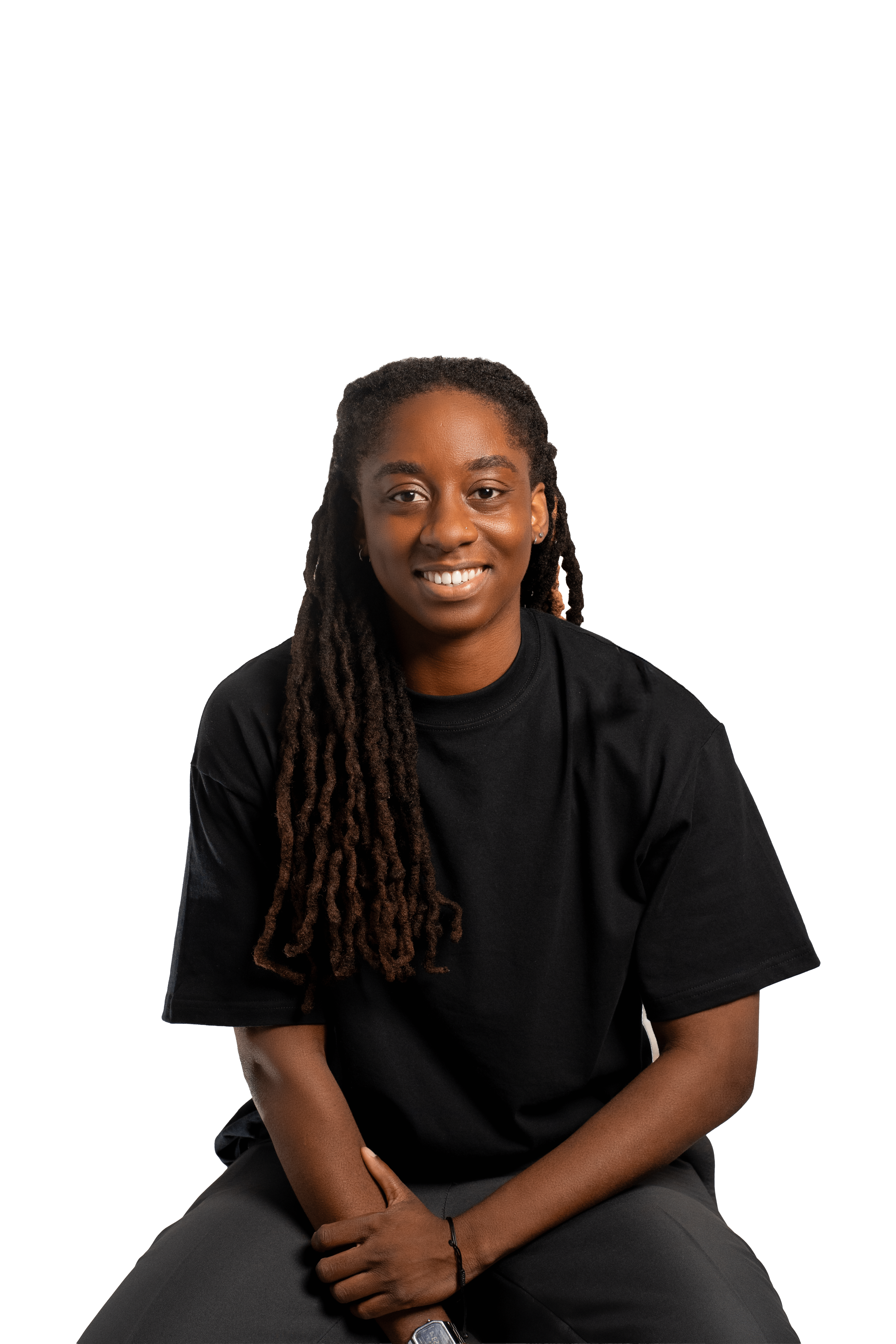
Meet Yemi Knight: “Your experience is expertise”
By Yemi Knight (they/them), Founder and Executive Director, AnchorBridge Environmental Inc., Barbados
Yemi Knight is one of the three winners of the 2026 Irene Dankelman Young Ecofeminist Award, presented on 21 October at the UN Biodiversity Conference (CBD COP17) in Yerevan, Armenia. Yemi founded AnchorBridge Environmental, a youth-led organisation that combines policy advocacy with climate education across the Caribbean. We asked them what the award means to them, what they are working on, and what they would tell other young ecofeminist leaders.
Yemi is also part of the network of the Joke Waller-Hunter Initiative, powered by Both ENDS. With a JWH grant, Yemi followed courses in Social, Environmental and Economic Impact Assessment and in Risk, Crisis and Disaster Management at the University of the West Indies, Cave Hill Campusc, as well as a Level 1A Spanish course at the Centre for Language Learning at the university’s St. Augustine Campus.
What does it mean for you to receive an award named after Irene Dankelman?
I spent years doing this work from behind a screen. As a queer person, I learned early which rooms welcomed me and which did not. Irene Dankelman believed that women and local communities are agents of change with real expertise, and she spent her career, proving it. Receiving an award in her name tells me that people like me, and the communities I come from, hold knowledge worth recognising.
It also confirms something I believe about care. Ecofeminism values relationships, cooperation, empathy and the daily maintenance of life, such as clean water, food, community and housing, over profit-driven growth. Irene’s work lived in that space. This award honours the quiet, often unseen work of caring for people and place, which is the work that built AnchorBridge, and it gives me a responsibility to open doors for the young people behind me.
How are you contributing to gender and climate justice as an ecofeminist?
For me, ecofeminism begins with an ethic of care and a hard look at who pays the price when nature is damaged. Pollution, floods, storms and degraded land fall hardest on people with the least power, who contributed the least to causing them. Women, especially marginalised women, carry much of that burden. In the Caribbean, LGBTQ+ people, girls, young boys, persons with disabilities, houseless people, irregular migrants and the elderly carry it too, and they are often left out of disaster plans and climate decisions.
I work on that in practice. I contributed to the gender and human rights sections of Barbados’s Second Nationally Determined Contribution. AnchorBridge wrote a policy brief on the inclusion of lesbian, gay, bisexual, transgender and queer people in evacuation and disaster planning, which the Inter-American Court of Human Rights cited in 2025. We were also the only civil society organisation, alongside the United Nations, to make a submission on environmental provisions in Barbados’s constitutional reform process. I also see care in simple things. Green spaces and third spaces, the places beyond home and school where young people gather, are disappearing, and people of every age need to get into nature.
What are you focusing on in your work right now?
In December, we are running Island Sprouts, an enrichment programme for rural youth in Trinidad, rooted in the way island communities look after one another with whatever they have. AnchorBridge is also directing a disaster recovery initiative for marginalised communities in Jamaica after Hurricane Melissa. We have plans and committed people ready to carry all of this out. What we need is support.
Beyond the award ceremony, what are your plans at the CBD COP in Armenia?
At COP17, beyond the ceremony, I want to do three things. First, connect with people doing LGBTQ+ inclusion in the climate and biodiversity space, so that we can learn from each other and stop working in isolation. Second, meet Caribbean delegations to see where we can collaborate. Third, secure funding for AnchorBridge. We have a plan and people ready to execute it, and with support we can do this vital work at a much larger scale.
What is your message to young ecofeminist leaders?
The people who advocate for others are often advocating for themselves too, and many of us work in the very hostile environments we work to change. I know that because I live it. So look after yourself and each other. Build coalitions and partner with people, because no one carries this work alone, and a network of care outlasts any single leader. Write down what you do, share the load. Your experience is expertise, and the world needs your voice.
About the award: The Irene Dankelman Young Ecofeminist Award honours young ecofeminists and environmental and human rights defenders whose courageous, rights-based work shows that gender and social justice are prerequisites for effective biodiversity protection. It is named after Irene Dankelman, one of the founders of Both ENDS and a pioneer of women, environment and development work since the 1970s. The award is granted by WECF International, the Women's Environment & Development Organization (WEDO), IUCN NL and Both ENDS. The 2026 awardees are Sarah Adongo (Uganda), Yemi Knight (Barbados) and Monitte Lantas (Philippines).
Read more about this subject
-
 Dossier /
The JWH Initiative: supporting young environmental leaders
The JWH Initiative aims to stimulate leadership of young people in environmental organisations by giving small grants to individuals to expand their knowledge, experience and training.
-
 News / 25 October 2026
Meet Sarah Adongo: “The soil remembers those who cry and defend it”
By Sarah Adongo, Lawyer, Witness Radio, Uganda
Sarah Adongo is one of the three winners of the 2026 Irene Dankelman Young Ecofeminist Award, presented on 21 October at the UN Biodiversity Conference (CBD COP17) in Yerevan, Armenia. A lawyer working with Witness Radio Uganda, Sarah works with women affected by gender-based violence and communities affected by land dispossession and large-scale investments. In this piece, she shares what the award means to her and why gender and environmental justice must go hand in hand.
-
 News / 10 September 2026
Rutu Foundation receives UNESCO Literacy Prize for multilingual education
Both ENDS’ partner the Rutu Foundation for Intercultural Multilingual Education has been awarded the 2026 UNESCO King Sejong Literacy Prize for its language friendly school programme. This prestigious prize recognises the importance of multilingual education and the right of children to learn in an environment where their home languages are valued.
-
 News / 3 September 2026
Restoring Land, Restoring Hope: Both ENDS at UNCCD COP17 in Mongolia
From 17 to 28 August, governments gathered in Ulaanbaatar, Mongolia, for COP17 of the UN Convention to Combat Desertification (UNCCD). At stake was more than how the world responds to land degradation and drought. It was also a question of who gets to shape land restoration, whose knowledge counts, and where the money goes.
-
Publication / 3 July 2026
-
 News / 2 July 2026
Land restoration can help mitigate and resolve conflict - but only if everyone has a seat at the table
Can restoring degraded land also help reduce conflict? According to experts from Niger, Ghana, the Netherlands and other regions, the answer is yes - but only when restoration is rooted in inclusive land governance, local ownership and social cohesion.
-
Publication / 18 June 2026
-
Publication / 12 May 2026
-
 News / 19 March 2026
Winners of the ILED ‘Women Are Educators Award’ announced
Our partner organisation ILED (Indigenous-led Education Network) announced the seven winners of the ILED ‘Women Are Educators Award’ this month. These are women who play extraordinary roles in passing on knowledge, whether in formal or informal educational settings.
-
Publication / 9 October 2025
-
Publication / 2 October 2025
-
 Dossier /
Towards a socially and environmentally just energy transition
To address the climate crisis we need to urgently transition away from fossil fuels towards clean, renewable energy. However, this transition is not only about changing energy sources. It requires an inclusive and fair process that tackles systemic inequalities and demanding consumption patterns, prioritizes environmental and social justice, and which does not repeat mistakes from the past.
-
Publication / 1 July 2025
-
 Environmentally Just Practice /
Agroecology
Agroecology is a diverse set of agricultural practices, a field of science and a social movement. It aims to transform food systems towards greater ecological sustainability, social justice, and resilience. Both ENDS and CSO-partners around the world support farmers and pastoralists practising agroecology, both on the ground and in gathering political and financial support.
-
Letter / 15 April 2025
African civil society urges Oman against EACOP support as east Africa trade expo kicks off
Just one day before the Oman East Africa Trade and Investment
Expo opens in Muscat on April 16, over 70 civil society organisations (CSOs) from Uganda, Tanzania, the Democratic Republic of Congo, and beyond have published an open letter urging the Government of Oman to refrain from providing financial or diplomatic support for the controversial East African Crude Oil Pipeline (EACOP). -
Publication / 1 April 2025
-
 Blog / 31 March 2025
International cooperation and solidarity are in the interest of both the Netherlands and Africa
Traditional development aid keeps Africa in a state of aid dependency, but development cooperation is essential to break this post-colonial dependency, argues Melvin van der Veen in response to an interview in NRC Handelsblad with the Cameroonian economist Célestin Monga. By breaking off this cooperation on the basis of equality, we are actually stifling the voices of African civil society organisations, indigenous communities, youth and women's movements and human rights defenders, and we are not solving global problems.
-
Letter / 25 March 2025
Letter to Shell's CEO and plc Executive Committee: don’t leave the Niger Delta without cleaning up
Today, on Shell Capital Markets Day 2025, Both ENDS together with 195 international and Nigerian of civil society organisations is sending an open letter to Shell’s Executive Committee demanding a full cleanup of the SPDC pollution legacy and transparency on the cleanup process.
-
 News / 21 March 2025
Dutch Royal couple visits Thogoto Forest: a green oasis on the outskirts of Nairobi
This week, King Willem-Alexander and Queen Máxima visited Thogoto Forest as part of their state visit to Kenya. They were able to see the impact of the work of our partner MCDI in the area: a restored forest, clean water and farmers who can earn a living by selling their agro-ecological products.
-
 News / 21 February 2025
Cabinet turns its back on international cooperation and solidarity with callous policy letter
Foreign Trade and Development Minister Klever's published policy letter is coldhearted and callous. It places the Netherlands in international isolation and abandons the most vulnerable people worldwide, including many women, farmers, indigenous peoples and youth.