


ISDS infringement complaint filed with the European Commission
The Netherlands and Portugal join four other EU countries facing such a complaint.
What is this about?
HandelAnders, SOMO and Both ENDS are calling on the European Commission to start a so-called infringement procedure against The Netherlands over incompatibility between its bilateral investment treaties (BITs) and EU law. They are hereby joining a European coalition of CSOs from France, Austria, Germany and Sweden who have filed similar complaints in their respective countries in December 2025. The infringement complaints contend that 1) the overwhelming majority of BITs, in particular those signed before 2009, are incompatible with EU law because they allow investors to sue EU Member States outside of the EU legal system and 2) the majority of BITs are incompatible with EU sanction powers, because sanctioned businessmen can invoke capital transfer clauses to seek compensation from EU Member States.
Why now?
This is particularly pertinent now, because in July 2026, it emerged that a Russian oligarch is using the Netherlands – Russia BIT from 1989 to sue The Netherlands over sanctions resulting from the Russian war of aggression against Ukraine. In other EU countries as well, sanctioned Russian investors are invoking free-transfer provisions against EU Member States implementing EU sanctions (Fridman v Luxembourg) or are likely to do so (Euroclear/Belgium). See the 2025 report Frozen Assets, Hot Claims for a comprehensive overview.
At the same time, globally the call is growing to revise and reform unfair trade- and investment agreements that accord investors disproportionate rights, for instance through investor-state dispute settlement (ISDS). ISDS was a central theme at the recently organized conference on Transitioning Away from Fossil Fuels (TAFF) in Colombia.
What is the legal basis for this?
Procedural
HandelAnders, SOMO and Both ENDS point to a violation of Art. 4(3) TEU, resulting from The Netherlands’ failure to take appropriate steps to eliminate the incompatibilities between its bilateral investment treaties concluded with third countries (BITs) and the autonomy of EU law (1) as well as the EU’s sanction powers (2). They are calling on the Commission to initiate an infringement procedure against The Netherlands under Art. 258 TFEU.
Content
The incompatibility of EU countries’ investment treaties with EU sanctions policy has already been highlighted by the European Court of Justice in 2009. In three rulings against Austria, Sweden, and Finland, it found that capital transfer clauses in the three countries’ investment treaties conflict with the Council’s authority to unilaterally impose sanctions on third countries. However in the years since then, the countries and other EU Member States with similar clauses in their treaties have failed to remedy the situation. They have not renegotiated their treaties to include safeguards, nor have they cancelled them.
What are the consequences of this complaint?
Only the European Commission can actually initiate an infringement procedure against an EU Member State. EU citizens and organizations can call on the European Commission to do so, however the Commission is not obliged to act. Upon reception of our complaint, the Commission will have to decide how and in what form it will further pursue this case.
What should The Netherlands do according to the complainants?
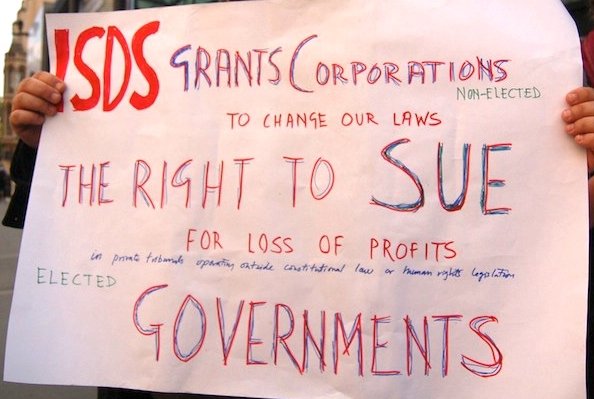
HandelAnders, SOMO and Both ENDS call on The Netherlands to terminate or amend existing investment treaties to bring them in line with European law. In practice, this means getting rid of problematic clauses in investment treaties – in this case, investor-state dispute settlement (ISDS), which allows investors to sue governments outside of the European legal system and provisions on capital transfer, which contradict the autonomy of EU law and the EU’s sanction powers. See also Phasing out ISDS in the Netherlands: a roadmap.
What are the risks of ISDS for countries in the Global South?
The overwhelming majority of ISDS claims in the fossil fuel and mining sectors are brought by investors from the global North against states in the Global South. These claims put disproportionate pressure on those countries' public finances and limit their capacity to enact policies in the public interest. For the Global South, already vulnerable to climate and debt shocks, the threat of ISDS therefore exacerbates obstacles to effective policymaking.
Notes
2. "The Member States shall facilitate the achievement of the Union's tasks and refrain from any measure which could jeopardise the attainment of the Union's objectives."
3. "If the Commission considers that a Member State has failed to fulfil an obligation under the Treaties, it shall deliver a reasoned opinion on the matter after giving the State concerned the opportunity to submit its observations."
4. https://www.bothends.org/en/Whats-new/News/New-report-Phasing-out-ISDS-in-the-Netherlands-a-roadmap/
Read more about this subject
-
 Dossier /
International trade and investment with respect for people and planet
The network of international trade and investment treaties is large and complex. The Netherlands alone has signed more than 70 bilateral investment treaties (BITs) and is party to the trade and investment agreements concluded by the EU, like the EU-Mercosur and EU-Indonesia trade deals.
-
 Dossier /
Rights for People, Rules for Corporations – Stop ISDS!
Indigenous communities in Paraguay saw their attempts to regain their ancestral lands thwarted by German investors. In Indonesia, US-based mining companies succeeded to roll back new laws that were meant to boost the country’s economic development and protect its forests. This is the level of impact that investment treaties can have on social, environmental and economic development and rights. Why? Because of the ‘Investor-to-State Dispute Settlement’ clauses that are included in many such treaties.
-
 Dossier /
Trade agreements
International trade agreements often have far-reaching consequences not only for the economy of a country, but also for people and the environment. It is primarily the most vulnerable groups who suffer most from these agreements.
-
 Press release / 15 October 2026
Dutch and Portuguese organisations file EU complaint over investment treaties that let companies and sanctioned Russian oligarchs sue EU countries for compensation
The Netherlands and Portugal join four other EU countries facing such a complaint, as the Global Days of Action against Investor-State Dispute Settlement (ISDS) begin.
-
 News / 29 September 2026
Summary - Both ENDS complaint under the EU-New Zealand trade agreement
On 29 September 2026, Both ENDS lodged the first complaint on climate grounds with the European Commission's Single Entry Point. It asks the Commission to examine whether Aotearoa New Zealand has broken two promises both sides made in the EU-New Zealand Free Trade Agreement: not to weaken or set aside environmental laws in order to encourage trade or investment, and to effectively implement the Paris Agreement.
-
Publication / 29 September 2026
-
 News / 29 September 2026
Q&A: New Zealand's climate rollback and the EU trade agreement
On 29 September 2026 / 30 September in Aotearoa New Zealand, Both ENDS lodged a complaint with the European Commission under the EU-New Zealand Free Trade Agreement. These are the questions we are asked most often, and our answers. The complaint summary, the case explainer and the key public sources are linked at the end of this page.
-
 Press release / 29 September 2026
New Zealand faces its first climate complaint under EU trade rules
UTRECHT / WELLINGTON, 29 September 2026 /30 September in Aotearoa New Zealand
Both ENDS, a Dutch environmental justice organisation, has lodged a formal complaint with the European Commission arguing that New Zealand has broken the climate promises it made in its free trade agreement with the European Union. It is the first complaint on environmental and climate grounds under the Commission's Single Entry Point, the mechanism that lets civil society ask the EU to enforce the sustainability commitments in its trade agreements.
-
Publication / 3 July 2026
-
Publication / 18 June 2026
-
Publication / 14 April 2026
-
 Blog / 25 November 2025
COP30 shows why dismantling ISDS is essential for real climate action
Standing in Belém during COP30, I felt the weight of the moment. We came to the Amazon hoping for decisive progress on phasing out fossil fuels, yet the final outcome fell far short of the ambition science and justice demand. The agreement brought welcome commitments on adaptation finance and global indicators, but it refused to confront the structural forces that make climate action so difficult.
-
 News / 5 November 2025
Another ISDS claim hits the Netherlands: Petrogas sues over solidarity contribution and royalty regulations
SOMO and Both ENDS strongly condemn the newly revealed investor-state dispute settlement (ISDS) case filed by Petrogas, an Omani oil and gas company operating two shallow-water gas fields in the Dutch North Sea, against the Netherlands under the Netherlands-Oman bilateral investment treaty (BIT).
-
Publication / 16 October 2025
-
Publication / 16 October 2025
-
 News / 6 October 2025
From Entebbe to Accra: civil society is rewriting the rules of investment
By Fernando Hernández Espino and Bart-Jaap Verbeek
Almost a year after African civil society gathered in Uganda to adopt the Entebbe Declaration, the call to transform international investment governance continues to gain strength. From the 6th to the 9th of October, over 50 civil society organisations from across West Africa, including from Ghana, Senegal, Nigeria, Côte d’Ivoire, Cameroon, Gambia, Sierra Leone, as well as from Kenya and Latin America, are convening in Accra to deepen and operationalise the Declaration’s vision.
-
 News / 23 September 2025
With the undemocratic splitting of the EU-Mercosur deal, Europe is missing the chance to lead on fair trade
Recently, many newspapers have written about Brussels’ rush to finalize the trade agreement between the EU and the South American Mercosur countries. According to the European Commission, national parliaments do not need to approve it because the trade part and the “political” part have been separated. This “splitting” means that the trade part can be approved as an EU-only decision by the European Council and the European Parliament, while national parliaments are sidelined and the political-cooperation part is postponed. Both ENDS and its partners are deeply concerned and are calling on the Dutch government to vote against this outdated agreement.
-
 News / 22 September 2025
EU-Indonesia Trade Deal Threatens Communities and Environment
On September 23th the European Union and Indonesia concluded their negotiations of the EU-Indonesia Comprehensive Economic Partnership Agreement (CEPA), a free trade agreement between the EU and Indonesia. Both ENDS condemns this agreement for favoring corporate interests over those of local communities and the environment.
-
 News / 11 September 2025
EU-Mercosur: Small GDP Gain, Big Question Marks for Farmers and Democracy
A recent report by Wageningen Economic Research (WER) on the economic consequences of the trade agreement between the EU and Mercosur confirms what civil society organizations, policymakers, and trade unions have been signaling for years: this agreement does not offer a balanced perspective for farmers and the environment. Instead, it increases power inequalities and shifts burdens onto (small-scale) farmers. Moreover, the deal risks reinforcing unsustainable practices that complicate the climate transition and addressing environmental challenges in both the EU and Mercosur countries.
-
 Blog / 12 August 2025
Nickel mining for the energy transition: who is accountable for the damage?
Photo blog - In June, I travelled to Indonesia with our partner organization Puanifesto to research the impacts of nickel mining in East Sulawesi. On July 13th, the news broke that the European Union and Indonesia have reached a political agreement on a free trade agreement that was years in the making, called the Comprehensive Economic Partnership Agreement (CEPA). Nickel from Sulawesi is already being used in European cars. This makes it all the more important that we ensure that human and environmental rights are secured in mining and refining operations in Indonesia, before the road is opened to more extraction and exploitation for the European market. The conversations we have had with communities and workers on East Sulawesi show that more binding regulations are necessary to make this happen and ensure an energy transition that is socially and environmentally just.