




Fórum Suape empowers women's groups with Dare to Trust-grants
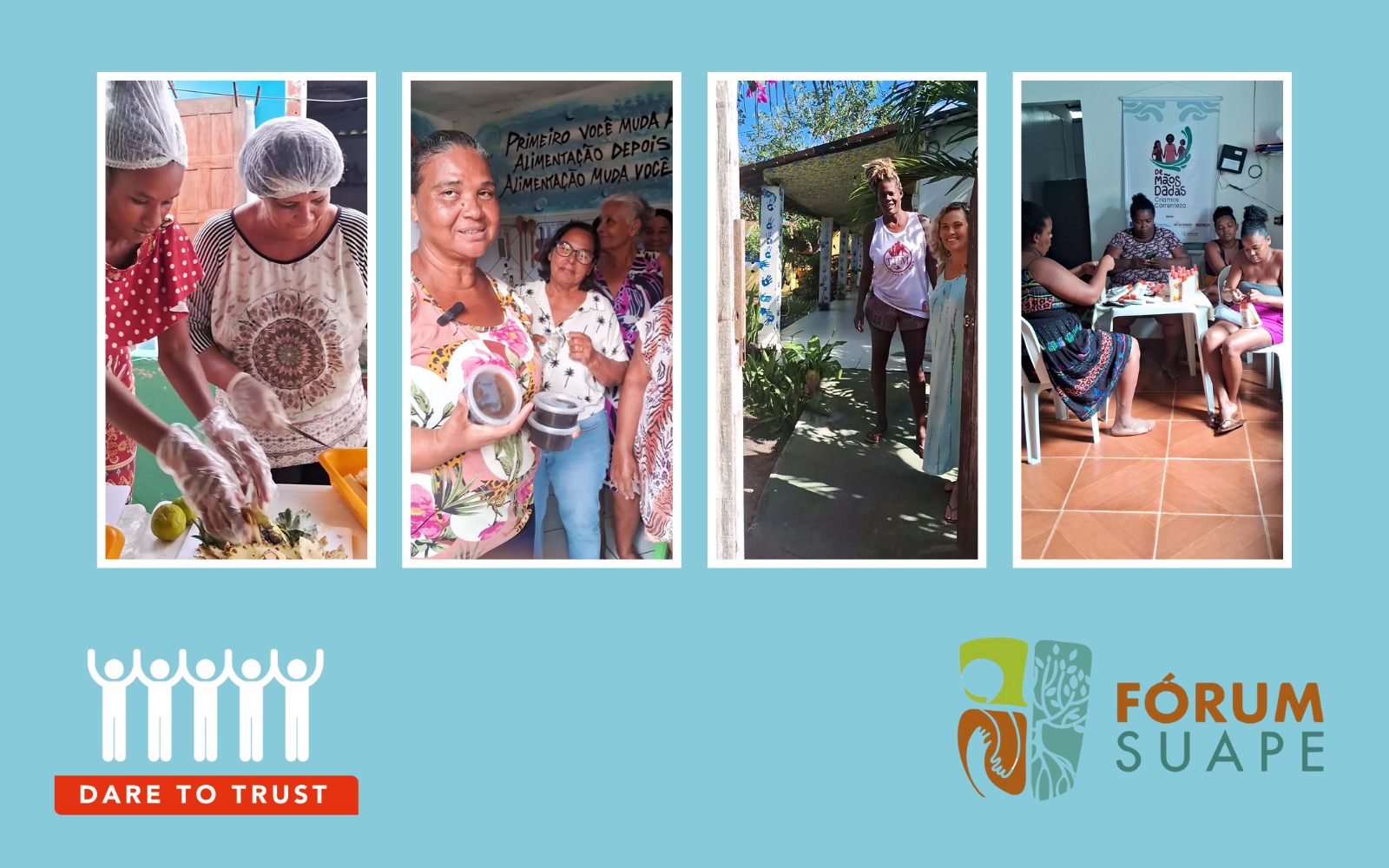
Fórum Suape decided to help several women’s groups in their network. First, they wanted to understand the desires and needs of each group, with the aim of fostering collective thinking and understanding their collective interests and goals. Five groups were selected, one group had difficulty in organizing themselves. They did not move forward and did not receive the money. The other four had wonderful results.
What the members of Fórum Suape noticed was that, in all conversations with the different groups, one common concern stood out: women's mental health. All the women feel overwhelmed by the developments and threats in their areas, especially the women leaders. This impacts every aspect of their lives. Therefore, they wanted to leverage this resource in a way that could help mitigate the feeling of being overwhelmed among the participants.
Empowering by making jam
The women of Quilombo Ilha de Mercês built a small kitchen to produce all kinds of food, for instance guava jam and banana caramelada (a caramel banana cake). A quilombo is a Brazilian settlement established by escaped enslaved people.They share recipes, produce the fruits in their own gardens, sell the food and meet each other in a safe place. Making jam together is also a form of therapy. They invite women to join and turn themselves into entrepreneurs.
One of the women: “When someone might ask, are you going to empower yourself by selling a jar of jam? Yes, I’m going to empower myself by selling a jar of sweets. I made it, I produced it, I’m selling it, I’m meeting new people, I’m making new friends. I want to inspire other women to be strong.”
Watch the full movie (in Portuguese):
A space for women to come together
In one village there was no communal space for women to come together. The men ruled the communal areas and women had no place. With the donation from Dare to Trust, the women from Raízes da Resistência (Roots of Resistance) built their collective community kitchen where they produce jams, jellies, cakes and breads. They saw the potential to create traditional sweets, using artisanal methods such as wood-fired cooking, going against the traditional idea of development. Additionally, they agreed to invest part of the resources in a garden to plant food products. They created a community kitchen called Raízes da Resistência, which is not only a production space but also a place for gathering, sharing, and learning among the women participating.
One of the women: “It was an old dream to have our own kitchen. And every cent has been invested in improving this collective, this space. We believe that it has only strengthened our group even more. We welcome others to come and join us too.”
Watch the full movie (in Portuguese):
Surfing and building bridges
In this town the women group Associação Todas Para o Mar invested in their community centre, where they focus on strengthening women and children through joint sport events. Their many activities are aimed at social transformation and it serves as a welcoming space for everyone—children, women, and the community in general. They upgraded the place with a vegetable garden, musical instruments, sewing machines, educational material like land charts and a classroom where activities can take place such as yoga, capoeira and workshops. They have reached out to 85 children, 120 women and 250 families in the community. They are very passionate about surfing together on the beach while bridging the gap between cultures and skin color.
One of the women: “This is a space for social transformation, especially for black women and children; it‘s a welcoming space for the whole community. It has helped us to keep growing, thriving and embracing more and more people, more women and more children.”
Watch the full movie (in Portuguese):
Uniting fisherwomen for joint mobilisation
The fisherwomen of Mangue Mulher in the town of Itapojuca, state of Pernambuco, have seen a rapid decline of fish in their fishing waters. Large scale dredging for a port in the area has diminished the fish stock enormously and left the women without income. With the donation from Dare to Trust, they rented a community room where the women can meet, share experiences and work together. The goal was combating environmental racism and social exclusion—issues already present in their daily lives. This process, in addition to fostering autonomy and collective strength, was also important for the group’s safety in a region marked by territorial conflicts. As a result of the Dare to Trust project, they increased their capacity for organising, resource mobilisation and political advocacy.
One of the women : “This space for us is a cosy, caring, supportive space and a space for us to share our daily lives.”
Watch the full movie (in Portuguese):
For more information
Read more about this subject
-
 Dossier /
Dare to Trust: the power of unconditional funding
At Both ENDS we cherish our long-term relationships with partners in our global network. These relationships are based on equality and built on trust. The trust we have in each other has developed from years of strategic cooperation, including joint advocacy around common agendas, knowledge sharing, networking, and mobilising and sharing resources to advance environmental justice.
-
 Dossier /
Global Alliance for Green and Gender Action (GAGGA)
GAGGA rallies the collective power of the women's rights and environmental justice movements to realize a world where women can and do access their rights to water, food security, and a clean, healthy and safe environment.
-
 News / 27 February 2026
Both ENDS strengthens the resilience of female environmental defenders worldwide thanks to multi-year contribution from the Postcode Lottery
In recent years, Both ENDS has received an additional contribution of €875,000 from the Postcode Lottery for the Autonomy & Resilience Fund (2022–2025), implemented in collaboration with the Global Alliance for Green and Gender Action (GAGGA). This support was essential because female environmental rights defenders around the world are increasingly facing climate change, repression and shrinking civil space. With this contribution, Both ENDS supports female activists and their communities with flexible, trust-based funding, enabling them to develop their own solutions to urgent environmental and climate problems.
-
 Dossier /
Seeking justice for the affected communities of Vale’s mining disasters in Mariana and Brumadinho
In 2015 and 2019, the Brazilian state of Minas Gerais experienced two severe mining tragedies in Mariana and Brumadinho, due to the same mining company: Vale. Since then, the affected communities have been seeking justice, via the criminal punishment of the responsible parties, and a fair compensation for the loss of their loved ones, their homes and their livelihoods. Both ENDS supports local CSOs by amplifying their quest for justice within an international audience and, more specifically, by raising awareness amongst Dutch investors in Vale about the high risks this company’s activities pose for people and the environment.
-
 News / 2 February 2026
Seven years after Brumadinho: impunity allows Vale’s disasters to continue
Seven years ago, the dam owned by mining company Vale collapsed in Brumadinho, Brazil, killing 272 people and severely polluting the surrounding area. While the relatives of the victims commemorate them and fight for justice, the pollution continues.
-
 Blog / 25 November 2025
COP30 shows why dismantling ISDS is essential for real climate action
Standing in Belém during COP30, I felt the weight of the moment. We came to the Amazon hoping for decisive progress on phasing out fossil fuels, yet the final outcome fell far short of the ambition science and justice demand. The agreement brought welcome commitments on adaptation finance and global indicators, but it refused to confront the structural forces that make climate action so difficult.
-
 Dossier /
Wetlands without Borders
With our Wetlands without Borders program, we work towards environmentally sustainable and socially responsible governance of the wetlands system of the La Plata Basin in South America.
-
 Environmentally Just Practice /
Non-Timber Forest Products (NTFPs)
About one in every six people, particularly women, directly rely on forests for their lives and livelihoods, especially for food. This shows how important non-timber forest products (NTFPs) and forests are to ensure community resilience. Not only as a source of food, water and income, but also because of their cultural and spiritual meaning.
-
 Dossier /
Communities Regreen the Sahel
In various countries in the Sahel, vast tracts of land have been restored by the local population by nurturing what spontaneously springs from the soil and protecting the sprouts from cattle and hazards.
-
 News / 5 November 2025
Interview: Both ENDS at COP30 for Climate Justice and Systemic Change
Both ENDS is present at COP30 to advocate for genuine access to climate finance for locally led, gender-just climate solutions and the mechanisms that facilitate this, including those for farmer-led restoration. Furthermore, the organisation participates to ensure the crucial connection between the climate negotiations and the trade and investment frameworks that shape them.
Learn more about the Both ENDS team at COP30 below, and find all the activities and side-events in which Both ENDS will participate.
-
 News / 5 November 2025
Overview of Both ENDS events at COP30 in Belem, Brazil
Both ENDS is present at COP30 to advocate for genuine access to climate finance for locally led, gender-just climate solutions, and for the mechanisms that make these possible, including those supporting farmer-led restoration. The organisation also engages to highlight the crucial connection between climate negotiations and the trade and investment frameworks that shape them.
Below is an overview of the Both ENDS team at COP30 and a detailed look at the activities and side-events in which Both ENDS will participate.
-
 Dossier /
Soy: trade in deforestation
The rising demand for soy is having negative consequences for people and the environment in South America. Both ENDS reminds Dutch actors in the soy industry of their responsibilities and is working with partners on fair and sustainable alternatives.
-
 Dossier /
Towards a socially and environmentally just energy transition
To address the climate crisis we need to urgently transition away from fossil fuels towards clean, renewable energy. However, this transition is not only about changing energy sources. It requires an inclusive and fair process that tackles systemic inequalities and demanding consumption patterns, prioritizes environmental and social justice, and which does not repeat mistakes from the past.
-
 News / 16 July 2025
Case Study: Fighting Environmental Transphobia and Social Fragmentation in Brazil
In the face of environmental transphobia, a form of discrimination where trans and gender-diverse communities are disproportionately impacted by environmental degradation,excluded from climate policies, and often met with stigma and exclusion by environmental justice movements, Grupo Orgulho, Liberdade e Dignidade (GOLD) has emerged as a bold and visionary force for change in Brazil. At the heart of this movement is Débora Sabará ,GOLD’s leader, a travesti activist who has fought tirelessly to place the perspectives andneeds of LGBTIQAPN+ (Lesbian, Gay, Bisexual, Trans, Intersex, Queer, Asexual, Pansexual, Nonbinary and other identities), Indigenous and Afro-Brazilian communities at the center of environmental justice conversations.
-
 Dossier /
Fair Green and Global Alliance (FGG)
Together with civil society organisations from all over the world, the Fair Green and Global (FGG) Alliance aims for socially just, inclusive and environmentally sustainable societies in the Netherlands and the Global South.
-
Publication / 1 July 2025
-
 Environmentally Just Practice /
Analog Forestry
Analog forestry is a transformative approach to the ecological restoration of degraded lands. Natural forests are used as guides to create ecologically sustainable landscapes, which support the social and economical needs of local communities.
-
 Environmentally Just Practice /
Agroecology
Agroecology is a diverse set of agricultural practices, a field of science and a social movement. It aims to transform food systems towards greater ecological sustainability, social justice, and resilience. Both ENDS and CSO-partners around the world support farmers and pastoralists practising agroecology, both on the ground and in gathering political and financial support.
-
 External link / 29 April 2025
 -
 Blog / 23 April 2025
The power of trust
Trust builds trust. That is what I have learned from how Both ENDS works - within our team, with partners in joint strategies and advocacy, and in our relationships with partners as a funder. Trust is the foundation. It is what allows compassion to grow, what gives rise to hope, and what fuels real solidarity. This is especially powerful in contrast to the prevailing global trend of political and international leaders who prioritize hard measures and self-interest, ignoring relations of trust. It is even more reason for us to share what we have experienced when we put trust first.

