




Charge against Dutch FMO for complicity in human rights violations in Honduras
Today, three representatives of the Honduran indigenous people's organisation COPINH, together with the family of environmental activist Berta Cáceres, who was murdered in March 2016, announced that they are preparing to press charges against the Dutch development bank FMO. COPINH accuses the FMO of complicity in human rights violations in connection with the controversial Agua Zarca hydroelectric project.
The charge states that, by providing its Honduran client with financial support, the FMO helped maintain the political climate of repression and impunity. COPINH hopes that taking the FMO to court will encourage the bank – and other development banks – to ensure that, in the future, human rights violations do not occur in projects in which they are involved.
Impunity and repression in Honduras
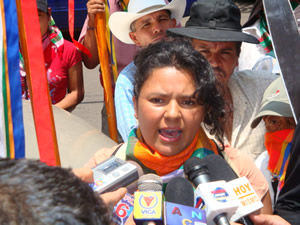
A delegation arrived in the Netherlands this week to announce the complaint against the FMO. The delegation consists of COPINH coordinator Bertha Zuniga Cáceres, a community leader from Rio Blanco (where the Agua Zarca dam is being built) and daughter of Berta Cáceres, together with two Honduran lawyers. The COPINH delegates wish to take advantage of their visit to the Netherland to emphasise the continuing need for a fair and independent legal process surrounding the murder Berta Cáceres and to focus attention on the impunity and repression in Honduras.
Meeting with members of parliament and Ministry of Foreign Affairs
Both ENDS has been supporting COPINH for more than five years in its efforts to initiate and maintain a dialogue with the FMO and other relevant parties in the Netherlands, and is facilitating COPINH's current visit. The delegates will be meeting members of parliament and officials from the Ministry of Foreign Affairs. They will also speak with representatives of Dutch civil society organisations that have been involved in developments around the Agua Zarca project from the beginning and, like Both ENDS, have closely monitored the situation surrounding the murder of Berta Cáceres.
There will be a short press conference today at 14:00 and, on Friday 18 May, the organisations involved have organised a public meeting at the Transnational Institute (TNI) in Amsterdam.
Participatory decision-making
Both ENDS continues to support COPINH's work and is helping to secure justice for those whose rights have been violated by the Agua Zarca project. We will also continue to remind development banks like the FMO of their responsibility to prevent human rights violations. They not only have to tighten up their investment policies, but also apply those rules in practice. Rule one should be that, before deciding to finance a project, banks must be able to guarantee that everyone involved, directly or indirectly, or who might be affected by the project in some way, is informed, consulted and listened to at a very early stage. If that does not happen, they should not agree to finance the project.
Read more about this subject
-
 Dossier /
Agua Zarca: indigenous fight against dam costs lives
Indigenous Hondurans are resisting the construction of the Agua Zarca hydrodam. Their fight has cost several lives, including that of Berta Cáceres. After considerable public pressure, Dutch development bank FMO withdrew from the project.
-
 Dossier /
Advocating for responsible policies of development banks
Development banks should comply with strict environmental and human rights rules to ensure that their projects benefit and do not harm the poorest groups. Both ENDS monitors the banks to make sure they do.
-
 Press release / 13 januari 2026
Investigation: FMO failed to exercise adequate control over project linked to the murder of Berta Cáceres
TEGUCIGALPA/UTRECHT, January 12, 2026 – The murder of indigenous environmental activist Berta Cáceres, which took place almost 10 years ago in Honduras, appears to be the result of an organized criminal operation, in which funds from the Dutch Development Bank FMO were misappropriated to finance illegal activities. This is the conclusion of the investigation report published today by the independent commission set up by the Inter-American Commission on Human Rights, the Honduran state, and the relatives of Berta Cáceres.
For years, FMO was a major financier of the Agua Zarca project. Berta Cáceres, an indigenous leader, fought against this controversial dam and was murdered for that reason in March 2016.
-
 Dossier /
Gas in Mozambique
In 2011 one of the world’s largest gas reserves was found in the coastal province of Cabo Delgado, in the north of Mozambique. A total of 35 billion dollars has been invested to extract the gas. Dozens of multinationals and financiers are involved in these rapid developments. It is very difficult for the people living in Cabo Delgado to exert influence on the plans and activities, while they experience the negative consequences. With the arrival of these companies, they are losing their land.
-
 Dossier /
Indigenous communities threatened by Barro Blanco dam in Panama
The Barro Blanco dam project in Panama, which has Dutch financial support, is causing indigenous lands to disappear under water. Both ENDS is working to protect the rights of indigenous communities living near the dam.
-
 Blog / 1 december 2025
The Long Road to Justice for the Ngäbe of Kiad
In October 2025 I travelled to Kiad, the Indigenous Ngäbe community that led the struggle against the FMO-financed Barro Blanco dam, for one last time. I went there to say my goodbyes, both personally and on behalf of Both ENDS, and to catch a first glimpse on how a community program financed by FMO and DEG – the result of a dialogue process that took several years – is giving a new impulse to the dam-affected communities. But how did we get here?
-
 News / 27 november 2025
Communities and International Consortium Present Community-Led Plan for Nature-Based Adaptation to Sea-Level Rise in Coastal Bangladesh
Local communities in the southwestern coastal region of Bangladesh—together with an international consortium including Uttaran, CEGIS, and Both ENDS—have presented a community-led plan to confront climate change and accelerating sea-level rise through nature-based adaptation. The People’s Plan for Upscaling Ecosystem-Based Adaptation outlines a scalable strategy rooted in local ownership and generations of lived experience. At its centre is Community-Based Tidal River Management (CBTRM), a proven approach that reduces waterlogging, raises land elevation, and restores ecological balance by working with natural tidal and sediment dynamics.
-
 Dossier /
Global Alliance for Green and Gender Action (GAGGA)
GAGGA rallies the collective power of the women's rights and environmental justice movements to realize a world where women can and do access their rights to water, food security, and a clean, healthy and safe environment.
-
 News / 27 oktober 2025
New Step in FMO’s Complaint Policy – Civil Society Organizations Call for Further Strengthening
The updated complaint mechanism of the development banks FMO, DEG, and Proparco marks an important step forward. Organizations that participated in the consultation acknowledge the efforts to improve the mechanism. At the same time, they emphasize that much still needs to be done to make the policy truly effective, transparent, and independent.
-
Publication / 9 oktober 2025
-
 Dossier /
Towards a socially and environmentally just energy transition
To address the climate crisis we need to urgently transition away from fossil fuels towards clean, renewable energy. However, this transition is not only about changing energy sources. It requires an inclusive and fair process that tackles systemic inequalities and demanding consumption patterns, prioritizes environmental and social justice, and which does not repeat mistakes from the past.
-
 Dossier /
Fair Green and Global Alliance (FGG)
Together with civil society organisations from all over the world, the Fair Green and Global (FGG) Alliance aims for socially just, inclusive and environmentally sustainable societies in the Netherlands and the Global South.
-
 Blog / 2 juli 2025
Women at the frontlines of climate action: local power for global change
By Tamara MohrLast week, GAGGA, the Global Alliance for Green and Gender Action, with Both ENDS as one of the Alliance members, together with FCAM and Mama Cash, organised its Global Meeting in Indonesia. The goal of this meeting was to recognise, celebrate and look ahead at cross-movement and cross-regional connections, to strengthen the collective power of gender, climate and environmental justice movements.
-
Publication / 1 juli 2025
-
 News / 24 juni 2025
Indigenous communities in Panama obtain recognition and partial mitigation measures by Development Banks FMO and DEG in relation to the Barro Blanco dam
Both ENDS and SOMO welcome the signing of the agreement of understanding between four Indigenous Ngäbe communities in Panama and the European development banks FMO and DEG on June 17th 2025. The arrangement includes a community development program that, together with a public statement issued by the banks, aims to recognize and mitigate some of the negative impacts caused by the Barro Blanco hydropower dam. We wish to congratulate the community-based organisation Movimiento 10 de Abril (M10) for its perseverance to seek justice for the affected communities, and we acknowledge the commitment of FMO and DEG to pursue a solution to their long-standing dispute with the communities arising from their partial financing of the hydropower project since 2011.
-
 Blog / 11 april 2025
FMO is very pleased with its own success – now the local population still needs to be
The FMO development bank is proud of its results and the opportunities it seizes where commercial banks fail to act. But do the bank's actions really help, ask Anne de Jonghe and Nick Middeldorp.
-
Letter / 3 maart 2025
Input for FMO’s “investment approach to responsibly managed forest plantations”
Both ENDS has been asked by FMO to comment on its draft investment approach to responsibly managed forest plantations. To follow are a number of observations and recommendations, partially informed by Both ENDS long legacy of working in the forest & land arena, in dialogue with international donors, philanthropic foundations, companies, certification bodies and notably with forest dependent communities and other land users.
-
Publication / 16 januari 2025
-
 Dossier /
Small Grants Big Impacts
Small grants funds offer an effective, alternative way to channel big money from large donors and funds to local groups and organisations that are striving for a sustainable and just society everywhere around the world.
-
Letter / 22 juli 2024
Joint Call to Action: International Civil Society Demands Justice for Berta Cáceres' Murder Victims in Honduras
This is a joint call to action by international civil society organizations to call upon the Honduran authorities to ensure there is justice for the victims of the murder on Berta Caceres. Eight years and four months have passed since the crime against Berta and the Honduran justice system has not confirmed the sentences of those convicted and has not prosecuted the intellectual authors. We are extremely concerned that independent administration of justice and international agreements on human rights are not being upheld.



