




3 Steps to Stand Up for Human Rights in Development!
As we celebrate both the 30th anniversary of the UN Declaration on the Right to Development (December 4th) and Human Rights Day (December 10th), Both ENDS joins with communities and civil society groups around the world to call on development finance institutions, governments, and businesses to take 3 steps to stand up for Human Rights in development.
- Promote Rights-Respecting Development. Adopt a policy commitment to respect human rights and implement due diligence to prevent human rights violations.
- Protect Civil Society Participation. Ensure meaningful participation in development processes and promote an enabling environment for civil society.
- Defend the Defenders. Adopt a zero-tolerance policy on attacks against human rights defenders and enact protocols to prevent and respond to such attacks.
Join our call on the website of the Coalition for Human Rights in Development, of which Both ENDS is also a member.
Read more about this subject
-
 Dossier /
Agua Zarca: indigenous fight against dam costs lives
Indigenous Hondurans are resisting the construction of the Agua Zarca hydrodam. Their fight has cost several lives, including that of Berta Cáceres. After considerable public pressure, Dutch development bank FMO withdrew from the project.
-
 News / 20 oktober 2016
Laura Cáceres: “By continuing my mother’s fight, I continue the defense of life”
This week, Laura Zuniga Cáceres, daughter of Berta Cáceres*, visits the Netherlands. She will talk with the directors of the involved departments of the Dutch Ministry of Foreign Affairs, participated in a colloquium about indigenous right of Leiden University and meet with several Dutch NGO's. Both ENDS asked this brave young woman about the situation in Honduras and her motivation to continue her mother's work.
-
 News / 29 juni 2022
In solidarity with daughter of murdered Indigenous leader
On Tuesday 28 June, the Honduran organisation COPINH and the Global Justice Association filed a complaint with the public prosecutor in the Netherlands against Dutch development bank FMO. For COPINH, this is part of their continued efforts to bring to justice those involved in the murder of their leader Berta Cáceres. FMO financed the Agua Zarca project in Honduras in 2014. The new complaint is based on documents indicating that FMO's money has been used improperly.
-
 Dossier /
Advocating for responsible policies of development banks
Development banks should comply with strict environmental and human rights rules to ensure that their projects benefit and do not harm the poorest groups. Both ENDS monitors the banks to make sure they do.
-
 News / 1 december 2018
7 suspects of the murder of the Honduran Berta Cáceres were found guilty
On Thursday, November 29, seven suspects of the murder of Berta Cáceres (in March 2016) were found guilty. Members of the indigenous human rights organisation COPINH, of which Cáceres was the leader, and close relatives of Cáceres herself see the ruling as the first step towards justice for her murder and the recognition that the company DESA is co-responsible for this. They also point out, however, that the process was permeated with corruption, intimidation and other abuses from the very beginning, and that the masterminds behind the murder are still walking around freely.
-
 News / 23 juli 2021
Dutch development bank FMO's funding for Agua Zarca project possibly linked to malpractices
The million-dollar loan that the Dutch development bank FMO provided to project developers of Honduran company DESA for the construction of the controversial Agua Zarca dam project in Honduras, may be related to gross corruption and malpractice. This is concluded in an article published today in the Dutch news paper Financieel Dagblad, based on information provided by COPINH, the indigenous organisation that has been opposing the construction of the dam for years. Several members of the organisation, including its leader Berta Cáceres, were murdered. DESA director David Castillo has recently been convicted of being involved in the assassination of Cáceres in 2016.
-
 News / 2 maart 2021
5 years after her murder, Berta Cáceres’ family is still waiting for justice
Today it is 5 years ago that Berta Cáceres was shot in haar home in La Esperanza, Honduras, for defending the rights of indigenous people. The leader of indigenous organisation COPINH resisted the Agua-Zarca hydropower dam that was planned to be build in indigenous territory. The actual murderers have been convicted, but not so the intellectual authors of the murders.
-
 News / 6 maart 2018
Director of electricity company arrested in Berta Cáceres case
On Friday, March 2, the director of DESA, David Castillo, was arrested in Honduras on suspicion of involvement in the murder of Berta Cáceres, exactly 2 years ago. The Honduran government refused for a long time to not only detect the actual murderers, but also the intellectual authors of the murder of Cáceres.
-
 Dossier /
Large-scale infrastructure
Large-scale infrastructural projects have detrimental effects on local people and the environment, while their benefits are felt elsewhere. Both ENDS is working to ensure that local people have a greater say in decision-making and is investigating the way these projects are funded.
-
 News / 28 september 2018
Joan Carling is awarded with the UN’s highest environmental honor!
We congratulate Joan Carling, member of the permanent commission on indigenous peoples of the UN, for having received the Lifetime Achievement Award as 'Champion of the Earth' by the UN Environment! This is the UN's highest environmental honor, given to six of the world's most outstanding environmental change makers once a year.
-
 News / 8 november 2021
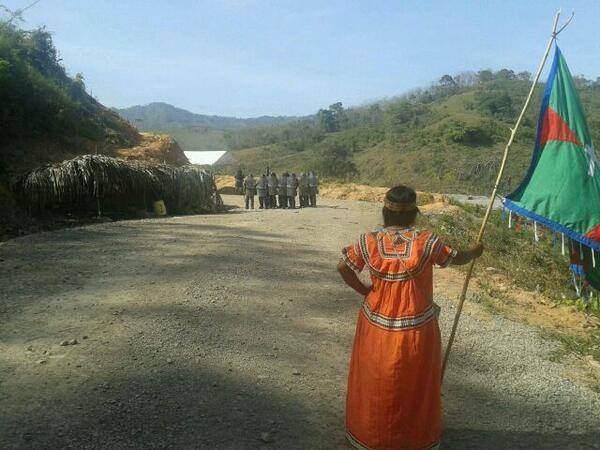
Both ENDS and SOMO condemn violence against Indigenous community near the Barro Blanco dam in Panama
Members of the Indigenous Ngäbe Buglé people were brutally attacked by Panamanian police on Friday 29 October 2021 from a parcel of private land near the FMO-financed Barro Blanco hydroelectric dam. The victims, all members of the anti-dam movement M22, had peacefully occupied the land after their protest camp got dismantled in July this year.
-
 News / 6 juli 2017
Press Release 6 July 2017: FMO and FinnFund exit the controversial Agua Zarca project
Both ENDS and SOMO welcome the announcement done today by the Dutch and Finnish development banks, FMO and FinnFund, to exit the controversial Agua Zarca hydroelectric project in Honduras. Conflict about the project has led to violence in the region, including the murder of three leaders who opposed the project. In March 2016, renowned human rights defender Berta Caceres was murdered for opposing this project in indigenous Lenca territory.
-
 Dossier /
Indigenous communities threatened by Barro Blanco dam in Panama
The Barro Blanco dam project in Panama, which has Dutch financial support, is causing indigenous lands to disappear under water. Both ENDS is working to protect the rights of indigenous communities living near the dam.
-
Publication / 10 juli 2019
-
 Press release / 5 december 2022
Groups react with dismay to FMO’s position statement on Financial Intermediaries, pointing to outstanding human rights and climate concerns
On October 13th 2022, FMO published the final version of its Position Statement on Impact and ESG for Financial Intermediaries (FI statement). As civil society groups which have engaged with FMO on this topic for more than four years, we are extremely disappointed with the result. In the statement, FMO does not show sufficient commitment to ensuring its investments into financial intermediaries – which represent the bank's largest investment sector* – do not violate human rights or contribute to environmental harms.
-
 News / 27 juli 2021
In conversation with the Ngäbe-Bugle community in Panama, after five years of Barro Blanco-dam
In April 2021, the Dutch development bank FMO announced that it is no longer involved in the Barro Blanco project, a controversial dam in Panama. GENISA, the Panamanian company that built the dam, unexpectedly paid off the multi-million dollar loan early. The question is to what extent, now that the bank is no longer actively financing the project, FMO can still be held responsible for the damage and suffering that was caused when this was still the case.
-
 External link / 24 augustus 2022
Supporting civil society to work freely and safely (Annual Report 2021)
Both ENDS aims to ensure that civil society can work freely and safely to influence decision-making related to ecosystems, environmental justice and human rights. In many places around the world, the space for civil society organisations to operate is shrinking. Repression, harassment and violence against environmental human rights defenders – our partners among them – is on the rise.
-
 News / 26 oktober 2022
Senegal: 26 innocent people including Both ENDS' partner arrested in Senegal
Update October 27th:
Today our friends have been released after five nights in detention. We welcome this great news and we are happy and relieved that Babacar Diouf and the others who were arrested will soon be back with their loved ones.
Nonetheless this was a very bad signal from Senegalese authorities and police and an indication of the growing restriction on civic space in Senegal. It is unacceptable that freedom of expression is restricted, people should not have to go to jail for peacefully expressing their opinion - especially when their livelihood is at stake.
-
 News / 23 december 2021
2022 is the year for FMO to make good on its promises and provide financial support only to sustainable development
2021 was a turbulent year for Dutch development bank FMO, to say the least. The bank has been under fire for many years for investments linked to human rights violations and suspected corruption. But in the past year, the Dutch press and media have reported on one new development after the other in ongoing cases involving FMO. Below we give a short summary of these cases and call on FMO to make the promised improvements in 2022.
-
 News / 24 juni 2025
Indigenous communities in Panama obtain recognition and partial mitigation measures by Development Banks FMO and DEG in relation to the Barro Blanco dam
Both ENDS and SOMO welcome the signing of the agreement of understanding between four Indigenous Ngäbe communities in Panama and the European development banks FMO and DEG on June 17th 2025. The arrangement includes a community development program that, together with a public statement issued by the banks, aims to recognize and mitigate some of the negative impacts caused by the Barro Blanco hydropower dam. We wish to congratulate the community-based organisation Movimiento 10 de Abril (M10) for its perseverance to seek justice for the affected communities, and we acknowledge the commitment of FMO and DEG to pursue a solution to their long-standing dispute with the communities arising from their partial financing of the hydropower project since 2011.

