




Global Alliance Urges Dutch Government to Reconsider Endorsement of Controversial Timber Certification Scheme
A coalition of Malaysian and international NGOs has released a memorandum in response to the recent TPAC report on the Malaysian Timber Certification Scheme (MTCS). The organizations express serious concerns about the independence, quality, and credibility of the assessment carried out by the Timber Procurement Assessment Committee (TPAC).
According to the authors of the memorandum, the report once again highlights systemic weaknesses within the Malaysian certification system, including the neglect of indigenous community complaints, poor adherence to international human rights norms such as Free, Prior and Informed Consent (FPIC), and a lack of transparency in audit and grievance procedures.
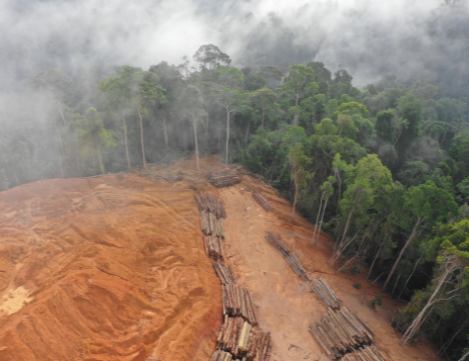
They argue that TPAC’s largely positive conclusions about MTCS do not reflect the on-the-ground realities. By continuing to recognize MTCS without much more stringent demands and monitoring, the Dutch government risks implicitly legitimizing human rights violations and deforestation.
As Komeok Joe, managing director of indigenous organisation Keruan states "Logging in Sarawak often happens without our consent. It destroys our forests and the food we rely on, contaminates our rivers, and worsens our lives. Calling this 'sustainable' is a mockery of Indigenous rights."
“It is disappointing to see once again that Indigenous peoples welfare are not being taken seriously enough to change the way business as usual are conducted in their customary domain. The environmental and social problems are briefly acknowledged, but with no resolved towards real solution and protection for peoples whose livelihood, and homes are in continuos state of threat and insecurity,” Celine Lim, managing director, SAVE Rivers, observes.
“After more than fifteen years, the same problems persist. Without independent oversight and transparent monitoring, the label ‘sustainable timber’ remains misleading,” Paul Wolvekamp of Both ENDS concludes.
In the memorandum, the NGOs call on the Dutch authorities to:
- Reconsider the recognition of MTCS;
- Establish a robust and independent monitoring framework;
- Ensure full alignment with the EU Deforestation Regulation (EUDR), the EU Corporate Sustainability Due Diligence Directive (CSDDD), and international conventions such as ILO-169 and UNDRIP.
The signatories emphasize that they are not opposed to timber production, provided it is carried out in full compliance with human rights, environmental safeguards, and credible certification standards.
Read the full piece: “Response to TPAC Report ‘Final Judgement Detailed Research MTCS, 11 June 2025’’.
For more information
Read more about this subject
-
 Environmentally Just Practice /
Non-Timber Forest Products (NTFPs)
About one in every six people, particularly women, directly rely on forests for their lives and livelihoods, especially for food. This shows how important non-timber forest products (NTFPs) and forests are to ensure community resilience. Not only as a source of food, water and income, but also because of their cultural and spiritual meaning.
-
 Dossier /
Wetlands without Borders
With our Wetlands without Borders program, we work towards environmentally sustainable and socially responsible governance of the wetlands system of the La Plata Basin in South America.
-
Publication / 17 november 2025
-
Letter / 14 november 2025
Letter: TPAC’s report “Final Judgement Detailed Research MTCS’’
A coalition of Malaysian and international NGOs has released a memorandum in response to the recent TPAC report on the Malaysian Timber Certification Scheme (MTCS). The organisations express serious concerns about the independence, quality, and credibility of the assessment carried out by the Timber Procurement Assessment Committee (TPAC).
-
 News / 5 november 2025
Overview of Both ENDS events at COP30 in Belem, Brazil
Both ENDS is present at COP30 to advocate for genuine access to climate finance for locally led, gender-just climate solutions, and for the mechanisms that make these possible, including those supporting farmer-led restoration. The organisation also engages to highlight the crucial connection between climate negotiations and the trade and investment frameworks that shape them.
Below is an overview of the Both ENDS team at COP30 and a detailed look at the activities and side-events in which Both ENDS will participate.
-
Publication / 16 oktober 2025
-
Publication / 16 oktober 2025
-
Publication / 9 oktober 2025
-
 Dossier /
Amplifying environmentally just practices
Because of the close relationship with their living environment, local communities often have the best ideas for the sustainable and equitable use and governance of land, water and forests. These environmentally just practices and processes successfully protect and restore ecosystems and address climate change. They are essential in the light of the multiple crises the world faces, but are in dire need of financial and policy support.
-
Publication / 2 oktober 2025
-
 News / 23 september 2025
With the undemocratic splitting of the EU-Mercosur deal, Europe is missing the chance to lead on fair trade
Recently, many newspapers have written about Brussels’ rush to finalize the trade agreement between the EU and the South American Mercosur countries. According to the European Commission, national parliaments do not need to approve it because the trade part and the “political” part have been separated. This “splitting” means that the trade part can be approved as an EU-only decision by the European Council and the European Parliament, while national parliaments are sidelined and the political-cooperation part is postponed. Both ENDS and its partners are deeply concerned and are calling on the Dutch government to vote against this outdated agreement.
-
 News / 22 september 2025
EU-Indonesia Trade Deal Threatens Communities and Environment
On September 23th the European Union and Indonesia concluded their negotiations of the EU-Indonesia Comprehensive Economic Partnership Agreement (CEPA), a free trade agreement between the EU and Indonesia. Both ENDS condemns this agreement for favoring corporate interests over those of local communities and the environment.
-
 News / 11 september 2025
EU-Mercosur: Small GDP Gain, Big Question Marks for Farmers and Democracy
A recent report by Wageningen Economic Research (WER) on the economic consequences of the trade agreement between the EU and Mercosur confirms what civil society organizations, policymakers, and trade unions have been signaling for years: this agreement does not offer a balanced perspective for farmers and the environment. Instead, it increases power inequalities and shifts burdens onto (small-scale) farmers. Moreover, the deal risks reinforcing unsustainable practices that complicate the climate transition and addressing environmental challenges in both the EU and Mercosur countries.
-
 Dossier /
Soy: trade in deforestation
The rising demand for soy is having negative consequences for people and the environment in South America. Both ENDS reminds Dutch actors in the soy industry of their responsibilities and is working with partners on fair and sustainable alternatives.
-
 News / 9 september 2025
Simplification Must Not Mean Weakening: Why the EUDR and other Environmental Legislation Must Stay Strong
Both ENDS warns that the current debate on “simplification” of EU environmental law must not become an excuse to weaken or postpone urgently needed safeguards. In earlier contributions to the drafting of the EU Deforestation Regulation (EUDR), Both ENDS relayed the voices of local and Indigenous forest-dependent peoples, who consistently urged the EU to take responsibility for the massive deforestation linked to European imports. They underlined how this deforestation destroys biodiversity, undermines climate stability, and erodes their rights, livelihoods and cultures.
-
 Blog / 12 augustus 2025
Nickel mining for the energy transition: who is accountable for the damage?
Photo blog - In June, I travelled to Indonesia with our partner organization Puanifesto to research the impacts of nickel mining in East Sulawesi. On July 13th, the news broke that the European Union and Indonesia have reached a political agreement on a free trade agreement that was years in the making, called the Comprehensive Economic Partnership Agreement (CEPA). Nickel from Sulawesi is already being used in European cars. This makes it all the more important that we ensure that human and environmental rights are secured in mining and refining operations in Indonesia, before the road is opened to more extraction and exploitation for the European market. The conversations we have had with communities and workers on East Sulawesi show that more binding regulations are necessary to make this happen and ensure an energy transition that is socially and environmentally just.
-
 Dossier /
Towards a socially and environmentally just energy transition
To address the climate crisis we need to urgently transition away from fossil fuels towards clean, renewable energy. However, this transition is not only about changing energy sources. It requires an inclusive and fair process that tackles systemic inequalities and demanding consumption patterns, prioritizes environmental and social justice, and which does not repeat mistakes from the past.
-
 Blog / 17 juli 2025
A disaster for farmers: here and there
The trade agreement with South America is harmful to farmers, the climate, and biodiversity, on both sides of the Atlantic. It’s time to take this deal off the table once and for all, argues Fernando Hernandez, Senior Policy Officer for Trade and Investment at Both ENDS.
-
 Dossier /
Fair Green and Global Alliance (FGG)
Together with civil society organisations from all over the world, the Fair Green and Global (FGG) Alliance aims for socially just, inclusive and environmentally sustainable societies in the Netherlands and the Global South.
-
Publication / 1 juli 2025




