




COP22: Marrakech Climate Change Conference
From 7 to 18 november, the Climate Change COP22 will take place in Marrakech, Morrocco. This '22nd Conference of the Parties to the United Nations Framework Convention on Climate Change (UNFCCC)' as it is called officially, is the annual meeting of the 195 countries which have signed and ratified the convention.
This Conference of Parties, taking place a year after the big climate summit in Paris last year, will focus primarily on the implementation of the Paris agreement which entered into force on November 4 this year.
Also on the agenda are issues like climate finance (the 100 billion dollar roadmap) the 2018 review of commitments for mitigation (lowering the emission of greenhouse gasses) and transparency.
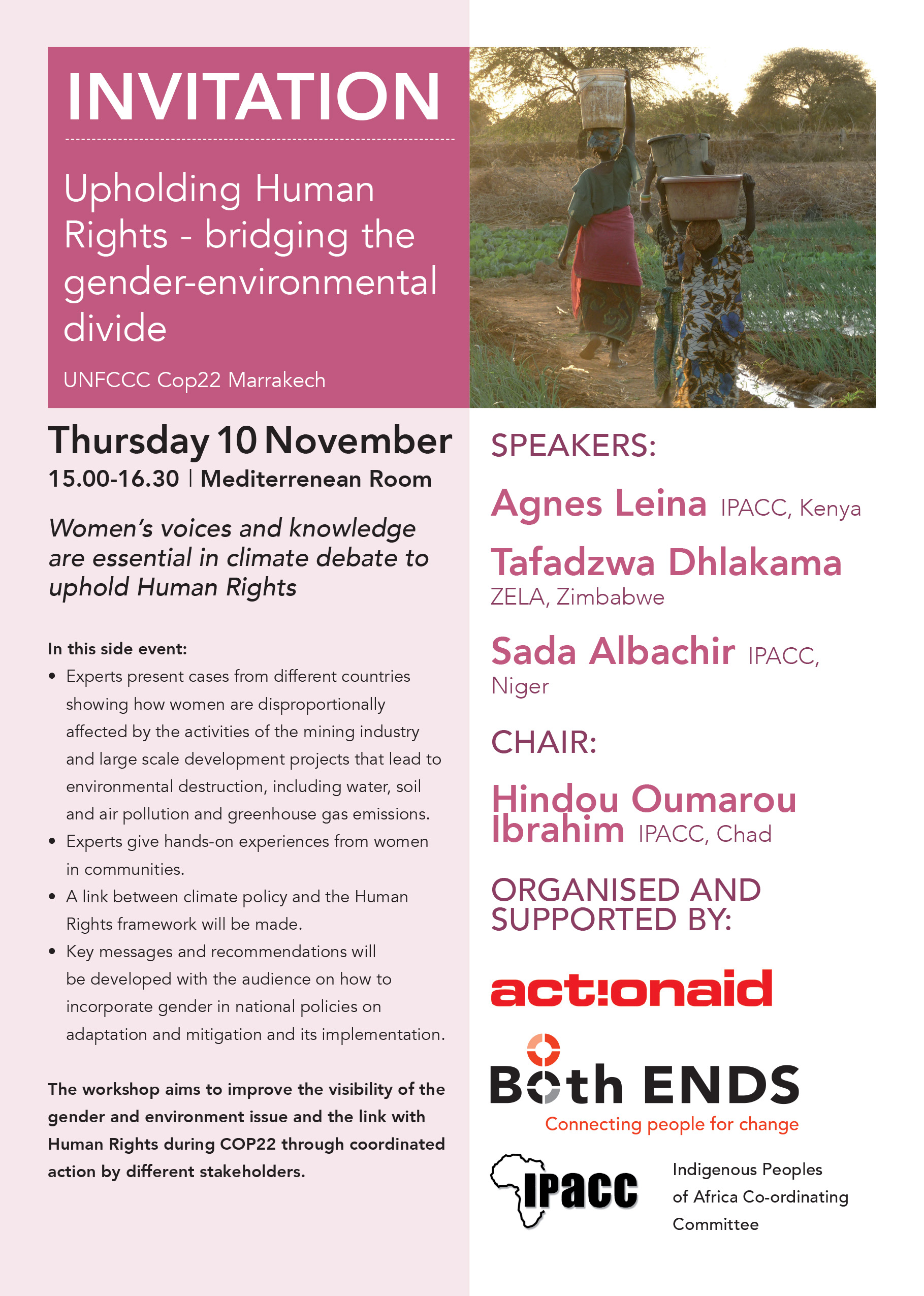
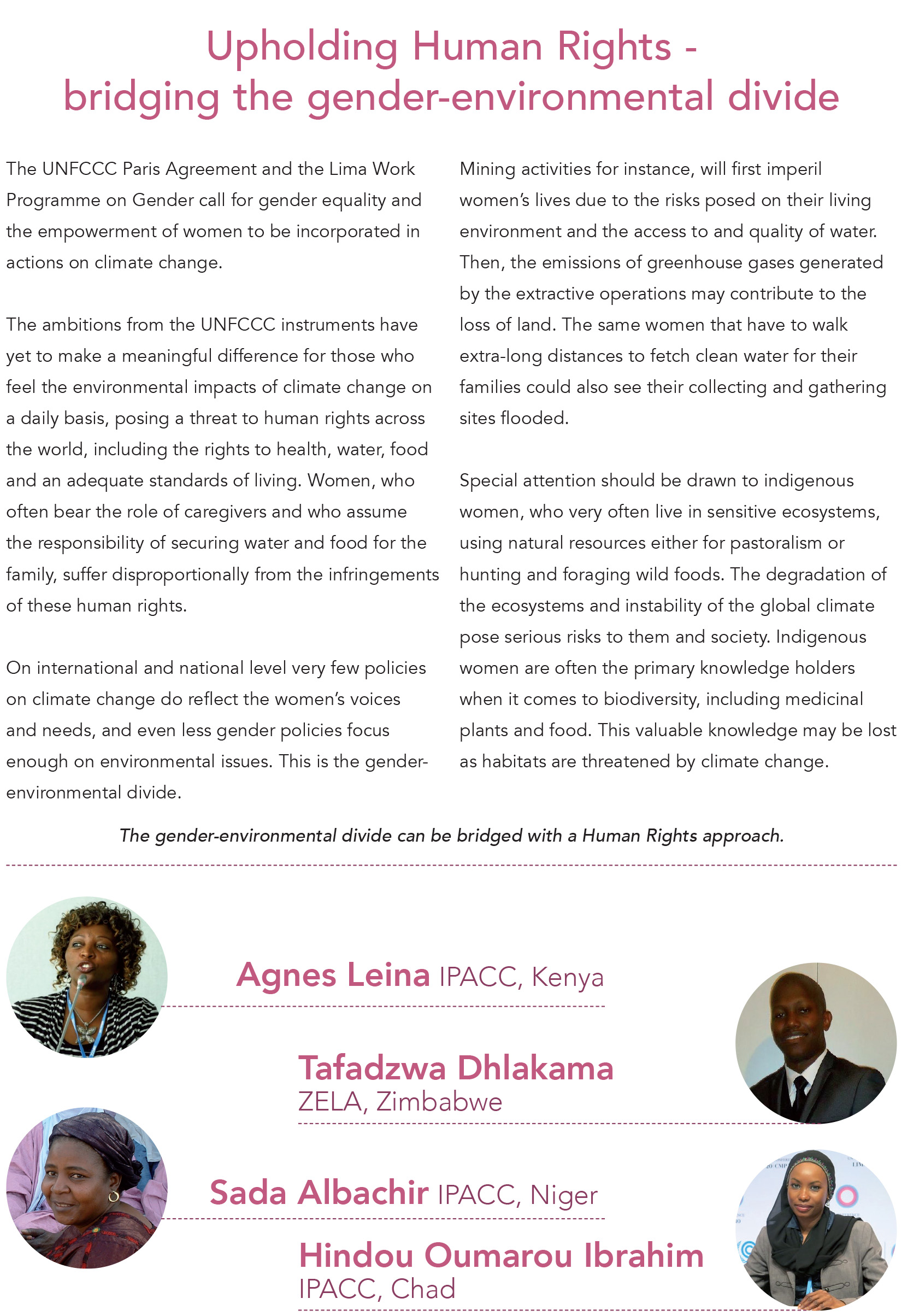
Sabina Voogd of Both ENDS will be joining the CoP to actively follow the negotiations on climate finance, adaptation, gender and trade. She will participate in the demonstration which will take place on the 12th of november and during her stay in Marrakech she will write at least two blogs to keep us posted on what is happening. Also, together with Action Aid and IPACC Both ENDS organises a side event:
Nathalie van Haren of Both ENDS will also be present for a few days, especially to meet up with our Drynet partners. Together, they wrote a Consultation on the environmental and social standards of the Land Degradation Neutrality Fund. On the morning 11th of November, Drynet organises a side-event called 'Where to Agriculture in the UNFCCC' (see also invitation at the bottom).
Together with partner organisations in the Global South, Both ENDS has been working on the issues of climate change mitigation and adaptation and on climate finance for many years. Below, you'll find an overview of what it is that we do in this respect.
For more information

-
 Dossier /
Green Climate Fund: calling for local access to climate finance
Local organisations and groups must be given access to climate finance from the Green Climate Fund. They know exactly what is happening in their local context and what is required for climate adaptation.
-
 Dossier /
Global Alliance for Green and Gender Action (GAGGA)
GAGGA rallies the collective power of the women's rights and environmental justice movements to realize a world where women can and do access their rights to water, food security, and a clean, healthy and safe environment.
-
 Dossier /
Communities Regreen the Sahel
In various countries in the Sahel, vast tracts of land have been restored by the local population by nurturing what spontaneously springs from the soil and protecting the sprouts from cattle and hazards.
-
 Dossier /
Finance for agroecology
The lion's share of public budgets for climate, agriculture and development still goes to conventional agroindustrial projects that contribute to the current climate, food and biodiversity crises. Both ENDS and our partners are calling for a transition to agroecological practices that are people- and environment-friendly.
-
 Dossier /
Fair Green and Global Alliance (FGG)
Together with civil society organisations from all over the world, the Fair Green and Global (FGG) Alliance aims for socially just, inclusive and environmentally sustainable societies in the Netherlands and the Global South.
-
 Environmentally Just Practice /
Agroecology
Agroecology is a diverse set of agricultural practices, a field of science and a social movement. It aims to transform food systems towards greater ecological sustainability, social justice, and resilience. Both ENDS and CSO-partners around the world support farmers and pastoralists practising agroecology, both on the ground and in gathering political and financial support.
-
 Dossier /
Inclusive ways to sustainable and healthy food for all
All around the world small-scale farmers are using sustainable and inclusive methods to produce food. Working together with nature and each other, they provide their families and communities with sufficient and healthy food. But their production methods are under pressure from large-scale agriculture and the globally dominant system of industrial food production. Together with our partners, Both ENDS is trying to turn the tide in favour of sustainable, local practices that are mostly known as 'agro-ecological' or 'nature-inclusive'. Why are we focusing on these methods? Agro-ecological practices are climate-proof and inclusive and increase the opportunities for communities around the world to produce their food sustainably.
-
 Dossier /
Small Grants Big Impacts
Small grants funds offer an effective, alternative way to channel big money from large donors and funds to local groups and organisations that are striving for a sustainable and just society everywhere around the world.
-
 Event / 4 December 2024, 18:00 - 19:30
Enhancing the role of civil society in the UNCCD to achieve Land Degradation Neutrality (LDN)
Effective local action by land-using communities is at the heart of achieving LDN globally. However, their contributions are often not well recognized or adequately supported by governments and other agencies. Within the UNCCD framework, civil society organisations play a key role in engaging with policymakers in the context of recognizing and supporting these contributions by local communities. The side event will engage participants in a GEF-supported joint Drynet/ IUCN initiative to enhance the capacities of civil society to engage effectively in the achieving Land Degradation Neutrality (LDN) within the UNCCD framework.
-
 News / 2 December 2024
Ten recommendations for the UNCCD COP16 to strengthen its efforts in combating desertification, land degradation, and drought
For decades, our local partner organisations have been developing and promoting effective ways to combat land degradation, desertification, and drought. This includes regions like the drylands, as well as forests, and wetlands. Supporting these locally-led actions is essential to reversing negative trends. For COP16, Drynet has developed 10 recommendations to strengthen the implementation of the UNCCD. Success at COP16 would mean turning these recommendations into action, fostering inclusive land governance and sustainable land management practices globally. By enabling locally-led actions—particularly those led by women, youth, pastoralists, and Indigenous Peoples—we can build a more resilient future.
-
 News / 2 December 2024
Advocating for Local Solutions: Both ENDS at UNCCD COP16 to Champion Sustainable Land Management and Gender Equality
As the United Nations Convention to Combat Desertification (UNCCD) celebrates its 30th anniversary, the global community faces an urgent need to address the escalating challenges of land degradation, desertification and drought. At the forefront of these efforts, Both ENDS has long advocated for inclusive, locally-led solutions to these critical issues. In this interview, Nathalie van Haren and Yordanos Mulder, who will represent Both ENDS at the upcoming UNCCD COP16, share insights into the significance of the conference, the key issues on the agenda, and the crucial role of local communities in shaping effective land governance. They discuss Both ENDS' ongoing work to amplify the voices of marginalised groups and emphasise the importance of sustainable land management practices, particularly those driven by women, youth, and Indigenous Peoples.
-
 News / 2 December 2024
Both ENDS at UNCCD COP16
Since 1994, Both ENDS has been advocating for inclusive governance in addressing desertification, land degradation, and drought, ensuring local communities have a strong voice in global discussions. As a member of Drynet, a network of over 20 civil society organisations, we champion the inclusion of women, youth, and Indigenous Peoples in land governance and highlight the importance of locally-led initiatives. Our work promotes gender equality, agroecology, and sustainable land management. This landing page serves as a comprehensive hub for all information and updates related to the UNCCD COP16 and Both ENDS' efforts to drive positive change. Here, you’ll find key resources, initiatives, and insights into how locally-led solutions can shape the future of land governance and environmental sustainability.
-
 News / 21 October 2024
Disappointment over failure to submit National Biodiversity Strategy and Action Plan
We are deeply disappointed and frustrated that the Dutch government has not submitted its National Biodiversity Strategy and Action Plan (NBSAP) for the CBD COP16 in Cali. This disregard for international agreements undermines the concerted global effort to address the urgent biodiversity crisis.
-
 News / 19 June 2024
Recognition for PROBIOMA from the Chamber of Deputies of the Plurinational State of Bolivia
PROBIOMA have received recognition from the Chamber of Deputies of the Plurinational State of Bolivia. The presentation of this tribute took place at the Museum of Natural History Noel Kempff Mercado, in the framework of the Environment Day.
-
 News / 14 June 2023
Both ENDS’s partners combat land degradation and drought
For decades, the local partner organisations of Both ENDS have been developing and promoting ways to fight land degradation, desertification and drought in their surroundings. And this accounts not only for regions like the Sahel, but also for forests and wetlands. To celebrate the UNCCD's Desertification and Drought Day 2023, we'd like to show a few examples of how our partners restore ecosystems to serve the well-being of people and the environment.
-
Publication / 10 October 2022
-
 Environmentally Just Practice /
Inclusive Land Governance
Both ENDS works with partners around the world to ensure that land is governed fairly and inclusively and managed sustainably with priority for the rights and interests of local communities.
-
Letter / 9 June 2022
Appeal to the FAO to rescind the FAO partnership with CropLife
Pesticide Action Network and 430 civil society and indigenous peoples organizations from 69 countries have sent a letter of concern to the 170th session of FAO council about the FAO partnership agreement with CropLife International.
CropLife International is a global trade association whose members are the world's largest agrichemical, pesticide and seed companies: BASF, Bayer Crop Science, Corteva Agriscience, FMC Corporation, Sumitomo Chemical and Syngenta. The UN Food and Agricultural Organisation (FAO) en CropLife International have started a partnership in 2020 to collaborate on pesticide use. We think that this partnership is incompatible with FAO's obligations to uphold human rights, directly counters any efforts toward progressively banning Highly Hazardous Pesticides, and undercuts the FAO and several Member States' support for agroecology and other transformative practices.
The letter asks the Council to review and end immediately the partnership agreement with CropLife International.
-
 News / 29 April 2022
In Memoriam: Khadija Catherine Razavi (CENESTA)
Both ENDS mourns the death of Khadija Catherine Razavi, founder of CENESTA – Centre for Sustainable Development and Environment in Iran.
-
 Dossier /
The merits of community-based restoration
Globally, the area that is suffering desertification and land degradation is ever expanding. Unsustainable and often large-scale agricultural practices, including the copious use of pesticides and fertilisers, are a major driver of land degradation, aprocess that is further exacerbated by climate change, causing more erratic rainfall patterns, longer periods of drought and unpredictable growing seasons. This is very problematic not only for the hundreds of millions of people who directly depend on land and water for their livelihoods, but also for life on earth as a whole. It is clear that this process must be stopped and reversed, better sooner than later. But how to go about it?

