




UNCCD COP 2017 - CHINA
From 6-16 september, the 13th Conference of Parties' of the UNCCD (UN Convention to Combat Desertification) took place, this time in Ordos, China. The UNCCD is the global convention of the United Nations on combating desertification and drought. Every country in the world has signed this convention. Canada withdrew in 2012, but in 2016 - under the Trudeau administration - started a process to re-enter the convention. Both ENDS is a member of Drynet, a network of local organisations and communities in dry regions searching for ways to use land in a sustainable manner.
Nathalie van Haren en Karin van Boxtel from Both ENDS have attended the conference in Ordos, primarily to put several themes on the agenda of the delegates of the UNCCD. One of these themes is that while combating land degradation, the focus should always be on local people. If a government is planning to stimulate sustainable land use, local people must be involved in the discussion and decision making. They can indicate best what is necessary and what is not to make things work.
Together with Drynet partners, Both ENDS organised three 'side events' during the UNCCD COP 13:
Just, accountable and responsible land governance
Good land governance which respects the different land use and tenure rights of local communities enables local land users with formal or non-formal (including customary) use rights to be active agents in sustainable land management and land restoration and contribute to the UNCCD goals and SDG 15.3 on Land Degradation Neutrality. With the new UNCCD strategic framework for 2018 - 2030, the challenge is to put the Voluntary Guidelines on the Responsible Governance of Tenure of Land, Forests and Fisheries (VGGT) adopted by the UN Committee on World Food Security at the heart of the UNCCD. The CSO panel's policy paper on land governance highlights actions to be taken in this area.
These developments raise several questions:
• What elements of good land governance practices push sustainable land management and restoration?
• In what way does the implementation of the VGGT contribute to the UNCCD objectives and SDG 15.3?
• What can we learn from local initiatives and policy-making experiences which recognize formal and non-formal land use rights?
In this side event we aim to show inspiring practices of just, accountable and responsible land governance and translate them into policy messages to be integrated in the UNCCD strategic framework.
Small is beautiful
Interactive dialogue on linking local initiatives on sustainable land management and restoration to the SDG 15.3 implementation.
Community-led initiatives are numerous, often small-scale, very local and not seen by government agencies. How do these local initiatives fit in national LDN programmes? What is needed for them to be recognized by government agencies, monitors and statistical bureaus? What can government agencies do to have a good overview of sustainable land management and restoration activities which will support implementation of the target 15.3?
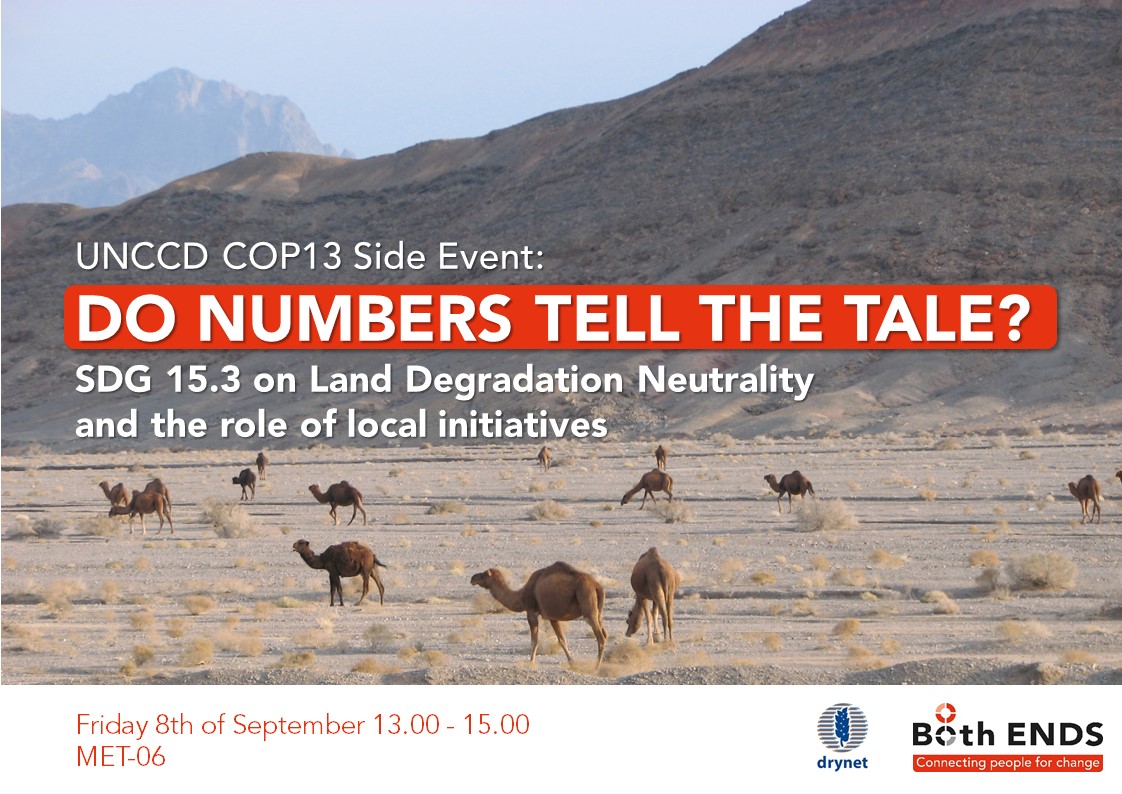
Do numbers tell the tale?
Financing land restoration has been increasingly emphasized as a focus area to meet SDG 15.3 on Land Degradation Neutrality. Most financial mechanisms for community-led land restoration originate from governments through grants, programme funding or climate funds, or involve private philanthropic means. Nevertheless, more and more private commercial funds are mobilized for land restoration projects. The Land Degradation Neutrality Fund illustrates this development, aiming to offer long-term financial mechanisms for land restoration.
This workshop will focus on the question how different public and private financing mechanisms can engage in initiatives of local land users and communities - whose land user rights are often informal and customary - to restore land and to use the land sustainably?
The question will be addressed by looking at good practices from Niger, where CRESA has successfully re-greened large areas of the Sahel. Hereafter, an overview of financing land restoration possibilities will be presented by WRI. A representative of Mirova will thereafter zoom in on the Land Degradation Neutrality Fund and its role in engaging with local land users and communities.
More information about what Both ENDS works on with partners in dry areas.
Briefing paper September 2017 'Grounding Sustainability: land, soils and the SDG's'
Summary 'Grounding Sustainability: land, soils and the SDG's'
2-pager 'Regreening the Sahel'
2-pager 'Innovative Seed Management in Iran'
For more information


-
 Dossier /
Dare to Trust: the power of unconditional funding
At Both ENDS we cherish our long-term relationships with partners in our global network. These relationships are based on equality and built on trust. The trust we have in each other has developed from years of strategic cooperation, including joint advocacy around common agendas, knowledge sharing, networking, and mobilising and sharing resources to advance environmental justice.
-
 Dossier /
Global Alliance for Green and Gender Action (GAGGA)
GAGGA rallies the collective power of the women's rights and environmental justice movements to realize a world where women can and do access their rights to water, food security, and a clean, healthy and safe environment.
-
 Dossier /
Communities Regreen the Sahel
In various countries in the Sahel, vast tracts of land have been restored by the local population by nurturing what spontaneously springs from the soil and protecting the sprouts from cattle and hazards.
-
 News / 3 September 2026
Restoring Land, Restoring Hope: Both ENDS at UNCCD COP17 in Mongolia
From 17 to 28 August, governments gathered in Ulaanbaatar, Mongolia, for COP17 of the UN Convention to Combat Desertification (UNCCD). At stake was more than how the world responds to land degradation and drought. It was also a question of who gets to shape land restoration, whose knowledge counts, and where the money goes.
-
 News / 6 July 2026
Strengthening Women's Land Rights Across the Rio Conventions
From 29 June – 2 July 2026, Tamara Mohr, GAGGA coordinator at Both ENDS participated in the 4th convening of the Women's Land Rights Initiative (WLRI) in Nairobi, Kenya.Hosted by the Robert Bosch Stiftung, TMG Research and the Huairou Commission, the event brought together grassroots organisations, (inter)national NGOs, government institutions and donors from around the world.
-
Publication / 3 July 2026
-
 News / 2 July 2026
Land restoration can help mitigate and resolve conflict - but only if everyone has a seat at the table
Can restoring degraded land also help reduce conflict? According to experts from Niger, Ghana, the Netherlands and other regions, the answer is yes - but only when restoration is rooted in inclusive land governance, local ownership and social cohesion.
-
 Dossier /
Finance for agroecology
The lion's share of public budgets for climate, agriculture and development still goes to conventional agroindustrial projects that contribute to the current climate, food and biodiversity crises. Both ENDS and our partners are calling for a transition to agroecological practices that are people- and environment-friendly.
-
Publication / 12 May 2026
-
Publication / 14 April 2026
-
 News / 9 April 2026
Minister Sjoerdsma hosts roundtable conversations with civil society
This week, Minister Sjoerdsma organized roundtable conversations with civil society organizations – a valuable initiative that brings together Dutch civil society voices to address critical challenges faced by democratic societies.
-
 News / 24 March 2026
Statement: Invest in local leadership for tropical forest management and local economies
IUCN-NL, Both ENDS, and 16 other Dutch and international civil society organizations (CSOs), networks, and expert groups are calling on the Dutch government to invest more strongly in locally led forest management and forest-based economies. This should be done within the framework of Dutch international cooperation and its associated policy instruments.
-
 News / 27 February 2026
Both ENDS strengthens the resilience of female environmental defenders worldwide thanks to multi-year contribution from the Postcode Lottery
In recent years, Both ENDS has received an additional contribution of €875,000 from the Postcode Lottery for the Autonomy & Resilience Fund (2022–2025), implemented in collaboration with the Global Alliance for Green and Gender Action (GAGGA). This support was essential because female environmental rights defenders around the world are increasingly facing climate change, repression and shrinking civil space. With this contribution, Both ENDS supports female activists and their communities with flexible, trust-based funding, enabling them to develop their own solutions to urgent environmental and climate problems.
-
Publication / 27 November 2025
-
 News / 27 November 2025
Communities and International Consortium Present Community-Led Plan for Nature-Based Adaptation to Sea-Level Rise in Coastal Bangladesh
Local communities in the southwestern coastal region of Bangladesh—together with an international consortium including Uttaran, CEGIS, and Both ENDS—have presented a community-led plan to confront climate change and accelerating sea-level rise through nature-based adaptation. The People’s Plan for Upscaling Ecosystem-Based Adaptation outlines a scalable strategy rooted in local ownership and generations of lived experience. At its centre is Community-Based Tidal River Management (CBTRM), a proven approach that reduces waterlogging, raises land elevation, and restores ecological balance by working with natural tidal and sediment dynamics.
-
 Environmentally Just Practice /
Non-Timber Forest Products (NTFPs)
About one in every six people, particularly women, directly rely on forests for their lives and livelihoods, especially for food. This shows how important non-timber forest products (NTFPs) and forests are to ensure community resilience. Not only as a source of food, water and income, but also because of their cultural and spiritual meaning.
-
 News / 5 November 2025
Interview: Both ENDS at COP30 for Climate Justice and Systemic Change
Both ENDS is present at COP30 to advocate for genuine access to climate finance for locally led, gender-just climate solutions and the mechanisms that facilitate this, including those for farmer-led restoration. Furthermore, the organisation participates to ensure the crucial connection between the climate negotiations and the trade and investment frameworks that shape them.
Learn more about the Both ENDS team at COP30 below, and find all the activities and side-events in which Both ENDS will participate.
-
 News / 5 November 2025
Overview of Both ENDS events at COP30 in Belem, Brazil
Both ENDS is present at COP30 to advocate for genuine access to climate finance for locally led, gender-just climate solutions, and for the mechanisms that make these possible, including those supporting farmer-led restoration. The organisation also engages to highlight the crucial connection between climate negotiations and the trade and investment frameworks that shape them.
Below is an overview of the Both ENDS team at COP30 and a detailed look at the activities and side-events in which Both ENDS will participate.
-
 News / 6 October 2025
From Entebbe to Accra: civil society is rewriting the rules of investment
By Fernando Hernández Espino and Bart-Jaap Verbeek
Almost a year after African civil society gathered in Uganda to adopt the Entebbe Declaration, the call to transform international investment governance continues to gain strength. From the 6th to the 9th of October, over 50 civil society organisations from across West Africa, including from Ghana, Senegal, Nigeria, Côte d’Ivoire, Cameroon, Gambia, Sierra Leone, as well as from Kenya and Latin America, are convening in Accra to deepen and operationalise the Declaration’s vision.
-
Publication / 1 July 2025




