




Searching for the good life
Searching for the good life
The dreams and visions of a different, better society, have always been a source of inspiration. Visionaries have moved the masses throughout history. From Jesus of Nazareth to Karl Marx, Mahatma Gandhi to Nelson Mandela: they've inspired people to take action and did this by coming up with an attractive message: all efforts are worthwhile because God's Kingdom, or a classless, nonviolent and just society, is close at hand.
Are we still dreaming these same dreams today? Are there still visionaries around who can inspire us? There is no single unanimous answer to this question. Visionaries appear regularly and present us with their appealing and inspiring ideas. Think of those people who came up with the Cradle2Cradle principle, the dream of a world without waste and framed within a perfect closed cycle. Prior to that, new concepts such as sustainable development, corporate social responsibility and, more recently, the Green Economy, were also sources of inspiration.
On the other hand, one observes that these visions have not actually managed to mobilise crowds, especially not in the West. We have grown increasingly sceptical, cynical even. Credulous individuals have all too often been disappointed by self proclaimed leaders who promised them paradise. We seldom fall for this type of rhetoric. We also stopped believing in a society that can be transformed. The idea of a group of motivated people realising actual changes has been portrayed as either naive or fanciful. That's why we no longer like talking about visions (let alone dreams); we prefer scenarios, which give us the room to produce the best possible results.
There is also something else: concepts like Cradle2Cradle or the Green Economy are Western visions that originated in North America and Europe, and are chiefly Anglo-American capitalist-based ideas. And so, where are the analyses, experiences, and dreams of non-Western thinkers and doers? While more and more Asian, African and Latin American products are reaching our shores; their ideas and visions seldom reach us. Are we not open to them? Are they making too little effort to reach us? In any event, we are depriving ourselves of the visions that originate elsewhere, and with them, potential out-of-the-box ideas from parts of the world we know less about. We need to do something about this situation.
Therefore, prompted by Both ENDS and Cordaid, we, two Dutch journalists, started searching for new, inspiring alternatives from the rest of the world. The following pages include numerous interviews with prominent thinkers, doers and analysts from the South. We would like to make it clear from the start that we do not pretend them to be in any way representative of the entire spectrum of ideas regarding a green economy. We chose from a list of names supplied to us by Both ENDS and Cordaid. This list includes their contacts, their colleagues in the South. They are people who are familiar with both actual practice and participating in international conferences where they regularly meet one another at venues around the world. They have all been active in the lead-up to the Rio+20 conference, as members of one or more working groups. Some of them, such as Chee Yoke Ling from Malaysia, have been part of this process for some twenty years or so. She was one of the most prominent spokespersons of the - then still so-called - 'Third World' during the first Earth Summit. All of the interviewed visionaries have strong criticism for how free market thinking and globalisation affect their own societies and the world as a whole. This criticism is nothing new. But what does their ideal society look like? How would things be different if they were in power? These are some of the questions we asked them.
Dare to Dream
On YouTube there is an interesting film about the Donella Meadows Leadership Fellows, entitled Vision 2050. Participants were asked to envision the year 2050 and - this is even more difficult! - to imagine the planet is all right, everything is going well in 2050! "Now close your eyes. What do you see?" The participants' responses varied: "I see solar panels on every rooftop." "I see people knowing each other's names." "Older people who tell stories that others are listening to again." "I see windmills and mini-power plants in the river so that children can study at night with electric lights. The message of the movie is clear: "You can't make it happen if you can't even imagine it!"
This may be true, but daring to dream is not all that easy. Who is ready to respond to the questions of what the ideal society will look like? Isn't it a bit naïve in this day and age to even bother to dream of a better world? And maybe it's even a bit pretentious to think you have the answers. And yet, another response might be: Isn't it all kind of trivial to be translating these grand designs for a better society into concrete images?
For whatever reason, several candidates we approached were slightly shocked when we asked them to share their dreams with us. Some of them even considered our questions inappropriate. "So sorry, but I'm not a guru," was the response of Janaki Lenin, an important environmentalist, columnist, and moviemaker in India. "The challenge is to build a sustainable lifestyle that is so appealing that everyone wants to adopt it. Then, you have to begin thinking about how to realise this. But that's a dynamic process, and the outcomes are uncertain. So I will not speculate."
She is probably right. However, we were looking for something more. Others also politely declined our invitation. There was also a more strategic reason for declining. When you're continuously struggling with major issues such as uncontrolled globalisation or the unbridled profits of venture capitalism on a daily basis, you often feel you like you are just shedding tears in the middle of a desert. You have identified the problem, you have a potential strategy or solution but idle dreams of a better society during an interview also has its pitfalls because, before you know it, your opponents will simply dismiss you as a naive dreamer.
Fortunately, others were prepared to take up our challenge. Our challenge was inspired by the Rio+20 conference slogan - The Future We Want. Our question was simply: Which future? Who dares to dream of a better and more just world these days? And, to make it perfectly clear, it didn't necessarily need to be a feasible vision of this world or a world you were willing to settle for, but the world you truly desire.
Obviously, this vision would use a sustainable world as its starting point, a world in which the planet was no longer headed for inevitable ecological disaster. The major components of a sustainable world are generally agreed upon: using only renewable natural resources, banning waste streams, addressing hunger and extreme poverty, and working towards true democracy, with equal right for one and all. Nice notions, but not exactly what we were looking for either. We wanted the interviewee to actually envision an ideal society. What would they change for themselves, for their children and/or grandchildren? What is the first thing they think of when they hear the term "ideal society"? Imagine you are in power, you are the mayor, the governor or even the enlightened dictator: what would you do first? These are the kinds of questions we posed to help clarify our request for the interviewees.
Blue Skies
Our questions aroused a multitude of images: blue skies over Beijing again - that was Chee Yoke Ling's dream. She has been living in the Chinese capital for several years now and has not been able to adjust to a state of permanent smog. Meanwhile, Egypt's Emad Adly dreams about approaching the Cairo of the future in an airplane and seeing an ocean of green rooftops. He also dreams of tens of thousands of unemployed youth being properly trained to become urban farmers. They will lease flat rooftops and supply the city with vegetables and fruit on a daily basis. Farida Akhter from Bangladesh also dreams of vegetables and grains: she envisions the return of forgotten species to the plates of her fellow countrymen. Moreover, she also hopes that Europeans will discover the wonderful flavours of the various kinds of vegetables, rice and lentils that could become plentiful once again. Kenya's Janet Awimbo envisions new opportunities for an African form of consensus decision making - but she is seeking brave citizens willing to take up this effort. Eduardo Gudynas from Uruguay, meanwhile, dreams of unaffordable digital watches that have become the symbol of the increasing consumer desires of the global middle class, which the planet cannot possibly hope to satisfy. A little further inland, Brazilian Moema Miranda wants to ensure that every peasant family has its own parcel of land. She believes that this will benefit the entire country. While Zenaida Delica Willison from the Philippines envisions a world where all live to be as old as her father (who passed away last year at the age of 103), if only we can be convinced to a live a healthier lifestyle.
And we eventually discovered the remarkable common thread of all of these dreams: the conviction that there was a significant need to return to the human dimension. One after another, they all advocated smaller, more human cities, combined with a revitalisation of the countryside that so many people have left in their pursuit of a better life. Perhaps the only exception to these modest dreams was Adly, who envisioned radical changes for Cairo. The others prefer shifting the emphasis on large-scale agriculture to supporting the millions of small farmers. This would also entail choosing for traditional knowledge, respect for nature, and ecologically sound farming methods and against large-scale farming, monocropping, and the unlimited use of pesticides and genetically modified seeds. "Large-scale agriculture has saddled us with a climate crisis, a water crisis, and a bee crisis," Farida Akhter observed. Furthermore, she points out that this type of production method also has a very negative impact on the position of women.
Are these the dreams of a handful of greenies or resurrected hippies who reject all progress and deny the reality of a world population that will soon surpass 9 billion people? No way, was their unanimous response. Traditional values and new technologies are wonderfully interlinked, Adly, a Muslim, pointed out. Isn't it the Koran that inculcates in Muslims the need to spare limited natural resources such as the soil and water? Is it not the same Koran that stated that every Muslim has a duty to learn as much as possible, including from non-Muslim countries? The traditional indigenous vision of the relationship between man and nature is experiencing a revival in South America. The concept of buen vivir - loosely translated as the simple good life - has now even been integrated into the constitutions of both Ecuador and Bolivia. "Even if we switch over to the concept of 'buen vivir', we'll still actually need good computers and other equipment," notes Eduardo Gudynas with a laugh. There is a need for modern technology, to ensure that consumer products last a lot longer than they presently do and also that these products can be easily repaired.
Janet Awimbo advocates the return of the typical African form of decision making, which is based on consensus, the palaver, but this time as applied to new clothing. Young people and women would be able to join the roundtable negotiations or simply a discussion under a tall, shady baobab tree. "We no longer want a group of old men making all the decisions," she emphasises.
Meanwhile, when Farida Akhter works together with Bangladeshi farmers to re-evaluate traditional farming methods and products, she creates a permanent links between this approach and efforts to alter the rigid social structures, such as male-female relations and the caste system. It is no problem, she insists, as long as it is all done with respect, and "taking into account everyone's feelings, while still managing to change the system."
These dreams span the oceans. Akhter in Bangladesh totally agrees with Gudynas in Uruguay, that people can be happy without having to live a life of luxury. Basically everyone wants to live a good life. "That is also what the peasants keep telling us. To be happy, that is what they want. They do not need a big car or a lot of money in the bank. Safe and good food, health for themselves and their children, nature in balance. That is what ordinary people want."
Over the past two decades, Chee Yoke Ling has seen much of the optimism and hope that characterised the 1992 Earth Summit, go up in smoke. But now, in the period leading up to the Rio+20 conference, she has begun noticing some hopeful developments. "I still dream of social equality, justice, and harmony with nature, and of a lifestyle that fits into this vision. To see that more and more young people are fighting for sustainability and for a different way of life is an enormous source of inspiration to me."
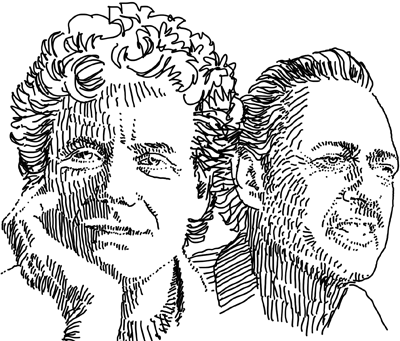
Hans van de Veen & Han van de Wiel
Read more about this subject
-
 Dossier /
Global Alliance for Green and Gender Action (GAGGA)
GAGGA rallies the collective power of the women's rights and environmental justice movements to realize a world where women can and do access their rights to water, food security, and a clean, healthy and safe environment.
-
 News / 27 February 2026
Both ENDS strengthens the resilience of female environmental defenders worldwide thanks to multi-year contribution from the Postcode Lottery
In recent years, Both ENDS has received an additional contribution of €875,000 from the Postcode Lottery for the Autonomy & Resilience Fund (2022–2025), implemented in collaboration with the Global Alliance for Green and Gender Action (GAGGA). This support was essential because female environmental rights defenders around the world are increasingly facing climate change, repression and shrinking civil space. With this contribution, Both ENDS supports female activists and their communities with flexible, trust-based funding, enabling them to develop their own solutions to urgent environmental and climate problems.
-
 News / 17 February 2026
Civic space at the frontlines: "Build strong coalitions and counter repressive regimes"
Today, we look back on an inspiring event Civic space at the frontlines -
Environmental Defenders and the Role of International Trade and Investment Policy. The panel exist of Michel Forst, UN Special Rapporteur Environmental Defenders under the Aarhus Convention, Suzanne Kröger, Member of Parliament for GroenLinks–PvdA, Dr. Margit van Wessel, Associate Professor at Wageningen University, Anne de Jonghe, policy advisor at Both ENDS, and Jonila Castro, national spokesperson for Kalikasan People's Network for the Environment. With an audience of CSO experts, academics, accountability experts and students we discussed the effects of Dutch economic activity on Environmental Defenders, and what we all can do to support those on the front lines of the fight for the environment and human rights. -
 News / 2 February 2026
Response to the D66-VVD-CDA coalition agreement
Coalition: Repair the damage and dare to go further
At Both ENDS, we see a number of cautious steps in the right direction in this coalition agreement. There is a slight emphasis on green issues, renewed attention to women's rights, recognition of the importance of civil society, and discussion of trade agreements with a focus on mutual interests. However, without structural change in how we trade, invest, and cooperate, fine words remain empty shells.
-
 Dossier /
Seeking justice for the affected communities of Vale’s mining disasters in Mariana and Brumadinho
In 2015 and 2019, the Brazilian state of Minas Gerais experienced two severe mining tragedies in Mariana and Brumadinho, due to the same mining company: Vale. Since then, the affected communities have been seeking justice, via the criminal punishment of the responsible parties, and a fair compensation for the loss of their loved ones, their homes and their livelihoods. Both ENDS supports local CSOs by amplifying their quest for justice within an international audience and, more specifically, by raising awareness amongst Dutch investors in Vale about the high risks this company’s activities pose for people and the environment.
-
 News / 2 February 2026
Seven years after Brumadinho: impunity allows Vale’s disasters to continue
Seven years ago, the dam owned by mining company Vale collapsed in Brumadinho, Brazil, killing 272 people and severely polluting the surrounding area. While the relatives of the victims commemorate them and fight for justice, the pollution continues.
-
Event / 26 January 2026
Civic space at the frontlines
Environmental Defenders and the Role of International Trade and Investment Policy
Both ENDS invites you to an interactive dialogue with experts from the UN, policy, academia, and civil society on environmental defenders and international trade. Together, we will explore how citizens, policymakers, academics, and activists can defend civic space and support those on the frontlines of environmental and human rights struggles. With a focus on the Netherlands’ role in international trade and investment policy, and drawing on the experiences of activists from the Philippines, the event aims to foster solidarity and identify strategic priorities to better protect environmental defenders amid the global crackdown on civic space
-
 News / 22 January 2026
Shell files new arbitration against the Netherlands over Groningen gas field closure
Shell is suing the Netherlands in yet another attempt to evade its responsibility for decades of gas extraction in Groningen. For years, gas production has triggered earthquakes, damaged over a hundred thousand homes, and left residents living in prolonged insecurity, still waiting for repairs, reinforcement, and justice.
-
 Dossier /
Agua Zarca: indigenous fight against dam costs lives
Indigenous Hondurans are resisting the construction of the Agua Zarca hydrodam. Their fight has cost several lives, including that of Berta Cáceres. After considerable public pressure, Dutch development bank FMO withdrew from the project.
-
 Press release / 13 January 2026
Investigation: FMO failed to exercise adequate control over project linked to the murder of Berta Cáceres
TEGUCIGALPA/UTRECHT, January 12, 2026 – The murder of indigenous environmental activist Berta Cáceres, which took place almost 10 years ago in Honduras, appears to be the result of an organized criminal operation, in which funds from the Dutch Development Bank FMO were misappropriated to finance illegal activities. This is the conclusion of the investigation report published today by the independent commission set up by the Inter-American Commission on Human Rights, the Honduran state, and the relatives of Berta Cáceres.
For years, FMO was a major financier of the Agua Zarca project. Berta Cáceres, an indigenous leader, fought against this controversial dam and was murdered for that reason in March 2016.
-
 Dossier /
Gas in Mozambique
In 2011 one of the world’s largest gas reserves was found in the coastal province of Cabo Delgado, in the north of Mozambique. A total of 35 billion dollars has been invested to extract the gas. Dozens of multinationals and financiers are involved in these rapid developments. It is very difficult for the people living in Cabo Delgado to exert influence on the plans and activities, while they experience the negative consequences. With the arrival of these companies, they are losing their land.
-
 Blog / 11 December 2025
Reflections on working on Dutch finance for Mozambique LNG
Last Tuesday, I received a short text message with big news: the minister had just announced that the financing policy for the Mozambique LNG project was stopped. It was a decision that I – along with so many others – have fought for for years. Only now, more than a week later, it is slowly sinking in that we have really won. The years of perseverance, frustration, discussions and investigations have finally led to this result. It still feels a bit surreal.
-
 Dossier /
Export Credit Agencies: Who pays the price?
Both ENDS calls on the government only to provide export credit insurance to sustainable projects that cause no social and/or environmental damage in the countries where they take place.
-
 Press release / 2 December 2025
End of Dutch involvement in controversial gas project in Mozambique in sight after TotalEnergies withdraws from Dutch insurance
THE HAGUE/CABO DELGADO, December 1, 2025 - Today, Minister of Finance Eelco Heinen announced that TotalEnergies is withdrawing from a $640 million Dutch export credit insurance policy for a controversial gas project in Mozambique. Although the Dutch government has been avoiding this decision for years, this move has finally ended part of the Dutch involvement in this disastrous project.
-
 Dossier /
Indigenous communities threatened by Barro Blanco dam in Panama
The Barro Blanco dam project in Panama, which has Dutch financial support, is causing indigenous lands to disappear under water. Both ENDS is working to protect the rights of indigenous communities living near the dam.
-
 Blog / 1 December 2025
The Long Road to Justice for the Ngäbe of Kiad
In October 2025 I travelled to Kiad, the Indigenous Ngäbe community that led the struggle against the FMO-financed Barro Blanco dam, for one last time. I went there to say my goodbyes, both personally and on behalf of Both ENDS, and to catch a first glimpse on how a community program financed by FMO and DEG – the result of a dialogue process that took several years – is giving a new impulse to the dam-affected communities. But how did we get here?
-
Publication / 27 November 2025
-
 Environmentally Just Practice /
A Negotiated Approach for Inclusive Water Governance
A Negotiated Approach envisages the meaningful and long-term participation of communities in all aspects of managing the water and other natural resources on which their lives depend. It seeks to achieve healthy ecosystems and equitable sharing of benefits among all stakeholders within a river basin. This inclusive way of working is an essential precondition for the Transformative Practices that are promoted by Both ENDS and partners.
-
 News / 27 November 2025
Communities and International Consortium Present Community-Led Plan for Nature-Based Adaptation to Sea-Level Rise in Coastal Bangladesh
Local communities in the southwestern coastal region of Bangladesh—together with an international consortium including Uttaran, CEGIS, and Both ENDS—have presented a community-led plan to confront climate change and accelerating sea-level rise through nature-based adaptation. The People’s Plan for Upscaling Ecosystem-Based Adaptation outlines a scalable strategy rooted in local ownership and generations of lived experience. At its centre is Community-Based Tidal River Management (CBTRM), a proven approach that reduces waterlogging, raises land elevation, and restores ecological balance by working with natural tidal and sediment dynamics.
-
 Dossier /
Rights for People, Rules for Corporations – Stop ISDS!
Indigenous communities in Paraguay saw their attempts to regain their ancestral lands thwarted by German investors. In Indonesia, US-based mining companies succeeded to roll back new laws that were meant to boost the country’s economic development and protect its forests. This is the level of impact that investment treaties can have on social, environmental and economic development and rights. Why? Because of the ‘Investor-to-State Dispute Settlement’ clauses that are included in many such treaties.

