




Partners fighting for rights within natural resource exploration in Uganda
A recent visit to Uganda highlighted the country as the latest example of ethical, environmental and human rights dilemmas brought forth by natural resource exploration.
Under the guise of economic prosperity and energy security, the future of Uganda’s forests, lakes, national parks, and by extension that of the people that depend on these resources, is increasingly endangered. Both ENDS partners in Uganda work with local communities to preserve these natural environments and the livelihoods that come from it.
Kikandwa Environmental Association (KEA), an organization that Both ENDS has worked with, for example, is a community based organization that addresses natural resource management. By mobilizing the community to plant trees, and training them on agroecological practices, KEA has improved food and nutrition security, reduced poverty, and improved soil fertility and biodiversity. Other Both ENDS’ partners we visited in Uganda such as SEATINI, similarly aim to protect Uganda’s natural resources and those using them by tackling unequal trade relations, and economic, social and cultural rights. For example, by addressing women’s right to land, or issues brought by GMO crops.
Displacing communities
Another partner we visited is actively advocating to halt sugar cane companies from cutting a forest that their community relies on for firewood, medicinal plants and income generating products such as honey. Expansion of pine forests for logging, or sugar cane plantations increasingly endanger these forests and displace communities reliant on them. Their successful lobbying has led to a delegation of EU ambassadors visiting the area in 2021 and pledging to secure the boundaries of the forest. This has to date not been done, something that we followed up on during our visit to the Dutch and EU embassies on this trip.
Discovery of oil
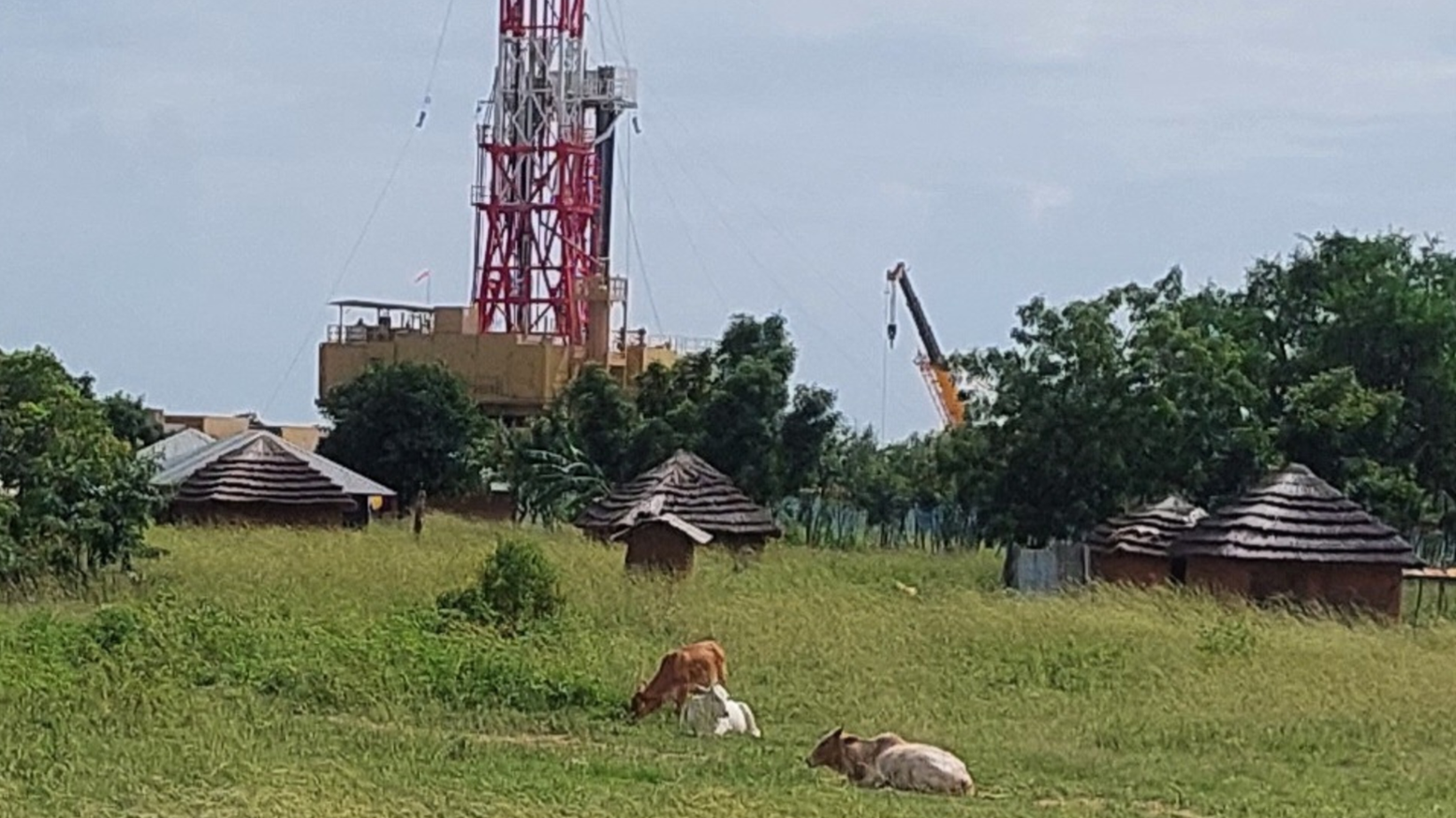
One of the newest menaces to Ugandan communities and environment is the discovery of oil, and the building of a pipeline by TotalEnergies to export this oil. EACOP will transport crude oil from the Albertine region in northwest Uganda to Tanga, a port in Tanzania from where it will be exported around the world. The oil drilling and the pipeline threatens biodiversity, water supply and fishing resources for millions of people and displaces thousands of households. It now already leads to human rights violations, especially targeted at activists speaking out against EACOP. Both ENDS is extremely concerned about the shrinking civil space in Uganda, and the safety of our partners and the local communities they work with.
A new Finance Risk Update, published recently in collaboration with Both ENDS also sets out the growing risks of the East African Crude Oil Pipeline to financiers, including banks, insurers and investors.
Traveling with two Both ENDS partners from Nigeria showed that oil exploration in Uganda risks (and in many cases already has) repeating the mistakes that led to widespread environmental devastation and social upheaval caused by oil exploration in the Niger Delta. From land grabs and displacement, to pollution and health hazards, the negative impacts are already profound, with more sure to follow if nothing is done. Local communities, reliant on land for their livelihoods, have borne the brunt of these consequences. Jacob Iniodu, from the Kebetkache Women Development Centre in Nigeria, writes about the parrallels he saw during our trip between Uganda and the Niger delta risks here.
The quest for oil, and exploitation of other natural resources in Uganda underscores the broader dilemma facing the world: the urgent need for a transition to renewable energy sources that are developed together with, and benefit local communities. Uganda is a good candidate for many off-grid renewable energy solutions. Both ENDS partners such as AFIEGO work with their communities to promote these community led solutions already.
“They told us we would get rich, and we would get jobs but instead I lost my home and my land”
Creating change
It is clear that decision makers do not sufficiently take into account the environmental destruction, human rights abuses, and devastation that natural resource exploitation projects have at the local and national level. Through our trip we were able to see the important work that our partners in Uganda do, and bring their stories back to policy makers, investors and donors in the Netherlands. We follow up this trip with new collaborations with partners and new pressure we can put on decision makers.
For more information
Read more about this subject
-
 Dossier /
Towards a socially and environmentally just energy transition
To address the climate crisis we need to urgently transition away from fossil fuels towards clean, renewable energy. However, this transition is not only about changing energy sources. It requires an inclusive and fair process that tackles systemic inequalities and demanding consumption patterns, prioritizes environmental and social justice, and which does not repeat mistakes from the past.
-
 Dossier /
Global Alliance for Green and Gender Action (GAGGA)
GAGGA rallies the collective power of the women's rights and environmental justice movements to realize a world where women can and do access their rights to water, food security, and a clean, healthy and safe environment.
-
 Dossier /
Communities Regreen the Sahel
In various countries in the Sahel, vast tracts of land have been restored by the local population by nurturing what spontaneously springs from the soil and protecting the sprouts from cattle and hazards.
-
 News / 23 oktober 2025
TotalEnergies financiers beware: EACOP is eating up money, nature and livelihoods
A new analysis shows that the developers of the East African Crude Oil Pipeline, led by France’s TotalEnergies, are being forced to self-finance the project almost entirely. The analysis, part of a new Finance Risk Updatefrom a coalition of African and International civil society organisations, shows that the companies have abandoned plans to raise 60% of the project’s growing costs from bank loans, and are now on the hook for almost 90% of the costs themselves.
-
 News / 6 oktober 2025
From Entebbe to Accra: civil society is rewriting the rules of investment
By Fernando Hernández Espino and Bart-Jaap Verbeek
Almost a year after African civil society gathered in Uganda to adopt the Entebbe Declaration, the call to transform international investment governance continues to gain strength. From the 6th to the 9th of October, over 50 civil society organisations from across West Africa, including from Ghana, Senegal, Nigeria, Côte d’Ivoire, Cameroon, Gambia, Sierra Leone, as well as from Kenya and Latin America, are convening in Accra to deepen and operationalise the Declaration’s vision.
-
 Blog / 12 augustus 2025
Nickel mining for the energy transition: who is accountable for the damage?
Photo blog - In June, I travelled to Indonesia with our partner organization Puanifesto to research the impacts of nickel mining in East Sulawesi. On July 13th, the news broke that the European Union and Indonesia have reached a political agreement on a free trade agreement that was years in the making, called the Comprehensive Economic Partnership Agreement (CEPA). Nickel from Sulawesi is already being used in European cars. This makes it all the more important that we ensure that human and environmental rights are secured in mining and refining operations in Indonesia, before the road is opened to more extraction and exploitation for the European market. The conversations we have had with communities and workers on East Sulawesi show that more binding regulations are necessary to make this happen and ensure an energy transition that is socially and environmentally just.
-
 News / 10 juli 2025
Shell's Silent Exit: Evading Accountability in the Niger Delta
Following Both ENDS & Kebekatche Women Development & Research Centre participation in Shell’s Annual General Meeting (AGM) and a formal follow-up in writing, the response received from Shell plc raises more questions than it answers.
-
 Dossier /
Fair Green and Global Alliance (FGG)
Together with civil society organisations from all over the world, the Fair Green and Global (FGG) Alliance aims for socially just, inclusive and environmentally sustainable societies in the Netherlands and the Global South.
-
Publication / 1 juli 2025
-
 News / 4 juni 2025
Demanding Shell’s Accountability for decades of pollution in Niger Delta
Both ENDS and our Nigerian partner Kebetkache Women Development & Research Centre attended Shell’s Annual General Meeting (AGM), on May 20th, in London, to demand transparency and accountability for Shell Plc’s opaque divesment in the Niger Delta.
-
 News / 20 mei 2025
Both ENDS and partners demand Shell to clean up the Niger Delta before divesting
At the Annual General Meeting (AGM) of Shell in London, community leaders from the Niger Delta and international allies, including Both ENDS, are confronting Shell with a clear demand: Shell must take full responsibility for decades of pollution and human suffering in Nigeria’s Niger Delta before divesting from its on-shore oil operations.
-
 News / 9 mei 2025
Women’s leadership in agroecology flourishes in Eastern and Southern Africa
On 12 and 13 February 2025, women from Kenya, Uganda, and Zimbabwe gathered in Nairobi for the Africa Women Leaders in Agroecology (AWOLA) Regional Networking Forum. The event marked a significant moment in the leadership programme of PELUM Kenya, which empowers young women in their role as leaders in the agroecological transition. This project was made possible thanks to support from Both ENDS as part of the Fair, Green and Global (FGG) Alliance.
-
Letter / 15 april 2025
African civil society urges Oman against EACOP support as east Africa trade expo kicks off
Just one day before the Oman East Africa Trade and Investment
Expo opens in Muscat on April 16, over 70 civil society organisations (CSOs) from Uganda, Tanzania, the Democratic Republic of Congo, and beyond have published an open letter urging the Government of Oman to refrain from providing financial or diplomatic support for the controversial East African Crude Oil Pipeline (EACOP). -
 Blog / 31 maart 2025
International cooperation and solidarity are in the interest of both the Netherlands and Africa
Traditional development aid keeps Africa in a state of aid dependency, but development cooperation is essential to break this post-colonial dependency, argues Melvin van der Veen in response to an interview in NRC Handelsblad with the Cameroonian economist Célestin Monga. By breaking off this cooperation on the basis of equality, we are actually stifling the voices of African civil society organisations, indigenous communities, youth and women's movements and human rights defenders, and we are not solving global problems.
-
 Blog / 27 maart 2025
Fair trade and equal partnerships: only then can Kenya stand on its own
Several media outlets, including de Volkskrant, focused last week on the shift from “aid” to “trade,” partly in response to the state visit of the Dutch royal couple to Kenya. The idea is that it would be beneficial for Kenya to stand on its own two feet. A beautiful ideal—one I whole heartedly believe in. But this ideal can only become a reality if equality is at the heart of trade and international cooperation.
-
 News / 25 maart 2025
Urgent call to Shell: Don’t leave the Niger Delta without cleaning up decades of pollution
Last week, Shell reported that it officially completed the sale of its on-shore oil assets in the Niger Delta, leaving behind a vast oil pollution caused by 70 years of oil extraction in the region.
-
 Blog / 30 januari 2025
Brumadinho’s painful “seas of mud”
By Carolina de Moura
Six years ago, Brumadinho tailings dam I, from the Paraopeba Complex, owned by mining company Vale, collapsed. January 25th, 2019, forever changed the lives of thousands. The scars remain open, and the quest for justice, remembrance, and prevention of future mining crimes endures despite all adversities. This was manslaughter coupled with socio-environmental devastation of proportions difficult to measure. These are irreparable losses and damages that could have been avoided if it wasn’t for the greed, negligence, and irresponsibility of decision-makers at Vale, the German certification firm Tüv Süd, and the state of Minas Gerais.
-
Letter / 16 december 2024
Urgent call to halt all divestments in the Niger Delta, including Shell's refused sale of SPDC shares
The proposed sale of Shell’s shares in the Shell Petroleum Development Company (SPDC) to the Renaissance consortium, alongside similar divestments by TotalEnergies and other oil companies, threatens the Niger Delta and its people environmental and social well-being for generations to come.
-
Letter / 9 december 2024
People and the Planet Entebbe Declaration: Reclaiming investment frameworks for people and the planet
The time for change is now. Civil society demands international investment
frameworks that are aligned with economic justice, social and environmental
sustainability, and the needs of communities worldwide. -
 News / 26 november 2024
The Time to Rethink Investment Rules: Amplifying Civil Society Voices
At the core of the Fair, Green, and Global (FGG) Alliance’s mission is the commitment to building a just and sustainable world. As members of this alliance, Both ENDS, SOMO, and the Transnational Institute (TNI) recognise the urgent need to reimagine global investment frameworks. These frameworks, entrenched in outdated treaties such as Bilateral Investment Treaties (BITs) and the Energy Charter Treaty (ECT), often prioritise corporate profits over human rights, environmental sustainability, and social justice.

