




Oil palms, water and women: gender in the watershed
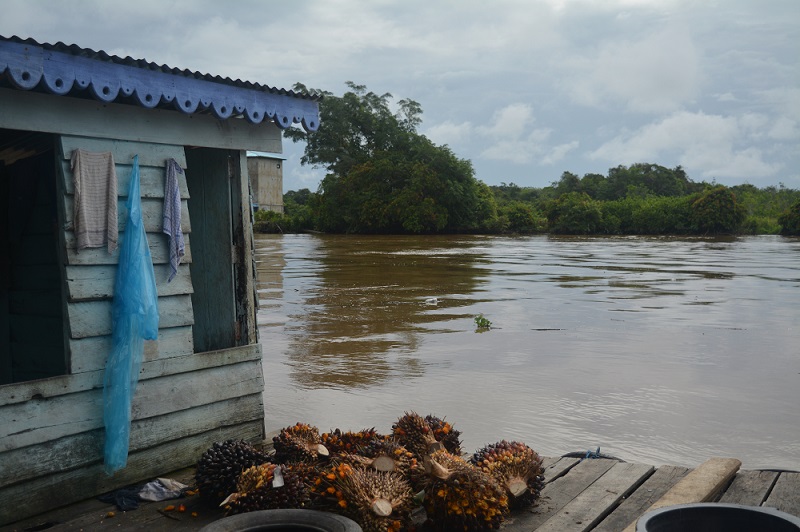
Photo Blog - Like many communities in Indonesia, life in Semanga Village, West Kalimantan, revolves around a river. The 90 or so houses follow the curving bank of the Sambas River, each with a path down to a small pontoon where fishing traps and baskets are stacked and boats are tied.
For generations, the river has been the foundation of the community's prosperity and welfare; it gave them fresh drinking water, it's their highway to the nearest city, it's a primary source of food, a place to bathe, wash, and play, a source of livelihood, it flushes their toilets, it washes away their waste, and it's ebbs and flows in the wet and dry seasons mark the high points of the community's social and cultural calendar.
"...and then the plantations came."
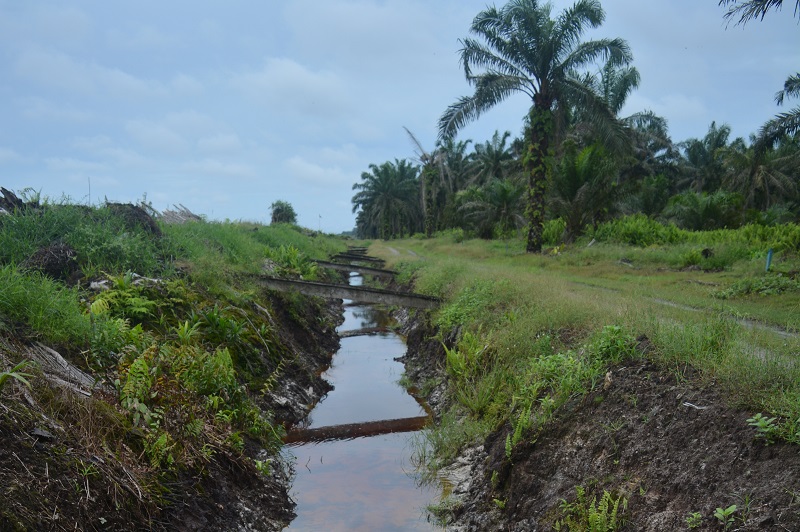
Drainage canal in an oil palm plantation near Semanga
But the river began to change when palm oil plantations arrived in the late 1990s, and life for the people of Semanga has changed with it. Earlier this year I visited Semanga with our local partner organisations Ecoton and Gemawan. The stories I heard were both heartbreaking and inspiring.
Palm oil plantations have become infamous for their environmental and social impacts, but still relatively little is known about the impacts of palm oil plantations on local water supplies and watersheds. This is why Both ENDS is working together with partners in two districts in West Kalimantan to support local communities to understand the impacts of surrounding palm oil plantations on their rivers, water sources, health and livelihoods. In Semanga, Ecoton and Gemawan are working with women to identify and map river contamination under a research and advocacy project jointly supported by ELSAM.
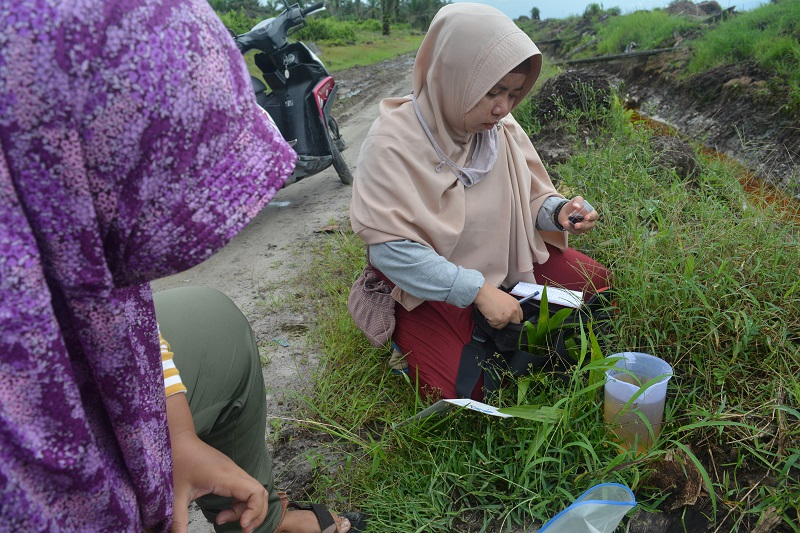
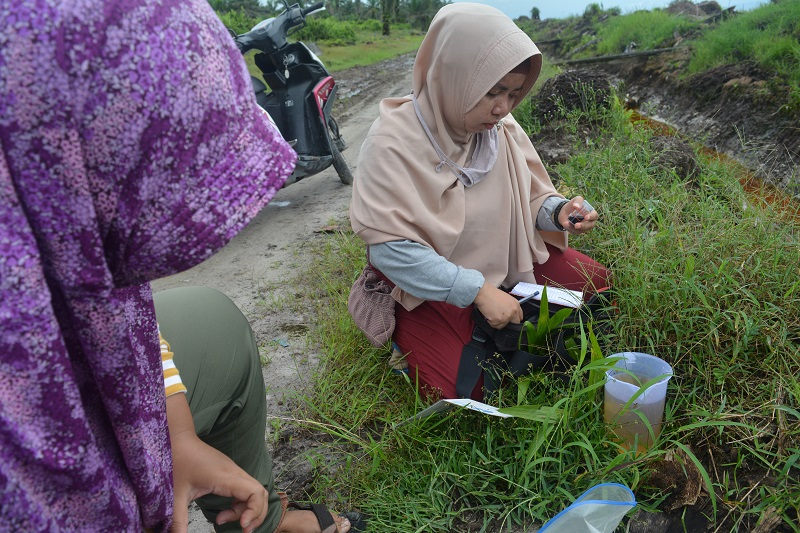
Members of the village women's group testing drainage canal water for chemical pesticide and fertilizer contamination.
"We know the river is sick."
The people in Semanga know the river is sick with pollution. The Sambas River and its tributaries that flow past the plantations previously provided shelter and breeding grounds for many fish species. The river was known for its giant freshwater shrimp. Now the waters are chocked with toxic run-off from the plantations and palm oil mills upstream. There are very few fish and many fish species have disappeared, including several from the IUCN's Red List of Threatened Species. It's been years since a giant shrimp has been seen in Semanga.
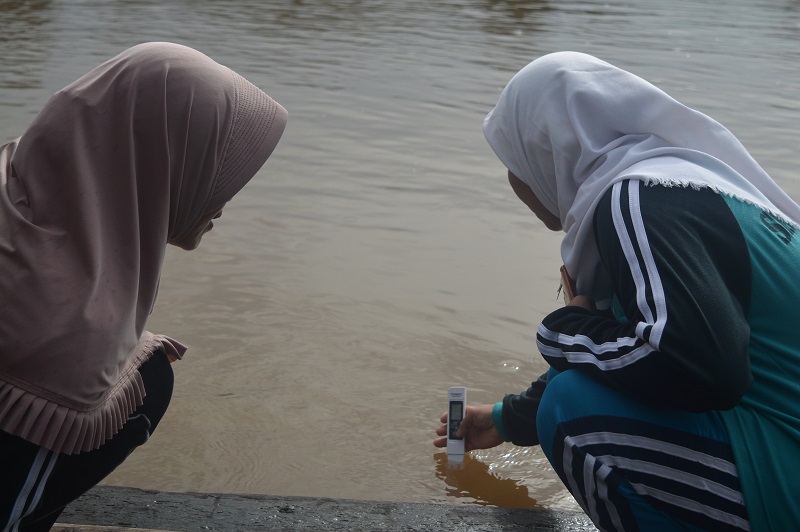
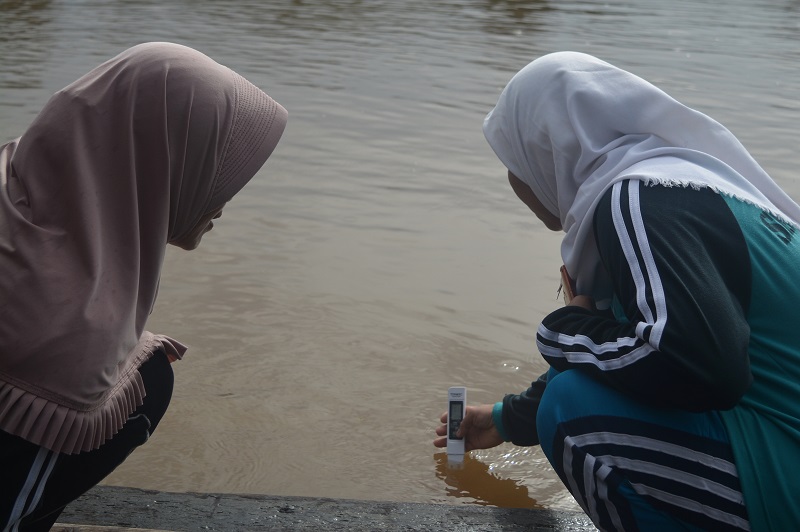
Two members of the Semanga women's group test the level of heavy metals in the surface flow of the Sambas River
'Fisherman' is no longer a feasible occupation in Semanga.
So, many villagers now rely on their small plots of rubber trees and labouring on the plantation for their livelihood. Both are extremely hard work, with men and women travelling to their rubber plots at around 3am every day before the hot sun rises, to tap rubber in the dark. At 7am they return home for breakfast and to see their children, before heading to the plantation to labour until the early afternoon.
Women bear the brunt of these impacts, as they must also tend to household duties like washing, cleaning and cooking, and looking after their children. Women also work as 'sprayers' on the plantations – labourers that spray pesticide and herbicide and spread fertilizer, as men are employed to do the heavy lifting; harvesting bunches of fruit from the tall palms and loading them onto trucks for transport to nearby mills. Sprayers are rarely provided with adequate safety equipment and, unsurprisingly, many also suffer chronic health issues related to long-term exposure to dangerous chemicals.
"The river is smelly and leaves an oily feeling on your skin that can't be washed off."
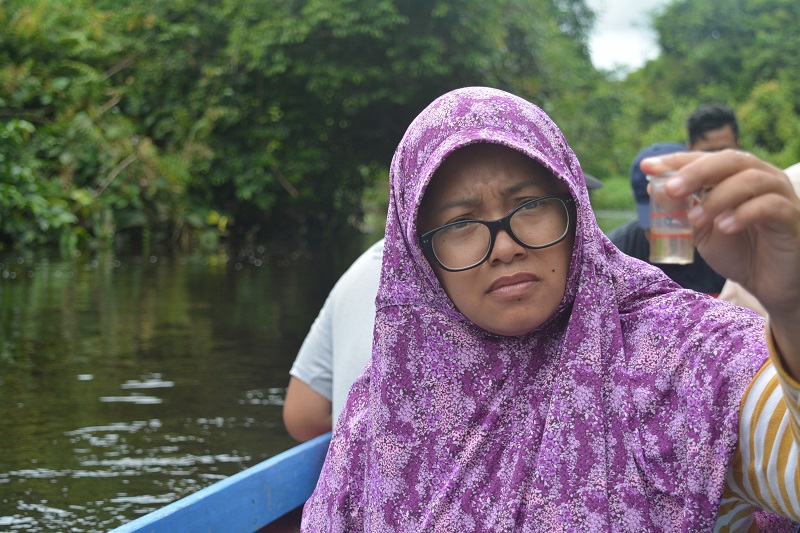
Riska Darmawanti of Ecoton testing water in a Sambas River tributary
And there are more problems. Now that the river is too polluted to drink, each family must collect rainwater during the rainy season. When their water supplies run out in the dry season, they must buy drinking water at the nearest town or collect water from upstream springs. Given clean water is scarce and expensive, all families still wash and bathe in the river, and their health is suffering. Everyone in Semanga suffers from skin irritations; a red itchiness that doesn't go away, and a greasy feeling that doesn't wash off. This especially effects children, who like to swim and play in the river, and especially during the dry season when the river water is low and level of contamination is higher. I ask the women how the people in the community can tolerate the itchiness and irritation. They answer simply that this is 'the new normal' in Semanga – people have no other choice but to accept it.

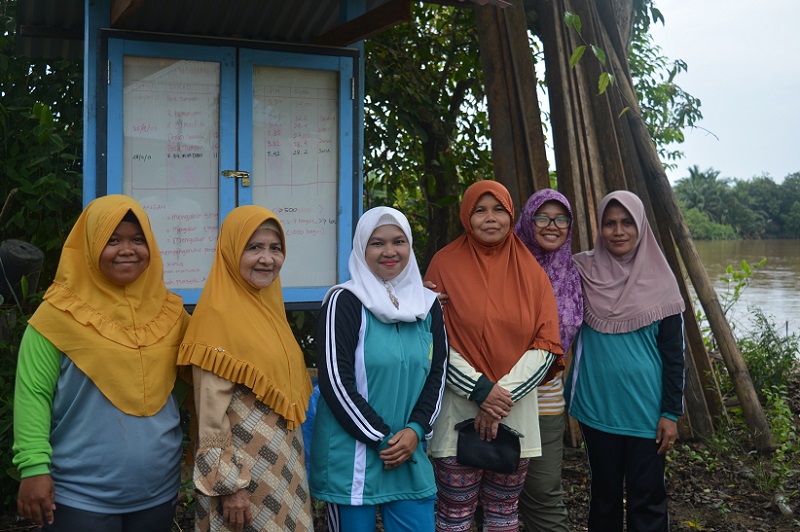
Members of the KUMPAI women's group in front of the community notice board where they record their test results.
To help the community map and understand the connection between the plantations, the river, the fish stock and their health, Ecoton, Gemawan and ELSAM are training a group of local women to test the river water for various contaminants and to communicate the results and implications to the rest of the community. The women, who call their group "KUMPAI" after a giant grass that grows in abundance in the shallow waters of the river, update a notice board in the community with their results. They use indicators like PH, heavy metals, solid matter and bacteria to track the health of the river. They also speak with women who work on the plantations about the kinds of pesticides, herbicides and fertilizers they use, what safety equipment they are given, and whether they suffer any health issues.

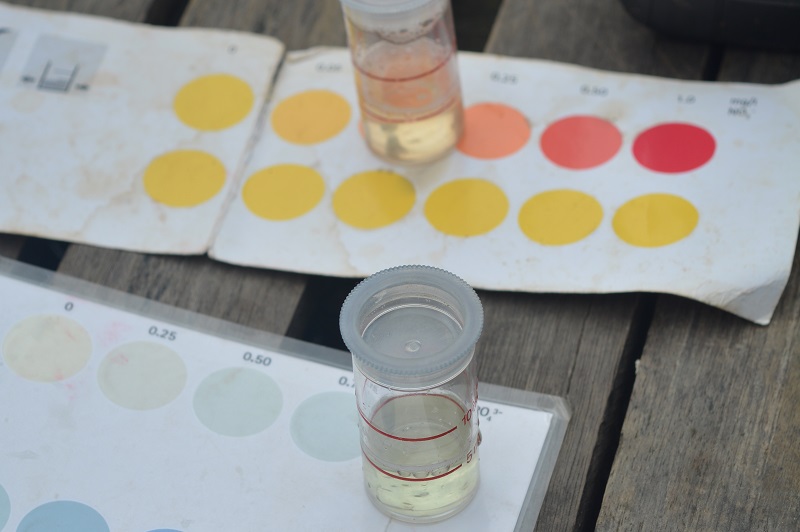
Water samples can be assessed with the use of these simple tools
It is hoped that linking the pollution in the river to the chemicals used on the plantations will open doors for the community to start discussing possible solutions with local authorities and political representatives.
However, the KUMPAI women are worried that if they raise their concerns about the pollution in the river, other community members will not support them, especially if they implicate the palm oil plantations where many people in the village now work and rely on for their income. The Semanga community is caught in a cruel trap suffered by countless other communities in palm oil plantation areas – after the plantations destroy their livelihood, they have little choice but to work on those same plantations to survive.
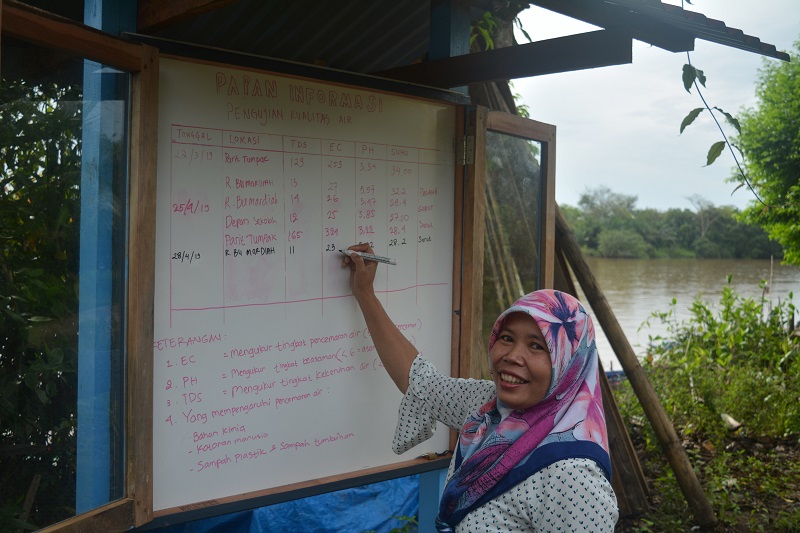
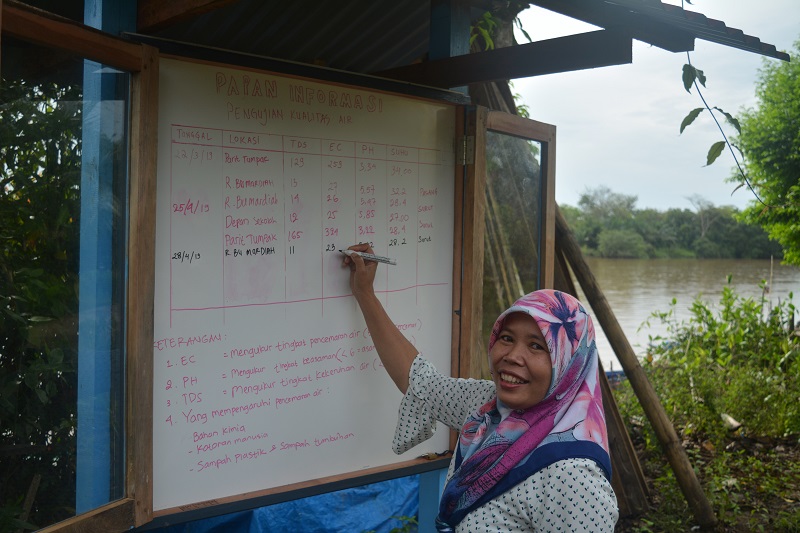 A member of KUMPAI updates the public notice board with today's results.
Nevertheless, the KUMPAI women are leading by example and raising awareness in the community about pollution, health, hygiene, sanitation and waste management issues. Slowly they are building support within the community and momentum to tackle the river pollution and the powerful plantation companies behind it. Their stories are inspiring others – including me – to have hope that another 'new normal' is possible in Semanga, where the community is united around a healthy river brimming once again with life.
"The pollution needs to be stopped somewhere and it can start with me."
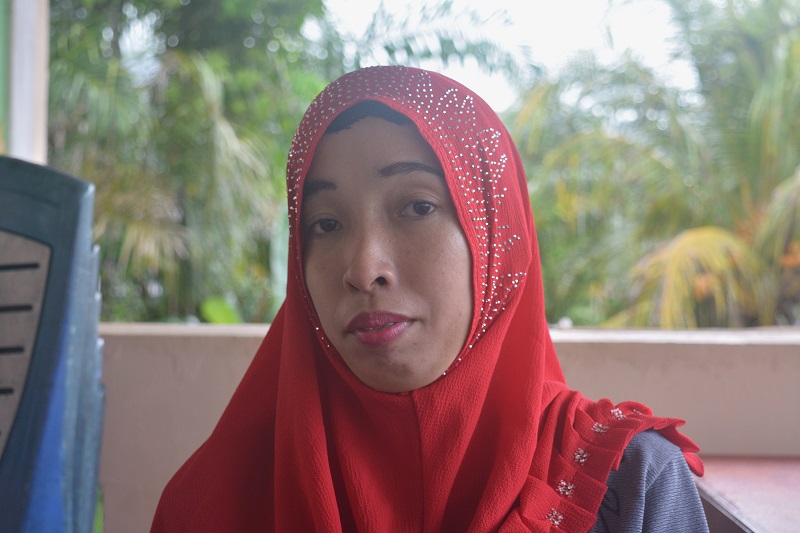
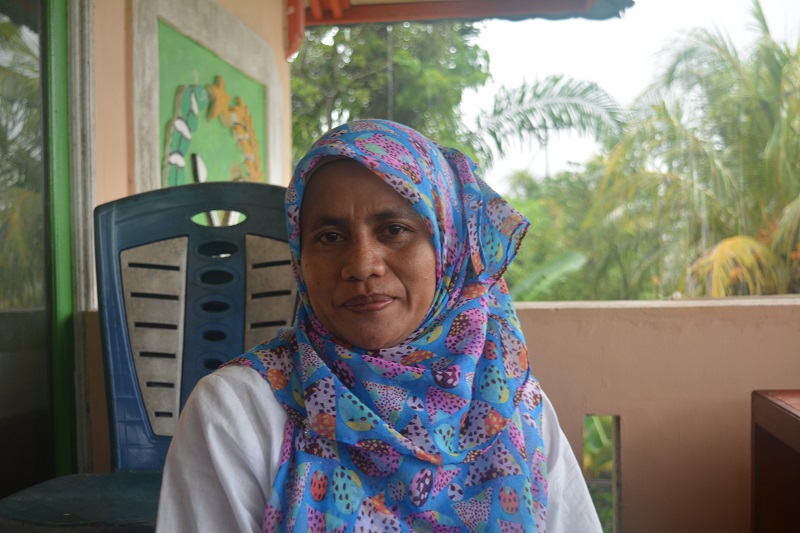
 Atika, a member of the KUMPAI women's group
"I joined KUMPAI because I was curious about what was happening and I hoped I would learn new skills. I feel responsible to help the river because it is now so polluted by the oil palm plantations and other waste. I wanted to act, but wasn't sure what I could do. My husband used to be a fisherman but his livelihood has been ruined. Now he travels to Sanggau [about 600km away] each year to help with the honey harvest. When he is in Semanga he lays fish traps every three days but the catch is so small it cannot support our family. During the dry season there are no fish at all.
The pollution needs to be stopped somewhere and it can start with me. I hope to see the fish return and that people will stop throwing their garbage into the river. Being part of KUMPAI is key to achieving that."
"I hope the next generation will be able to use the river again like we did as children"
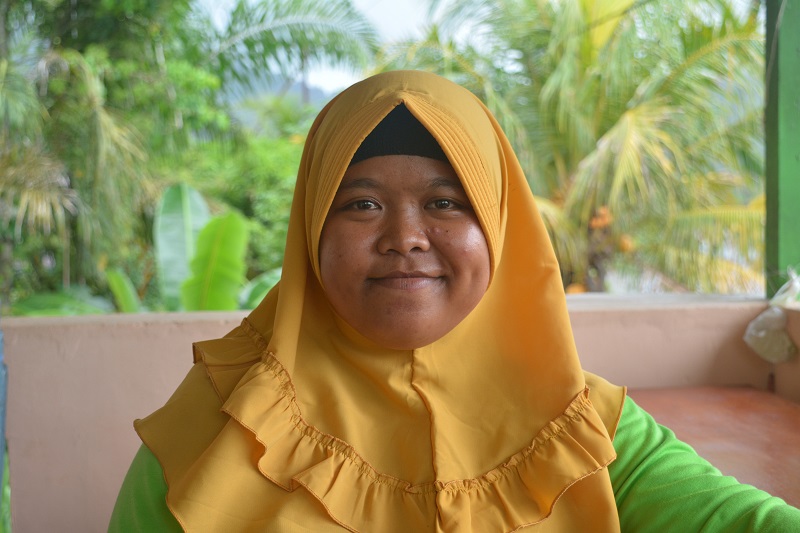
 Siti Hajar, a member of the KUMPAI women's group
"I like to try new things and be involved in community life, so I agreed to be involved in KUMPAI when I heard the group would have a focus on the river. The river is a source of life, so the health of the river is important for me. Before the palm oil plantations arrived, we used the river for drinking and cooking, but now it can't be used because it's not safe. Now sometimes when we bathe there is a yellow colour in the water that we can't wash off with soap. We all suffer itchy skin in the dry season. I hope the next generation will be able to use the river again like we did as children."
"I'm worried about my children's health and the future of all children in the village. I decided to do something about it"
 Irriyanti, a member of the KUMPAI women's group
"My family's livelihood depends on the river, I wash my clothes in the river, I bathe my children in the river and we all used to drink from the river. Since joining KUMPAI I've become very conscious of the river pollution and my own waste. I see families throwing their rubbish and children's diapers in the river. I'm worried about my children's health and the future of all children in the village. I decided to do something about it, so I bought washable nappies from the city and introduced them in in the village. Now I sell them here. I hope to convince all women in Semanga to use washable nappies so that soon there won't be any diapers floating in the river anymore."
The activities of ELSAM, Ecoton and Gemawan receive support from the Fair Green and Global Alliance (FGG) and the Global Alliance for Green and Gender Action (GAGGA).


Read more about this subject
-
 Dossier /
Global Alliance for Green and Gender Action (GAGGA)
GAGGA rallies the collective power of the women's rights and environmental justice movements to realize a world where women can and do access their rights to water, food security, and a clean, healthy and safe environment.
-
 News / 5 October 2026
Rural Women's Assembly wins Right Livelihood Award
We are thrilled to share that our partner the Rural Women's Assembly (RWA) is one of this year's Right Livelihood Laureates! The award, often called the "Alternative Nobel Prize", honours RWA for bringing together more than 178,000 women farmers in eleven Southern African countries. Together, these women stand up for their land, their seeds and their right to make decisions about their own lives and bodies.
-
Publication / 3 July 2026
-
Publication / 18 June 2026
-
Publication / 12 May 2026
-
 Dossier /
Rights for People, Rules for Corporations – Stop ISDS!
Indigenous communities in Paraguay saw their attempts to regain their ancestral lands thwarted by German investors. In Indonesia, US-based mining companies succeeded to roll back new laws that were meant to boost the country’s economic development and protect its forests. This is the level of impact that investment treaties can have on social, environmental and economic development and rights. Why? Because of the ‘Investor-to-State Dispute Settlement’ clauses that are included in many such treaties.
-
 News / 24 March 2026
Statement: Invest in local leadership for tropical forest management and local economies
IUCN-NL, Both ENDS, and 16 other Dutch and international civil society organizations (CSOs), networks, and expert groups are calling on the Dutch government to invest more strongly in locally led forest management and forest-based economies. This should be done within the framework of Dutch international cooperation and its associated policy instruments.
-
 News / 27 February 2026
Both ENDS strengthens the resilience of female environmental defenders worldwide thanks to multi-year contribution from the Postcode Lottery
In recent years, Both ENDS has received an additional contribution of €875,000 from the Postcode Lottery for the Autonomy & Resilience Fund (2022–2025), implemented in collaboration with the Global Alliance for Green and Gender Action (GAGGA). This support was essential because female environmental rights defenders around the world are increasingly facing climate change, repression and shrinking civil space. With this contribution, Both ENDS supports female activists and their communities with flexible, trust-based funding, enabling them to develop their own solutions to urgent environmental and climate problems.
-
 Environmentally Just Practice /
A Negotiated Approach for Inclusive Water Governance
A Negotiated Approach envisages the meaningful and long-term participation of communities in all aspects of managing the water and other natural resources on which their lives depend. It seeks to achieve healthy ecosystems and equitable sharing of benefits among all stakeholders within a river basin. This inclusive way of working is an essential precondition for the Transformative Practices that are promoted by Both ENDS and partners.
-
 News / 27 November 2025
Communities and International Consortium Present Community-Led Plan for Nature-Based Adaptation to Sea-Level Rise in Coastal Bangladesh
Local communities in the southwestern coastal region of Bangladesh—together with an international consortium including Uttaran, CEGIS, and Both ENDS—have presented a community-led plan to confront climate change and accelerating sea-level rise through nature-based adaptation. The People’s Plan for Upscaling Ecosystem-Based Adaptation outlines a scalable strategy rooted in local ownership and generations of lived experience. At its centre is Community-Based Tidal River Management (CBTRM), a proven approach that reduces waterlogging, raises land elevation, and restores ecological balance by working with natural tidal and sediment dynamics.
-
 Dossier /
Wetlands without Borders
With our Wetlands without Borders program, we work towards environmentally sustainable and socially responsible governance of the wetlands system of the La Plata Basin in South America.
-
Publication / 17 November 2025
-
 Environmentally Just Practice /
Non-Timber Forest Products (NTFPs)
About one in every six people, particularly women, directly rely on forests for their lives and livelihoods, especially for food. This shows how important non-timber forest products (NTFPs) and forests are to ensure community resilience. Not only as a source of food, water and income, but also because of their cultural and spiritual meaning.
-
Letter / 14 November 2025
Letter: TPAC’s report “Final Judgement Detailed Research MTCS’’
A coalition of Malaysian and international NGOs has released a memorandum in response to the recent TPAC report on the Malaysian Timber Certification Scheme (MTCS). The organisations express serious concerns about the independence, quality, and credibility of the assessment carried out by the Timber Procurement Assessment Committee (TPAC).
-
 News / 5 November 2025
Interview: Both ENDS at COP30 for Climate Justice and Systemic Change
Both ENDS is present at COP30 to advocate for genuine access to climate finance for locally led, gender-just climate solutions and the mechanisms that facilitate this, including those for farmer-led restoration. Furthermore, the organisation participates to ensure the crucial connection between the climate negotiations and the trade and investment frameworks that shape them.
Learn more about the Both ENDS team at COP30 below, and find all the activities and side-events in which Both ENDS will participate.
-
 News / 5 November 2025
Overview of Both ENDS events at COP30 in Belem, Brazil
Both ENDS is present at COP30 to advocate for genuine access to climate finance for locally led, gender-just climate solutions, and for the mechanisms that make these possible, including those supporting farmer-led restoration. The organisation also engages to highlight the crucial connection between climate negotiations and the trade and investment frameworks that shape them.
Below is an overview of the Both ENDS team at COP30 and a detailed look at the activities and side-events in which Both ENDS will participate.
-
Publication / 16 October 2025
-
Publication / 16 October 2025
-
Publication / 9 October 2025
-
 News / 22 September 2025
EU-Indonesia Trade Deal Threatens Communities and Environment
On September 23th the European Union and Indonesia concluded their negotiations of the EU-Indonesia Comprehensive Economic Partnership Agreement (CEPA), a free trade agreement between the EU and Indonesia. Both ENDS condemns this agreement for favoring corporate interests over those of local communities and the environment.




