


Economics vs. man and the environment in the Pearl of Africa
Economics vs. man and the environment in the Pearl of Africa
I was off to Uganda with Michel, as "the Pearl of Africa" was about to start losing its lustre. The government was building a large dam in the Nile, just above Lake Victoria, to generate electricity. Uganda suffers from chronic power shortage, which forces the government to blackout parts of the country daily. The situation is far from being ideal, especially for entrepreneurs, and the building of the dam was planned to give the economy a boost, and provide an additional 250 megawatts, according to the government's calculations.
Once we'd arrived in Uganda and were on our way to the dam, it became clear just how diametrically opposite to man and environment Uganda's economic interests had become. Our guide Robbert, from NAPE (National Association of Professional Environmentalists) an environmental organisation, explained that the impact on the population in the area is huge, "people who lived in the fertile area have been displaced to dry ground deeper into the interior. Women need to walk much further for water and firewood and the barren land offers less sustenance." In addition to these new circumstances, the residents also have to deal with climate change, which causes delayed and reduced rainfall.
The dam's adverse effects are taken for granted by the government, because the dam will be profitable. But the change in climate also seems to threaten the dam's production capabilities. "The absolute maximum we come to in our calculations is a production of 160 megawatts," says Robbert, "but it will probably be less." A recent study of water levels in Lake Victoria, which supplies the dam with water, appears to confirm the problem. "The lake's water level is now more than one meter below the 10 year average. Clearly, this dam should never have been allowed," Robbert emphasises.
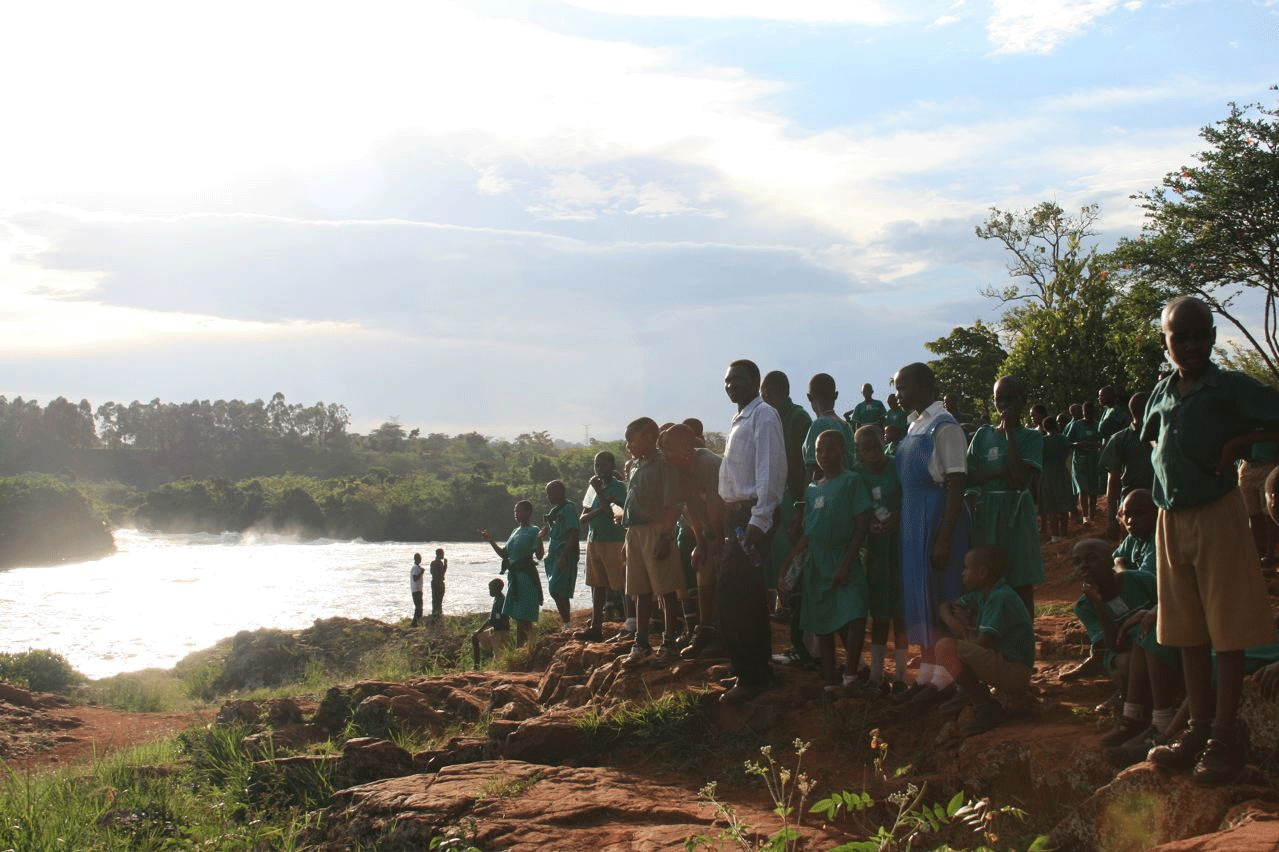
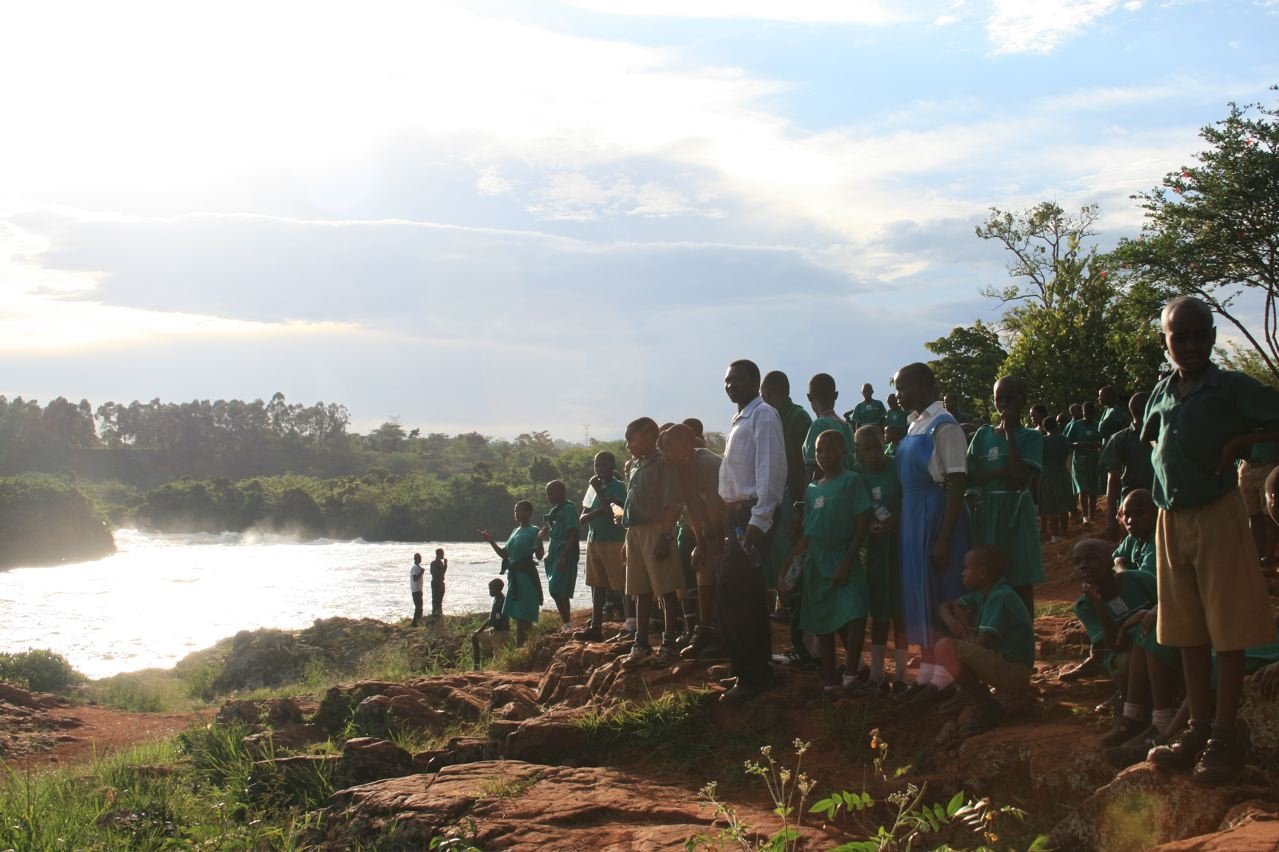
We drive to the famous Bujagali Falls, which will disappear due to the dam, and descend along the banks of the Nile. Hundreds of boys, girls, women and men have gathered at the falls, to watch. Or, as Robbert says: "To pay their last respects." He points to the grass along the river, with a strip of exposed river stones underneath. "The water used to go up to there, but you can see that it has dropped by 20 centimetres already," the result of climate change, according to Robbert. Together we enjoy the water views and watch some kayakers being swept along by the flow.
On the way to the hotel, Michel and I realise that a complex story awaits us in the coming days. What is the impact of climate change on humans, the environment and the dam? What is the economic importance of the project? What is the impact of the dam on the people who live in the area? Can the project indeed be a catalyst for economic development and would it therefore be worth the investment? The filming was yet to begin, however it was clear to me that here in Uganda climate change is no longer an abstract concept but an everyday reality.
Posted by Thomas Hurkxkens, Lokaalmondiaal


Read more about this subject
-
 News / 27 oktober 2026
Both ENDS at COP31: Locally led climate finance and gender-just climate action
At COP31, Both ENDS advocates for climate finance that reaches women-led and community-based organisations at the forefront of climate action, while challenging the economic rules that obstruct the transition away from fossil fuels. Together with partners in the Global Alliance for Green and Gender Action (GAGGA) and the PAPeS programme, we push for locally led adaptation, gender-just climate action and greater accountability for governments and companies.
We asked our colleagues Daan Robben and Fernando Hernandez why they are going to COP31, what messages they want to bring to negotiators, and what a positive outcome would look like.
-
 News / 25 oktober 2026
Meet Sarah Adongo: “The soil remembers those who cry and defend it”
By Sarah Adongo, Lawyer, Witness Radio, Uganda
Sarah Adongo is one of the three winners of the 2026 Irene Dankelman Young Ecofeminist Award, presented on 21 October at the UN Biodiversity Conference (CBD COP17) in Yerevan, Armenia. A lawyer working with Witness Radio Uganda, Sarah works with women affected by gender-based violence and communities affected by land dispossession and large-scale investments. In this piece, she shares what the award means to her and why gender and environmental justice must go hand in hand.
-
 Dossier /
The JWH Initiative: supporting young environmental leaders
The JWH Initiative aims to stimulate leadership of young people in environmental organisations by giving small grants to individuals to expand their knowledge, experience and training.
-
 News / 25 oktober 2026
Meet Yemi Knight: “Your experience is expertise”
By Yemi Knight (they/them), Founder and Executive Director, AnchorBridge Environmental Inc., Barbados
Yemi Knight is one of the three winners of the 2026 Irene Dankelman Young Ecofeminist Award, presented on 21 October at the UN Biodiversity Conference (CBD COP17) in Yerevan, Armenia. Yemi founded AnchorBridge Environmental, a youth-led organisation that combines policy advocacy with climate education across the Caribbean. We asked them what the award means to them, what they are working on, and what they would tell other young ecofeminist leaders.
Yemi is also part of the network of the Joke Waller-Hunter Initiative, powered by Both ENDS. With a JWH grant, Yemi followed courses in Social, Environmental and Economic Impact Assessment and in Risk, Crisis and Disaster Management at the University of the West Indies, Cave Hill Campusc, as well as a Level 1A Spanish course at the Centre for Language Learning at the university’s St. Augustine Campus.
-
 Dossier /
Trade agreements
International trade agreements often have far-reaching consequences not only for the economy of a country, but also for people and the environment. It is primarily the most vulnerable groups who suffer most from these agreements.
-
 Dossier /
International trade and investment with respect for people and planet
The network of international trade and investment treaties is large and complex. The Netherlands alone has signed more than 70 bilateral investment treaties (BITs) and is party to the trade and investment agreements concluded by the EU, like the EU-Mercosur and EU-Indonesia trade deals.
-
 Dossier /
Rights for People, Rules for Corporations – Stop ISDS!
Indigenous communities in Paraguay saw their attempts to regain their ancestral lands thwarted by German investors. In Indonesia, US-based mining companies succeeded to roll back new laws that were meant to boost the country’s economic development and protect its forests. This is the level of impact that investment treaties can have on social, environmental and economic development and rights. Why? Because of the ‘Investor-to-State Dispute Settlement’ clauses that are included in many such treaties.
-
 News / 15 oktober 2026
ISDS infringement complaint filed with the European Commission
The Netherlands and Portugal join four other EU countries facing such a complaint.
-
 Press release / 15 oktober 2026
Dutch and Portuguese organisations file EU complaint over investment treaties that let companies and sanctioned Russian oligarchs sue EU countries for compensation
The Netherlands and Portugal join four other EU countries facing such a complaint, as the Global Days of Action against Investor-State Dispute Settlement (ISDS) begin.
-
 Dossier /
Dare to Trust: the power of unconditional funding
At Both ENDS we cherish our long-term relationships with partners in our global network. These relationships are based on equality and built on trust. The trust we have in each other has developed from years of strategic cooperation, including joint advocacy around common agendas, knowledge sharing, networking, and mobilising and sharing resources to advance environmental justice.
-
 Dossier /
Global Alliance for Green and Gender Action (GAGGA)
GAGGA rallies the collective power of the women's rights and environmental justice movements to realize a world where women can and do access their rights to water, food security, and a clean, healthy and safe environment.
-
 News / 5 oktober 2026
Rural Women's Assembly wins Right Livelihood Award
We are thrilled to share that our partner the Rural Women's Assembly (RWA) is one of this year's Right Livelihood Laureates! The award, often called the "Alternative Nobel Prize", honours RWA for bringing together more than 178,000 women farmers in eleven Southern African countries. Together, these women stand up for their land, their seeds and their right to make decisions about their own lives and bodies.
-
 News / 29 september 2026
Summary - Both ENDS complaint under the EU-New Zealand trade agreement
On 29 September 2026, Both ENDS lodged the first complaint on climate grounds with the European Commission's Single Entry Point. It asks the Commission to examine whether Aotearoa New Zealand has broken two promises both sides made in the EU-New Zealand Free Trade Agreement: not to weaken or set aside environmental laws in order to encourage trade or investment, and to effectively implement the Paris Agreement.
-
Publication / 29 september 2026
-
Publication / 29 september 2026
-
 News / 29 september 2026
Q&A: New Zealand's climate rollback and the EU trade agreement
On 29 September 2026 / 30 September in Aotearoa New Zealand, Both ENDS lodged a complaint with the European Commission under the EU-New Zealand Free Trade Agreement. These are the questions we are asked most often, and our answers. The complaint summary, the case explainer and the key public sources are linked at the end of this page.
-
 News / 29 september 2026
What happens now? A timeline of the SEP Case
What happens now? On 29 September 2026 / 30 September in Aotearoa New Zealand, Both ENDS lodged a formal complaint with the European Commission. It is the first complaint to the EU's Single Entry Point on environmental and climate grounds. It asks the Commission to hold New Zealand to two promises it made in its trade agreement with the EU: not to weaken environmental protection to encourage trade or investment, and not to undermine the Paris Agreement on climate change.
-
 Press release / 29 september 2026
New Zealand faces its first climate complaint under EU trade rules
UTRECHT / WELLINGTON, 29 September 2026 /30 September in Aotearoa New Zealand
Both ENDS, a Dutch environmental justice organisation, has lodged a formal complaint with the European Commission arguing that New Zealand has broken the climate promises it made in its free trade agreement with the European Union. It is the first complaint on environmental and climate grounds under the Commission's Single Entry Point, the mechanism that lets civil society ask the EU to enforce the sustainability commitments in its trade agreements.
-
 News / 10 september 2026
Rutu Foundation receives UNESCO Literacy Prize for multilingual education
Both ENDS’ partner the Rutu Foundation for Intercultural Multilingual Education has been awarded the 2026 UNESCO King Sejong Literacy Prize for its language friendly school programme. This prestigious prize recognises the importance of multilingual education and the right of children to learn in an environment where their home languages are valued.
-
 News / 7 september 2026
Unprecedented criminal conviction in the Mariana disaster case breaks mining industry's cycle of impunity
A Brazilian federal court has, for the first time, criminally convicted a mining company and three of its managers for their role in the 2015 collapse of the Fundão dam, one of the worst environmental disasters in Brazil's history. Our partner Instituto Cordilheira, which represented victims as assistant prosecutors in the case, calls it a historic breakthrough after years of impunity.


