




Celebrate countervailing power!
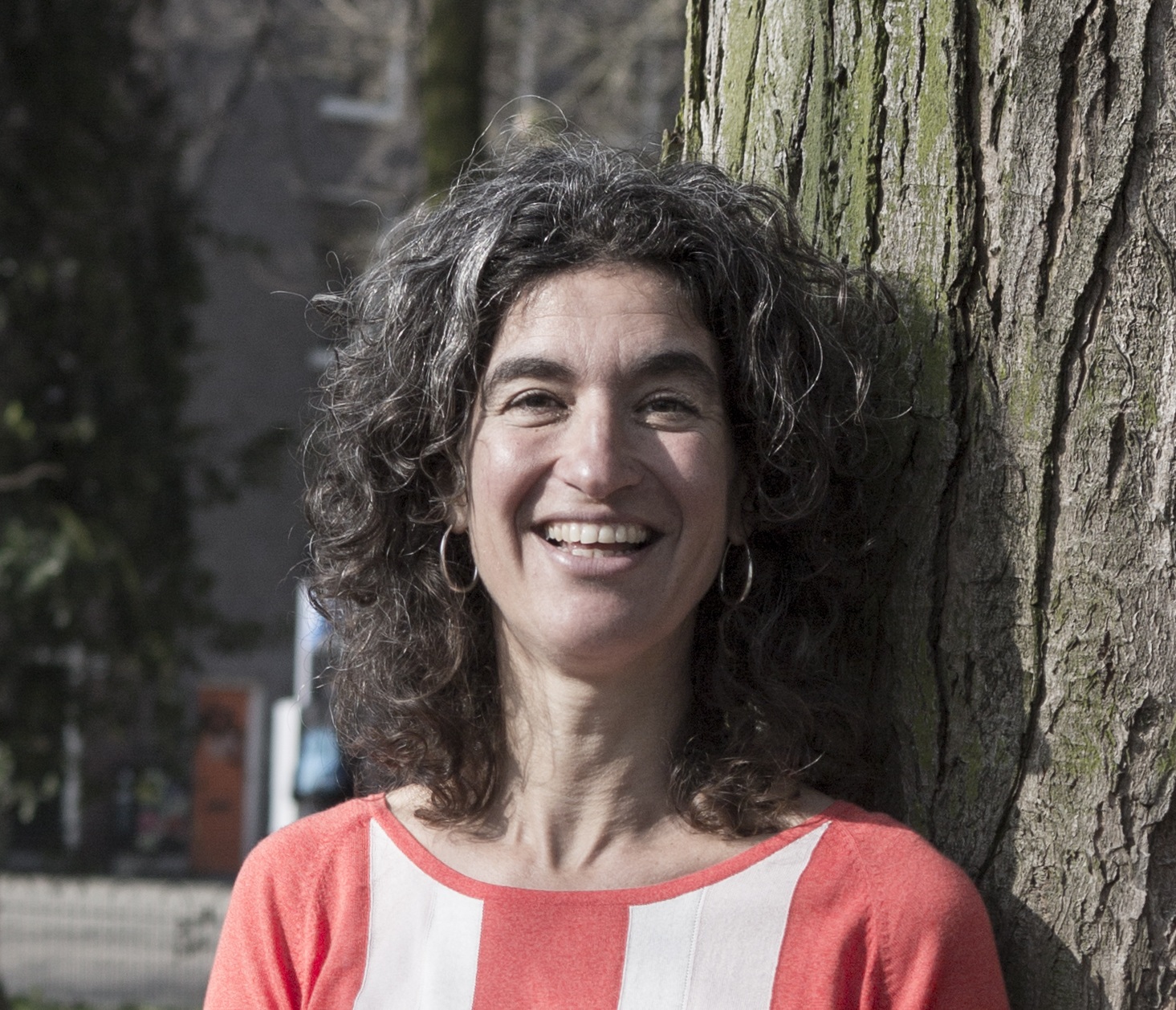
This is the text of the speech given by Danielle Hirsch on the 'Nacht van de Tegenmacht' (Night of Countervailing Power)
Today, we are celebrating countervailing power, that very diverse area in our society that contains everyone and everything that is not part of the established institutions of government and business.
There is an abundance of symbols representing countervailing power: the pianist in Kiev, the brave Chinese demonstrator who dared stand in front of a tank in Tiananmen Square armed only with a plastic bag, and the thousands of people who took part in the Occupy movement.
We can feel the effects of countervailing power everywhere in our daily lives. That is different for all of us. Personally, I would not be standing here, if a large Catholic family in Limburg had not offered my mother shelter when the Germans occupied the Netherlands in 1940. The family not only saved my mother, who spent the war years posing as their youngest daughter, but also served as a transit house for many Jews fleeing Germany via Limburg.
But the effects of countervailing power can also be seen everywhere in our whole society. We would not have had a public health care system if, a couple of hundred years ago, a group of wealthy ladies had not come together to set up orphanages and to ensure that people received treatment when they were sick. We would not have had 35,000 kilometres of cycle tracks in the Netherlands if there had not been public protests in the 1970s because of the increasing numbers of road deaths. And we would not have had solar panels everywhere if there had not been a very large movement promoting sustainable energy.
These examples show that countervailing power consists not only of protests by a few individuals, but also of many collectivities of people who express their ideas without formal planning and investment.
Countervailing power thus brings society wellbeing and prosperity. Amartya Sen, Nobel Prize winner for Economics in 1998, has researched this extensively. He showed, backed up by hard statistics, that societies that give countervailing power a voice have less hunger, a better-functioning public sector and a more healthy economy. His explanation is simple: criticism and unusual ideas drive development, involve all citizens in their society and, in that way, generate healthy societies.
Countervailing power also gives us hope in the future. In 'This Changes Everything', Naomi Klein honours the countervailing power of thousands of local groups who fight against oil pipelines, offshore havens and coal mines. She sees these hotbeds of resistance as our only hope for restricting climate change. And I think she is right. Especially after the election of Donald Trump, we have to pin our hopes on all those people who challenge established power directly and say "Stop, here and no further!"
We should celebrate countervailing power. Not only because the days are getting darker and shorter and we have to grasp any excuse for a party, but also because countervailing power is under pressure all around the world. In many countries, people who raise their voices in protest against large infrastructural projects are dismissed by the incumbent powers as troublemakers who want to stop development. And, increasingly, countervailing power is met with violence. The hardhanded repression of the peaceful protest against the Dakota Access Pipeline in the US and the murder of Berta Cáceres at the beginning of the year in Honduras, are only two recent examples.
In the Netherlands, too, space for civil society is getting smaller. People who raise their voices are increasingly branded as troublemakers. Entrepreneurs, bankers and politicians decreasingly involve social movements and potentially critical voices in dialogue and are reducing the capital flows that support many counter-movements. Our Dutch government provides many examples: despite a clear ruling by the court in the climate case, it still refuses to take on its responsibilities and continues to support companies that extract fossil fuels abroad. Or take the response of both NAM, the Shell-and ExxonMobile-owned company that produces gas and oil in the Netherlands, and the Dutch Minister of Economic Affairs to the protests against the gas drilling in Groningen: the illusion of a debate is upheld, yet in the end the decisions made behind closed doors determine the outcome.
Tonight, we are celebrating countervailing power. In these times of Trump and Wilders, it is very important for me to emphasize the difference between countervailing power and protest voices. Protest voices (and votes) resist in word and deed those who take decisions, make investments, and have a lot of power and influence over the lives of others. Like countervailing power, protest voices come from both left and right, and challenge the established order. The motivations and political identity are the same.
But there is one big difference. The protest voices that today dominate the media call for hate and discrimination, divide our society and offer no solutions to the problems they observe.
Countervailing power is different: it seeks to connect, not only within like-minded groups, but also with those who think differently, so as to encourage a dialogue in search of improvement. This countervailing power is open to criticism and capable of learning. And countervailing power offers solutions. Solutions to climate change, to make cities liveable, to improve the working conditions of small farmers or textile workers.
On this Night of Countervailing Power, we celebrate all those people who colour outside the lines and work to achieve a better society, with passion and often sticking their necks out. The aim of this night is to put the spotlight on those people who keep countervailing power alive. And this night is an appeal, to ourselves and to everyone who can hear it: cherish that countervailing power, because it is the only way that we can continue to develop towards a sustainable, fair and equal society.
Cheers... and have a great evening!
Read more about this subject
-
Publication / 10 July 2019
-
 Event / 26 January 2026
Civic space at the frontlines
Environmental Defenders and the Role of International Trade and Investment Policy
Both ENDS invites you to an interactive dialogue with experts from the UN, policy, academia, and civil society on environmental defenders and international trade. Together, we will explore how citizens, policymakers, academics, and activists can defend civic space and support those on the frontlines of environmental and human rights struggles. With a focus on the Netherlands’ role in international trade and investment policy, and drawing on the experiences of activists from the Philippines, the event aims to foster solidarity and identify strategic priorities to better protect environmental defenders amid the global crackdown on civic space
-
 News / 17 February 2026
Civic space at the frontlines: "Build strong coalitions and counter repressive regimes"
Today, we look back on an inspiring event Civic space at the frontlines -
Environmental Defenders and the Role of International Trade and Investment Policy. The panel exist of Michel Forst, UN Special Rapporteur Environmental Defenders under the Aarhus Convention, Suzanne Kröger, Member of Parliament for GroenLinks–PvdA, Dr. Margit van Wessel, Associate Professor at Wageningen University, Anne de Jonghe, policy advisor at Both ENDS, and Jonila Castro, national spokesperson for Kalikasan People's Network for the Environment. With an audience of CSO experts, academics, accountability experts and students we discussed the effects of Dutch economic activity on Environmental Defenders, and what we all can do to support those on the front lines of the fight for the environment and human rights. -
 Blog / 25 November 2024
The Need for Civic Space in Global Policymaking
and Kyra Pohlan
In today’s interconnected world, international forums play a pivotal role in shaping policies and strategies that impact communities and the environment worldwide. These gatherings, whether they focus on climate change, water resources, or biodiversity, are critical venues where decisions are made that affect the lives of billions of people and species. However, for these decisions to be truly inclusive and effective, they must be informed by the voices of those most affected by climate change and environmental degradation.
-
 News / 7 October 2018
Our Director ranking 52nd on Dutch ‘Sustainable 100’-list
We are very proud that our director Daniëlle Hirsch has been included again in the ‘Sustainable 100’ (an annual ranking list published by Dutch newspaper Trouw), and has gone up more than 40 spots compared to last year! Danielle was included in the list because of the many things she does with her organisation as a whole, but she got the higher ranking for the way she combines her criticism of the destructive role of the Netherlands as a trading nation and large cause of CO2 emissions in the world (often supported by the Dutch government), with a constructive attitude when it comes to finding alternatives and solutions.
-
 Blog / 23 March 2017
Déjà vu: from Famatina via Orissa and Dakota to Groningen
Whenever I see pictures of the people in the Dutch province of Groningen whose houses are collapsing because of gas extraction and who, even if they wanted to move somewhere else, would never be able to sell them, I can't help but think of all the people worldwide who have been experiencing the same problems, sometimes for decades. Every time I see the anger and powerlessness of the people of Groningen, the comparison to the many people we have been working with for many years in many parts of the world comes to my mind.
-
Publication / 25 November 2024
-
 Press release / 11 November 2024
Both ENDS's response to government letter on future cooperation with civil society organisations
DEN HAAG, 11 November 2024 - Today, the Dutch government published its policy on future cooperation with development organisations, both in the Netherlands and abroad. PVV minister Reinette Klever is putting the axe to this funding: she has decided to cut the budget for aid to international civil society by more than two-thirds: from roughly €1.4 billion to €0.4 billion in the period 2026 to 2030. This has major implications for critical voices at home and abroad, at a time when civic space for organisations around the world is already shrinking. Karin van Boxtel, director of environmental and human rights organisation Both ENDS: ‘This is an unprecedented step in exactly the wrong direction. Civil society organisations are essential for sustainable and social change worldwide. International movements fulfil multiple, indispensable roles: as a watchdog of the rule of law, as a driver of change, and as a counterforce against authoritarian tendencies. The weakening of support for these roles is a telling signal.’
-
 News / 21 September 2017
Civil society is being silenced
September 22nd websites of civil society organisations and NGO's all over the world will go black, in protest and solidarity. Protest against the shrinking space for civilians and organisations to speak out, unite and protest peacefully.
-
 Dossier /
Dare to Trust: the power of unconditional funding
At Both ENDS we cherish our long-term relationships with partners in our global network. These relationships are based on equality and built on trust. The trust we have in each other has developed from years of strategic cooperation, including joint advocacy around common agendas, knowledge sharing, networking, and mobilising and sharing resources to advance environmental justice.
-
 Dossier /
Global Alliance for Green and Gender Action (GAGGA)
GAGGA rallies the collective power of the women's rights and environmental justice movements to realize a world where women can and do access their rights to water, food security, and a clean, healthy and safe environment.
-
 News / 27 February 2026
Both ENDS strengthens the resilience of female environmental defenders worldwide thanks to multi-year contribution from the Postcode Lottery
In recent years, Both ENDS has received an additional contribution of €875,000 from the Postcode Lottery for the Autonomy & Resilience Fund (2022–2025), implemented in collaboration with the Global Alliance for Green and Gender Action (GAGGA). This support was essential because female environmental rights defenders around the world are increasingly facing climate change, repression and shrinking civil space. With this contribution, Both ENDS supports female activists and their communities with flexible, trust-based funding, enabling them to develop their own solutions to urgent environmental and climate problems.
-
 News / 2 July 2025
 -
Publication / 1 April 2025
-
 News / 21 February 2025
Cabinet turns its back on international cooperation and solidarity with callous policy letter
Foreign Trade and Development Minister Klever's published policy letter is coldhearted and callous. It places the Netherlands in international isolation and abandons the most vulnerable people worldwide, including many women, farmers, indigenous peoples and youth.
-
 Press release / 12 December 2024
Website names companies excluded by global investors and banks
The Hague/San Francisco, Dec 12, 2024 - The updated version of the Financial Exclusions Tracker is released today: financialexclusionstracker.org. The website tracks which companies are being excluded by institutional investors, pension funds and banks due to human rights, public health and sustainability issues. The most common reasons for exclusion are links to fossil fuels, weapons or tobacco.
The Financial Exclusions Tracker is an initiative from an international coalition of NGOs striving for more transparency and information disclosure.
-
Letter / 9 December 2024
People and the Planet Entebbe Declaration: Reclaiming investment frameworks for people and the planet
The time for change is now. Civil society demands international investment
frameworks that are aligned with economic justice, social and environmental
sustainability, and the needs of communities worldwide. -
 News / 26 November 2024
The Time to Rethink Investment Rules: Amplifying Civil Society Voices
At the core of the Fair, Green, and Global (FGG) Alliance’s mission is the commitment to building a just and sustainable world. As members of this alliance, Both ENDS, SOMO, and the Transnational Institute (TNI) recognise the urgent need to reimagine global investment frameworks. These frameworks, entrenched in outdated treaties such as Bilateral Investment Treaties (BITs) and the Energy Charter Treaty (ECT), often prioritise corporate profits over human rights, environmental sustainability, and social justice.
-
 News / 25 November 2024
Empowering Civil Society: Shaping investment policies for climate and sustainable development in Africa
From 26-29 November 2024, Both ENDS and its partners will host the Civil Society Forum on Investment Policies, Climate and Sustainable Development Goals in Entebbe, Uganda. Our colleagues Iván and Fernando explain the importance of this event: “Through this event, we aim to provide an in-depth perspective on the impact of current investment policies on climate and environmental issues, with a strong focus on the African continent.”
-
 Blog / 18 November 2024
The global rise of authoritarian regimes demands global strategies
The global funding landscape for civil society movements is changing, and is increasingly faced with policies that restrict funding streams, limit philanthropic work, and silence critical voices. These are not incidental shifts but part of a broader pattern that erodes the support for those international networks and movements under the guise ‘necessary financial cuts’, ‘aid reform’ or ‘efficiency’.



