Both ENDS



On the 14th of April, Both ENDS wil host a workshop called 'Small Grants, Big Impacts' on the annual Africa day in Amsterdam. The workshop aims to demonstrate that so called 'small grants funds' effectively deliver (devopment and climate) money where it matters, to people that need it the most. Large development banks, funds, donors and governments could use small grants funds as alternative financing mechanisms to make sure their money benefits people and their environment now and it the far future.

It was minus 20 degrees Celsius when 2.000 women gathered at the main square of Ulaanbaatar, Mongolia, to voice their distress about the terrible smog in the city caused by three large power plants. Soon after, the women were invited to speak about the problem of air pollution with the minister of environment.

Although the human rights to water, food and a healthy environment have been incorporated in international legal instruments, in many countries these rights are violated on a massive scale. Women suffer disproportionally, because it is mostly still their role to feed the family and fetch water, but also because they lack decision-making power over the use of natural resources.

We are shocked and alarmed by the news that the Philippine government has declared a list of 600 people to be communist terrorists. On the list are mostly indigenous leaders, environmental activists and human rights defenders. Among them are some of our partners, and we are deeply worried about them and the other people on this list.

"How many layers of clothing are you wearing? One? No, that's not enough. You should wear your ski pants over your jeans, and change your shoes for snowboots." And there you are, on day 1 of your trip to Mongolia. I had already heard that Mongolia is very cold at the end of November, and with -22 degrees that seemed to be all true.
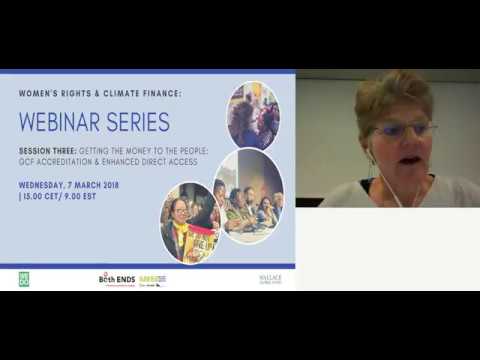
The third session of our five part series on women's rights and climate finance, Getting the Money to the People: GCF Accreditation and Enhanced Direct Action, focused on accessing the Green Climate Fund through working with stakeholders at the country level (engaging with the National Designated Authority), utilizing Enhanced Direct Access, and seeking accreditation.

Join us for the third session of this five-part series on women's rights and climate finance, aimed at building knowledge and power to ensure finance flows benefit local women's groups, respond to community needs and respect human rights.

At the end of November EFLAC, the most important gathering of feminists from throughout Latin America and the Caribbean, took place in a park just outside Montevideo, Uruguay. Within Both ENDS, I coordinate the GAGGA programme, in which we promote cooperation between the environmental and women's movements. Our partners Mama Cash and FCAM persuaded me that this meeting was the perfect opportunity to find out whether and, if so, in which way women are interested in the environment. They had prepared me for a very intensive meeting, at which the whole spectrum of emotions would be aroused and expressed. I had no idea what to expect and set off with a completely open mind. And so it came that I spent four days among more than 2,000 women from across the continent.

Last month, our partner Utz Che' filed a lawsuit against the Guatemalan state on behalf of some communities along the Madre Vieja River. The communities demand, among other things, that their right to water is respected and that they are protected against water abuse and pollution by large-scale agriculture.