Both ENDS



Below, you find Both ENDS's strategy 2026-2030: "Connecting people for an environmentally just world”. This strategy was developed in close collaboration with our partner network. Together, we strive for an environmentally just world in which people and ecosystems thrive and all people can live a life of dignity.
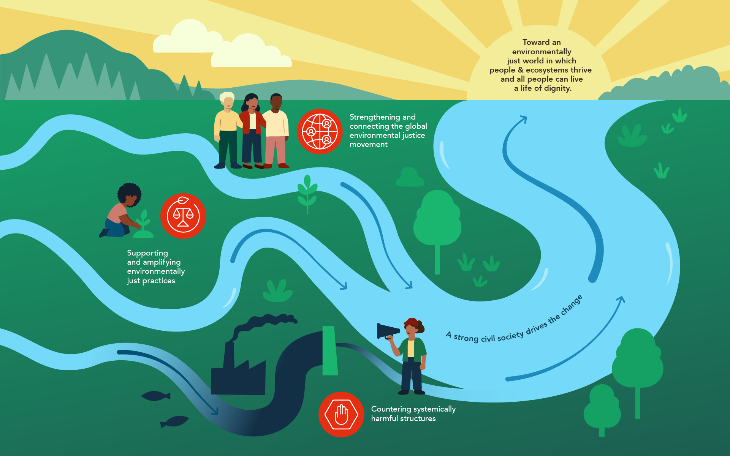
Both ENDS envisions an environmentally just world in which people and ecosystems thrive and all people can live a life of dignity.
Both ENDS strengthens, connects, advocates and creates space for civil society actors globally to bring about an environmentally just world.
Achieving our vision requires no less than the re-balancing of power in societies and the re-orientation of the global economic system away from extractivism and exploitation, and toward environmental justice.
In the coming five years, we work towards this vision along these three interlinked strategic objectives:
Next to these strategic objectives, we also have an organisational objective. In our ways of working, both internally and externally, we aim to reflect the values of the world we envision.
Examination of Power
We are committed to regularly reflect on and address power relations in all of our relationships, including with partners and donors, and internally within the organisation. This entails ongoing two-way communication, being ready and open to difficult conversations, and being willing to act on feedback.
We recognise examination of power as a continual process: our work is never finished. We aim to embed transparency, inclusion and trust in our ways of working, including in how we organise granting and reporting processes.
A self organising structure and culture
At Both ENDS, we hold our own responsibility, self-direction, an open feedback culture, and personal development in high regard. Our structure has been developed collaboratively with all colleagues. The approach mirrors Both ENDS' vision of the world and puts 'sharing power' into practice. This means that authority and decision-making power are not confined to a limited number of individuals but are shared throughout the organization. Decision-making becomes more robust and effective as a result. And it increases the level of enjoyment of colleagues.
Read more in our Strategy 2026-2030: Connecting people for an environmentally just world
 |