




A Transformative Water Pact : A radical response to the global water governance crisis
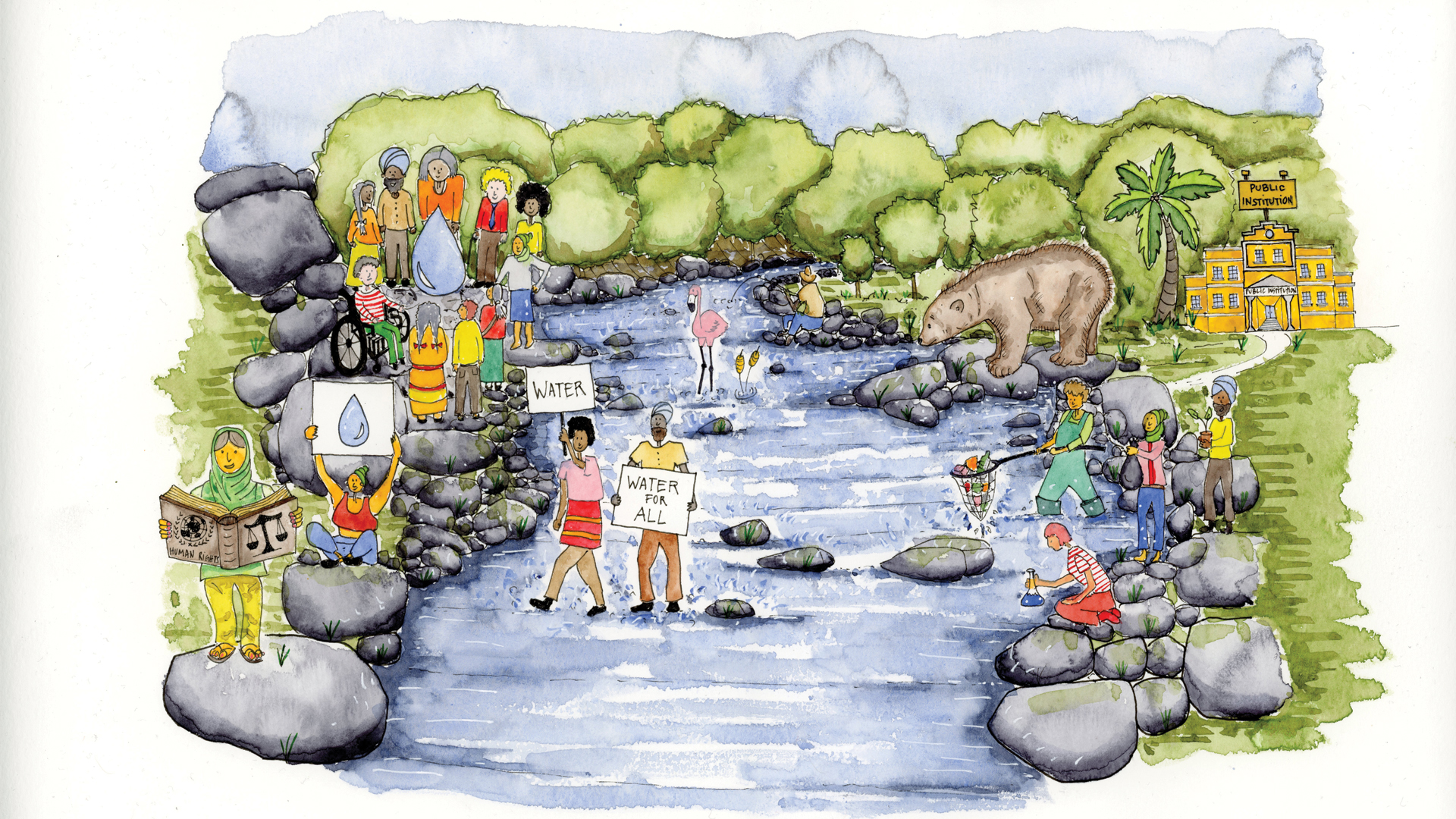
Academics and civil society representatives from around the world came together to articulate an alternative vision and framework for water governance, in the run-up to the UN Water Conference 2023 in New York. The Transformative Water Pact was developed in response to the continued exploitation of nature, neglect of human rights and the extreme power-imbalances that characterize contemporary water governance throughout the world. It details an alternative vision of water governance based on the tenets of environmental justice, equality and care.
Murtah Shannon, Both ENDS: "Mainstream policy continues to offer more of the same when it comes to tackling the global water crises; more technology, more data, more finance, more markets. But the water crisis is an environmental justice crisis and as long as the underlying power imbalances remain unaddressed, such called "solutions" will continue to reinforce the status quo at the expense of people and nature". For decades, environmental justice advocates have been drawing attention to the injustices produced by water related policies and interventions such as the construction of large-scale dams in rivers, industrial water extraction and land reclamation near coasts, as well as to the many indigenous practices and community innovations that offer a glimpse of a better future. "So far, however, there has not been a concerted effort to consolidate these diverse movements under a shared vision of water governance. With this pact, we hope to take a first step in that direction".
Urgent need for systemic change
The Transformative Water Pact was developed through several online round-tables by a coalition of more than 40 water environmental justice advocates from around the world, most notably the global South, all of whom work on a variety of water-issues. They all recognize that the world is in urgent need of a systemic change towards sustainable and equitable water governance.
Nadine Sander, IHE-Delft: "The Pact not only consists of a set of key principles that all participants agreed on, but also provides a tangible and concrete framework for action to guide decision-making for transformative change in water governance. It's aimed at all actors – mainly within the area of water governance - that support these principals and are committed to incorporating them in their own area of expertise and sphere of influence, such as policy-makers, private sector, government organizations, NGO's, academics and community groups.
Suppport and endorsement
The Transformative water pact is available in 8 languages and can be found and endorsed on this website. To gain attention and support, it will be promoted during the coming months, starting with an online event on March 23rd in collaboration with Latin-America based network Interamerican Association for Environmental Defense (AIDA) and the Colombian Government.
More information:
Website Transformative Water Pact
Online event 23rd of March: Towards just water governance in Colombia; a dialogue on the Transformative Water Pact
For more information
Read more about this subject
-
 Environmentally Just Practice /
A Negotiated Approach for Inclusive Water Governance
A Negotiated Approach envisages the meaningful and long-term participation of communities in all aspects of managing the water and other natural resources on which their lives depend. It seeks to achieve healthy ecosystems and equitable sharing of benefits among all stakeholders within a river basin. This inclusive way of working is an essential precondition for the Transformative Practices that are promoted by Both ENDS and partners.
-
Publication / 3 July 2026
-
Publication / 12 May 2026
-
 Press release / 12 May 2026
UN report warns of a growing sand crisis - The Dutch dredging sector plays a key role in global sand extraction
GENEVA/UTRECHT, 12 May 2026 – A new report by the United Nations Environment Programme (UNEP), Sand and Sustainability: An Essential Resource for Nature and Development, warns that global demand for sand is exceeding ecological limits. Large-scale extraction of sand from marine and coastal ecosystems is leading to biodiversity loss, damage to coastal communities and increasing risks in an era of climate change. Dutch dredging companies play a prominent role in this as global market leaders in large-scale sand extraction and land reclamation. “Our analyses show that the dredging sector operates globally within a system in which ecological damage and the consequences for coastal communities are systematically underestimated, whilst transparency and effective oversight are often lacking,” says the Dutch environmental and human rights organisation Both ENDS, which contributed to the report.
-
 News / 24 March 2026
Statement: Invest in local leadership for tropical forest management and local economies
IUCN-NL, Both ENDS, and 16 other Dutch and international civil society organizations (CSOs), networks, and expert groups are calling on the Dutch government to invest more strongly in locally led forest management and forest-based economies. This should be done within the framework of Dutch international cooperation and its associated policy instruments.
-
 News / 27 February 2026
Both ENDS strengthens the resilience of female environmental defenders worldwide thanks to multi-year contribution from the Postcode Lottery
In recent years, Both ENDS has received an additional contribution of €875,000 from the Postcode Lottery for the Autonomy & Resilience Fund (2022–2025), implemented in collaboration with the Global Alliance for Green and Gender Action (GAGGA). This support was essential because female environmental rights defenders around the world are increasingly facing climate change, repression and shrinking civil space. With this contribution, Both ENDS supports female activists and their communities with flexible, trust-based funding, enabling them to develop their own solutions to urgent environmental and climate problems.
-
 News / 27 November 2025
Communities and International Consortium Present Community-Led Plan for Nature-Based Adaptation to Sea-Level Rise in Coastal Bangladesh
Local communities in the southwestern coastal region of Bangladesh—together with an international consortium including Uttaran, CEGIS, and Both ENDS—have presented a community-led plan to confront climate change and accelerating sea-level rise through nature-based adaptation. The People’s Plan for Upscaling Ecosystem-Based Adaptation outlines a scalable strategy rooted in local ownership and generations of lived experience. At its centre is Community-Based Tidal River Management (CBTRM), a proven approach that reduces waterlogging, raises land elevation, and restores ecological balance by working with natural tidal and sediment dynamics.
-
 Dossier /
Wetlands without Borders
With our Wetlands without Borders program, we work towards environmentally sustainable and socially responsible governance of the wetlands system of the La Plata Basin in South America.
-
Letter / 14 November 2025
Letter: TPAC’s report “Final Judgement Detailed Research MTCS’’
A coalition of Malaysian and international NGOs has released a memorandum in response to the recent TPAC report on the Malaysian Timber Certification Scheme (MTCS). The organisations express serious concerns about the independence, quality, and credibility of the assessment carried out by the Timber Procurement Assessment Committee (TPAC).
-
Publication / 9 October 2025
-
 Dossier /
Amplifying environmentally just practices
Because of the close relationship with their living environment, local communities often have the best ideas for the sustainable and equitable use and governance of land, water and forests. These environmentally just practices and processes successfully protect and restore ecosystems and address climate change. They are essential in the light of the multiple crises the world faces, but are in dire need of financial and policy support.
-
 News / 10 July 2025
Both ENDS and Global Witness condemn harassment of anti-reclamation activists in Manila Bay
Global Witness and Both ENDS strongly condemn the reported of harassment and surveillance by the Armed Forces of the Philippines of environmental activists and fishing communities in Navotas, Philippines. Pamalakaya-Pilipinas, a National Federation of Small Fisherfolk Organisation in the Philippines, has received credible reports that the Armed Forces of the Philippines (AFP) are engaged in “red-tagging” their members.
-
Publication / 1 July 2025
-
 News / 23 June 2025
Who benefits from better protection of our oceans?
The ocean emerged strengthened from the UN Ocean Conference in Nice. More countries are supporting a ban on deep-sea mining, more marine protected areas are being established, and more pledges are being made to fight pollution. The question now is whether countries will follow through on their commitments. Because the ocean movement faces a camp of powerful interests.
This article was originally posted in Dutch on MO*Magazine.
-
 News / 6 June 2025
Both ENDS at the UN Ocean Conference: voicing our environmental justice concerns about the “Blue Economy”
Next week, the United Nations Ocean Conference will take place in Nice, France. This conference is focused on the conservation and sustainable use of coasts, seas and marine resources. Both ENDS colleague Murtah Shannon will be attending. We’ve asked him to explain a bit more about his plans.
-
 Dossier /
Inclusive ways to sustainable and healthy food for all
All around the world small-scale farmers are using sustainable and inclusive methods to produce food. Working together with nature and each other, they provide their families and communities with sufficient and healthy food. But their production methods are under pressure from large-scale agriculture and the globally dominant system of industrial food production. Together with our partners, Both ENDS is trying to turn the tide in favour of sustainable, local practices that are mostly known as 'agro-ecological' or 'nature-inclusive'. Why are we focusing on these methods? Agro-ecological practices are climate-proof and inclusive and increase the opportunities for communities around the world to produce their food sustainably.
-
 News / 21 March 2025
Dutch Royal couple visits Thogoto Forest: a green oasis on the outskirts of Nairobi
This week, King Willem-Alexander and Queen Máxima visited Thogoto Forest as part of their state visit to Kenya. They were able to see the impact of the work of our partner MCDI in the area: a restored forest, clean water and farmers who can earn a living by selling their agro-ecological products.
-
 Blog / 28 January 2025
Sinking promises in Manila
Yesterday, Global Witness published a new report, "Sunk Costs" - in which I had a modest role to play - that comes up with new facts about the disastrous New Manila International Airport project in the Philippines, for which the Dutch dredging multinational Boskalis received Dutch export credit insurance (ekv) of €1.5 billion.
-
Publication / 16 January 2025
-
 News / 2 December 2024
Ten recommendations for the UNCCD COP16 to strengthen its efforts in combating desertification, land degradation, and drought
For decades, our local partner organisations have been developing and promoting effective ways to combat land degradation, desertification, and drought. This includes regions like the drylands, as well as forests, and wetlands. Supporting these locally-led actions is essential to reversing negative trends. For COP16, Drynet has developed 10 recommendations to strengthen the implementation of the UNCCD. Success at COP16 would mean turning these recommendations into action, fostering inclusive land governance and sustainable land management practices globally. By enabling locally-led actions—particularly those led by women, youth, pastoralists, and Indigenous Peoples—we can build a more resilient future.




