




Divest from EACOP before it’s too late
and Abigail Kyomuhendo*
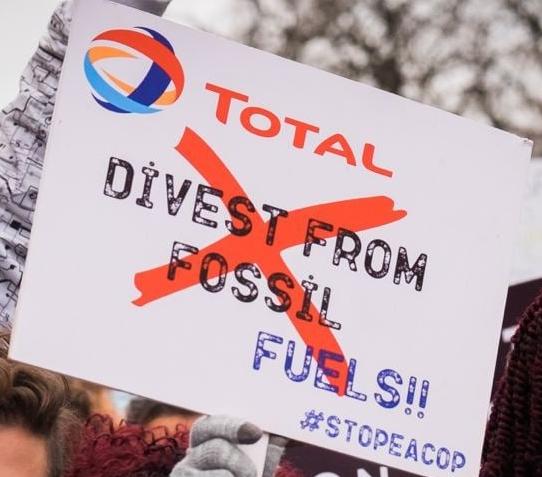
This week the annual shareholder meeting (AGM) of TotalEnergies took place. Whilst the shareholders celebrated their profits, Ugandan people were being evicted from their lands, thousands of kilometers away, for Total's East African Crude Oil Pipeline (EACOP).
EACOP will transport crude oil from the Albertine region in northwest Uganda to Tanga, a port in Tanzania from where it will be exported around the world. The oil drilling and the pipeline threatens biodiversity, water supply and fishing resources for millions of people and displace thousands of households. It now already leads to human rights violations, especially targeted at activists speaking out against EACOP**.
EACOP has the dubious honour to become a replicate of the Niger Delta trauma. And that in an era when we all know we shouldn't be building any more pipelines and drill for new oil and gas sources. To keep the 1.5 degrees of the Paris Agreement within reach, we should keep fossil fuels in the ground.
Ugandan CSO's call for investments in clean energy instead
Says one citizen activist: "We want people in Europe and around the world to know about the East Africa Crude Oil Pipeline. We want financial institutions and other big companies supporting Total to withdraw their support. We want to see this project stopped, as well as any other new oil projects in Africa and around the world."
Our Ugandan partners want to see an end to the funding of any new fossil-fuel projects, including EACOP, and an increased investment in clean and sustainable energy, particularly off grid solar energy. Because EACOP oil is for export, the project will not help the more than 90% of rural Ugandan people without electricity access. As such, Both ENDS supports their calls on government for putting in place policy frameworks, consumer protection laws, and investment that promotes expansion of off-grid solar energy.
Alarm bells are ringing: divest from TotalEnergies
Lately, good news has been coming in: earlier this year Dutch asset manager ACTIAM has set the standard: after a year long engagement failed to deliver adequate assurances from TotalEnergies on EACOP, they took the decision to exclude the oil and gas company from their investments. BankTrack on behalf of the coalition of #StopEACOP announced that this week seven more banks and insurers have confirmed they will not join the project loan to finance the EACOP. This takes the number of banks that want nothing to do with the EACOP project loan to 20 and the number of insurers to eight.
We think many other Dutch pension funds and asset managers need to influence TotalEnergies to stop EACOP or when they resist being influenced, do as ACTIAM has, and get out. The 11 mainly Dutch asset managers who tried to get a climate resolution on the agenda at this week's shareholder meeting but whose resolution was rejected to be tabled by TotalEnergies management should turn an even more critical eye towards TotalEnergies.
Both ENDS has sent information about EACOP to more than 15 Dutch pension funds and asked for meetings between these funds and our Ugandan partners so they can hear for themselves the perspective from the ground about how the oil and gas companies TotalEnergies and its Chinese counterpart CNOOC are operating. The first of these meetings occurred in April 2022 with Achmea, who manages the assets of 15 pension funds.
EACOP should be setting off alarm bells for investors committed to the Paris agreement. EACOP shows that TotalEnergies is not transitioning to becoming a renewable energy leader as some investors have hoped.
Call on investors: save Uganda from the disaster called EACOP
Banks, insurers, pension funds and export credit agencies need to cut off the money supply to develop EACOP.
At this moment, we can still save Uganda and its citizens from this disaster called EACOP. So let's join forces and help protect the lives, lands, and water supplies for thousands of Ugandans, as well as score one for the climate crisis.
*This is a pseudonym
**The environmental and human rights consequences of EACOP
EACOP will transport crude oil from the Albertine region in northwest Uganda to Tanga, a port in Tanzania from where it will be exported around the world. Nearly a third of EACOP will be constructed in the Lake Victoria basin, affecting Ramsar wetlands teeming with culturally-significant biodiversity. The lake also meets the water needs of up to 40 million people in East Africa.
The pipeline will cross 2,000sq. km of protected areas in Uganda and Tanzania, a third of which are habitats for chimpanzees and elephants. The oil to be transported by the pipeline will be extracted from Murchison Falls National Park, one of Uganda's largest, oldest and most visited parks, as well as Lake Albert, which contributes 43% of Uganda's fish resources.
Over 13,000 households are being re-located, more than 100,000 people affected. Human rights violations in the region are increasing, targeted mostly at activists protesting the pipeline and speaking out for the environment and the rights of the local communities. Women activists who speak out fare worse as when they are arrested, they face domestic and other pressures that take a psychological toll on them.
Read more about this subject
-
 Dossier /
Uganda’s Energy Future
Despite the existence of many hydropower dams, foreign investments and large government spending on energy, and new plans for hydropower, oil and gas projects, the vast majority of rural Uganda still remains without electricity. Together with our local partners we are striving towards a sustainable energy strategy for Uganda that starts from the needs and wishes of local communities.
-
 Dossier /
Making pension funds more sustainable
Pension funds have a lot of influence because of their enormous assets. Both ENDS therefore wants pension funds such as the Dutch ABP to withdraw their investments from the fossil industry and to invest sustainably instead.
-
Publication / 3 juli 2026
-
 Dossier /
Gas in Mozambique
In 2011 one of the world’s largest gas reserves was found in the coastal province of Cabo Delgado, in the north of Mozambique. A total of 35 billion dollars has been invested to extract the gas. Dozens of multinationals and financiers are involved in these rapid developments. It is very difficult for the people living in Cabo Delgado to exert influence on the plans and activities, while they experience the negative consequences. With the arrival of these companies, they are losing their land.
-
Publication / 18 juni 2026
-
 News / 14 april 2026
New report: Phasing out ISDS in the Netherlands: a roadmap
Today, Both ENDS and SOMO are publishing the report Phasing out ISDS in the Netherlands: a roadmap. In the report, we highlight the Netherlands’ role in the ISDS system and offer practical guidance on phasing out ISDS.
-
Publication / 14 april 2026
-
 News / 26 maart 2026
New project: Climate Accountability in EU Trade
Through its new project “Climate Accountability in EU Trade: Testing the SEP and DAGs for Climate-Linked FTA Enforcement” Both ENDS, with support from the European Climate Foundation, is exploring how the European complaints mechanism (SEP) and Domestic Advisory Groups (DAGs) can be more effectively used to advance climate accountability. The project runs for 13 months, until end of 2026.
-
 Dossier /
Global Alliance for Green and Gender Action (GAGGA)
GAGGA rallies the collective power of the women's rights and environmental justice movements to realize a world where women can and do access their rights to water, food security, and a clean, healthy and safe environment.
-
 Dossier /
Seeking justice for the affected communities of Vale’s mining disasters in Mariana and Brumadinho
In 2015 and 2019, the Brazilian state of Minas Gerais experienced two severe mining tragedies in Mariana and Brumadinho, due to the same mining company: Vale. Since then, the affected communities have been seeking justice, via the criminal punishment of the responsible parties, and a fair compensation for the loss of their loved ones, their homes and their livelihoods. Both ENDS supports local CSOs by amplifying their quest for justice within an international audience and, more specifically, by raising awareness amongst Dutch investors in Vale about the high risks this company’s activities pose for people and the environment.
-
 News / 2 februari 2026
Seven years after Brumadinho: impunity allows Vale’s disasters to continue
Seven years ago, the dam owned by mining company Vale collapsed in Brumadinho, Brazil, killing 272 people and severely polluting the surrounding area. While the relatives of the victims commemorate them and fight for justice, the pollution continues.
-
 News / 22 januari 2026
Shell files new arbitration against the Netherlands over Groningen gas field closure
Shell is suing the Netherlands in yet another attempt to evade its responsibility for decades of gas extraction in Groningen. For years, gas production has triggered earthquakes, damaged over a hundred thousand homes, and left residents living in prolonged insecurity, still waiting for repairs, reinforcement, and justice.
-
 Blog / 11 december 2025
Reflections on working on Dutch finance for Mozambique LNG
Last Tuesday, I received a short text message with big news: the minister had just announced that the financing policy for the Mozambique LNG project was stopped. It was a decision that I – along with so many others – have fought for for years. Only now, more than a week later, it is slowly sinking in that we have really won. The years of perseverance, frustration, discussions and investigations have finally led to this result. It still feels a bit surreal.
-
 Dossier /
Export Credit Agencies: Who pays the price?
Both ENDS calls on the government only to provide export credit insurance to sustainable projects that cause no social and/or environmental damage in the countries where they take place.
-
 Blog / 25 november 2025
COP30 shows why dismantling ISDS is essential for real climate action
Standing in Belém during COP30, I felt the weight of the moment. We came to the Amazon hoping for decisive progress on phasing out fossil fuels, yet the final outcome fell far short of the ambition science and justice demand. The agreement brought welcome commitments on adaptation finance and global indicators, but it refused to confront the structural forces that make climate action so difficult.
-
 News / 5 november 2025
Another ISDS claim hits the Netherlands: Petrogas sues over solidarity contribution and royalty regulations
SOMO and Both ENDS strongly condemn the newly revealed investor-state dispute settlement (ISDS) case filed by Petrogas, an Omani oil and gas company operating two shallow-water gas fields in the Dutch North Sea, against the Netherlands under the Netherlands-Oman bilateral investment treaty (BIT).
-
 News / 23 oktober 2025
TotalEnergies financiers beware: EACOP is eating up money, nature and livelihoods
A new analysis shows that the developers of the East African Crude Oil Pipeline, led by France’s TotalEnergies, are being forced to self-finance the project almost entirely. The analysis, part of a new Finance Risk Updatefrom a coalition of African and International civil society organisations, shows that the companies have abandoned plans to raise 60% of the project’s growing costs from bank loans, and are now on the hook for almost 90% of the costs themselves.
-
 News / 9 oktober 2025
Both ENDS launches new strategy: “Connecting people for an environmentally just world”
With great pride, Both ENDS launches today it’s new strategy for the coming 5 years: “Connecting people for an environmentally just world”. This strategy was developed in close collaboration with our partner network, which has always been, and still is, the foundation of our work. Together, we strive for an environmentally just world in which people and ecosystems thrive and all people can live a life of dignity.
-
Publication / 9 oktober 2025
-
 Dossier /
International trade and investment with respect for people and planet
The network of international trade and investment treaties is large and complex. The Netherlands alone has signed more than 70 bilateral investment treaties (BITs) and is party to the trade and investment agreements concluded by the EU, like the EU-Mercosur and EU-Indonesia trade deals.




