




Violet Matiru: “Communities around colonial Ruiru I Dam still struggle”
After many years of advocating for strong environmental policies at international platforms such as the UN, Kenyan Violet Matiru asked herself: "How does all this lobbying trickle down to our communities? How does this help our mothers who are still struggling with fetching water and cooking on wood stoves?" This is when she and her colleagues founded MCDI Kenya (Millennium Community Development Initiatives) and started to work with local communities. We talked to her about the historical and current power imbalance in water governance and her efforts to improve water governance in the Athi River basin, that runs all the way from upstream of Nairobi, through the city, into the Indian Ocean.
What kind of organisation is MCDI? How do you work with local communities and improve their access to water?
"When we started in 2005 we thought it was enough to inform people. We published a magazine with successes and challenges in local water governance. But soon we realized that more was needed, that communities needed practical help and that we had to empower them to stand up for their right to water.
In Kenya we have a national Water Resource Authority that stimulates the formation of a Water Resource Users Association (WRUA) for each of the 1,237 sub-catchment areas in the country. In these WRUAs, local water users jointly decide how the water in their catchment is being distributed and used. MCDI encourages community members in the whole Athi River basin to form a new WRUA or to join the existing WRUA for their area."
This sounds really promising. Does this mean that with the WRUAs, Kenya has an inclusive water governance system?
"It is a good system but it still has its challenges. For example, local governments often don't have the capacity to cooperate with the WRUAs. Also, in many cases big users have too much power within the WRUA. Privatization of water sources is also a big problem. Kenya is officially a water scarce country, with approximately 80% of the country classified as Arid or Semi-Arid, so there are many conflicts over water.
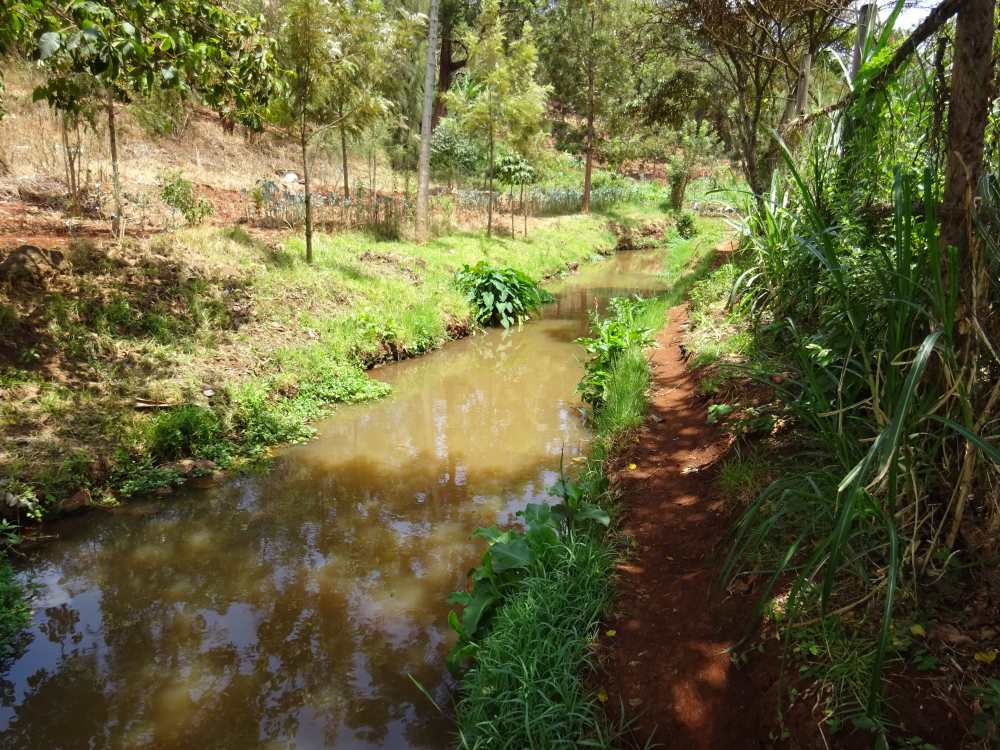
There are many power imbalances when it comes to water governance. Water is a very political issue, at all levels. For example, together with our partners PELUM and ICE we are working with communities around the Ruiru I Dam, which was built in the Athi River in the 1950s, during colonial times, upstream of Nairobi to provide the Europeans in the city with water.
The upstream communities nowadays still struggle, since they have no access to water. For example, officials remove water pipes that divert river water upstream of the dam. And one day, when we visited the dam we witnessed how a local woman who went to fetch water from the reservoir with some jerrycans was chased away by officials on a speedboat. After we discussed with the officials, they let her fill the jerrycans, but when we are not there, communities are terrorised this way.
But when the local residents went to their county government to complain, it turned out the dam is not controlled by the Kiambu county, but by the Nairobi Water Company. And now another dam, Ruiru 2, is being built by a state-owned corporation called Athi River Works and financed by Deutsche Bank through a Public-Private Partnership (PPP) arrangement. Again, with the goal to provide Nairobi with water. So the water resources are being privatised for the interest of the rich and powerful in the city, and the county government has lost power over their local resources. The interests and needs of local water users are not being taken into account."
What can you at MCDI do to change the situation for local communities?
"As we realised the Kiambu county has no control over the water at Ruiru I Dam, we are now working directly with the national Water Resource Authority to get information about what happened there in the past and to see how current local water users can regain their access to water.
We can then equip the communities with information. What is happening and what are their rights? We have also developed a community guide on the Kenyan Water Act of 2002 that was updated in 2016.
But we also investigate how different communities are solving their water issues. For example, some communities are quite successful in drawing water from upland forests, where there are many natural springs. We heard of a women-led project like this that seems to be very well-managed, and we need to go there and see how they do that for other communities to learn from.
With the support of Both ENDS, we have been able to connect the various WRUAs in the Athi River basin to form the Athi River Community Network. This way, they can inspire one another other and teach one another the lessons they have learned.
But we know: the solution is different for each location. When you don't take the local situation into account, the odds of causing a conflict over water are much higher. This is why it is best to work with the local communities themselves."
World Water Week Session "The politics of water and the choices we can make"
Violet Matiru is one of the speakers at the World Water Week session which will be led by Both ENDS on 23 August. Among other things, this session is about the importance of power relations in water management, with examples from Bangladesh, Kenya, Canada and Nepal.
For more information

Read more about this subject
-
 Environmentally Just Practice /
A Negotiated Approach for Inclusive Water Governance
A Negotiated Approach envisages the meaningful and long-term participation of communities in all aspects of managing the water and other natural resources on which their lives depend. It seeks to achieve healthy ecosystems and equitable sharing of benefits among all stakeholders within a river basin. This inclusive way of working is an essential precondition for the Transformative Practices that are promoted by Both ENDS and partners.
-
 Dossier /
Inclusive ways to sustainable and healthy food for all
All around the world small-scale farmers are using sustainable and inclusive methods to produce food. Working together with nature and each other, they provide their families and communities with sufficient and healthy food. But their production methods are under pressure from large-scale agriculture and the globally dominant system of industrial food production. Together with our partners, Both ENDS is trying to turn the tide in favour of sustainable, local practices that are mostly known as 'agro-ecological' or 'nature-inclusive'. Why are we focusing on these methods? Agro-ecological practices are climate-proof and inclusive and increase the opportunities for communities around the world to produce their food sustainably.
-
 Dossier /
Communities Regreen the Sahel
In various countries in the Sahel, vast tracts of land have been restored by the local population by nurturing what spontaneously springs from the soil and protecting the sprouts from cattle and hazards.
-
Publication / 3 July 2026
-
 Dossier /
Finance for agroecology
The lion's share of public budgets for climate, agriculture and development still goes to conventional agroindustrial projects that contribute to the current climate, food and biodiversity crises. Both ENDS and our partners are calling for a transition to agroecological practices that are people- and environment-friendly.
-
Publication / 12 May 2026
-
 News / 24 March 2026
Statement: Invest in local leadership for tropical forest management and local economies
IUCN-NL, Both ENDS, and 16 other Dutch and international civil society organizations (CSOs), networks, and expert groups are calling on the Dutch government to invest more strongly in locally led forest management and forest-based economies. This should be done within the framework of Dutch international cooperation and its associated policy instruments.
-
 Dossier /
Global Alliance for Green and Gender Action (GAGGA)
GAGGA rallies the collective power of the women's rights and environmental justice movements to realize a world where women can and do access their rights to water, food security, and a clean, healthy and safe environment.
-
 News / 27 February 2026
Both ENDS strengthens the resilience of female environmental defenders worldwide thanks to multi-year contribution from the Postcode Lottery
In recent years, Both ENDS has received an additional contribution of €875,000 from the Postcode Lottery for the Autonomy & Resilience Fund (2022–2025), implemented in collaboration with the Global Alliance for Green and Gender Action (GAGGA). This support was essential because female environmental rights defenders around the world are increasingly facing climate change, repression and shrinking civil space. With this contribution, Both ENDS supports female activists and their communities with flexible, trust-based funding, enabling them to develop their own solutions to urgent environmental and climate problems.
-
 Dossier /
Agua Zarca: indigenous fight against dam costs lives
Indigenous Hondurans are resisting the construction of the Agua Zarca hydrodam. Their fight has cost several lives, including that of Berta Cáceres. After considerable public pressure, Dutch development bank FMO withdrew from the project.
-
 Dossier /
Indigenous communities threatened by Barro Blanco dam in Panama
The Barro Blanco dam project in Panama, which has Dutch financial support, is causing indigenous lands to disappear under water. Both ENDS is working to protect the rights of indigenous communities living near the dam.
-
Publication / 27 November 2025
-
 News / 27 November 2025
Communities and International Consortium Present Community-Led Plan for Nature-Based Adaptation to Sea-Level Rise in Coastal Bangladesh
Local communities in the southwestern coastal region of Bangladesh—together with an international consortium including Uttaran, CEGIS, and Both ENDS—have presented a community-led plan to confront climate change and accelerating sea-level rise through nature-based adaptation. The People’s Plan for Upscaling Ecosystem-Based Adaptation outlines a scalable strategy rooted in local ownership and generations of lived experience. At its centre is Community-Based Tidal River Management (CBTRM), a proven approach that reduces waterlogging, raises land elevation, and restores ecological balance by working with natural tidal and sediment dynamics.
-
 Dossier /
Wetlands without Borders
With our Wetlands without Borders program, we work towards environmentally sustainable and socially responsible governance of the wetlands system of the La Plata Basin in South America.
-
Letter / 14 November 2025
Letter: TPAC’s report “Final Judgement Detailed Research MTCS’’
A coalition of Malaysian and international NGOs has released a memorandum in response to the recent TPAC report on the Malaysian Timber Certification Scheme (MTCS). The organisations express serious concerns about the independence, quality, and credibility of the assessment carried out by the Timber Procurement Assessment Committee (TPAC).
-
Publication / 9 October 2025
-
 Dossier /
Amplifying environmentally just practices
Because of the close relationship with their living environment, local communities often have the best ideas for the sustainable and equitable use and governance of land, water and forests. These environmentally just practices and processes successfully protect and restore ecosystems and address climate change. They are essential in the light of the multiple crises the world faces, but are in dire need of financial and policy support.
-
Publication / 1 July 2025
-
 News / 23 June 2025
Who benefits from better protection of our oceans?
The ocean emerged strengthened from the UN Ocean Conference in Nice. More countries are supporting a ban on deep-sea mining, more marine protected areas are being established, and more pledges are being made to fight pollution. The question now is whether countries will follow through on their commitments. Because the ocean movement faces a camp of powerful interests.
This article was originally posted in Dutch on MO*Magazine.
-
 Environmentally Just Practice /
Agroecology
Agroecology is a diverse set of agricultural practices, a field of science and a social movement. It aims to transform food systems towards greater ecological sustainability, social justice, and resilience. Both ENDS and CSO-partners around the world support farmers and pastoralists practising agroecology, both on the ground and in gathering political and financial support.




