




River Basin Management - A Negotiated Approach
Read the full publication

River Basin Management - A Negotiated Approach

Read more about this subject
-
 Environmentally Just Practice /
A Negotiated Approach for Inclusive Water Governance
A Negotiated Approach envisages the meaningful and long-term participation of communities in all aspects of managing the water and other natural resources on which their lives depend. It seeks to achieve healthy ecosystems and equitable sharing of benefits among all stakeholders within a river basin. This inclusive way of working is an essential precondition for the Transformative Practices that are promoted by Both ENDS and partners.
-
 News / 27 November 2025
Communities and International Consortium Present Community-Led Plan for Nature-Based Adaptation to Sea-Level Rise in Coastal Bangladesh
Local communities in the southwestern coastal region of Bangladesh—together with an international consortium including Uttaran, CEGIS, and Both ENDS—have presented a community-led plan to confront climate change and accelerating sea-level rise through nature-based adaptation. The People’s Plan for Upscaling Ecosystem-Based Adaptation outlines a scalable strategy rooted in local ownership and generations of lived experience. At its centre is Community-Based Tidal River Management (CBTRM), a proven approach that reduces waterlogging, raises land elevation, and restores ecological balance by working with natural tidal and sediment dynamics.
-
 Dossier /
Wetlands without Borders
With our Wetlands without Borders program, we work towards environmentally sustainable and socially responsible governance of the wetlands system of the La Plata Basin in South America.
-
 Dossier /
Amplifying environmentally just practices
Because of the close relationship with their living environment, local communities often have the best ideas for the sustainable and equitable use and governance of land, water and forests. These environmentally just practices and processes successfully protect and restore ecosystems and address climate change. They are essential in the light of the multiple crises the world faces, but are in dire need of financial and policy support.
-
 News / 23 June 2025
Who benefits from better protection of our oceans?
The ocean emerged strengthened from the UN Ocean Conference in Nice. More countries are supporting a ban on deep-sea mining, more marine protected areas are being established, and more pledges are being made to fight pollution. The question now is whether countries will follow through on their commitments. Because the ocean movement faces a camp of powerful interests.
This article was originally posted in Dutch on MO*Magazine.
-
 Dossier /
Inclusive ways to sustainable and healthy food for all
All around the world small-scale farmers are using sustainable and inclusive methods to produce food. Working together with nature and each other, they provide their families and communities with sufficient and healthy food. But their production methods are under pressure from large-scale agriculture and the globally dominant system of industrial food production. Together with our partners, Both ENDS is trying to turn the tide in favour of sustainable, local practices that are mostly known as 'agro-ecological' or 'nature-inclusive'. Why are we focusing on these methods? Agro-ecological practices are climate-proof and inclusive and increase the opportunities for communities around the world to produce their food sustainably.
-
Publication / 25 November 2024
-
 Blog / 25 November 2024
The Need for Civic Space in Global Policymaking
and Kyra Pohlan
In today’s interconnected world, international forums play a pivotal role in shaping policies and strategies that impact communities and the environment worldwide. These gatherings, whether they focus on climate change, water resources, or biodiversity, are critical venues where decisions are made that affect the lives of billions of people and species. However, for these decisions to be truly inclusive and effective, they must be informed by the voices of those most affected by climate change and environmental degradation.
-
 External link / 2 July 2024
 -
 News / 15 November 2023
Strengthening social movements for inclusive water governance in Bangladesh
For generations, the people of Bangladesh’ flood-prone deltas have shaped their natural environment to support agricultural production. They used temporary embankments to keep tidal waters out of the floodplains for most of the year and let the rivers flow freely during monsoon season, allowing the sediment to settle on the floodplains as an important part of the delta formation process.
-
 Event / 23 March 2023, 09:00 - 11:00
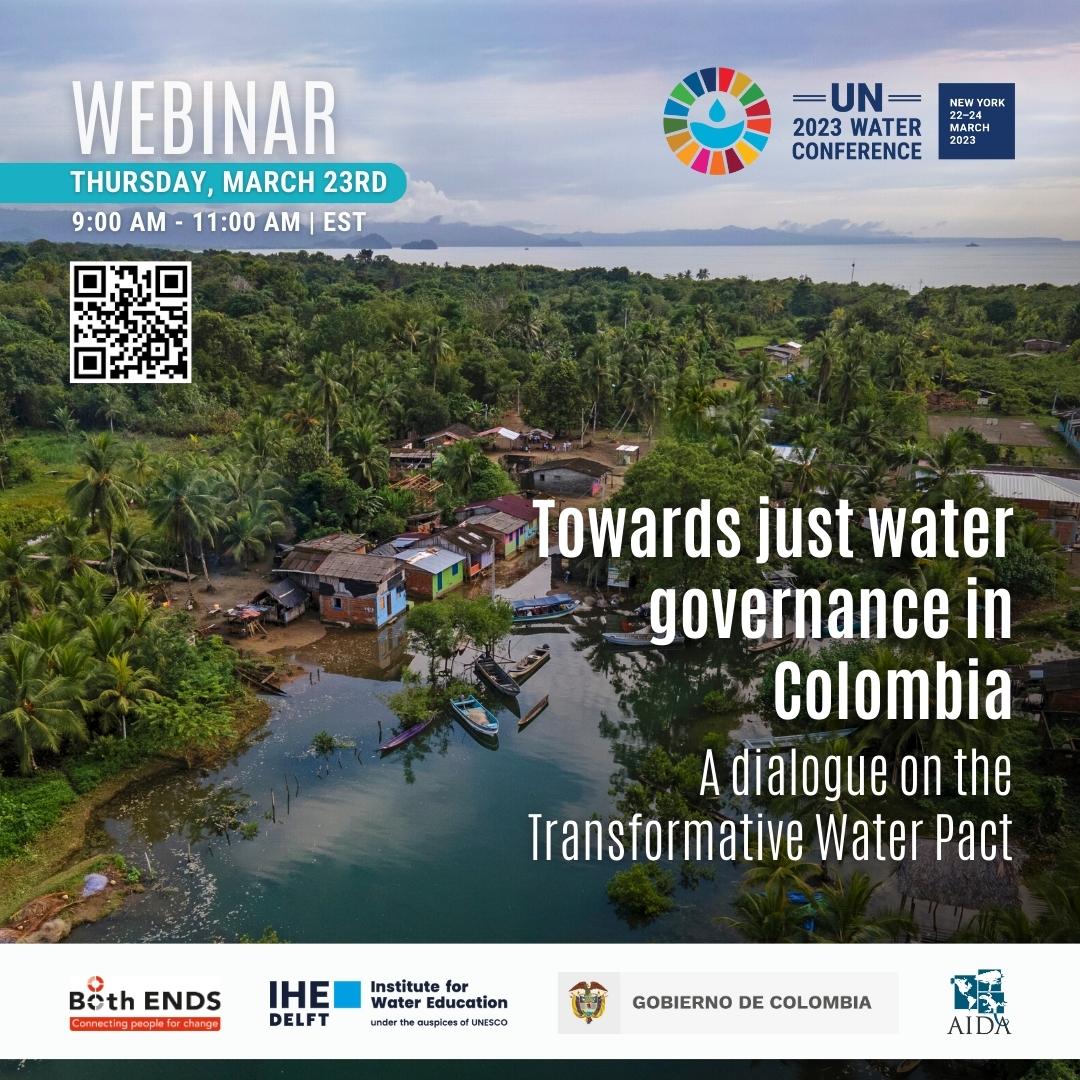
Towards just water governance in Colombia; a dialogue on the Transformative Water Pact
Online side event at the UN Water conference in New York
This event will present The Transformative Water Pact (TWP), an innovative framework for water governance that has been developed by environmental justice experts from around the world. The TWP will serve as a starting point for dialogue between representatives of the government of Colombia, academia, regional and international NGOs in relation to Colombia's current ambitions in multi-scalar water governance.
-
Publication / 21 March 2023
-
 News / 21 March 2023
Agua es vida: Both ENDS and water governance
Water is literally life, the lifeblood of ecosystems, of nature, of humans. However, in many places the distribution and use of water is unjust and unsustainable. Water management is generally focused on short-term economic interests, on maximizing the profit of a well-connected few at the expense of people and nature. This dominant view of water and water management has its origins in the European industrial revolution, which became the global norm through colonialism and globalization. But according to Melvin van der Veen and Murtah Shannon, water experts at Both ENDS, this view will have to give way to equitable, sustainable and inclusive water management. Both ENDS cooperates with and supports communities and organisations worldwide who are working to this end.
-
 Press release / 20 March 2023
A Transformative Water Pact : A radical response to the global water governance crisis
Academics and civil society representatives from around the world came together to articulate an alternative vision and framework for water governance, in the run-up to the UN Water Conference 2023 in New York. The Transformative Water Pact was developed in response to the continued exploitation of nature, neglect of human rights and the extreme power-imbalances that characterize contemporary water governance throughout the world. It details an alternative vision of water governance based on the tenets of environmental justice, equality and care.
-
 Dossier /
Large-scale infrastructure
Large-scale infrastructural projects have detrimental effects on local people and the environment, while their benefits are felt elsewhere. Both ENDS is working to ensure that local people have a greater say in decision-making and is investigating the way these projects are funded.
-
 News / 22 March 2022
World Water Day: just climate solutions already exist
These past weeks we have been joining the #WeWomenAreWater campaign to put the spotlights on just climate solutions of and for women, girls, trans, intersex and non-binary people around the world. The campaign started on International Women's Day (March 8th) and ends today, on World Water Day. Just climate solutions already exist but these initiatives are grossly underfunded, and the people implementing them are also those most impacted by climate change and climate-related water scarcity. Therefore, we would like to highlight, especially today on World Water Day, some of these solutions below. And we also have a special message from the colleagues at Both ENDS working on inclusive water governance.
-
 Event / 23 August 2021, 13:00 - 14:00
World Water Week seminar: the politics of water and the choices we can make
What do we mean when we say the 'politics of water'? How are the distribution of water and the access to water influenced by political-economic interests? And who has the power to reverse the flow and change tides?
-
 News / 19 August 2021
Violet Matiru: “Communities around colonial Ruiru I Dam still struggle”
After many years of advocating for strong environmental policies at international platforms such as the UN, Kenyan Violet Matiru asked herself: "How does all this lobbying trickle down to our communities? How does this help our mothers who are still struggling with fetching water and cooking on wood stoves?" This is when she and her colleagues founded MCDI Kenya (Millennium Community Development Initiatives) and started to work with local communities. We talked to her about the historical and current power imbalance in water governance and her efforts to improve water governance in the Athi River basin, that runs all the way from upstream of Nairobi, through the city, into the Indian Ocean.
-
 News / 13 August 2021
Food sovereignty in the polders of Southwest Bangladesh
The situation in the southwest delta of Bangladesh is critical. Because of sea level rise, floods are increasing and the area is about to become uninhabitable, despite Dutch-style dikes and polders built in the previous century. Partner organisation Uttaran works with local communities on climate-friendly solutions that restore the living environment and give the inhabitants a say about their future and food production.
-
 External link / 19 June 2020
Community-based governance for free-flowing tidal rivers (Annual Report 2019)
Tidal River Management (TRM) is based on age-old community practices. In 2019, Uttaran helped ensure that TRM was seen by policymakers as a solution to waterlogging in the delta of Bangladesh, and that the voices of women and youth were being taken into account.

