




Wealthy Dutch investors to disinvest personal capital worth 200 million euros from the fossil industry
Joint press release from Both ENDS and Fossielvrij NL - 26 March 2019
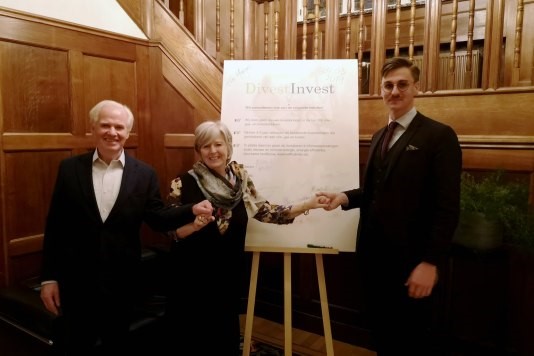
A group of 22 wealthy Dutch investors have decided to disinvest all their personal capital, worth a total of 200 million euros, from the top 200 oil, gas and coal companies. The investors have pledged to disinvest all their capital from the fossil industry within three to five years. By doing so, they are giving a clear signal that they do not want their capital to contribute to disastrous climate change.
By signing the pledge, the Dutch investors are joining the worldwide DivestInvest movement that has already resulted in more than eight billion dollars being disinvested from the fossil industry – almost ten times the entire GNP of the Netherlands. As leaders of the movement in the Netherlands, the pledgers are showing that resolute action is required to ensure that a liveable climate remains within reach. Together they make up the Dutch DivestInvest network that is supported by Both ENDS, Fossielvrij NL and Stichting DOEN.
Why sign up?
Frank van Beuningen, founder of Pymwymic: "It is time that we investors spoke out. We normally say nothing but it is time to step forward. Now. Stop fossil energy. Stop using your capital to finance a climate crisis."
Jan Willem Nieuwenhuys, Director of Fair Capital Partners: "Money changes the world. It has an enormous impact on how companies and people behave. In the past fifteen years, sustainable investment has become the norm. But we're not there yet. We need to take the next step to become 100% sustainable and Divest Invest is part of that step! We have to combine our financial strength to persuade stock exchange investors to change course. To pursue the sustainable development goals (SDGs) and make the world better and ready for the following generations. Money offers us the opportunity to exert influence and make the world better and fairer."
Leonard van Oord: fifth generation of the Van Oord family dredging business. Full-time student and active in various initiatives and organisations including Pymwymic, NEXUS and Yunus Social Business: "We are aware that if we are serious about our concerns for the climate, we have to put our words into deeds. That doesn't apply only to these 22 investors, it is a choice everyone can make. And that is precisely what we hope to inspire with this pledge. That people conduct a dialogue with their financial partners and see how things can be done differently. Because we have to do things differently, in the interests of our shared future."
Margaret McGovern, Irish/Californian entrepreneur and investor, and co-founder of Pywymic: "Investing in fossil energy is the worst kind of short-term thinking. I call it 'disaster capitalism'. The very real costs of the damage caused are not reflected on the balance sheet."
International support
The international DivestInvest movement also supports the Dutch pledgers:
Justin Rockefeller, Chairman, The ImPact; Member of the Investment Committee, Rockefeller Brothers Fund: "I'm thrilled to be joined in the DivestInvest movement by Dutch investors who recognize that what people and institutions do with money has moral consequences, including how we earn, spend, donate, and invest it. By aligning their values and their investments, they're empowering others to follow their moral leadership, and addressing the existential threat posed by climate change."
Mark Sainsbury trustee of the Mark Leonard, JJ Charitable and Linbury Trusts: "While divesting from fossil fuels is relatively easy in practice, speaking out publicly about it takes courage and leadership. These Dutch families are sending a powerful message - it's time for industry, society and the financial markets to move beyond fossil fuels for the benefit of everyone."
Reactions of the initiators
Liset Meddens of Fossielvrij NL: "It is wonderful to see that wealthy Dutch investors are now also turning their backs on the fossil industry. The movement is growing very rapidly. We can only break the power of the fossil multinationals and create political space for effective measures against climate change if we show leadership and make tough and clear choices."
Danielle Hirsch of Both ENDS is delighted that the pledge has been signed by so many people. "The climate movement is multifaceted and has its roots in all parts of society. With this pledge, a group of Dutch investors who do not like to be in the spotlight are sending out a strong signal in the public debate; if we want to stop climate change, everyone will have to take action. It is no longer acceptable that we make economic profit from an industry that is putting our future at risk."
What next?
The pledgers are all addressing their promise in their own ways. The ultimate aim is of course to persuade many more people and organisations to stop investing in the fossil industry. They are doing that by drawing attention to the issue in their own networks of contacts, organisations and partners. Together with the initiators, they will also challenge banks, pension funds and other financial service providers to go green and want to make it possible for everyone to join the movement. People can already put their savings in an account at a green bank, and everyone can sign the worldwide DivestInvest pledge, committing themselves to take their savings out of the fossil industry within three years.
Three overarching reasons
The Dutch investors are making this pledge for three reasons:
- the moral conviction that we should leave all fossil reserves in the ground to avoid a catastrophic climate crisis,
- the financial-economic belief that the fossil industry is a declining market
- the fiduciary obligation to invest responsibly by taking long-term uncertainties seriously in current investment strategies.
About DivestInvest
DivestInvest is a worldwide movement supported in the Netherlands by an informal alliance of people, companies and organisations including Frank van Beuningen (Pymwymic), Stephen Brenninkmeijer (Willow Investments), Sarah Butler-Sloss (Ashden Trust), Mark Sainsbury (Mark Leonard Trust), Fossielvrij NL and Both ENDS, and with financial support from Stichting DOEN.
The worldwide movement includes organisations like the Rockefeller Brothers Fund, a large number of religious institutions, the pension funds of New York and other cites, and a wide range of universities including the London School of Economics. Since the movement was formed in 2012, some eight billion dollars have already been disinvested in the fossil industry.
See here the pledge that the investors have signed.
Read more about this subject
-
 Dossier /
The Climate lawsuit against Shell
Both ENDS is co-plaintiff in the climate lawsuit brought by Milieudefensie (Friends of the Earth The Netherlands) in 2018 against Shell to stop the company from causing harm to the climate. In 2021, the judge ruled in favor of the climate, but unfortunately the company appealed. The court will therefore render its verdict at the end of 2024.
-
 Dossier /
Paris Proof Export Support
Almost two-thirds of the export credit insurances that Atradius DSB provided in the 2012-2018 period went to the fossil energy sector. That is contrary to the climate agreements that the Netherlands signed in Paris.
-
 News / 19 March 2026
Winners of the ILED ‘Women Are Educators Award’ announced
Our partner organisation ILED (Indigenous-led Education Network) announced the seven winners of the ILED ‘Women Are Educators Award’ this month. These are women who play extraordinary roles in passing on knowledge, whether in formal or informal educational settings.
-
 News / 27 February 2026
Both ENDS strengthens the resilience of female environmental defenders worldwide thanks to multi-year contribution from the Postcode Lottery
In recent years, Both ENDS has received an additional contribution of €875,000 from the Postcode Lottery for the Autonomy & Resilience Fund (2022–2025), implemented in collaboration with the Global Alliance for Green and Gender Action (GAGGA). This support was essential because female environmental rights defenders around the world are increasingly facing climate change, repression and shrinking civil space. With this contribution, Both ENDS supports female activists and their communities with flexible, trust-based funding, enabling them to develop their own solutions to urgent environmental and climate problems.
-
 News / 2 February 2026
Response to the D66-VVD-CDA coalition agreement
Coalition: Repair the damage and dare to go further
At Both ENDS, we see a number of cautious steps in the right direction in this coalition agreement. There is a slight emphasis on green issues, renewed attention to women's rights, recognition of the importance of civil society, and discussion of trade agreements with a focus on mutual interests. However, without structural change in how we trade, invest, and cooperate, fine words remain empty shells.
-
 Dossier /
Seeking justice for the affected communities of Vale’s mining disasters in Mariana and Brumadinho
In 2015 and 2019, the Brazilian state of Minas Gerais experienced two severe mining tragedies in Mariana and Brumadinho, due to the same mining company: Vale. Since then, the affected communities have been seeking justice, via the criminal punishment of the responsible parties, and a fair compensation for the loss of their loved ones, their homes and their livelihoods. Both ENDS supports local CSOs by amplifying their quest for justice within an international audience and, more specifically, by raising awareness amongst Dutch investors in Vale about the high risks this company’s activities pose for people and the environment.
-
 News / 2 February 2026
Seven years after Brumadinho: impunity allows Vale’s disasters to continue
Seven years ago, the dam owned by mining company Vale collapsed in Brumadinho, Brazil, killing 272 people and severely polluting the surrounding area. While the relatives of the victims commemorate them and fight for justice, the pollution continues.
-
 News / 22 January 2026
Shell files new arbitration against the Netherlands over Groningen gas field closure
Shell is suing the Netherlands in yet another attempt to evade its responsibility for decades of gas extraction in Groningen. For years, gas production has triggered earthquakes, damaged over a hundred thousand homes, and left residents living in prolonged insecurity, still waiting for repairs, reinforcement, and justice.
-
 Dossier /
Gas in Mozambique
In 2011 one of the world’s largest gas reserves was found in the coastal province of Cabo Delgado, in the north of Mozambique. A total of 35 billion dollars has been invested to extract the gas. Dozens of multinationals and financiers are involved in these rapid developments. It is very difficult for the people living in Cabo Delgado to exert influence on the plans and activities, while they experience the negative consequences. With the arrival of these companies, they are losing their land.
-
 Blog / 11 December 2025
Reflections on working on Dutch finance for Mozambique LNG
Last Tuesday, I received a short text message with big news: the minister had just announced that the financing policy for the Mozambique LNG project was stopped. It was a decision that I – along with so many others – have fought for for years. Only now, more than a week later, it is slowly sinking in that we have really won. The years of perseverance, frustration, discussions and investigations have finally led to this result. It still feels a bit surreal.
-
 Dossier /
Export Credit Agencies: Who pays the price?
Both ENDS calls on the government only to provide export credit insurance to sustainable projects that cause no social and/or environmental damage in the countries where they take place.
-
 News / 27 November 2025
Communities and International Consortium Present Community-Led Plan for Nature-Based Adaptation to Sea-Level Rise in Coastal Bangladesh
Local communities in the southwestern coastal region of Bangladesh—together with an international consortium including Uttaran, CEGIS, and Both ENDS—have presented a community-led plan to confront climate change and accelerating sea-level rise through nature-based adaptation. The People’s Plan for Upscaling Ecosystem-Based Adaptation outlines a scalable strategy rooted in local ownership and generations of lived experience. At its centre is Community-Based Tidal River Management (CBTRM), a proven approach that reduces waterlogging, raises land elevation, and restores ecological balance by working with natural tidal and sediment dynamics.
-
 Blog / 25 November 2025
COP30 shows why dismantling ISDS is essential for real climate action
Standing in Belém during COP30, I felt the weight of the moment. We came to the Amazon hoping for decisive progress on phasing out fossil fuels, yet the final outcome fell far short of the ambition science and justice demand. The agreement brought welcome commitments on adaptation finance and global indicators, but it refused to confront the structural forces that make climate action so difficult.
-
 Dossier /
Wetlands without Borders
With our Wetlands without Borders program, we work towards environmentally sustainable and socially responsible governance of the wetlands system of the La Plata Basin in South America.
-
 Environmentally Just Practice /
Non-Timber Forest Products (NTFPs)
About one in every six people, particularly women, directly rely on forests for their lives and livelihoods, especially for food. This shows how important non-timber forest products (NTFPs) and forests are to ensure community resilience. Not only as a source of food, water and income, but also because of their cultural and spiritual meaning.
-
 News / 5 November 2025
Another ISDS claim hits the Netherlands: Petrogas sues over solidarity contribution and royalty regulations
SOMO and Both ENDS strongly condemn the newly revealed investor-state dispute settlement (ISDS) case filed by Petrogas, an Omani oil and gas company operating two shallow-water gas fields in the Dutch North Sea, against the Netherlands under the Netherlands-Oman bilateral investment treaty (BIT).
-
 News / 5 November 2025
Interview: Both ENDS at COP30 for Climate Justice and Systemic Change
Both ENDS is present at COP30 to advocate for genuine access to climate finance for locally led, gender-just climate solutions and the mechanisms that facilitate this, including those for farmer-led restoration. Furthermore, the organisation participates to ensure the crucial connection between the climate negotiations and the trade and investment frameworks that shape them.
Learn more about the Both ENDS team at COP30 below, and find all the activities and side-events in which Both ENDS will participate.
-
 News / 5 November 2025
Overview of Both ENDS events at COP30 in Belem, Brazil
Both ENDS is present at COP30 to advocate for genuine access to climate finance for locally led, gender-just climate solutions, and for the mechanisms that make these possible, including those supporting farmer-led restoration. The organisation also engages to highlight the crucial connection between climate negotiations and the trade and investment frameworks that shape them.
Below is an overview of the Both ENDS team at COP30 and a detailed look at the activities and side-events in which Both ENDS will participate.
-
 News / 14 October 2025
Communities regreening the Sahel: strengthening resilience from the ground up
How can communities in the Sahel strengthen their food systems in the face of climate change and other shocks? Through the ARFSA Programme, Both ENDS and its partners SPONG (Burkina Faso), CRESA/INRAN (Niger) and IED Afrique (Senegal) are working together to show that locally led landscape restoration works. -
 News / 9 October 2025
Both ENDS launches new strategy: “Connecting people for an environmentally just world”
With great pride, Both ENDS launches today it’s new strategy for the coming 5 years: “Connecting people for an environmentally just world”. This strategy was developed in close collaboration with our partner network, which has always been, and still is, the foundation of our work. Together, we strive for an environmentally just world in which people and ecosystems thrive and all people can live a life of dignity.