


Trade deal fueling resource grab? 120+ groups from Europe and Indonesia sound the alarm
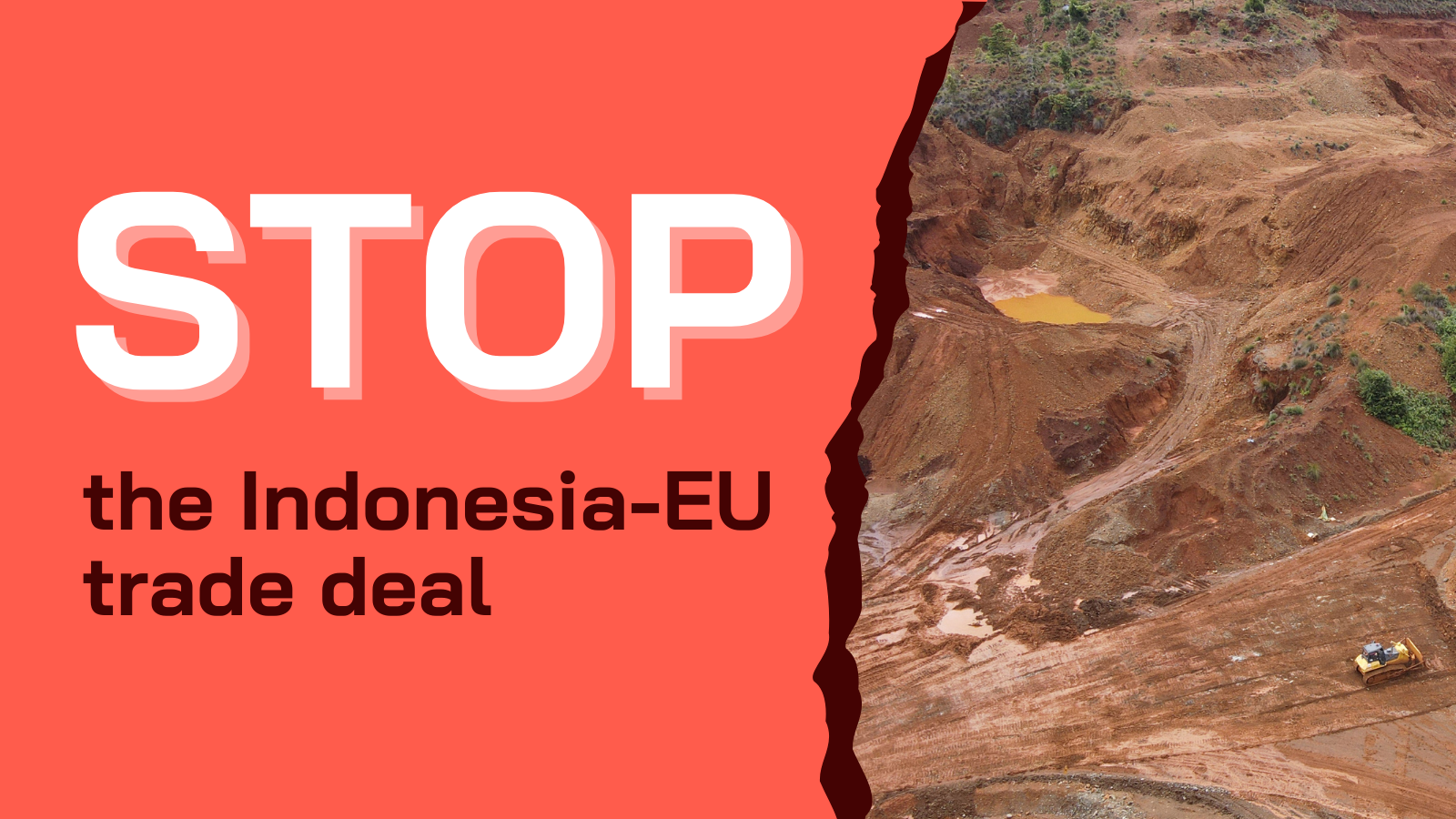
Brussels, 18 February 2025 - Over 120 civil society organizations and trade unions from Indonesia and Europe today call on the Indonesian government and the European Union to stop the negotiations for the Indonesia-EU free trade agreement – the Comprehensive Economic Partnership Agreement (CEPA).
The organizations warn that this agreement threatens the environment, climate, and the rights of women, Indigenous Peoples, workers, small farmers and fisherfolk. A flashpoint is control of globally valuable nickel resources and the ability to ensure these are managed sustainably in a way that benefits local communities in Indonesia.
Indonesia and the European Union have been negotiating the EU-Indonesia trade agreement since 2016. Both sides have signaled that they want to bring the negotiations to a conclusion soon.
Rachmi Hertanti of the Transnational Institute based in Indonesia said:
“The free trade agreement would require the raw materials sector to be fully opened to global markets and foreign corporations. It would limit measures currently in place to encourage processing of raw materials such as nickel in the country, creating jobs and adding value. Indonesia has abundant natural resources, but to support its people’s development we need to limit the over-extraction of raw commodity exports that only benefits transnational corporations.
“The trade agreement risks trapping Indonesia in low-value trade and undermining energy democratisation by liberalising critical mineral policies that remove policy space for the Indonesian government to protect people's livelihoods.”
Fanny Tri Jambore Christanto of WALHI in Indonesia said:
“Indonesia’s development of its natural resources needs to be done in a sustainable and responsible manner - we need to protect the planet, local communities and workers rights. There are far too many bad examples and we are pushing for measures to improve. However this trade agreement risks undermining these efforts, which could have dire consequences for people and nature.”
Marius Troost of Both ENDS in the Netherlands said:
“The EU’s obstinate dash for maximum market liberalisation has actually had the effect of shooting itself in the foot. While the EU has been fighting Indonesia over trade rules, China has invested tens of billions in the nickel mining and refining industry in Indonesia and is now dominant in the sector. Europe needs to build a more equal partnership with Indonesia, for mutual benefit, respecting each other’s needs and paying a fair price.”
Julie Zalcman, trade campaigner at Friends of the Earth Europe said:
“Critical raw materials are necessary for the energy transition but their exploitation should not happen at the expense of human rights, biodiversity and water. The EU must seriously question its demand for raw materials and adopt consumption reduction targets, before rushing to extract ever more resources from a finite planet.”
ENDS.
***
For inquiries, please contact:
- Julie Zalcman, Trade campaigner at Friends of the Earth Europe julie.zalcman@foeeurope.org [EN, FR]; +32 (0) 489 333 517 (press office)
- Rachmi Hertanti, Researcher at Transnational Institute (TNI), Jakarta office
r.hertanti@tni.org [EN, Bahasa] - Marius Troost, Senior Policy Advisor at Both ENDS, The Netherlands. m.troost@bothends.org [EN, NL]
For more information
Read more about this subject
-
 Dossier /
International trade and investment with respect for people and planet
The network of international trade and investment treaties is large and complex. The Netherlands alone has signed more than 70 bilateral investment treaties (BITs) and is party to the trade and investment agreements concluded by the EU, like the EU-Mercosur and EU-Indonesia trade deals.
-
 Dossier /
Trade agreements
International trade agreements often have far-reaching consequences not only for the economy of a country, but also for people and the environment. It is primarily the most vulnerable groups who suffer most from these agreements.
-
 Dossier /
Rights for People, Rules for Corporations – Stop ISDS!
Indigenous communities in Paraguay saw their attempts to regain their ancestral lands thwarted by German investors. In Indonesia, US-based mining companies succeeded to roll back new laws that were meant to boost the country’s economic development and protect its forests. This is the level of impact that investment treaties can have on social, environmental and economic development and rights. Why? Because of the ‘Investor-to-State Dispute Settlement’ clauses that are included in many such treaties.
-
 News / 15 oktober 2026
ISDS infringement complaint filed with the European Commission
The Netherlands and Portugal join four other EU countries facing such a complaint.
-
 Press release / 15 oktober 2026
Dutch and Portuguese organisations file EU complaint over investment treaties that let companies and sanctioned Russian oligarchs sue EU countries for compensation
The Netherlands and Portugal join four other EU countries facing such a complaint, as the Global Days of Action against Investor-State Dispute Settlement (ISDS) begin.
-
 Dossier /
Global Alliance for Green and Gender Action (GAGGA)
GAGGA rallies the collective power of the women's rights and environmental justice movements to realize a world where women can and do access their rights to water, food security, and a clean, healthy and safe environment.
-
 News / 29 september 2026
Summary - Both ENDS complaint under the EU-New Zealand trade agreement
On 29 September 2026, Both ENDS lodged the first complaint on climate grounds with the European Commission's Single Entry Point. It asks the Commission to examine whether Aotearoa New Zealand has broken two promises both sides made in the EU-New Zealand Free Trade Agreement: not to weaken or set aside environmental laws in order to encourage trade or investment, and to effectively implement the Paris Agreement.
-
Publication / 29 september 2026
-
 News / 29 september 2026
Q&A: New Zealand's climate rollback and the EU trade agreement
On 29 September 2026 / 30 September in Aotearoa New Zealand, Both ENDS lodged a complaint with the European Commission under the EU-New Zealand Free Trade Agreement. These are the questions we are asked most often, and our answers. The complaint summary, the case explainer and the key public sources are linked at the end of this page.
-
 Press release / 29 september 2026
New Zealand faces its first climate complaint under EU trade rules
UTRECHT / WELLINGTON, 29 September 2026 /30 September in Aotearoa New Zealand
Both ENDS, a Dutch environmental justice organisation, has lodged a formal complaint with the European Commission arguing that New Zealand has broken the climate promises it made in its free trade agreement with the European Union. It is the first complaint on environmental and climate grounds under the Commission's Single Entry Point, the mechanism that lets civil society ask the EU to enforce the sustainability commitments in its trade agreements.
-
 Dossier /
Communities Regreen the Sahel
In various countries in the Sahel, vast tracts of land have been restored by the local population by nurturing what spontaneously springs from the soil and protecting the sprouts from cattle and hazards.
-
Publication / 3 juli 2026
-
Publication / 18 juni 2026
-
Publication / 12 mei 2026
-
Publication / 14 april 2026
-
 Press release / 2 december 2025
End of Dutch involvement in controversial gas project in Mozambique in sight after TotalEnergies withdraws from Dutch insurance
THE HAGUE/CABO DELGADO, December 1, 2025 - Today, Minister of Finance Eelco Heinen announced that TotalEnergies is withdrawing from a $640 million Dutch export credit insurance policy for a controversial gas project in Mozambique. Although the Dutch government has been avoiding this decision for years, this move has finally ended part of the Dutch involvement in this disastrous project.
-
 Environmentally Just Practice /
A Negotiated Approach for Inclusive Water Governance
A Negotiated Approach envisages the meaningful and long-term participation of communities in all aspects of managing the water and other natural resources on which their lives depend. It seeks to achieve healthy ecosystems and equitable sharing of benefits among all stakeholders within a river basin. This inclusive way of working is an essential precondition for the Transformative Practices that are promoted by Both ENDS and partners.
-
 News / 5 november 2025
Another ISDS claim hits the Netherlands: Petrogas sues over solidarity contribution and royalty regulations
SOMO and Both ENDS strongly condemn the newly revealed investor-state dispute settlement (ISDS) case filed by Petrogas, an Omani oil and gas company operating two shallow-water gas fields in the Dutch North Sea, against the Netherlands under the Netherlands-Oman bilateral investment treaty (BIT).
-
Publication / 16 oktober 2025
-
Publication / 16 oktober 2025




