


Civil society calls upon EU and Indonesia to respect the rights of Indonesia’s farmers
89 NGOs and farmers' organisations from Indonesia, the EU and around the world sent open letters to the EU Commission and the Indonesian government today, calling on them to refrain from any clause that restrict farmers' rights in a future free trade agreement.
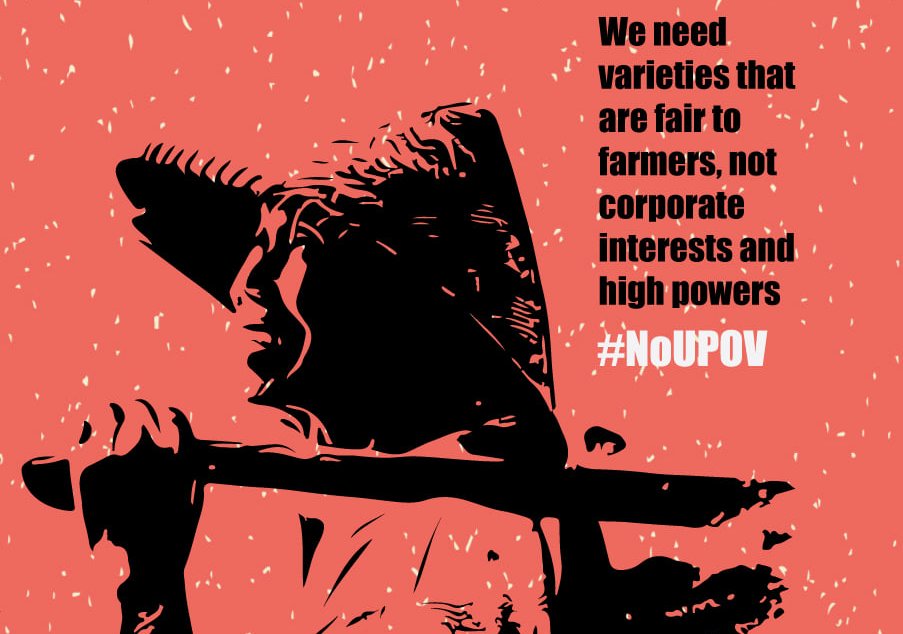
It is common practice for the EU to demand in trade agreement negotiations that the trading partner introduce a plant variety protection right* in accordance with UPOV 91**. This is also the case in the ongoing negotiations for a Free Trade Agreement between the EU and Indonesia. But UPOV 91 deprives farmers of the right to exchange and sell protected seeds or propagating material. Even saving seeds and replanting on their own fields is prohibited for most plant species and restricted for others. Therefore, UPOV 91 not only jeopardizes the right to food and food sovereignty, but is also a threat to agrobiodiversity.
UPOV 91 offers an inappropriate legal framework for Indonesia, where agriculture is of crucial importance for the economy and 93% of farmers have a small family farm with an average land holding of 0.6 hectares. UPOV 91 has been developed by industrialised countries for their agricultural system. Therefore multiple independent experts recommend that developing countries should not join or implement UPOV 91.
Attempting to impose a law on Indonesia that was drafted without its participation runs counter to the country's interests. Indonesia has the right and the duty to develop laws and policies related to seeds that best suit its agricultural system and the needs of its people. It is disturbing to see how the EU is jeopardising Indonesia's ability to develop tailor-made plant variety protection rights, that find a better balance between farmers' rights and the holders of plant variety protection rights.
Therefore, almost 90 organizations have signed the letters to call on the European Union to withdraw the demand for a UPOV 91-compliant plant variety protection law and to refrain from any request concerning plant variety protection rights in the free trade agreement with Indonesia. We also call on the government of Indonesia to stand up for the rights of their farmers and to resist the ask by the EU to comply with the rules of UPOV 91. This would be an important step towards more justice, the implementation of the United Nations Declaration on the Rights of Farmers and Other People Working in Rural Areas" (UNDROP) and an important contribution to the achievement of the United Nations Sustainable Development Goals (SDGs).
*A plant variety protection (PVP) right is a form of intellectual property on plant varieties.
** The International Union for the Protection of New Varieties of Plants (UPOV) is an intergovernmental organization that actively promotes strong intellectual property rights on plant varieties. The 1991 Act of the UPOV Convention was negotiated by 19 industrialised countries and South Africa and took effect in 1998. Other forms of PVP rights find a better balance between farmers' rights and the holders of PVP rights.
More information:
The press release that was sent out by APBREBES as pdf
The letter to the European Comission
The letter to the Indonesian government
and see other related content below
For more information
Read more about this subject
-
 Dossier /
Trade agreements
International trade agreements often have far-reaching consequences not only for the economy of a country, but also for people and the environment. It is primarily the most vulnerable groups who suffer most from these agreements.
-
 Dossier /
International trade and investment with respect for people and planet
The network of international trade and investment treaties is large and complex. The Netherlands alone has signed more than 70 bilateral investment treaties (BITs) and is party to the trade and investment agreements concluded by the EU, like the EU-Mercosur and EU-Indonesia trade deals.
-
 Dossier /
Rights for People, Rules for Corporations – Stop ISDS!
Indigenous communities in Paraguay saw their attempts to regain their ancestral lands thwarted by German investors. In Indonesia, US-based mining companies succeeded to roll back new laws that were meant to boost the country’s economic development and protect its forests. This is the level of impact that investment treaties can have on social, environmental and economic development and rights. Why? Because of the ‘Investor-to-State Dispute Settlement’ clauses that are included in many such treaties.
-
 News / 15 October 2026
ISDS infringement complaint filed with the European Commission
The Netherlands and Portugal join four other EU countries facing such a complaint.
-
 Press release / 15 October 2026
Dutch and Portuguese organisations file EU complaint over investment treaties that let companies and sanctioned Russian oligarchs sue EU countries for compensation
The Netherlands and Portugal join four other EU countries facing such a complaint, as the Global Days of Action against Investor-State Dispute Settlement (ISDS) begin.
-
 Dossier /
Global Alliance for Green and Gender Action (GAGGA)
GAGGA rallies the collective power of the women's rights and environmental justice movements to realize a world where women can and do access their rights to water, food security, and a clean, healthy and safe environment.
-
 News / 5 October 2026
Rural Women's Assembly wins Right Livelihood Award
We are thrilled to share that our partner the Rural Women's Assembly (RWA) is one of this year's Right Livelihood Laureates! The award, often called the "Alternative Nobel Prize", honours RWA for bringing together more than 178,000 women farmers in eleven Southern African countries. Together, these women stand up for their land, their seeds and their right to make decisions about their own lives and bodies.
-
 News / 29 September 2026
Summary - Both ENDS complaint under the EU-New Zealand trade agreement
On 29 September 2026, Both ENDS lodged the first complaint on climate grounds with the European Commission's Single Entry Point. It asks the Commission to examine whether Aotearoa New Zealand has broken two promises both sides made in the EU-New Zealand Free Trade Agreement: not to weaken or set aside environmental laws in order to encourage trade or investment, and to effectively implement the Paris Agreement.
-
Publication / 29 September 2026
-
 News / 29 September 2026
Q&A: New Zealand's climate rollback and the EU trade agreement
On 29 September 2026 / 30 September in Aotearoa New Zealand, Both ENDS lodged a complaint with the European Commission under the EU-New Zealand Free Trade Agreement. These are the questions we are asked most often, and our answers. The complaint summary, the case explainer and the key public sources are linked at the end of this page.
-
 Press release / 29 September 2026
New Zealand faces its first climate complaint under EU trade rules
UTRECHT / WELLINGTON, 29 September 2026 /30 September in Aotearoa New Zealand
Both ENDS, a Dutch environmental justice organisation, has lodged a formal complaint with the European Commission arguing that New Zealand has broken the climate promises it made in its free trade agreement with the European Union. It is the first complaint on environmental and climate grounds under the Commission's Single Entry Point, the mechanism that lets civil society ask the EU to enforce the sustainability commitments in its trade agreements.
-
Publication / 3 July 2026
-
Publication / 18 June 2026
-
Publication / 12 May 2026
-
 News / 14 April 2026
New report: Phasing out ISDS in the Netherlands: a roadmap
Today, Both ENDS and SOMO are publishing the report Phasing out ISDS in the Netherlands: a roadmap. In the report, we highlight the Netherlands’ role in the ISDS system and offer practical guidance on phasing out ISDS.
-
Publication / 14 April 2026
-
 News / 26 March 2026
New project: Climate Accountability in EU Trade
Through its new project “Climate Accountability in EU Trade: Testing the SEP and DAGs for Climate-Linked FTA Enforcement” Both ENDS, with support from the European Climate Foundation, is exploring how the European complaints mechanism (SEP) and Domestic Advisory Groups (DAGs) can be more effectively used to advance climate accountability. The project runs for 13 months, until end of 2026.
-
 News / 22 January 2026
Shell files new arbitration against the Netherlands over Groningen gas field closure
Shell is suing the Netherlands in yet another attempt to evade its responsibility for decades of gas extraction in Groningen. For years, gas production has triggered earthquakes, damaged over a hundred thousand homes, and left residents living in prolonged insecurity, still waiting for repairs, reinforcement, and justice.
-
 Environmentally Just Practice /
A Negotiated Approach for Inclusive Water Governance
A Negotiated Approach envisages the meaningful and long-term participation of communities in all aspects of managing the water and other natural resources on which their lives depend. It seeks to achieve healthy ecosystems and equitable sharing of benefits among all stakeholders within a river basin. This inclusive way of working is an essential precondition for the Transformative Practices that are promoted by Both ENDS and partners.
-
 Blog / 25 November 2025
COP30 shows why dismantling ISDS is essential for real climate action
Standing in Belém during COP30, I felt the weight of the moment. We came to the Amazon hoping for decisive progress on phasing out fossil fuels, yet the final outcome fell far short of the ambition science and justice demand. The agreement brought welcome commitments on adaptation finance and global indicators, but it refused to confront the structural forces that make climate action so difficult.




