




Two generations fighting against climate change in Ghana: meet our partners Richard and Kenneth
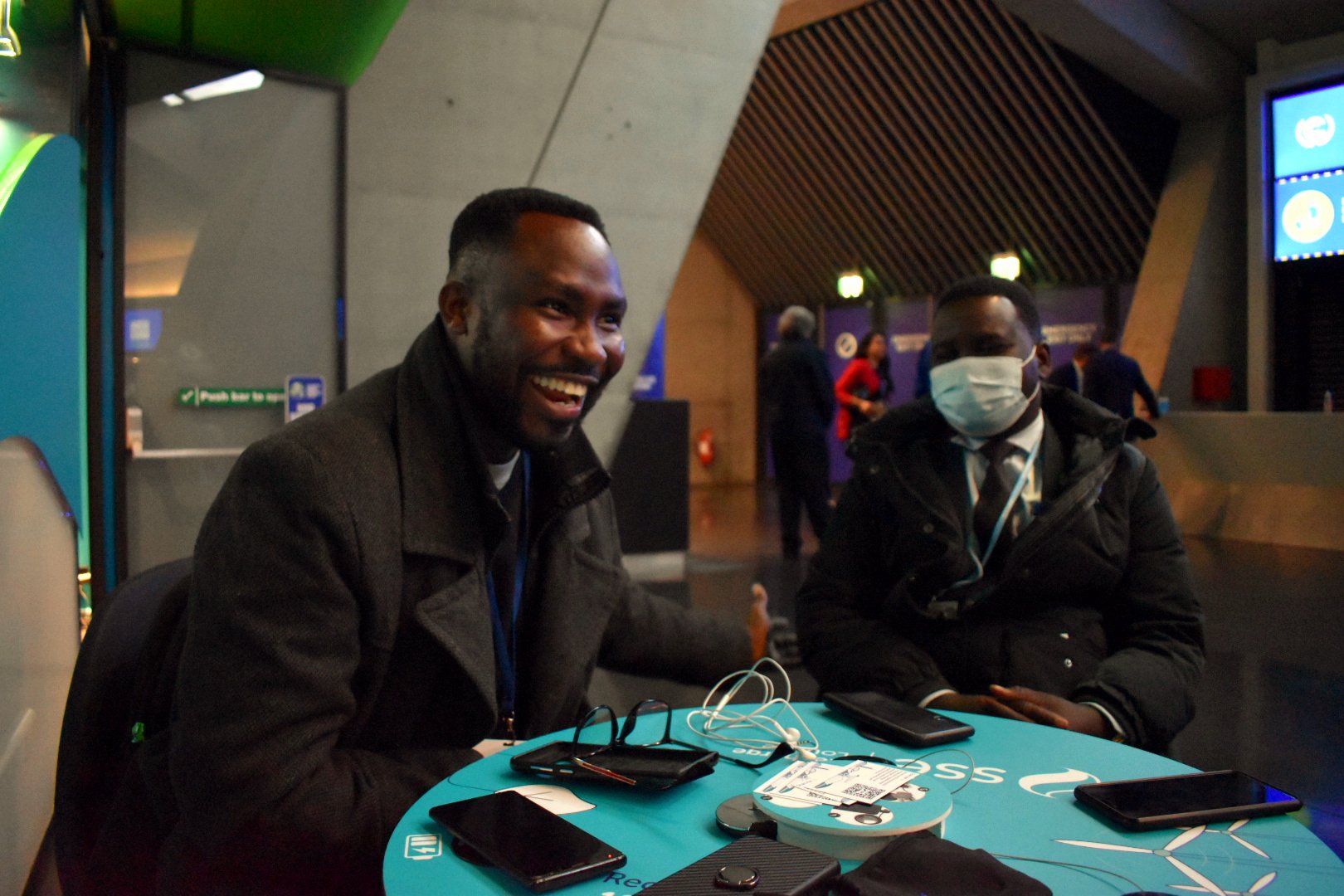
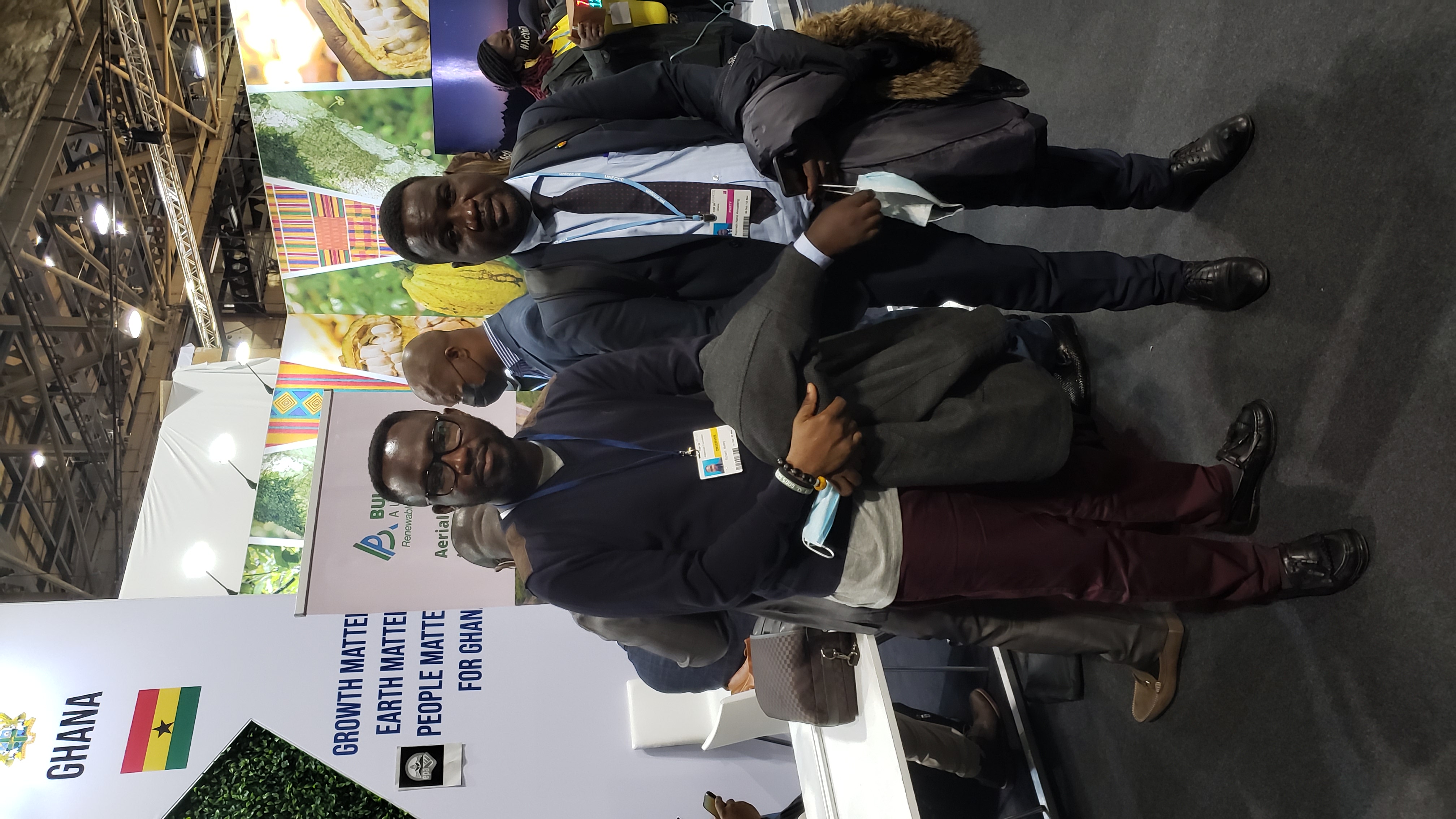
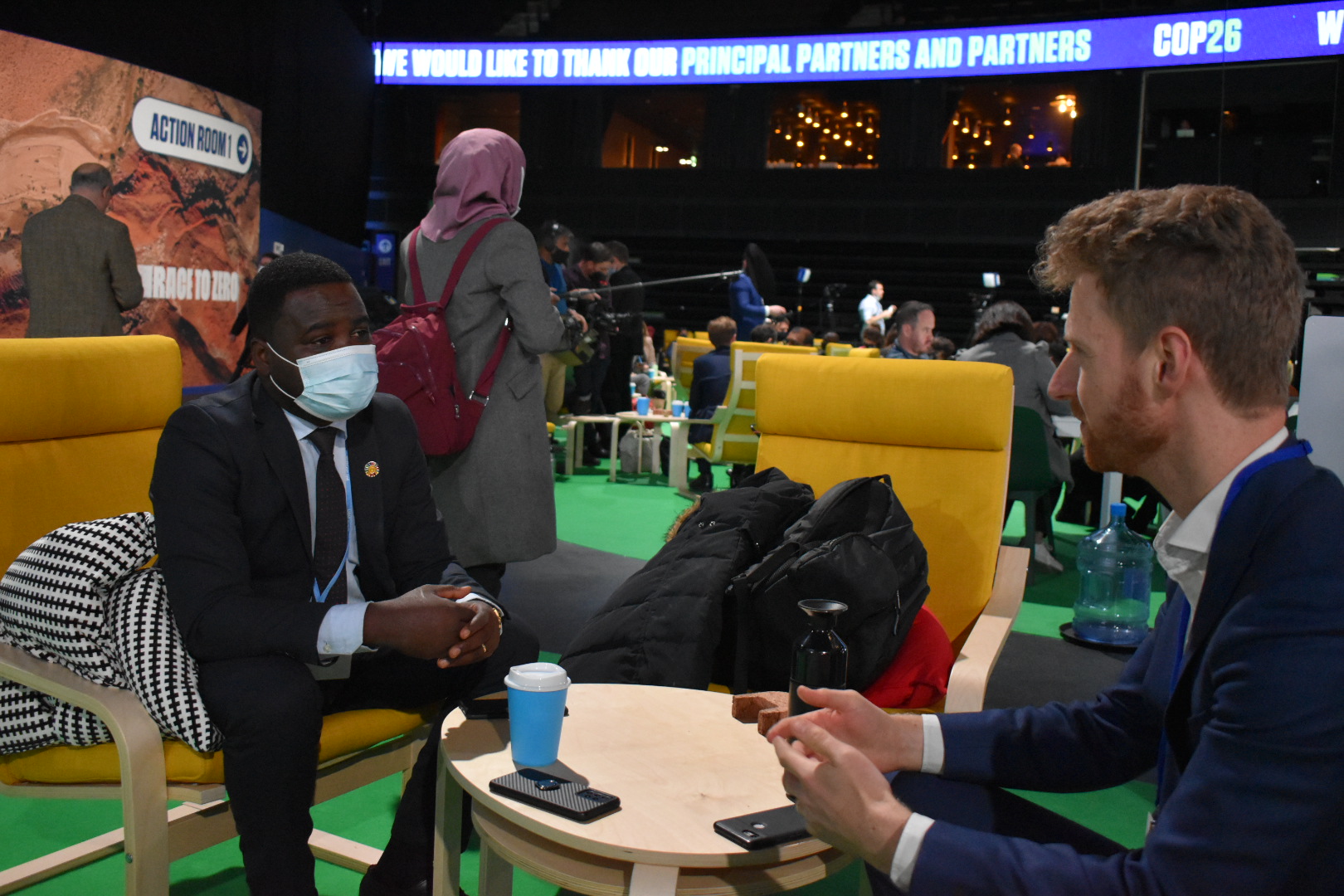
In Ghana, the effects of climate change are already tangible, just like in many countries around the world. How to ensure that these different experiences are heard and known by the Ghanaian government so that it will take actions that have a positive effect on people and their environment? And how to make local communities aware that they can hold the government accountable - and even have the responsibility to do so? During COP26 in Glasgow we spoke with Kenneth Nana Amoateng (47) and Richard Matey (30). Kenneth works at the AbibiNsroma Foundation, a local NGO, and took it as his mission to advocate for a healthy environment, climate change, and to give young people opportunities. Richard is part of that younger generation and works at the Alliance for Empowering Rural Communities in Ghana.
What are the climate change impacts in Ghana?
Richard: Climate change is impacting us in Ghana really fast. We now have migrations from North to South in Ghana and while they say this is because of economic reasons, the real reason is climate change. I will give you a personal example, I was at the family house in my mother's hometown by the sea in 2007. When I went back in 2013 the whole house was in the ocean. This means a lot to us and to me. Because I am only 30 and if am already experiencing this at a fast rate like this, imagine when I am 40.
Kenneth: The sea has washed away some of the coastal area, which means that also the livelihoods of many people have disappeared. To counter this, the government is now spending a lot of money on coastal defense. What we actually need in Ghana is an energy transition, but the challenge lies in making the government see this transition as something they can also benefit from.
Could you give an example of the impact of renewable energy in Ghana?
Richard: In rural areas, for example, having access to light is a very real and practical way to reduce teen pregnancies. The birth rate in those area's is very high. You find very young girls of 11/12 years old having children. Because what happens when people are home and there is no light? Imagine having solar energy in such rural areas!
Kenneth: Solar energy is a need, especially for women. Communities that have electricity have less teenage pregnancies. Instead of directly going home after having worked on the farm, electricity makes it possible for people to have some form of entertainment. However, when it comes to the energy transition and cleaner and renewable energy, it is a difficult subject because a lot of people in the community will lose their jobs. So we need to find a way to fill this gap. Fortunately, Ghana has everything within our hands needed for an energy transition and windmills: gold, diamond, copper, iron. We have good land for agriculture and a lot of sun of course for solar power and wind.
Is it dangerous to lobby for a energy transition?
Kenneth: I need to be careful in our lobby and advocacy when speaking about oil. Because the government uses oil to pay for education for example. So if you are trying to convince the government not the use the oil, you are seen as the enemy of the state and this can be dangerous. This makes having organisations such as Both ENDS out there important, you feel more protected to talk about your issue. Because if something happens, you have someone who is able to point at human rights and go public with it. We have Both ENDS to talk and back us, if not we can risk our life. I have a family with 5 children, so I need to be careful.
How do you make the politicians listen to you?
Kenneth: Unfortunately, more than having the community safe, the main drives of politicians are money and votes. So you need to make the issues known to them. What we try to do, for example, is link the Members of Parliament (MP) with the communities they are from. If it's affecting their families, we make those families speak out. Governments may want raw data, but sometimes you need to speak to the heart ánd the mind. In this way we try to explain to them that before signing anything they should also look at the input of the community, especially of young people.
Richard: I am very grateful to have come under Kenneth's leadership and mentorship. He has given me a lot of exposure by providing the platform to speak and represent young people. Platforms provide opportunities to meet decision and law makers, but you rarely see young people. Even when decisions are being made about young people, you do not see young people. But with the help of Kenneth I was able to, for example, lobby for a youth component in the 'national climate change learning and green economy strategy.'
Why are you Kenneth so dedicated to making young people heard?
Kenneth: One of my missions is to influence and inspire young people and to give them opportunities. Because we ourselves did not have those opportunities. Old people want to go their way and after they leave they die, without putting that knowledge into us. I said 'no, my generation needs to be willing to transform, change the dynamic'. When I see people that have passion, it inspires me to give them the opportunity and train them, and this I have been doing for years.
Richard: Some of the young people from Ghana who are doing very well at the national front, were mentored by him. Kenneth's influence in Civil Society space in Ghana is very huge and very enormous. When you come to Ghana, everybody knows him, also in the government.
Kenneth: I have been to eleven COP's. When I was only young guy, I started a 'Ghana youth Climate Change coalition' and that changed into an Africa's youth coalition of climate change. Our thought was that Africa needed to change. Africa needed to have a new face, for this we need to raise people and have young people pushing this.
Richard, can you give an example of how you have been pushing this?
Richard: Well, in 2018 Kenneth and I got in touch with Both ENDS, because we wanted to know more about the Export Credit Agencies (ECAs). And since 2019 we have been working closely together, conducting research into ECA support for the energy sector in Africa. Also, we have been lobbying in Africa and beyond to stop the support for fossil fuels and large hydro dams. We especially focus on the impact on local communities. This collaboration with Both ENDS has resulted in the publication "A Just Energy Transition for Africa - Mapping the impacts of ECAs active in the energy sector in Ghana, Nigeria, Togo and Uganda". When I got involved in this research I found out how communities in the specific case I investigated, were promised jobs, scholarships and a lot of goodies, but were not well-informed about the downsides to such fossil fuel projects. Such as contribution to climate change, human rights abuses and environmental destruction.heard. We hope to continue our work on this and other subjects with Both ENDS , strengthen local communities and advocate for energy transition in Ghana.
Read more about this subject
-
 Dossier /
Paris Proof Export Support
Almost two-thirds of the export credit insurances that Atradius DSB provided in the 2012-2018 period went to the fossil energy sector. That is contrary to the climate agreements that the Netherlands signed in Paris.
-
 Dossier /
Export Credit Agencies: Who pays the price?
Both ENDS calls on the government only to provide export credit insurance to sustainable projects that cause no social and/or environmental damage in the countries where they take place.
-
 Dossier /
Global Alliance for Green and Gender Action (GAGGA)
GAGGA rallies the collective power of the women's rights and environmental justice movements to realize a world where women can and do access their rights to water, food security, and a clean, healthy and safe environment.
-
 News / 27 February 2026
Both ENDS strengthens the resilience of female environmental defenders worldwide thanks to multi-year contribution from the Postcode Lottery
In recent years, Both ENDS has received an additional contribution of €875,000 from the Postcode Lottery for the Autonomy & Resilience Fund (2022–2025), implemented in collaboration with the Global Alliance for Green and Gender Action (GAGGA). This support was essential because female environmental rights defenders around the world are increasingly facing climate change, repression and shrinking civil space. With this contribution, Both ENDS supports female activists and their communities with flexible, trust-based funding, enabling them to develop their own solutions to urgent environmental and climate problems.
-
 News / 2 February 2026
Response to the D66-VVD-CDA coalition agreement
Coalition: Repair the damage and dare to go further
At Both ENDS, we see a number of cautious steps in the right direction in this coalition agreement. There is a slight emphasis on green issues, renewed attention to women's rights, recognition of the importance of civil society, and discussion of trade agreements with a focus on mutual interests. However, without structural change in how we trade, invest, and cooperate, fine words remain empty shells.
-
 News / 22 January 2026
Shell files new arbitration against the Netherlands over Groningen gas field closure
Shell is suing the Netherlands in yet another attempt to evade its responsibility for decades of gas extraction in Groningen. For years, gas production has triggered earthquakes, damaged over a hundred thousand homes, and left residents living in prolonged insecurity, still waiting for repairs, reinforcement, and justice.
-
 Dossier /
Gas in Mozambique
In 2011 one of the world’s largest gas reserves was found in the coastal province of Cabo Delgado, in the north of Mozambique. A total of 35 billion dollars has been invested to extract the gas. Dozens of multinationals and financiers are involved in these rapid developments. It is very difficult for the people living in Cabo Delgado to exert influence on the plans and activities, while they experience the negative consequences. With the arrival of these companies, they are losing their land.
-
 Blog / 11 December 2025
Reflections on working on Dutch finance for Mozambique LNG
Last Tuesday, I received a short text message with big news: the minister had just announced that the financing policy for the Mozambique LNG project was stopped. It was a decision that I – along with so many others – have fought for for years. Only now, more than a week later, it is slowly sinking in that we have really won. The years of perseverance, frustration, discussions and investigations have finally led to this result. It still feels a bit surreal.
-
 Press release / 2 December 2025
End of Dutch involvement in controversial gas project in Mozambique in sight after TotalEnergies withdraws from Dutch insurance
THE HAGUE/CABO DELGADO, December 1, 2025 - Today, Minister of Finance Eelco Heinen announced that TotalEnergies is withdrawing from a $640 million Dutch export credit insurance policy for a controversial gas project in Mozambique. Although the Dutch government has been avoiding this decision for years, this move has finally ended part of the Dutch involvement in this disastrous project.
-
 News / 27 November 2025
Communities and International Consortium Present Community-Led Plan for Nature-Based Adaptation to Sea-Level Rise in Coastal Bangladesh
Local communities in the southwestern coastal region of Bangladesh—together with an international consortium including Uttaran, CEGIS, and Both ENDS—have presented a community-led plan to confront climate change and accelerating sea-level rise through nature-based adaptation. The People’s Plan for Upscaling Ecosystem-Based Adaptation outlines a scalable strategy rooted in local ownership and generations of lived experience. At its centre is Community-Based Tidal River Management (CBTRM), a proven approach that reduces waterlogging, raises land elevation, and restores ecological balance by working with natural tidal and sediment dynamics.
-
 Blog / 25 November 2025
COP30 shows why dismantling ISDS is essential for real climate action
Standing in Belém during COP30, I felt the weight of the moment. We came to the Amazon hoping for decisive progress on phasing out fossil fuels, yet the final outcome fell far short of the ambition science and justice demand. The agreement brought welcome commitments on adaptation finance and global indicators, but it refused to confront the structural forces that make climate action so difficult.
-
 Dossier /
Wetlands without Borders
With our Wetlands without Borders program, we work towards environmentally sustainable and socially responsible governance of the wetlands system of the La Plata Basin in South America.
-
 Environmentally Just Practice /
Non-Timber Forest Products (NTFPs)
About one in every six people, particularly women, directly rely on forests for their lives and livelihoods, especially for food. This shows how important non-timber forest products (NTFPs) and forests are to ensure community resilience. Not only as a source of food, water and income, but also because of their cultural and spiritual meaning.
-
 News / 5 November 2025
Another ISDS claim hits the Netherlands: Petrogas sues over solidarity contribution and royalty regulations
SOMO and Both ENDS strongly condemn the newly revealed investor-state dispute settlement (ISDS) case filed by Petrogas, an Omani oil and gas company operating two shallow-water gas fields in the Dutch North Sea, against the Netherlands under the Netherlands-Oman bilateral investment treaty (BIT).
-
 News / 5 November 2025
Interview: Both ENDS at COP30 for Climate Justice and Systemic Change
Both ENDS is present at COP30 to advocate for genuine access to climate finance for locally led, gender-just climate solutions and the mechanisms that facilitate this, including those for farmer-led restoration. Furthermore, the organisation participates to ensure the crucial connection between the climate negotiations and the trade and investment frameworks that shape them.
Learn more about the Both ENDS team at COP30 below, and find all the activities and side-events in which Both ENDS will participate.
-
 News / 5 November 2025
Overview of Both ENDS events at COP30 in Belem, Brazil
Both ENDS is present at COP30 to advocate for genuine access to climate finance for locally led, gender-just climate solutions, and for the mechanisms that make these possible, including those supporting farmer-led restoration. The organisation also engages to highlight the crucial connection between climate negotiations and the trade and investment frameworks that shape them.
Below is an overview of the Both ENDS team at COP30 and a detailed look at the activities and side-events in which Both ENDS will participate.
-
 News / 14 October 2025
Communities regreening the Sahel: strengthening resilience from the ground up
How can communities in the Sahel strengthen their food systems in the face of climate change and other shocks? Through the ARFSA Programme, Both ENDS and its partners SPONG (Burkina Faso), CRESA/INRAN (Niger) and IED Afrique (Senegal) are working together to show that locally led landscape restoration works. -
 News / 9 October 2025
Both ENDS launches new strategy: “Connecting people for an environmentally just world”
With great pride, Both ENDS launches today it’s new strategy for the coming 5 years: “Connecting people for an environmentally just world”. This strategy was developed in close collaboration with our partner network, which has always been, and still is, the foundation of our work. Together, we strive for an environmentally just world in which people and ecosystems thrive and all people can live a life of dignity.
-
Publication / 9 October 2025
-
 Dossier /
International trade and investment with respect for people and planet
The network of international trade and investment treaties is large and complex. The Netherlands alone has signed more than 70 bilateral investment treaties (BITs) and is party to the trade and investment agreements concluded by the EU, like the EU-Mercosur and EU-Indonesia trade deals.

