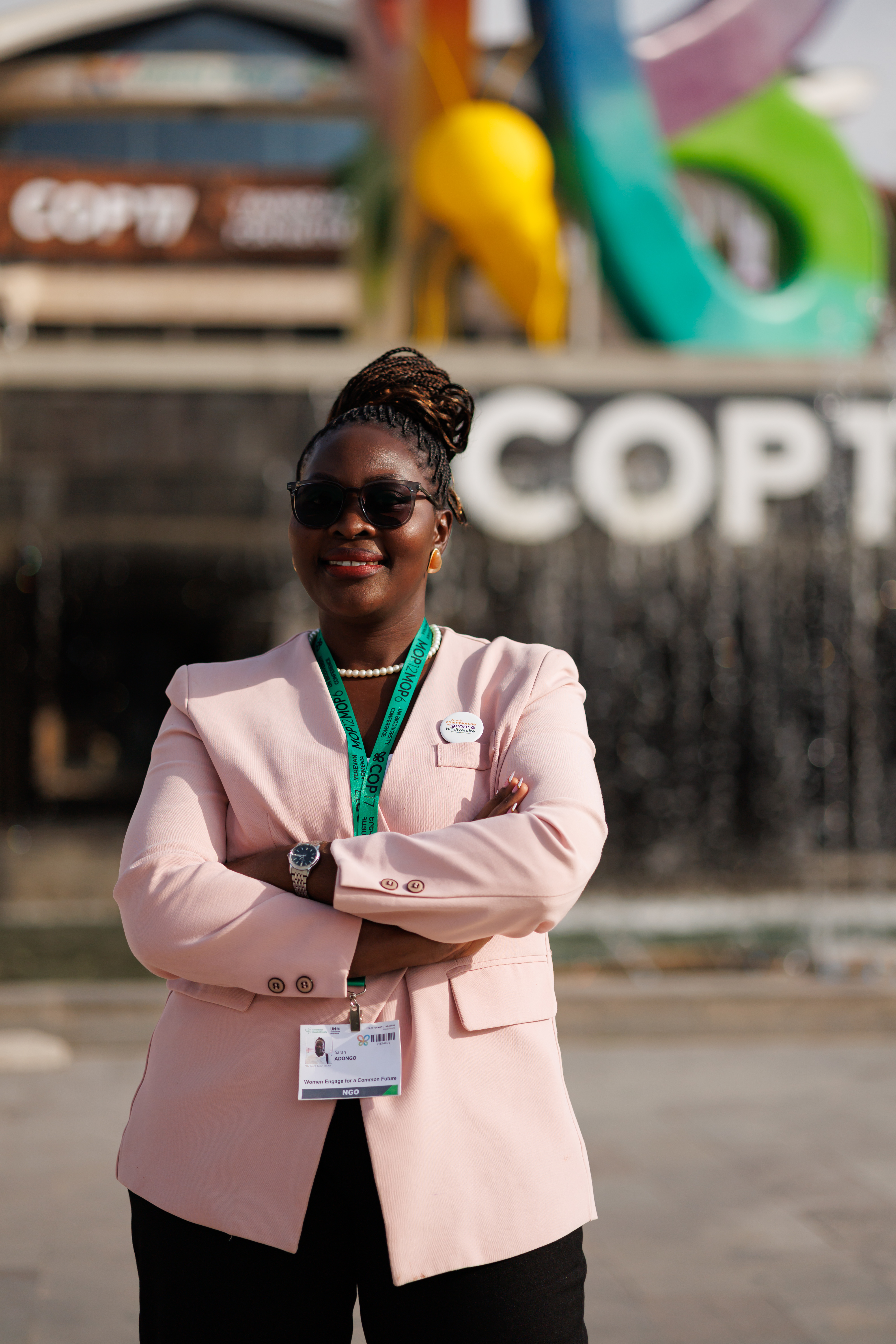
Meet Sarah Adongo: “The soil remembers those who cry and defend it”
By Sarah Adongo, Lawyer, Witness Radio, Uganda
Sarah Adongo is one of the three winners of the 2026 Irene Dankelman Young Ecofeminist Award, presented on 21 October at the UN Biodiversity Conference (CBD COP17) in Yerevan, Armenia. A lawyer working with Witness Radio Uganda, Sarah works with women affected by gender-based violence and communities affected by land dispossession and large-scale investments. In this piece, she shares what the award means to her and why gender and environmental justice must go hand in hand.
What does it mean to you to receive an award named after Irene Dankelman?
Receiving the Irene Dankelman Young Ecofeminist Award is both a profound honour and a responsibility. For me, it is a recognition of the women and communities whose struggles have shaped my work, often far from the national and international platforms where environmental decisions are made. It is also a reminder that gender equality, environmental protection and social justice cannot be pursued in isolation.
How are you contributing to gender and climate justice as an ecofeminist?
As a Ugandan lawyer working with Witness Radio Uganda, I have come to understand that land is much more than a physical resource. It is a source of food, livelihood, security, dignity and identity. Women are often closely involved in activities that depend on nature and may rely on land for their livelihoods, yet they remain excluded from decisions about land and the environment that determine their futures. This is where my work and my understanding of ecofeminism meet.
As a pioneer of the Legal Aid Clinic at Witness Radio Uganda, I have supported communities through advocacy, legal representation and documentation of human rights violations. I have supported women and communities affected by land dispossession and large-scale investments in Buvuma, Kiryandongo and Mubende. In this work, I have witnessed how land loss can intersect with gender-based violence, insecure livelihoods, and exclusion from compensation and decision-making because of underlying power inequalities. These experiences have strengthened my conviction that environmental justice cannot be achieved while women’s rights, voices and agency remain overlooked.
My work therefore goes beyond helping women navigate legal systems. It is about equipping them with the knowledge and confidence to defend their rights, tell their own stories, engage authorities and speak for their communities. I want women to be recognised not simply as victims of environmental harm, but as leaders capable of shaping sustainable solutions. For me, ecofeminism is not merely a theory; it is a daily commitment to challenging the unequal power structures that determine who controls land, who benefits from development and who bears its costs.
Alongside my community-based work, I have engaged in policy and advocacy processes aimed at strengthening women’s land rights and making environmental and business-related decisions more gender-responsive. Together with national civil society organisations, I participated in work on the National Action Plan on Business and Human Rights, advocating for stronger gender responsiveness in the priority area of land and environment and for reform of the Land Acquisition Act. I also participated in the review of the National Land Policy, where I advocated for reforms that secure women’s customary rights.
During Land Awareness Weeks, I have worked jointly with the Ministry of Lands, Housing and Urban Development on customary land rights registration to help secure women’s land rights. I have also contributed to advocacy around the IFC Sustainability Framework, including calls for more responsible environmental standards in business activities, stronger access-to-information policies and protection for communities holding land under collective customary tenure.
Across this work, my focus remains on ensuring that women and affected communities are not merely consulted, but have meaningful influence over decisions and remedies. Women must be at the centre of decisions about land, biodiversity and natural resources because of their roles in sustaining livelihoods and their knowledge of the environments on which communities depend. These processes must also be gender-responsive and inclusive of all genders if the solutions are to be fair and sustainable.
What are you focusing on now?
My focus right now is ensure that Rural women who often bear the greatest costs of land-based investments and environmental degradation while remaining excluded from decisions and benefits arising from the land and natural resources on which their livelihoods depend should have safe, inclusive spaces where rural women can share experiences, speak freely about land injustice and gender-based violence, and collectively develop solutions that reflect their needs and priorities that can be included in national and international policies.
I intend to achieve this through community dialogues, legal empowerment and advocacy for equitable benefit-sharing, women will be supported to demand fair compensation, meaningful participation, access to project benefits and protection of their land and resource rights and the desired impact is a shift from women being passive recipients of development to becoming recognized rights-holders and decision-makers who shape how resources are managed, benefits are distributed, and biodiversity and community livelihoods are protected.
Beyond the award ceremony, what are you plans for attending the CBD COP in Armenia?
Beyond the award ceremony, I see my participation at CBD COP17 in Armenia as an opportunity to connect the realities of the communities I work with to global conversations about biodiversity. I hope to exchange experiences with fellow ecofeminists, women’s rights advocates and civil society organizations, build partnerships, potential partnerships, and learn how global biodiversity commitments can translate into meaningful and effective gender responsive and protection for women and communities at the grass root levels.
I also want to share the lessons from my work in Uganda: biodiversity protection and conservation are more just and sustainable when they respect land rights, recognise women’s knowledge and leadership, and ensure that affected communities can participate meaningfully in decisions. I hope the relationships and ideas developed at COP17 will strengthen the work we continue long after the conference.
What is your message to young ecofeminist leaders?
To young ecofeminist leaders, my message is: do not underestimate the power of the work you do where you are. Change can begin with listening to one woman, helping a community understand its rights, documenting an injustice that others have ignored, or creating spaces where women can share solutions that respond to their experiences of the environment and the conservation of nature. We do not have to begin on an international stage to make a difference; real impact is built at the grassroots. We must remain courageous, build solidarity and ensure that the communities we serve remain at the centre of our work and priorities.
For me, this award is not a destination; it is an invitation to do more. Ecofeminism means ensuring that women do not merely survive environmental and social injustice, but have the power to shape a more just future. That is the responsibility I carry with this recognition, and the work I intend to continue long after the award ceremony.
About the award: The Irene Dankelman Young Ecofeminist Award honours young ecofeminists and environmental and human rights defenders whose courageous, rights-based work shows that gender and social justice are prerequisites for effective biodiversity protection. It is named after Irene Dankelman, one of the founders of Both ENDS and a pioneer of women, environment and development work since the 1970s. The award is granted by WECF International, the Women's Environment & Development Organization (WEDO), IUCN NL and Both ENDS. The 2026 awardees are Sarah Adongo (Uganda), Yemi Knight (Barbados) and Monitte Lantas (Philippines).
Read more about this subject
-
 Blog / 23 May 2012
Unemployed Youth Regain their Pride as City Farmers: Green rooftops in Cairo
Unemployed Youth Regain their Pride as City Farmers: Green rooftops in Cairo -
 News / 9 May 2012
‘Indigenous Youth Leaders’ are working together to maintain their natural environment
Megaprojects in South America like large dams and mines are a threat to the natural habitat of indigenous tribes. Cross Cultural Bridges - in cooperation with Both ENDS - therefore started a two-year project to encourage young indigenous leaders in the Amazon and Andes area to defend their rights. Ralph Schreinemachers of Cross Cultural Bridges came to visit Both ENDS to report on the project that he participated in as a trainer.
-
 News / 25 October 2026
Meet Yemi Knight: “Your experience is expertise”
By Yemi Knight (they/them), Founder and Executive Director, AnchorBridge Environmental Inc., Barbados
Yemi Knight is one of the three winners of the 2026 Irene Dankelman Young Ecofeminist Award, presented on 21 October at the UN Biodiversity Conference (CBD COP17) in Yerevan, Armenia. Yemi founded AnchorBridge Environmental, a youth-led organisation that combines policy advocacy with climate education across the Caribbean. We asked them what the award means to them, what they are working on, and what they would tell other young ecofeminist leaders.
Yemi is also part of the network of the Joke Waller-Hunter Initiative, powered by Both ENDS. With a JWH grant, Yemi followed courses in Social, Environmental and Economic Impact Assessment and in Risk, Crisis and Disaster Management at the University of the West Indies, Cave Hill Campusc, as well as a Level 1A Spanish course at the Centre for Language Learning at the university’s St. Augustine Campus.
-
 News / 13 January 2025
New partnership with Netherlands Enterprise Agency for resilient food systems in Sahel
The situation in Africa's Sahel is the world's fastest-growing humanitarian crisis. Over 3 million people are fleeing violence. They are ravaged by hunger, disease and increasing drought caused by climate change. Both ENDS and its partners are successfully working on accelerating the resilience of local food systems and communities in the Sahel, based on ‘Farmer Managed Natural Regeneration’ (FMNR). The project, funded by DOB Ecology, will end in mid-2026, but has already been followed up thanks to a new collaboration with the Netherlands Enterprise Agency (RVO).
-
 News / 2 July 2008
Baobabconnections wins award on UN-Habitat conference in Durban
Baobabconnections has won a 'Best Practices Award' at the UN-Habitat conference on International Youth & Crime Prevention. Baobabconnections - the youth programme of Both ENDS - was also taken up into the final resolution.
-
 News / 21 February 2025
Cabinet turns its back on international cooperation and solidarity with callous policy letter
Foreign Trade and Development Minister Klever's published policy letter is coldhearted and callous. It places the Netherlands in international isolation and abandons the most vulnerable people worldwide, including many women, farmers, indigenous peoples and youth.
-
 News / 23 December 2024
Dare to Trust: WoMin supports women's livelihoods in Madagascar
In the Dare to Trust project, WOMIN South Africa has worked with local women’s, youth and farmer groups in Madagascar. They worked on increasing capacities of local organisations, implemented sustainable livelihood initiatives and started a pilot on the promotion of communal land sovereignty.
-
 External link / 19 June 2020
Community-based governance for free-flowing tidal rivers (Annual Report 2019)
Tidal River Management (TRM) is based on age-old community practices. In 2019, Uttaran helped ensure that TRM was seen by policymakers as a solution to waterlogging in the delta of Bangladesh, and that the voices of women and youth were being taken into account.
-
Publication / 21 July 2009
-
 Press release / 7 May 2019
Press release: European stakeholders call for immediate action in face of climate emergency
Brussels, 7 May 2019 - In an unprecedented Climate Action Call published today, a broad coalition is urging European leaders to take decisive action to respond to the climate emergency. Hundreds of European cities, regions, businesses, youth and faith groups and civil society organisations working on climate, human rights, litigation, mobilization, sports and health call upon leaders to profoundly alter the way we run our societies and economies to limit temperature rise to 1.5°C.
-
 Blog / 31 March 2025
International cooperation and solidarity are in the interest of both the Netherlands and Africa
Traditional development aid keeps Africa in a state of aid dependency, but development cooperation is essential to break this post-colonial dependency, argues Melvin van der Veen in response to an interview in NRC Handelsblad with the Cameroonian economist Célestin Monga. By breaking off this cooperation on the basis of equality, we are actually stifling the voices of African civil society organisations, indigenous communities, youth and women's movements and human rights defenders, and we are not solving global problems.
-
 News / 2 December 2024
Ten recommendations for the UNCCD COP16 to strengthen its efforts in combating desertification, land degradation, and drought
For decades, our local partner organisations have been developing and promoting effective ways to combat land degradation, desertification, and drought. This includes regions like the drylands, as well as forests, and wetlands. Supporting these locally-led actions is essential to reversing negative trends. For COP16, Drynet has developed 10 recommendations to strengthen the implementation of the UNCCD. Success at COP16 would mean turning these recommendations into action, fostering inclusive land governance and sustainable land management practices globally. By enabling locally-led actions—particularly those led by women, youth, pastoralists, and Indigenous Peoples—we can build a more resilient future.
-
 News / 2 December 2024
Both ENDS at UNCCD COP16
Since 1994, Both ENDS has been advocating for inclusive governance in addressing desertification, land degradation, and drought, ensuring local communities have a strong voice in global discussions. As a member of Drynet, a network of over 20 civil society organisations, we champion the inclusion of women, youth, and Indigenous Peoples in land governance and highlight the importance of locally-led initiatives. Our work promotes gender equality, agroecology, and sustainable land management. This landing page serves as a comprehensive hub for all information and updates related to the UNCCD COP16 and Both ENDS' efforts to drive positive change. Here, you’ll find key resources, initiatives, and insights into how locally-led solutions can shape the future of land governance and environmental sustainability.
-
 Pathway /
Promoting people-driven solutions
Our goal is a massive upscaling and mainstreaming of bottom-up, planet-friendly practices, supported by favourable governance systems and availability of financial resources. There are many examples of successful community-led livelihood models based on collective participation, healthy ecosystems, gender justice and a vision of wellbeing beyond individual wealth. Approaches such as Regreening focus on ecosystem restoration led by forest communities or local farmers in the Sahel. These initiatives recognise and respect the interdependence between human prosperity and healthy ecosystems. They help to empower women, youth and other groups that often lack access to decision-making processes and tend to be excluded from land, water and forest management to assert their agency and rights to self-determination.
-
 News / 2 December 2024
Advocating for Local Solutions: Both ENDS at UNCCD COP16 to Champion Sustainable Land Management and Gender Equality
As the United Nations Convention to Combat Desertification (UNCCD) celebrates its 30th anniversary, the global community faces an urgent need to address the escalating challenges of land degradation, desertification and drought. At the forefront of these efforts, Both ENDS has long advocated for inclusive, locally-led solutions to these critical issues. In this interview, Nathalie van Haren and Yordanos Mulder, who will represent Both ENDS at the upcoming UNCCD COP16, share insights into the significance of the conference, the key issues on the agenda, and the crucial role of local communities in shaping effective land governance. They discuss Both ENDS' ongoing work to amplify the voices of marginalised groups and emphasise the importance of sustainable land management practices, particularly those driven by women, youth, and Indigenous Peoples.
-
 Event / 28 September 2023, 16:00 - 17:30
The Future We See - Food Systems
What does a food system look like that serves the well-being of people and the planet?
While agriculture and livestock food production in the world have become increasingly large-scale, industrial and ever more efficient for decades, the damage and inequality this food system causes is also becoming increasingly clear. Across the world, more and more people are therefore engaged in alternative, sustainable food production that ensures many generations to come to still have access to fertile, healthy land and clean water.
In this talkshow, we highlight some of these examples and hope to fuel the dialogue about this topic.
Speakers:
- Rosinah Mbenya - PELUM Kenya (via Zoom)
- Matt Canfield - University of Leiden
- Ida Simonsen - Dutch UN Youth Representative Biodiversity and Food
- John Arink - Ekoboerderij Arink (biodynamic farmer)
Moderator
Farid Tabarki - Studio Zeitgeist
Inspired? Join our 'The Future We See' - talkshow on September 28th! You can either attend live or online, quietly listen or actively participate in the discussion - or during the drinks afterwards. We hope to see you there!
Also take a look at our previous session
To get a glimpse of the atmosphere, see a short video of our last session (about economic systems): https://youtu.be/AUNGcROovnc
And to dive in a little deeper, watch this compilation: https://youtu.be/nzuwIREeiNo
-
 Blog / 14 May 2009
Raising the Stakes
Raising the Stakes -
 News / 24 December 2024
NTFP-EP supports grassroots women’s organisations with Dare to Trust-grants
The pilot of Dare to Trust, facilitated by NTFP-EP, was implemented in two grassroots women’s organisations in the Philippines and Cambodia. The Dare to Trust project provided them with the independence to utilize the resources they have and thus handed to them the agency for more grounded and better judgment. By giving more liberty to the communities we are moving them away from bureaucratic processes and power structures, and towards more empowered decision making capabilities.
-
 News / 23 December 2024
Dare to Trust: Mama Sorghum Peace Movement Maintains Biodiversity
Yasores was supported by the Samdhana Institute in our Dare to Trust-project, a no-strings-attached way of funding. We only asked them to send a creative report in any shape or form they want about the activities. The Samdhana Institute send this story about the history and founding of Yasores by Mama Loretha, to report about their grant.
-
 News / 19 March 2026
Winners of the ILED ‘Women Are Educators Award’ announced
Our partner organisation ILED (Indigenous-led Education Network) announced the seven winners of the ILED ‘Women Are Educators Award’ this month. These are women who play extraordinary roles in passing on knowledge, whether in formal or informal educational settings.