


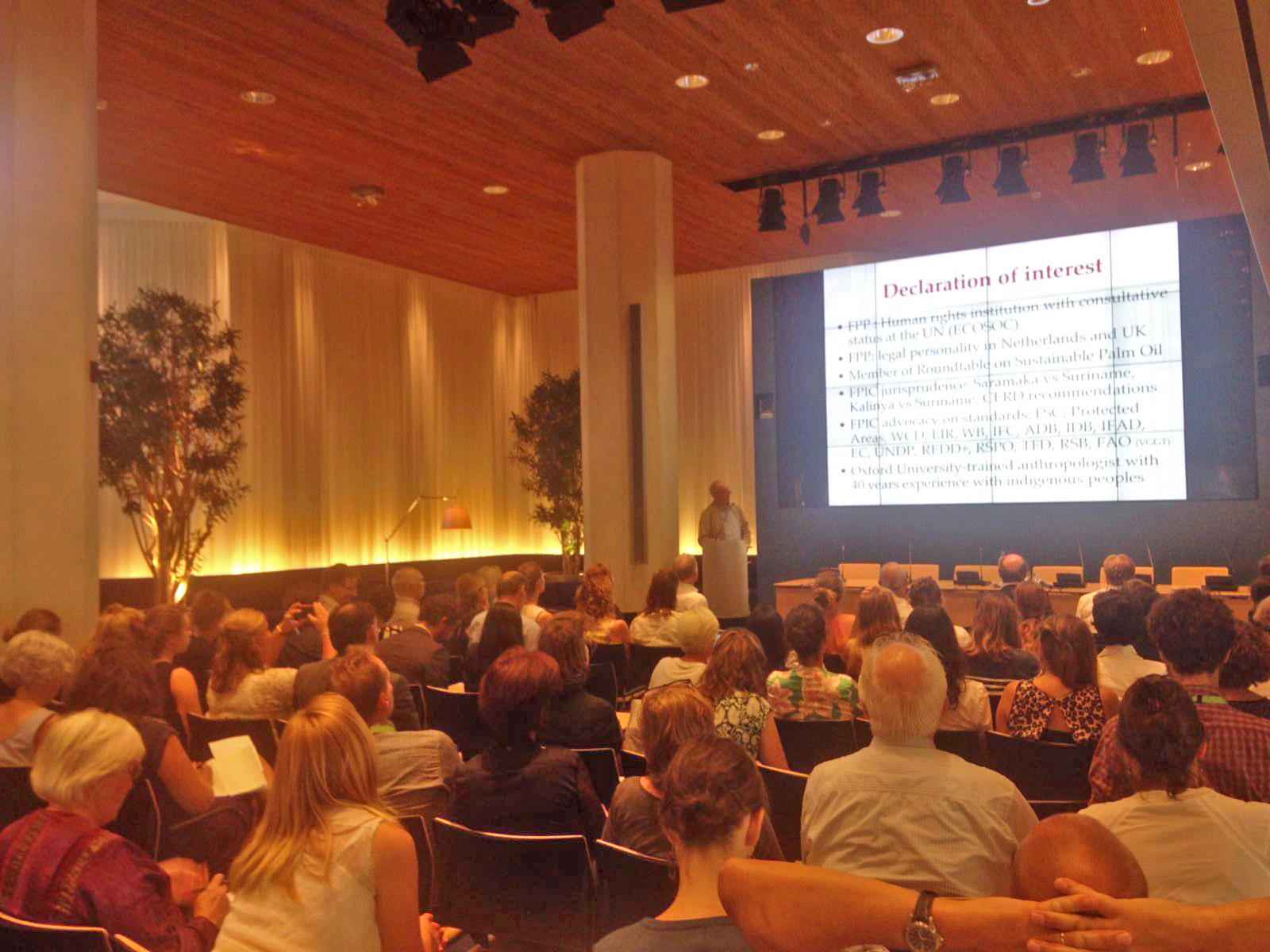
Full house during workshop on indigenous rights at Ministry of Foreign Affairs
While last Thursday afternoon half the Dutch population sat outside on a terrace to enjoy the last tropical heat of 2016, more than seventy people gathered in a room at the Ministry of Foreign Affairs. Why? To attend a workshop on 'Free, Prior and Informed Consent (FPIC), an international guideline which stipulates that indigenous peoples should be involved in and give permission for developments taking place in and around the area where they live.
The workshop was organised - at Both ENDS initiative – by the "Land Governance Multi-Stakeholder Dialogue" in which government, businesses, financial institutions and civil society organisations, including Both ENDS are represented.
Not only the organising group, but also the audience was diverse. "What particularly struck me was the amount of representatives of financial institutions and the government that attended the workshop," said Karin van Boxtel from Both ENDS, who was closely involved in the organisation. "Businesses, governments and financial institutions investing in projects in areas where indigenous peoples are living, must comply with the FPIC rules. Before plans are carried out in such an area the indigenous people and local communities need to be informed. But more importantly, after this they should be given the opportunity to give free consent (or not) to the plans.”
FPIC, how do you do that?
This sounds beautiful, but being a company or investor, how do you know that you’re applying FPIC rules in the right way? How do you identify local land users? How do you know if the spokesmen of the local land users actually represent the opinion of the entire group, when in practice this not always appears to be the case? And if you’re a Dutch financial institution or business, not physically present in the area, how can you be sure that FPIC is carried out well? A lot of uncertainty exists about these matters and too often things are going wrong. According to the initiators of the workshop all parties should be working together to eliminate these doubts and ambiguities.
Indispensable, but it can be even better
"Both ENDS promotes FPIC to ensure that the rights of indigenous land users are respected in investments," says Karin, "even though the mechanism leaves room for improvement. To start with, we find it a missed opportunity that under international law, FPIC only applies to indigenous peoples, while other local land users are also entitled to a participatory process. Another disadvantage is that indigenous peoples can only 'yes' or 'no' to a plan. They are not involved in the design of such a plan or project, which would be the ideal situation. Therefore, we would strongly support the idea of remodeling FPIC the future."
Good energy
Nevertheless, it would already be a very good start if FPIC would be implemented adequately everywhere, says Karin. "The first step is to make investors aware of what impact their investment may have on local communities and land users, and step two is to see how this impact can be minimised as much as possible. What should we work on to make FPIC more effective on one hand, and easy to carry out on the other hand?" Dr. Marcus Colchester, founder of the Forest Peoples Programme ( FPP), was one of the main speakers at the workshop. He was pleasantly surprised to feel the positive energy during the workshop: "It's good to see that government and industry in the Netherlands are taking the protection of indigenous peoples seriously and that they work together with civil society to improve their performance on FPIC. This is certainly not always the case in other Western countries! "
Back to practice
Both ENDS is going to actively engage in organising two follow-up workshops at the Ministry of Foreign Affairs, one in November and one in January, according to year. During these workshops we hope to go into more detail of the reality on the ground, and to develop – together with financial institutions and the government - real tools for conducting FPIC.
Read more about this subject
-
 News / 10 September 2026
Rutu Foundation receives UNESCO Literacy Prize for multilingual education
Both ENDS’ partner the Rutu Foundation for Intercultural Multilingual Education has been awarded the 2026 UNESCO King Sejong Literacy Prize for its language friendly school programme. This prestigious prize recognises the importance of multilingual education and the right of children to learn in an environment where their home languages are valued.
-
 News / 7 September 2026
Unprecedented criminal conviction in the Mariana disaster case breaks mining industry's cycle of impunity
A Brazilian federal court has, for the first time, criminally convicted a mining company and three of its managers for their role in the 2015 collapse of the Fundão dam, one of the worst environmental disasters in Brazil's history. Our partner Instituto Cordilheira, which represented victims as assistant prosecutors in the case, calls it a historic breakthrough after years of impunity.
-
 Dossier /
Communities Regreen the Sahel
In various countries in the Sahel, vast tracts of land have been restored by the local population by nurturing what spontaneously springs from the soil and protecting the sprouts from cattle and hazards.
-
 News / 3 September 2026
Restoring Land, Restoring Hope: Both ENDS at UNCCD COP17 in Mongolia
From 17 to 28 August, governments gathered in Ulaanbaatar, Mongolia, for COP17 of the UN Convention to Combat Desertification (UNCCD). At stake was more than how the world responds to land degradation and drought. It was also a question of who gets to shape land restoration, whose knowledge counts, and where the money goes.
-
Letter / 14 July 2026
Statement on CAO Cambodia Microfinance Case
The independent complaints mechanism of the International Finance Corporation (IFC) and the World Bank Group found that the IFC violated its own Environmental and Social Sustainability Framework by investing in six banks providing microfinance in Cambodia.
-
 News / 6 July 2026
Strengthening Women's Land Rights Across the Rio Conventions
From 29 June – 2 July 2026, Tamara Mohr, GAGGA coordinator at Both ENDS participated in the 4th convening of the Women's Land Rights Initiative (WLRI) in Nairobi, Kenya.Hosted by the Robert Bosch Stiftung, TMG Research and the Huairou Commission, the event brought together grassroots organisations, (inter)national NGOs, government institutions and donors from around the world.
-
Publication / 3 July 2026
-
 News / 2 July 2026
Land restoration can help mitigate and resolve conflict - but only if everyone has a seat at the table
Can restoring degraded land also help reduce conflict? According to experts from Niger, Ghana, the Netherlands and other regions, the answer is yes - but only when restoration is rooted in inclusive land governance, local ownership and social cohesion.
-
 Dossier /
Gas in Mozambique
In 2011 one of the world’s largest gas reserves was found in the coastal province of Cabo Delgado, in the north of Mozambique. A total of 35 billion dollars has been invested to extract the gas. Dozens of multinationals and financiers are involved in these rapid developments. It is very difficult for the people living in Cabo Delgado to exert influence on the plans and activities, while they experience the negative consequences. With the arrival of these companies, they are losing their land.
-
 Dossier /
Finance for agroecology
The lion's share of public budgets for climate, agriculture and development still goes to conventional agroindustrial projects that contribute to the current climate, food and biodiversity crises. Both ENDS and our partners are calling for a transition to agroecological practices that are people- and environment-friendly.
-
 Dossier /
Trade agreements
International trade agreements often have far-reaching consequences not only for the economy of a country, but also for people and the environment. It is primarily the most vulnerable groups who suffer most from these agreements.
-
Publication / 18 June 2026
-
Publication / 12 May 2026
-
 Press release / 12 May 2026
UN report warns of a growing sand crisis - The Dutch dredging sector plays a key role in global sand extraction
GENEVA/UTRECHT, 12 May 2026 – A new report by the United Nations Environment Programme (UNEP), Sand and Sustainability: An Essential Resource for Nature and Development, warns that global demand for sand is exceeding ecological limits. Large-scale extraction of sand from marine and coastal ecosystems is leading to biodiversity loss, damage to coastal communities and increasing risks in an era of climate change. Dutch dredging companies play a prominent role in this as global market leaders in large-scale sand extraction and land reclamation. “Our analyses show that the dredging sector operates globally within a system in which ecological damage and the consequences for coastal communities are systematically underestimated, whilst transparency and effective oversight are often lacking,” says the Dutch environmental and human rights organisation Both ENDS, which contributed to the report.
-
 News / 14 April 2026
New report: Phasing out ISDS in the Netherlands: a roadmap
Today, Both ENDS and SOMO are publishing the report Phasing out ISDS in the Netherlands: a roadmap. In the report, we highlight the Netherlands’ role in the ISDS system and offer practical guidance on phasing out ISDS.
-
 Dossier /
Rights for People, Rules for Corporations – Stop ISDS!
Indigenous communities in Paraguay saw their attempts to regain their ancestral lands thwarted by German investors. In Indonesia, US-based mining companies succeeded to roll back new laws that were meant to boost the country’s economic development and protect its forests. This is the level of impact that investment treaties can have on social, environmental and economic development and rights. Why? Because of the ‘Investor-to-State Dispute Settlement’ clauses that are included in many such treaties.
-
Publication / 14 April 2026
-
Publication / 10 April 2026
-
 News / 10 April 2026
Both ENDS: strengthened FMO complaints mechanism is a step forward, but major gaps remain
Both ENDS welcomes the strengthened Independent Complaints Mechanism (ICM) of development finance institutions FMO, DEG and Proparco as an important step forward in accountability. Working directly with communities affected by development projects, we see daily how essential it is that people can access justice when they are harmed in the name of development. For many communities, this mechanism is one of the few avenues through which harm can be formally recognised and addressed in relation to these development banks.
-
 News / 9 April 2026
Minister Sjoerdsma hosts roundtable conversations with civil society
This week, Minister Sjoerdsma organized roundtable conversations with civil society organizations – a valuable initiative that brings together Dutch civil society voices to address critical challenges faced by democratic societies.




