


Empowering Civil Society: Shaping investment policies for climate and sustainable development in Africa
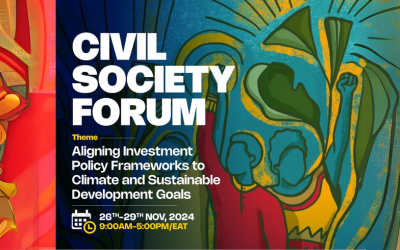
From 26-29 November 2024, Both ENDS and its partners will host the Civil Society Forum on Investment Policies, Climate and Sustainable Development Goals in Entebbe, Uganda. Our colleagues Iván and Fernando explain the importance of this event: “Through this event, we aim to provide an in-depth perspective on the impact of current investment policies on climate and environmental issues, with a strong focus on the African continent.”
From 26-29 November 2024, Both ENDS and its partners will host the Civil Society Forum on Investment Policies, Climate and Sustainable Development Goals in Entebbe, Uganda. Our colleagues Iván and Fernando explain the importance of this event: “Through this event, we aim to provide an in-depth perspective on the impact of current investment policies on climate and environmental issues, with a strong focus on the African continent.”
Why is Both ENDS organising this forum?
“We are organising it together with SOMO, ActionAid, TNI, and SEATINI, our main partner in East Africa. Through this event, we aim to provide an in-depth perspective on the impact of current investment policies on climate and environmental issues, with a strong focus on the African continent.
We also seek to support our local partner organisations in influencing local and national governments. Civil society organisations advocating for changes in investment policies, International Investment Agreements (IIAs), and harmful clauses - such as abolishing ISDS (Investor-State Dispute Settlement mechanisms) - benefit enormously from technical (legal) expertise and shared knowledge. In the past, we’ve observed that this is often a prerequisite for success.”
What is Both ENDS' role?
“We contribute technical analysis on IIAs in international and multilateral arenas. Additionally, we foster knowledge exchange and enhance partners' capacities in technical expertise and advocacy. During this event, we will support working group sessions, facilitate discussions, and process the outcomes.”
When is the CSO forum considered a success?
“The forum will be successful if it results in a joint advocacy strategy for the African continent regarding existing investment policies and ongoing negotiations on new treaties and agreements. This is also the primary goal of our main partner in the region. By facilitating discussions and exchanges, we hope to achieve this objective.
Furthermore, the event provides opportunities to share relevant knowledge from our previous work and ongoing processes related to IIAs and other aspects of investment policy, particularly those connected to climate and environmental issues.
We also aim to strengthen existing collaborations with allies while anticipating future challenges, such as countering ISDS mechanisms, the ‘modernisation’ of Dutch BITs, and addressing issues related to social and gender justice, climate and environmental policies, and corporate due diligence, among others.”
For more information
Read more about this subject
-
 Dossier /
International trade and investment with respect for people and planet
The network of international trade and investment treaties is large and complex. The Netherlands alone has signed more than 70 bilateral investment treaties (BITs) and is party to the trade and investment agreements concluded by the EU, like the EU-Mercosur and EU-Indonesia trade deals.
-
 Dossier /
Towards a socially and environmentally just energy transition
To address the climate crisis we need to urgently transition away from fossil fuels towards clean, renewable energy. However, this transition is not only about changing energy sources. It requires an inclusive and fair process that tackles systemic inequalities and demanding consumption patterns, prioritizes environmental and social justice, and which does not repeat mistakes from the past.
-
 Pathway /
Supporting a powerful civil society
Our goal is that civil society can work openly and safely, make their voices heard and influence decision-making on ecosystem challenges and matters of environmental justice and human rights. A strong civil society is indispensable to a healthy society. It checks the power of both state and corporate actors, holds decision-makers accountable, and defends the rights of those marginalised from positions of influence. A strong and independent civil society can advocate for fair and ecologically responsible policies as well as challenge structural inequalities in decision-making. It can also use accountability mechanisms to seek redress for the negative consequences of such inequitable decision-making, and instead promote, implement and upscale transformative practices.
-
 Dossier /
Communities Regreen the Sahel
In various countries in the Sahel, vast tracts of land have been restored by the local population by nurturing what spontaneously springs from the soil and protecting the sprouts from cattle and hazards.
-
 News / 3 september 2026
Restoring Land, Restoring Hope: Both ENDS at UNCCD COP17 in Mongolia
From 17 to 28 August, governments gathered in Ulaanbaatar, Mongolia, for COP17 of the UN Convention to Combat Desertification (UNCCD). At stake was more than how the world responds to land degradation and drought. It was also a question of who gets to shape land restoration, whose knowledge counts, and where the money goes.
-
 News / 6 juli 2026
Strengthening Women's Land Rights Across the Rio Conventions
From 29 June – 2 July 2026, Tamara Mohr, GAGGA coordinator at Both ENDS participated in the 4th convening of the Women's Land Rights Initiative (WLRI) in Nairobi, Kenya.Hosted by the Robert Bosch Stiftung, TMG Research and the Huairou Commission, the event brought together grassroots organisations, (inter)national NGOs, government institutions and donors from around the world.
-
Publication / 3 juli 2026
-
 Dossier /
Gas in Mozambique
In 2011 one of the world’s largest gas reserves was found in the coastal province of Cabo Delgado, in the north of Mozambique. A total of 35 billion dollars has been invested to extract the gas. Dozens of multinationals and financiers are involved in these rapid developments. It is very difficult for the people living in Cabo Delgado to exert influence on the plans and activities, while they experience the negative consequences. With the arrival of these companies, they are losing their land.
-
 Dossier /
Finance for agroecology
The lion's share of public budgets for climate, agriculture and development still goes to conventional agroindustrial projects that contribute to the current climate, food and biodiversity crises. Both ENDS and our partners are calling for a transition to agroecological practices that are people- and environment-friendly.
-
 Dossier /
Trade agreements
International trade agreements often have far-reaching consequences not only for the economy of a country, but also for people and the environment. It is primarily the most vulnerable groups who suffer most from these agreements.
-
Publication / 12 mei 2026
-
 Press release / 12 mei 2026
UN report warns of a growing sand crisis - The Dutch dredging sector plays a key role in global sand extraction
GENEVA/UTRECHT, 12 May 2026 – A new report by the United Nations Environment Programme (UNEP), Sand and Sustainability: An Essential Resource for Nature and Development, warns that global demand for sand is exceeding ecological limits. Large-scale extraction of sand from marine and coastal ecosystems is leading to biodiversity loss, damage to coastal communities and increasing risks in an era of climate change. Dutch dredging companies play a prominent role in this as global market leaders in large-scale sand extraction and land reclamation. “Our analyses show that the dredging sector operates globally within a system in which ecological damage and the consequences for coastal communities are systematically underestimated, whilst transparency and effective oversight are often lacking,” says the Dutch environmental and human rights organisation Both ENDS, which contributed to the report.
-
 News / 14 april 2026
New report: Phasing out ISDS in the Netherlands: a roadmap
Today, Both ENDS and SOMO are publishing the report Phasing out ISDS in the Netherlands: a roadmap. In the report, we highlight the Netherlands’ role in the ISDS system and offer practical guidance on phasing out ISDS.
-
 Dossier /
Rights for People, Rules for Corporations – Stop ISDS!
Indigenous communities in Paraguay saw their attempts to regain their ancestral lands thwarted by German investors. In Indonesia, US-based mining companies succeeded to roll back new laws that were meant to boost the country’s economic development and protect its forests. This is the level of impact that investment treaties can have on social, environmental and economic development and rights. Why? Because of the ‘Investor-to-State Dispute Settlement’ clauses that are included in many such treaties.
-
Publication / 14 april 2026
-
 News / 9 april 2026
Minister Sjoerdsma hosts roundtable conversations with civil society
This week, Minister Sjoerdsma organized roundtable conversations with civil society organizations – a valuable initiative that brings together Dutch civil society voices to address critical challenges faced by democratic societies.
-
 News / 26 maart 2026
New project: Climate Accountability in EU Trade
Through its new project “Climate Accountability in EU Trade: Testing the SEP and DAGs for Climate-Linked FTA Enforcement” Both ENDS, with support from the European Climate Foundation, is exploring how the European complaints mechanism (SEP) and Domestic Advisory Groups (DAGs) can be more effectively used to advance climate accountability. The project runs for 13 months, until end of 2026.
-
 News / 19 maart 2026
Winners of the ILED ‘Women Are Educators Award’ announced
Our partner organisation ILED (Indigenous-led Education Network) announced the seven winners of the ILED ‘Women Are Educators Award’ this month. These are women who play extraordinary roles in passing on knowledge, whether in formal or informal educational settings.
-
 Dossier /
Global Alliance for Green and Gender Action (GAGGA)
GAGGA rallies the collective power of the women's rights and environmental justice movements to realize a world where women can and do access their rights to water, food security, and a clean, healthy and safe environment.
-
 News / 27 februari 2026
Both ENDS strengthens the resilience of female environmental defenders worldwide thanks to multi-year contribution from the Postcode Lottery
In recent years, Both ENDS has received an additional contribution of €875,000 from the Postcode Lottery for the Autonomy & Resilience Fund (2022–2025), implemented in collaboration with the Global Alliance for Green and Gender Action (GAGGA). This support was essential because female environmental rights defenders around the world are increasingly facing climate change, repression and shrinking civil space. With this contribution, Both ENDS supports female activists and their communities with flexible, trust-based funding, enabling them to develop their own solutions to urgent environmental and climate problems.



