




“Seeds are the Very Source of Life and Women are the Ones who Manage that Source”
“Seeds are the Very Source of Life and Women are the Ones who Manage that Source”
When Farida Akhter was gathering material for the book she had long been thinking to write - about the special bond between women and nature - she interviewed an old woman in rural Bangladesh. When asked whether she was going to be able to count on her son when she was no longer be able to work, the answer was "No." "It is the trees, which are more reliable than the sons. If you have a tree you can be sure that at the time of nidan kal (the time of death), the funeral cost will be met by the tree."
Women and Trees, the book Akhter wrote about her findings, seeks to dispel a popular myth, namely that women are the plunderers of the forest, which is based on the mainstream image of women in poor areas gathering stacks of firewood. Nothing is less true, argues Akhter in her book. Women often have a much more intimate relationship with their surroundings than men. They tend to treat nature carefully and with thriftiness. In rural Asia, men mostly hold the deeds to the land, though it is the women who - besides household work - care for the vegetable garden and the smaller livestock. They also collect the seeds, which they nurture until they become (fruit) trees, and care for their entire lives. Trees provide fuel in the form of leaves and broken branches. And since a felled tree is worth money, trees are also regarded as a form of life insurance.
Besides tree seeds, women in Bangladesh also traditionally collect the seeds of vegetables, grains and rice. As Akhter notes, they thus manage "the very source of life," an essential and valued role in traditional agrarian culture. But this role has come under great pressure. The biggest culprit: the large-scale, often foreign-owned, agri-businesses that force their (genetically modified) seeds upon the farmers. When the farmers switch to the high-tech seeds, the women no longer have the task of collecting and managing seeds and, as a result, rapidly lose their economic power. Their roles are marginalised; and they are left with only housework and child care.
Akhter fights against this evolution through her peasant movement and via international networks. "The Monsantos of this world want to convince us that we need their seeds for increasing production and they take out patents on those seeds. As if you could possibly take out a patent on the source of life!" Monsanto is, after all, the world's number one GM-seed producer.
The people of Bangladesh (and elsewhere in Asia) have offered considerable resistance to large-scale agricultural pressures. "By growing monocrops, our soils lose their fertility," points out Akhter. "We have a bee crisis, a climate crisis, and a water crisis. Moreover, in the last 25 years, two-thirds of our crop species diversity has been lost. Sprayed to destruction with pesticides, driven out of the market by the large companies' seeds. Companies like Monsanto sell both the genetically modified seeds and the pesticides, so they make money twice. Meanwhile, our farmers become increasingly dependent."
The Counter-Attack
Resistance to this development is growing. In more and more places in Asia, peasant activists are setting up seed banks where the seeds of traditional crops are stored for future generations. Akhter was one of the pioneers of a peasant movement in Bangladesh that encourages recovering the use of forgotten vegetable and grain species. This is combined with organic agricultural practices and renouncing the use of pesticides and artificial fertilisers. "In the end, the peasants have to decide to stop. We offer the alternatives. And we show that you protect other plants by not spraying. What we call weeds are in fact non-cultivated species, which are traditionally used for a variety of purposes: as fodder, for medicinal use, and many other such things. They are part of our biodiversity. And this should not be lost."
The network of Women and Biodiversity is part of the New Agriculture Movement, which is active in two-thirds of the country's districts. In meetings with the population, discussions are held about the role people actually play. Akhter: "People tend to blame problems on things they cannot grasp, such as climate change. But you should realise that you yourself contribute to poisoning the earth when you spray or scatter chemicals. That is our message."
The farmers' organisation has its own centres in rural areas, where interested villagers can follow courses that last several days, and which allow one to address many more topics than merely organic farming. Akhter: "A lot of young people attend. Men and women sit together, they do everything together. The men do the dishes, the women work on the land. Thus, we break through prejudice. We respect social laws and religion, but, at the same time, we fight against traditional concepts of what men can do and what women can do."
Akhter's remarkable conclusion is that it's easier to break through social patterns in the countryside than in the city. She believes that this is because in rural areas, the productive roles of women are clearer. "Everyone knows their significance: in agriculture, within the families, and in the community. Their knowledge and skills are recognised. While in the cities women spend a lot of time in shopping malls, or at home in front of the television set. Unproductive occupations. Therefore, society sees them rather as a burden than as an added value."
Akhter says that rural women are open to new ideas. "As long as this is done in a respectful manner. Taking into account everyone's feelings, while still managing to change the system. In our centres, young female farmers hop on stage to perform. They dress up in men's clothing. They criticise the system. Things they have never done before, yet people accept this."
Whenever possible, Akhter also joins them. "I do not love the city, even though I must regularly spend time there. But I always feel tired in the city. And never when I am in the countryside, where we get up when the sun rises, where we work with the peasants, where they learn from us and we learn from them. We discuss crops and the harvest; we distinguish the types that are most suitable for the different seasons. And, over lunch in the field, we try to distinguish the sounds of the birds. I always enjoy this immensely."
An Arcadian Ideal?
Farida Akhter is convinced that the future belongs to small-scale organic agriculture. The unlimited confidence in the Green Revolution, the intensified and large-scale operations that are so bad for people and the environment, will come to an end. Even international institutions like the World Bank are starting to recognise the essential role that small-scale farmers play. "In my country, 70 percent of the farmers work on a small scale. If they get organised and receive good agricultural extension services, eventually we will no longer need this extremely large-scale sector."
To sceptical Westerners, this may all sound slightly too-Arcadian or excessively romantic. As if all old things have always been better. Besides, is Akhter's small-scale farmer actually able to feed the rapidly growing population in a country like Bangladesh? "But of course," she reacts. "Agriculture with a focus on nature, which follows the seasons and mainly produces local crops, indeed produces more compared to large-scale agriculture. The few high-yield crops, which the latter produces are extremely sensitive to diseases and pests, and are therefore full of chemical junk. In contrast, our agriculture is based on ancient knowledge. Our seeds do not need chemicals because they are adapted to local circumstances."
What is needed is a good government, which stands firmly behind its own farmers, instead of dancing to the tune of the large international companies. They need a government, Akhter adds, that no longer permits the importation of GM-seeds and doesn't sell off valuable arable land for monocropping. This government also needs to make much better plans for the provision of food for the population. It must be able to calculate where and when possible shortages may occur, and respond accordingly. Agrarian research should no longer focus on intensive agriculture but rather on the full range of indigenous species and varieties. "This calls for a different way of thinking, which the large companies want to hinder."
If it chooses to follow this path, Bangladesh will become an agricultural export country, Akhter believes. "Don't forget that at one point in history we had 15,000 rice varieties here. Each region had its own varieties: aromatic, highly productive, with an intense flavour, suitable for certain dishes, and so on. With our peasant movement, we have now been able to recover and collect some 3,000 types. In the Netherlands, you also eat basmati rice, I hear. If I told you there are many more varieties, each of them with its own taste and aroma, then people would surely be interested, right? And what goes for rice also goes for our lentils."
Women are the ones who have the most to gain from a revaluation of small-scale agriculture. Corporate farming, Akhter emphasises, is a male thing. "Men dominate the markets and capital, decide on the development of seeds, and conduct the research. Women no longer count. This has to stop. Policymakers should listen to the women, and recognise and support their essential role in agriculture. This will also signify a major improvement in yields."
Happiness is Everyone's Dream
In the ideal future, says Akhter, our daily plate of food will contain many different types of vegetables. Not only cauliflower or eggplant, for example. Besides, every vegetable has many varieties. They all have their own unique taste. Besides the greater diversity offered, the food looks colourful and tastes better than what most people eat today. It is free of chemicals and is grown from locally collected seeds. Moreover, the people only eat seasonal vegetables. The seasons are there for a reason, Akhter observes, you have to adapt to them. "That is what your body wants, products of the season. So, avoid eating winter products in spring."
Indeed, Akhter admits that this is traditional knowledge based on what our grandmothers already knew: the types of vegetables and fruits you should eat during certain times of year. For example, because they help people increase their immunity to certain diseases. This type of valuable knowledge is at risk of being lost. She also believes that scientists increasingly recognise that this is a negative development.
The ultimate goal of her efforts is simple, she says: "For people to have a good life. Like our farmers say: to be happy, that is what we want. They do not need a big car or a lot of money in the bank. Safe and good food, health for themselves and their children, nature in balance. That is what ordinary people want."
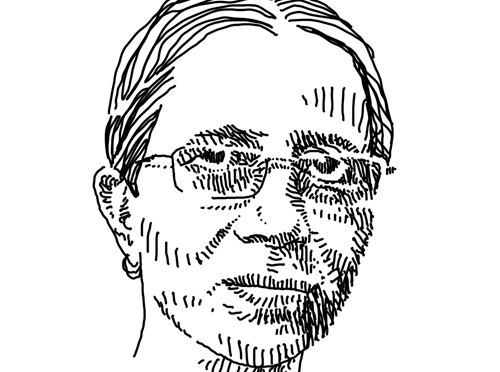
| A women's rights activist The acknowledgment of women's rights and the preservation of biodiversity are the topics that Farida Akhter (1953) has been involved in for decades, both in Bangladesh and in the international sphere. She is the director of UBINIG, an activist research institute in Bangladesh, which combines studies on the position of the rural population with political advocacy. Akhter also leads the only feminist publishing house in Bangladesh. And she is one of the founders of Nayakrishi Andolon (New Agriculture Movement), a farmers' organisation that encourages organic agriculture. It does this by distributing educational materials and organising trainings for the inhabitants of rural and urban areas. Farida Akhter is an active member in numerous regional networks that organise the opposition to genetic modification, domestic violence against women, and coercion in family planning. She has written several books, including Women and Trees and Seeds of Movement: On Women's Issues in Bangladesh. |
Read more about this subject
-
 Dossier /
Dare to Trust: the power of unconditional funding
At Both ENDS we cherish our long-term relationships with partners in our global network. These relationships are based on equality and built on trust. The trust we have in each other has developed from years of strategic cooperation, including joint advocacy around common agendas, knowledge sharing, networking, and mobilising and sharing resources to advance environmental justice.
-
 Dossier /
Global Alliance for Green and Gender Action (GAGGA)
GAGGA rallies the collective power of the women's rights and environmental justice movements to realize a world where women can and do access their rights to water, food security, and a clean, healthy and safe environment.
-
 News / 5 oktober 2026
Rural Women's Assembly wins Right Livelihood Award
We are thrilled to share that our partner the Rural Women's Assembly (RWA) is one of this year's Right Livelihood Laureates! The award, often called the "Alternative Nobel Prize", honours RWA for bringing together more than 178,000 women farmers in eleven Southern African countries. Together, these women stand up for their land, their seeds and their right to make decisions about their own lives and bodies.
-
 News / 29 september 2026
Summary - Both ENDS complaint under the EU-New Zealand trade agreement
On 29 September 2026, Both ENDS lodged the first complaint on climate grounds with the European Commission's Single Entry Point. It asks the Commission to examine whether Aotearoa New Zealand has broken two promises both sides made in the EU-New Zealand Free Trade Agreement: not to weaken or set aside environmental laws in order to encourage trade or investment, and to effectively implement the Paris Agreement.
-
Publication / 29 september 2026
-
Publication / 29 september 2026
-
 News / 29 september 2026
Q&A: New Zealand's climate rollback and the EU trade agreement
On 29 September 2026 / 30 September in Aotearoa New Zealand, Both ENDS lodged a complaint with the European Commission under the EU-New Zealand Free Trade Agreement. These are the questions we are asked most often, and our answers. The complaint summary, the case explainer and the key public sources are linked at the end of this page.
-
 News / 29 september 2026
What happens now? A timeline of the SEP Case
What happens now? On 29 September 2026 / 30 September in Aotearoa New Zealand, Both ENDS lodged a formal complaint with the European Commission. It is the first complaint to the EU's Single Entry Point on environmental and climate grounds. It asks the Commission to hold New Zealand to two promises it made in its trade agreement with the EU: not to weaken environmental protection to encourage trade or investment, and not to undermine the Paris Agreement on climate change.
-
 Press release / 29 september 2026
New Zealand faces its first climate complaint under EU trade rules
UTRECHT / WELLINGTON, 29 September 2026 /30 September in Aotearoa New Zealand
Both ENDS, a Dutch environmental justice organisation, has lodged a formal complaint with the European Commission arguing that New Zealand has broken the climate promises it made in its free trade agreement with the European Union. It is the first complaint on environmental and climate grounds under the Commission's Single Entry Point, the mechanism that lets civil society ask the EU to enforce the sustainability commitments in its trade agreements.
-
 Dossier /
Trade agreements
International trade agreements often have far-reaching consequences not only for the economy of a country, but also for people and the environment. It is primarily the most vulnerable groups who suffer most from these agreements.
-
 News / 10 september 2026
Rutu Foundation receives UNESCO Literacy Prize for multilingual education
Both ENDS’ partner the Rutu Foundation for Intercultural Multilingual Education has been awarded the 2026 UNESCO King Sejong Literacy Prize for its language friendly school programme. This prestigious prize recognises the importance of multilingual education and the right of children to learn in an environment where their home languages are valued.
-
 News / 7 september 2026
Unprecedented criminal conviction in the Mariana disaster case breaks mining industry's cycle of impunity
A Brazilian federal court has, for the first time, criminally convicted a mining company and three of its managers for their role in the 2015 collapse of the Fundão dam, one of the worst environmental disasters in Brazil's history. Our partner Instituto Cordilheira, which represented victims as assistant prosecutors in the case, calls it a historic breakthrough after years of impunity.
-
 Dossier /
Communities Regreen the Sahel
In various countries in the Sahel, vast tracts of land have been restored by the local population by nurturing what spontaneously springs from the soil and protecting the sprouts from cattle and hazards.
-
 News / 3 september 2026
Restoring Land, Restoring Hope: Both ENDS at UNCCD COP17 in Mongolia
From 17 to 28 August, governments gathered in Ulaanbaatar, Mongolia, for COP17 of the UN Convention to Combat Desertification (UNCCD). At stake was more than how the world responds to land degradation and drought. It was also a question of who gets to shape land restoration, whose knowledge counts, and where the money goes.
-
Letter / 14 juli 2026
Statement on CAO Cambodia Microfinance Case
The independent complaints mechanism of the International Finance Corporation (IFC) and the World Bank Group found that the IFC violated its own Environmental and Social Sustainability Framework by investing in six banks providing microfinance in Cambodia.
-
 News / 6 juli 2026
Strengthening Women's Land Rights Across the Rio Conventions
From 29 June – 2 July 2026, Tamara Mohr, GAGGA coordinator at Both ENDS participated in the 4th convening of the Women's Land Rights Initiative (WLRI) in Nairobi, Kenya.Hosted by the Robert Bosch Stiftung, TMG Research and the Huairou Commission, the event brought together grassroots organisations, (inter)national NGOs, government institutions and donors from around the world.
-
Publication / 3 juli 2026
-
 News / 2 juli 2026
Land restoration can help mitigate and resolve conflict - but only if everyone has a seat at the table
Can restoring degraded land also help reduce conflict? According to experts from Niger, Ghana, the Netherlands and other regions, the answer is yes - but only when restoration is rooted in inclusive land governance, local ownership and social cohesion.
-
 Dossier /
Gas in Mozambique
In 2011 one of the world’s largest gas reserves was found in the coastal province of Cabo Delgado, in the north of Mozambique. A total of 35 billion dollars has been invested to extract the gas. Dozens of multinationals and financiers are involved in these rapid developments. It is very difficult for the people living in Cabo Delgado to exert influence on the plans and activities, while they experience the negative consequences. With the arrival of these companies, they are losing their land.
-
 Dossier /
Finance for agroecology
The lion's share of public budgets for climate, agriculture and development still goes to conventional agroindustrial projects that contribute to the current climate, food and biodiversity crises. Both ENDS and our partners are calling for a transition to agroecological practices that are people- and environment-friendly.



