


Fair trade and equal partnerships: only then can Kenya stand on its own
Several media outlets, including de Volkskrant, focused last week on the shift from “aid” to “trade,” partly in response to the state visit of the Dutch royal couple to Kenya. The idea is that it would be beneficial for Kenya to stand on its own two feet. A beautiful ideal—one I whole heartedly believe in. But this ideal can only become a reality if equality is at the heart of trade and international cooperation.
Currently, however, global trade is far from equal. It’s a playing field heavily tilted in favor of wealthy multinationals—mainly from Europe and the United States—who profit often at the expense of local communities, small businesses, and the environment in countries like Kenya. Take the flower industry, for example. Much of it has shifted from the Netherlands to Kenya and other East African countries. In this industry, workers—especially women—are exploited. Meanwhile, scarce regional water sources are drying up, the environment is polluted with massive amounts of harmful pesticides, and less land and clean water remain available for local farming families to grow food. The damage is felt locally, while the profits largely benefit Dutch companies.
Another example is the seed trade in food production. Many farmers—including in Kenya—have long harvested, exchanged, and reused seeds in a centuries-old system that benefits farmers, food production, and biodiversity. The use of commercial seeds developed by multinational seed companies is at odds with this traditional seed system. Due to intellectual property rights, farmers are often prohibited from integrating these seeds into their traditional systems. This creates dependency on—often Dutch—seed companies and frequently forces farmers to take on risky loans to purchase new seeds.
We also won’t solve global issues like the climate and biodiversity crises through current unequal trade practices. To tackle those challenges, we need not only fair trade, but also international cooperation—or what the Dutch government now mistakenly labels as "development aid." This is not one-sided “aid,” but rather a partnership in which different parties learn from each other within international networks, and where the realities and interests of local communities (such as in Kenya) form the foundation for creating a fairer, more sustainable trade system and a just climate policy.
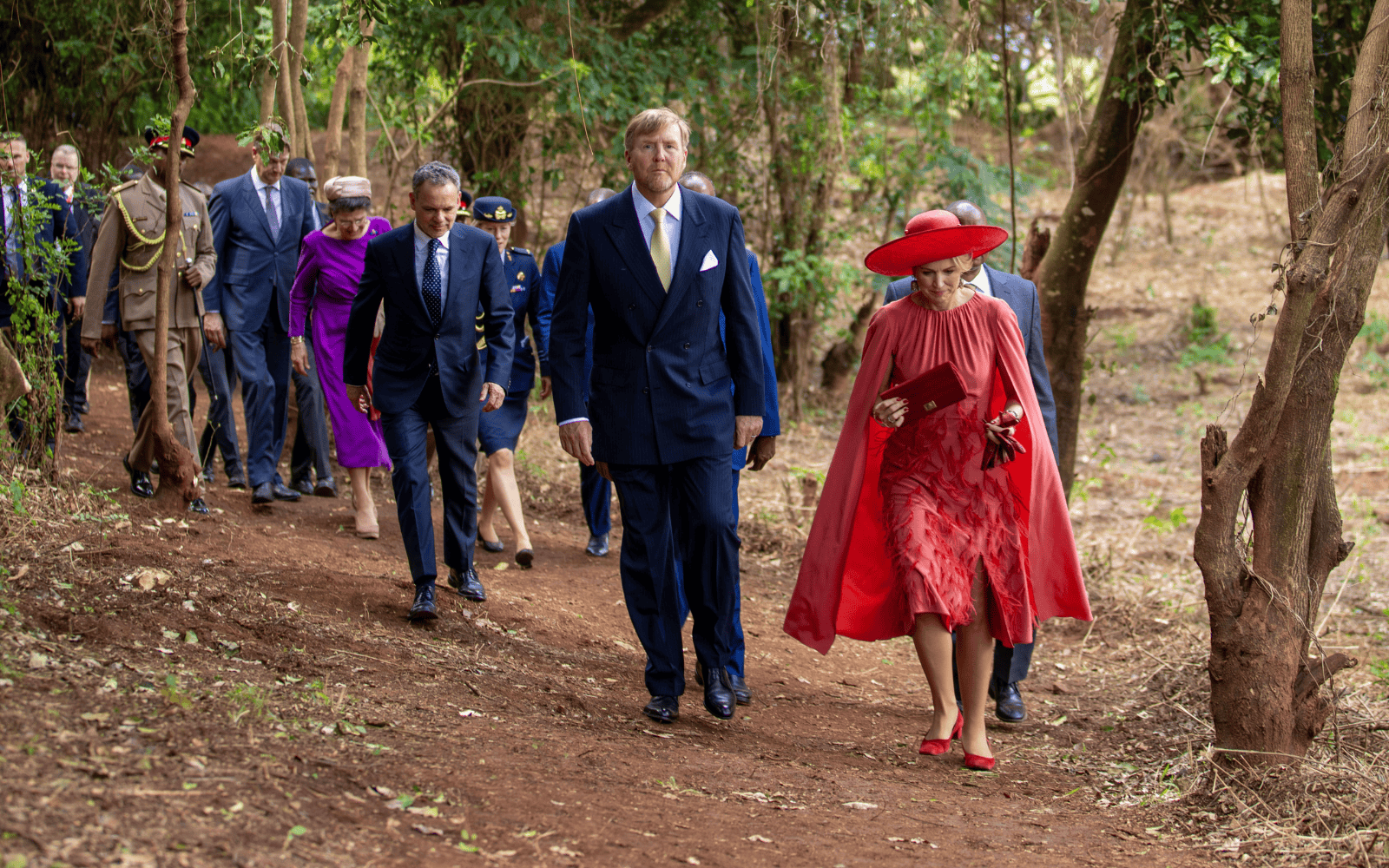
Fortunately, King Willem-Alexander and Queen Máxima also witnessed this part of the relationship between the Netherlands and Kenya. Their program included a visit to the Thogoto Forest, where the local organisation MCDI, together with others, works on nature conservation, agroecology, and ecotourism. Our collaboration with MCDI—funded by the Dutch Ministry of Foreign Affairs—has led to farmers in the region adopting more sustainable agricultural practices. By organising themselves, they’ve created a larger market for their products and their cooperative is now financially self-sufficient. This project is a clear example of how international cooperation can foster sustainable socioeconomic development.
International companies also benefit from fair trade relationships. Business federations like VNO-NCW and entrepreneurs’ association Evofenedex support the interplay between international cooperation and fair trade. They understand that by narrowly focusing on national self-interest, the current Dutch government is ultimately shooting itself in the foot. As economist Célestin Monga recently said in an interview with NRC: “Western countries have nothing to gain from Africa’s underdevelopment. Problems in Africa—such as terrorism, conflict, and disease—inevitably have consequences for Europe and beyond.” To foster development, Monga advocates for promoting fair and equitable trade relationships with Africa. Sadly, the Dutch government seems to be discarding this sense of equality altogether.
As long as political and economic power in the world remains so unequally distributed, deepening collaboration with organisations and communities in the Global South is more necessary than ever. That is exactly what we at Both ENDS and our partner organizations will continue to do—with full conviction.
This op-ed was originally published in Dutch by Joop.nl
For more information
Read more about this subject
-
 Dossier /
International trade and investment with respect for people and planet
The network of international trade and investment treaties is large and complex. The Netherlands alone has signed more than 70 bilateral investment treaties (BITs) and is party to the trade and investment agreements concluded by the EU, like the EU-Mercosur and EU-Indonesia trade deals.
-
 Dossier /
Global Alliance for Green and Gender Action (GAGGA)
GAGGA rallies the collective power of the women's rights and environmental justice movements to realize a world where women can and do access their rights to water, food security, and a clean, healthy and safe environment.
-
Publication / 3 juli 2026
-
 News / 9 april 2026
Minister Sjoerdsma hosts roundtable conversations with civil society
This week, Minister Sjoerdsma organized roundtable conversations with civil society organizations – a valuable initiative that brings together Dutch civil society voices to address critical challenges faced by democratic societies.
-
 Environmentally Just Practice /
A Negotiated Approach for Inclusive Water Governance
A Negotiated Approach envisages the meaningful and long-term participation of communities in all aspects of managing the water and other natural resources on which their lives depend. It seeks to achieve healthy ecosystems and equitable sharing of benefits among all stakeholders within a river basin. This inclusive way of working is an essential precondition for the Transformative Practices that are promoted by Both ENDS and partners.
-
 News / 5 november 2025
Interview: Both ENDS at COP30 for Climate Justice and Systemic Change
Both ENDS is present at COP30 to advocate for genuine access to climate finance for locally led, gender-just climate solutions and the mechanisms that facilitate this, including those for farmer-led restoration. Furthermore, the organisation participates to ensure the crucial connection between the climate negotiations and the trade and investment frameworks that shape them.
Learn more about the Both ENDS team at COP30 below, and find all the activities and side-events in which Both ENDS will participate.
-
 News / 5 november 2025
Overview of Both ENDS events at COP30 in Belem, Brazil
Both ENDS is present at COP30 to advocate for genuine access to climate finance for locally led, gender-just climate solutions, and for the mechanisms that make these possible, including those supporting farmer-led restoration. The organisation also engages to highlight the crucial connection between climate negotiations and the trade and investment frameworks that shape them.
Below is an overview of the Both ENDS team at COP30 and a detailed look at the activities and side-events in which Both ENDS will participate.
-
 News / 23 oktober 2025
TotalEnergies financiers beware: EACOP is eating up money, nature and livelihoods
A new analysis shows that the developers of the East African Crude Oil Pipeline, led by France’s TotalEnergies, are being forced to self-finance the project almost entirely. The analysis, part of a new Finance Risk Updatefrom a coalition of African and International civil society organisations, shows that the companies have abandoned plans to raise 60% of the project’s growing costs from bank loans, and are now on the hook for almost 90% of the costs themselves.
-
 News / 6 oktober 2025
From Entebbe to Accra: civil society is rewriting the rules of investment
By Fernando Hernández Espino and Bart-Jaap Verbeek
Almost a year after African civil society gathered in Uganda to adopt the Entebbe Declaration, the call to transform international investment governance continues to gain strength. From the 6th to the 9th of October, over 50 civil society organisations from across West Africa, including from Ghana, Senegal, Nigeria, Côte d’Ivoire, Cameroon, Gambia, Sierra Leone, as well as from Kenya and Latin America, are convening in Accra to deepen and operationalise the Declaration’s vision.
-
 News / 23 september 2025
With the undemocratic splitting of the EU-Mercosur deal, Europe is missing the chance to lead on fair trade
Recently, many newspapers have written about Brussels’ rush to finalize the trade agreement between the EU and the South American Mercosur countries. According to the European Commission, national parliaments do not need to approve it because the trade part and the “political” part have been separated. This “splitting” means that the trade part can be approved as an EU-only decision by the European Council and the European Parliament, while national parliaments are sidelined and the political-cooperation part is postponed. Both ENDS and its partners are deeply concerned and are calling on the Dutch government to vote against this outdated agreement.
-
 News / 22 september 2025
EU-Indonesia Trade Deal Threatens Communities and Environment
On September 23th the European Union and Indonesia concluded their negotiations of the EU-Indonesia Comprehensive Economic Partnership Agreement (CEPA), a free trade agreement between the EU and Indonesia. Both ENDS condemns this agreement for favoring corporate interests over those of local communities and the environment.
-
 News / 11 september 2025
EU-Mercosur: Small GDP Gain, Big Question Marks for Farmers and Democracy
A recent report by Wageningen Economic Research (WER) on the economic consequences of the trade agreement between the EU and Mercosur confirms what civil society organizations, policymakers, and trade unions have been signaling for years: this agreement does not offer a balanced perspective for farmers and the environment. Instead, it increases power inequalities and shifts burdens onto (small-scale) farmers. Moreover, the deal risks reinforcing unsustainable practices that complicate the climate transition and addressing environmental challenges in both the EU and Mercosur countries.
-
 Blog / 12 augustus 2025
Nickel mining for the energy transition: who is accountable for the damage?
Photo blog - In June, I travelled to Indonesia with our partner organization Puanifesto to research the impacts of nickel mining in East Sulawesi. On July 13th, the news broke that the European Union and Indonesia have reached a political agreement on a free trade agreement that was years in the making, called the Comprehensive Economic Partnership Agreement (CEPA). Nickel from Sulawesi is already being used in European cars. This makes it all the more important that we ensure that human and environmental rights are secured in mining and refining operations in Indonesia, before the road is opened to more extraction and exploitation for the European market. The conversations we have had with communities and workers on East Sulawesi show that more binding regulations are necessary to make this happen and ensure an energy transition that is socially and environmentally just.
-
 Blog / 17 juli 2025
A disaster for farmers: here and there
The trade agreement with South America is harmful to farmers, the climate, and biodiversity, on both sides of the Atlantic. It’s time to take this deal off the table once and for all, argues Fernando Hernandez, Senior Policy Officer for Trade and Investment at Both ENDS.
-
 News / 5 juni 2025
Op-ed: New trading partners, but not on the same terms
Since President Trump's trade war and tariffs, international trade has once again been thrust into the spotlight. In Europe and the Netherlands, there are growing calls for new free trade agreements to be concluded as quickly as possible, as reflected in recent opinions in FD and de Volkskrant. But that is the wrong reflex, writes our colleague Marius Troost.
-
 News / 9 mei 2025
Women’s leadership in agroecology flourishes in Eastern and Southern Africa
On 12 and 13 February 2025, women from Kenya, Uganda, and Zimbabwe gathered in Nairobi for the Africa Women Leaders in Agroecology (AWOLA) Regional Networking Forum. The event marked a significant moment in the leadership programme of PELUM Kenya, which empowers young women in their role as leaders in the agroecological transition. This project was made possible thanks to support from Both ENDS as part of the Fair, Green and Global (FGG) Alliance.
-
 Blog / 23 april 2025
The power of trust
Trust builds trust. That is what I have learned from how Both ENDS works - within our team, with partners in joint strategies and advocacy, and in our relationships with partners as a funder. Trust is the foundation. It is what allows compassion to grow, what gives rise to hope, and what fuels real solidarity. This is especially powerful in contrast to the prevailing global trend of political and international leaders who prioritize hard measures and self-interest, ignoring relations of trust. It is even more reason for us to share what we have experienced when we put trust first.
-
Letter / 15 april 2025
African civil society urges Oman against EACOP support as east Africa trade expo kicks off
Just one day before the Oman East Africa Trade and Investment
Expo opens in Muscat on April 16, over 70 civil society organisations (CSOs) from Uganda, Tanzania, the Democratic Republic of Congo, and beyond have published an open letter urging the Government of Oman to refrain from providing financial or diplomatic support for the controversial East African Crude Oil Pipeline (EACOP). -
 Blog / 31 maart 2025
International cooperation and solidarity are in the interest of both the Netherlands and Africa
Traditional development aid keeps Africa in a state of aid dependency, but development cooperation is essential to break this post-colonial dependency, argues Melvin van der Veen in response to an interview in NRC Handelsblad with the Cameroonian economist Célestin Monga. By breaking off this cooperation on the basis of equality, we are actually stifling the voices of African civil society organisations, indigenous communities, youth and women's movements and human rights defenders, and we are not solving global problems.
-
 External link / 28 maart 2025
Eerlijke handel en gelijkwaardige relaties: pas dán kan Kenia echt op eigen benen staan
This op-ed is available in Dutch.

