




Feminist March 2025: let's take to the streets for gender justice
Women's rights are under pressure worldwide, and hard-fought rights and freedoms are being dismantled. Whereas until recently the Netherlands was a champion of emancipation, women's rights and gender justice, the current cabinet is breaking with this policy and abandoning millions of women and girls. That is why Both ENDS, together with many other allies, will be taking to the streets on 8 March. It is time to make a strong stand against the dismantling of gender policy and to stand up for gender equality and social justice.
The cabinet's policy letter on international cooperation was clear: from now on, the Netherlands will no longer invest in programmes for women's rights and gender equality. Unfortunately, the Netherlands is not alone in this, as can be seen, for example, in the reintroduction of the Global GAG rule and the dismantling of USAID by the US. As a result, the rights and position of women and girls worldwide are coming under further pressure, and it is becoming increasingly difficult to support them in their struggle for emancipation.
Gender equality is the basis of democracy, justice and sustainability
As recently as 2022, the Netherlands joined a group of countries that would pursue a feminist foreign policy. And rightly so: gender equality is a fundamental human right, and it is an essential condition for the effective achievement of peace and security, healthy democracies, sustainable economic development, and last but not least, the fight against climate change. For example, Both ENDS works in the Global Alliance for Green and Gender Action (GAGGA) with feminist movements worldwide to recognise and support the crucial role that women play, both in the fight against fossil projects and in proposing and implementing effective climate solutions.
Without an integrated approach centred on gender equality, a fair, sustainable and effective climate and biodiversity policy is impossible.
Attack on human rights and democracy
The current attack on women's rights and the rights of other minorities, such as LGBT+ people and migrants, is an attack on human rights and democracy and a fixed part of extreme right-wing politics worldwide. It not only targets international cooperation programmes, but also the position of these groups in their own countries. The proposals for stricter abortion legislation, the rhetoric against transgender people and the openly professed hatred of migrants are all shameful examples of this.
Time to rise up en masse
Now more than ever, it is important to take to the streets and speak out forcefully against the dismantling of gender policy and women's rights, and in favour of solidarity and equality for all!
Both ENDS will therefore be present at the Feminist March on 8 March 2025 in Amsterdam. For more information about this demonstration, see feministmarch2025.nl.
Would you like to join Both ENDS? Then contact Marjolein van Rijn via m.vanrijn [at] bothends.org.

Read more about this subject
-
 Video / 31 mei 2016
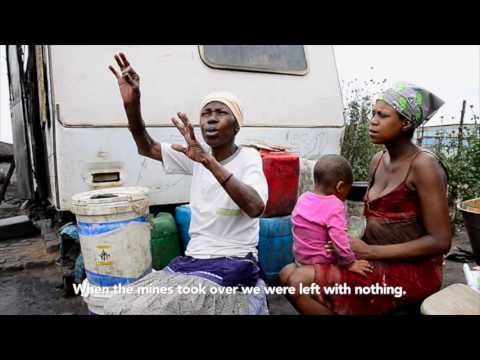
Women's rights undermined in South Africa
The population of the informal settlement Masakhane, South Africa is highly affected by the pollution and environmental damage caused by the the coal-fired Duvha power station. Before the mining and power station developments, families had access to and control over the land, even if they did not own it. Farming used to be the main source of livelihood. Today, mining companies and investors own most of the land, and as a direct consequence people have lost a lot of their farming and grazing land. This video shows testimonies of victims and their efforts to turn the tide.
-
 Event / 7 maart 2018, 15:00 - 16:30
Women's Rights & Climate Finance Webinar: getting the money to the people
Join us for the third session of this five-part series on women's rights and climate finance, aimed at building knowledge and power to ensure finance flows benefit local women's groups, respond to community needs and respect human rights.
-
Publication / 10 december 2018
-
 Video / 14 december 2017
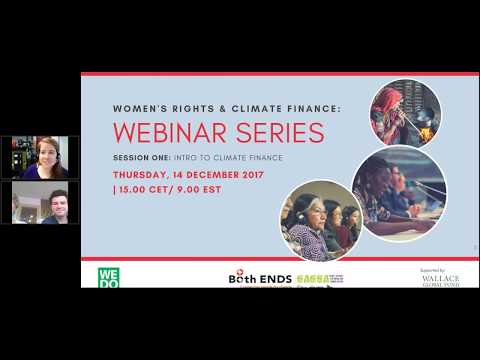
Webinar series: women’s rights and climate finance, #1
This Introduction to Climate Finance is the first of a five part series on women's rights and climate finance, aiming to build knowledge and power to ensure finance flows are benefiting local women's groups, responding to community needs and respecting human rights. This session will outline the climate finance landscape, as well as the key challenges and opportunities we hope to explore in this webinar series.
-
Publication / 3 november 2017
-
Letter / 19 oktober 2022
Both ENDS' input to the 'Consultation Feminist Foreign Policy' of Ministry of Foreign AffairsZa
In May 2022, Minister Hoekstra of Foreign Affairs and Minister Schreinemacher for International Trade and Development Cooperation announced that also The Netherlands will work towards implementing a Feminist Foreign Policy (FFP). This means that within its Foreign Policy, the Netherlands will pay more attention to inclusivity in general and specifically to women's rights and gender equality, including LGBTIQ+. This feminist lens will be central to all aspects of foreign policy; security, trade, diplomacy and international cooperation.
To foster an inclusive process and acquire insights in what a Dutch FFP should look like, the Ministry of Foreign Affairs opened an internet consultation. Both ENDS welcomes the FFP and therefore gladly shares its input and suggestions.
-
 News / 28 september 2018
Joan Carling is awarded with the UN’s highest environmental honor!
We congratulate Joan Carling, member of the permanent commission on indigenous peoples of the UN, for having received the Lifetime Achievement Award as 'Champion of the Earth' by the UN Environment! This is the UN's highest environmental honor, given to six of the world's most outstanding environmental change makers once a year.
-
 Video / 3 november 2017
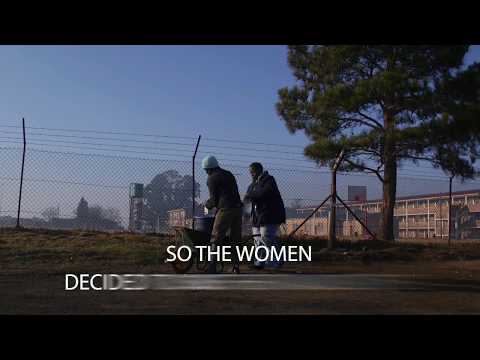
Reality of Mine: South Africa
In this video we see Maria Mkhatswa, who is claiming the right of her people to have access to clean water, like they had years ago, when the coal mining industry had not yet polluted the whole area. The three part series 'Reality of Mine' gives a voice to women affected by mining in India, Kenya and South Africa. With the support of international NGOs Both ENDS and ActionAid, they have begun to stand up for their rights.
-
 Video / 3 november 2017
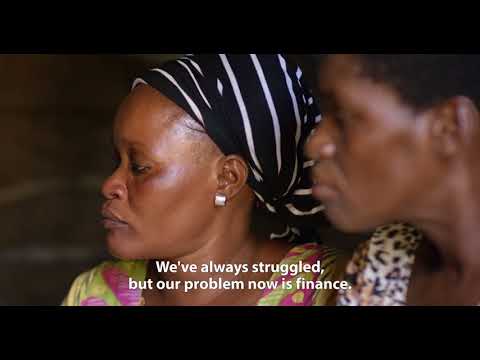
Reality of Mine: Kenya
In this video, Trivinia Mwanga Mwamburi from Kenya takes you with in her fight to get the land back which was taken from her because of the expansion of large scale salt mines. The three part series 'Reality of Mine' gives a voice to women affected by mining in India, Kenya and South Africa. With the support of international NGOs Both ENDS and ActionAid, they have begun to stand up for their rights.
-
 Video / 3 november 2017
Reality of Mine: India
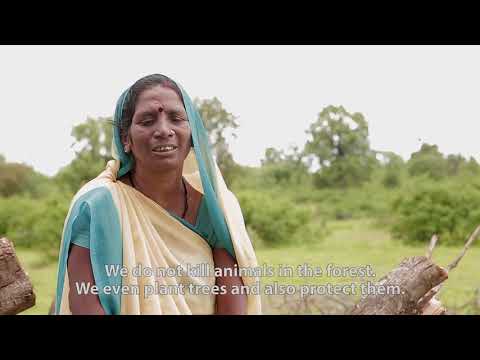
This short video takes you to Panna, India, where traditional adivasi women successfully oppose forced evictions. The three part series 'Reality of Mine' gives a voice to women affected by mining in India, Kenya and South Africa. With the support of international NGOs Both ENDS and ActionAid, they have begun to stand up for their rights.
-
 News / 2 juli 2019
Indonesia: Women’s Right to Water
The water quality of East Java's largest river, the Brantas River, is increasingly deteriorating due to a combination of industrial and household waste. This environmental pollution has a disproportionate impact on women. Yet, their participation in decision-making remains lacking. ECOTON is working to improve the situation.
-
 Video / 14 juni 2018
Webinar series: women’s rights and climate finance, #4
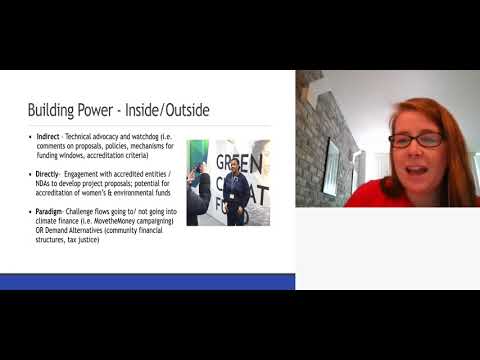
The fourth webinar of a five part series on women's rights and climate finance: Strategies for Organizing to Influence, Monitor, and Track Climate Finance (from Global to Local), focused on strategies to engage with various actors to both facilitate and advocate for the meaningful inclusion of the perspectives and experiences of women's groups, affected communities, and other civil society stakeholders in the design and implementation of projects and programs.
-
 External link / 19 juni 2020
Connecting women’s rights and IFI experts (Annual Report 2019)
When destructive projects are seen through the eyes of local women, it is clear that International financial Institutions (IFIs) are one piece of a large and complicated puzzle. Therefore, in 2019 we brought together experts in women's rights and IFIs to learn from each other.
-
 Video / 1 februari 2018
Webinar series: women’s rights and climate finance, #2
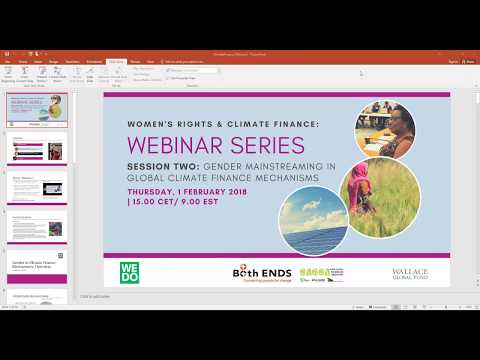
The second session of our five part series on women's rights and climate finance, Gender Mainstreaming in Climate Finance Mechanisms, provided an overview of how gender equality has been mainstreamed into global climate finance mechanisms, including a deep dive on gender considerations under the Green Climate Fund by Liane Schalatek of the Heinrich Boell Foundation - North America.
-
 Video / 7 maart 2018
Webinar series: women’s rights and climate finance, #3
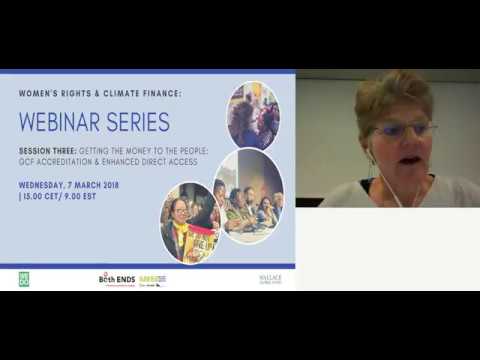
The third session of our five part series on women's rights and climate finance, Getting the Money to the People: GCF Accreditation and Enhanced Direct Action, focused on accessing the Green Climate Fund through working with stakeholders at the country level (engaging with the National Designated Authority), utilizing Enhanced Direct Access, and seeking accreditation.
-
 Video / 28 augustus 2018
Webinar series: women’s rights and climate finance, #5
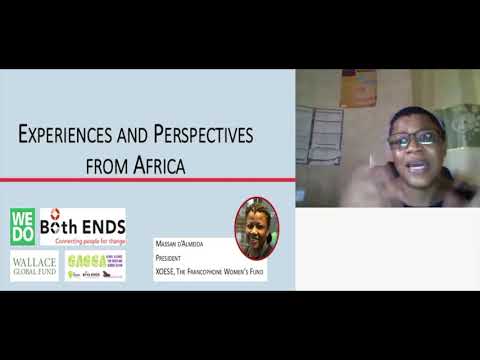
The fifth session of our five part series on women's rights and climate finance, Experiences and Perspectives of Women Engaging in Climate Finance, shared the insights of three activists who have been serving as GCF Monitors as part of the "Women Demand 'Gender-Just' Climate Finance" initiative. They spoke about their processes of learning about climate finance and connecting with others to monitor climate finance in their communities and regions, discussed the value they have found in this work, and answered questions from webinar participants.
-
 External link / 31 mei 2018
Harnessing the power of the women’s rights and environmental justice movements (Annual Report 2017)
It was minus 20 degrees Celsius when 2.000 women gathered at the main square of Ulaanbaatar, Mongolia, to voice their distress about the terrible smog in the city caused by three large power plants. Soon after, the women were invited to speak about the problem of air pollution with the minister of environment.
-
 News / 4 oktober 2017
Reaction to FMOs position statements on human rights, land and gender
On September 20th FMO published its new position statements on human rights, land governance and gender. We appreciate that FMO takes human rights serious and applaud the efforts that have been made to come to an improved position on human rights, land and gender. However, to truly have a positive impact on people and the environment, some important follow up steps are necessary.
-
Publication / 4 oktober 2019
-
Publication / 26 november 2020




