




Driving on palm oil: a dead end
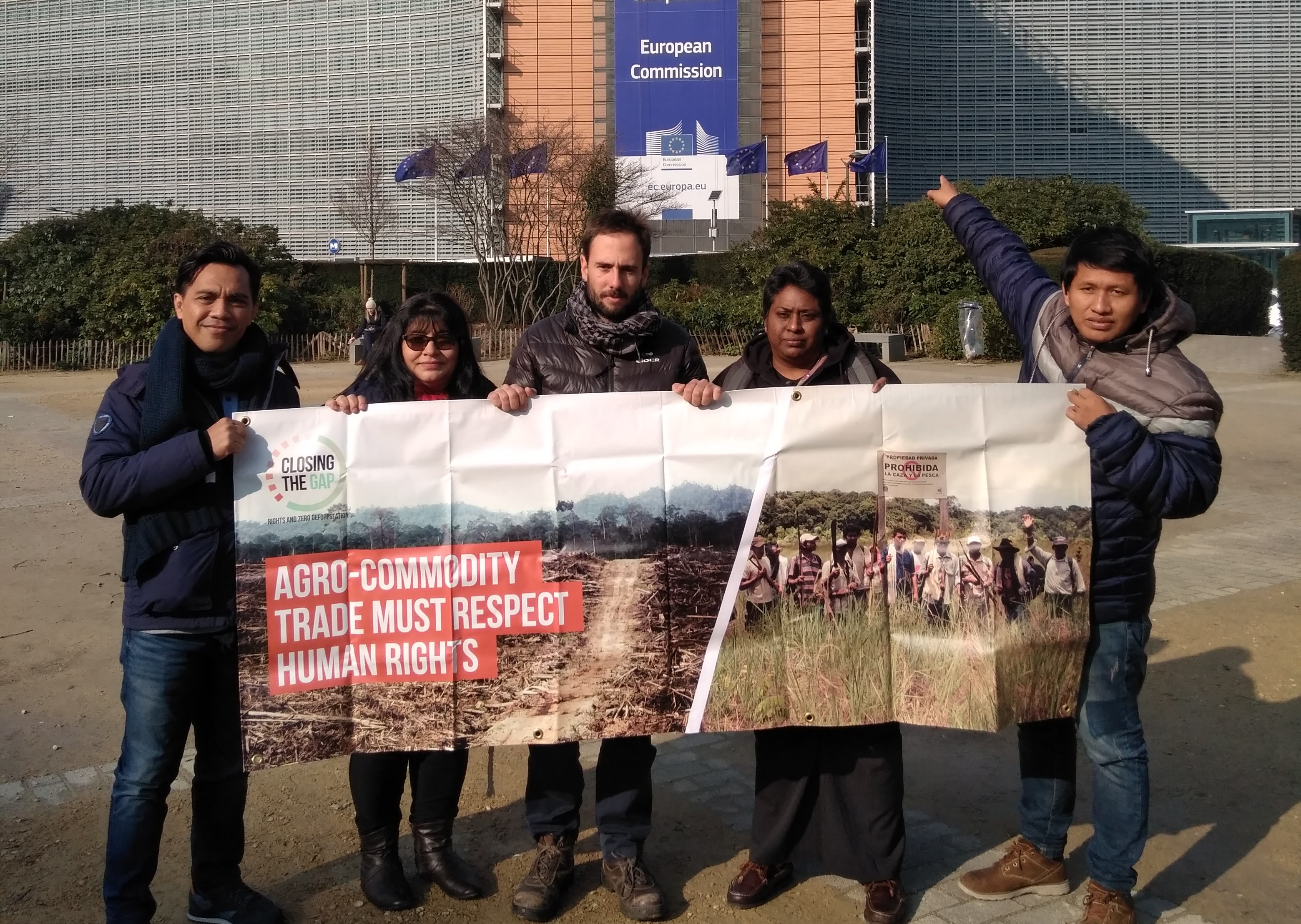
Both ENDS and Forest Peoples Program have formally requested the European Parliament, Commission and Council and the EU Commissioner for Trade, Cecilia Malmström, to consult indigenous and local communities impacted by EU trade in palm oil and other agricultural commodities in formal EU policy deliberations on these topics. Why did we decide to do so and what's it all about? Our colleague Michael Rice sheds some light on the matter.
Almost half the palm oil imported to the EU gets burned as biofuel
Almost half of the palm oil imported into the EU is used for biofuels. "This is an unfortunate consequence of the current Renewable Energy Directive (RED), as it requires EU members to aim to have 10% of their transport industry fueled by renewable sources like biofuels", says Michael. "Because palm oil is one of the cheapest vegetable oils available, it is appealing as biofuel. In order to encourage industries to change their behavior to meet the RED targets, EU members have created various incentives like subsidies for industry to shift to 'renewable energy' sources, including biofuels. Fuel wholesalers have both cost advantages and government incentives to buy palm oil to use as biofuel feedstock."
These extra incentives produced by the RED led to significant increases in the European energy sector's demand for and consumption of palm oil. Some researchers suggest that almost all of the increase in EU demand for palm oil since the introduction of the RED has been caused by the energy industry's use of palm oil as a biofuel, and not because of significant increases in palm oil consumption by other sectors.
At the same time, a growing body of research suggests that the climate impact of EU biofuel is on average 81% worse than conventional diesel when emissions from the deforestation required to build palm oil plantations are taken into account.
What is the biofuels debate really about?
The world is becoming increasingly aware of the problems caused by the large-scale production of palm oil. First of all, communities are displaced from their lands, families are evicted from their homes, and communal forests occupied and relied-upon by customary communities for generations are cleared. Rampant deforestation, often in precious bio-diverse rainforest areas, destroys flora and fauna and leads to soil erosion and degradation of groundwater systems. The heavy use of pesticides and fertilizers pollutes surface water and soil, often contaminating community farmlands and water sources. Last but not least, all this contributes to climate change.
In 2017, the debate about the use of palm oil for biofuels reached the European Parliament, and a resolution was passed calling for the Renewable Energy Directive to be amended so that from 2020 onwards biofuels made from palm oil and other vegetable crops would not be counted as 'renewable energy' for EU member's RED targets.
"The backlash from major palm oil producing countries and industry associations who sell to the EU market has been extreme", says Michael. "We have seen a concerted political, diplomatic and industry effort to oppose the phase-out of palm oil from the RED list of renewable energy sources, particularly through attempting to label the changes to the RED as a ban on palm oil in Europe. Unfortunately, many of the government ministers, ambassadors, CEOs, industry representatives and professional lobbyists from palm oil-producing countries have easy access to EU decision-makers, while community representatives from the same countries have no voice in the EU arena."
For example, on 15 February 2015, the ambassadors to the EU from Indonesia, Malaysia, Thailand, Colombia, Guatemala, Ecuador and Nigeria wrote to the Presidents of the EU Parliament, Commission, Council and representatives of various EU parliament trade, agriculture and energy committees in opposition to the proposed changes to the RED, claiming that the changes would undermine sustainable development and unfairly impact small-scale palm oil farmers. These claims are extremely questionable, but do have political influence.
The three governing institutions of the European Union – the European Parliament, European Commission and European Council, are currently deliberating the revisions to the RED and, in particular, the role of palm oil as a "renewable" energy source.
What's on the table and is it a ban?
The proposed changes to the RED do not contemplate anything like a ban on palm oil. There are no restrictions proposed on the import of palm oil into the EU, or even on the use of palm oil as a biofuel.
The proposal is to exclude palm oil as a 'renewable energy source' for the purpose of counting renewable energy consumption under the RED scheme from 2020 onwards. There are no restrictions whatsoever proposed on the import and use of palm oil in the food and cosmetic industries.
In practice, the proposed changes to the RED will mean that the government and market incentives for biofuel made from palm oil will probably decrease, and the EU energy sector will probably buy less palm oil. Given almost half of palm oil imported into the EU is currently consumed by the energy sector, the EU market for palm oil could shrink by up to half by 2020 if the RED changes are implemented.
It is for these commercial reasons that countries that produce and export large volumes of palm oil to the EU are opposed to the changes to the RED.
Impacted communities are essential participants for balanced and informed EU policy-making
Local and indigenous communities are very much impacted by the global trade in palm oil and other agricultural commodities like soy, beef, timber, pulp and paper, but are too often left out of EU trade policy-development processes. "We want to change this", says Michael, "as we believe it is very important to make EU policy processes inclusive and accessible for all stakeholders, especially for communities at the upstream end of EU supply chains who stand to suffer extreme hardship and rights violations if EU policy-making doesn't recognize them."
For these reasons, Both ENDS and Forest Peoples Programme issued a formal request to the Presidents of the European Parliament, Commission and Council on 17 April 2018 and to the EU Commissioner for Trade, Cecilia Malmström on 27 April 2018, requesting that local and indigenous community representatives from palm oil-producing regions be given equal access and involvement in EU deliberations on trade and biofuels policies.
Read more about this subject
-
 Dossier /
Fighting for improvements in the production of palm oil
The production of palm oil is causing social and environmental problems worldwide. Both ENDS is working to make the sector fairer and more sustainable and is promoting alternatives for palm oil.
-
 Dossier /
Trade agreements
International trade agreements often have far-reaching consequences not only for the economy of a country, but also for people and the environment. It is primarily the most vulnerable groups who suffer most from these agreements.
-
 Dossier /
International trade and investment with respect for people and planet
The network of international trade and investment treaties is large and complex. The Netherlands alone has signed more than 70 bilateral investment treaties (BITs) and is party to the trade and investment agreements concluded by the EU, like the EU-Mercosur and EU-Indonesia trade deals.
-
 Press release / 29 september 2026
New Zealand faces its first climate complaint under EU trade rules
UTRECHT / WELLINGTON, 29 September 2026 /30 September in Aotearoa New Zealand
Both ENDS, a Dutch environmental justice organisation, has lodged a formal complaint with the European Commission arguing that New Zealand has broken the climate promises it made in its free trade agreement with the European Union. It is the first complaint on environmental and climate grounds under the Commission's Single Entry Point, the mechanism that lets civil society ask the EU to enforce the sustainability commitments in its trade agreements.
-
 Dossier /
Communities Regreen the Sahel
In various countries in the Sahel, vast tracts of land have been restored by the local population by nurturing what spontaneously springs from the soil and protecting the sprouts from cattle and hazards.
-
Publication / 3 juli 2026
-
Publication / 18 juni 2026
-
 News / 24 maart 2026
Statement: Invest in local leadership for tropical forest management and local economies
IUCN-NL, Both ENDS, and 16 other Dutch and international civil society organizations (CSOs), networks, and expert groups are calling on the Dutch government to invest more strongly in locally led forest management and forest-based economies. This should be done within the framework of Dutch international cooperation and its associated policy instruments.
-
 Dossier /
Wetlands without Borders
With our Wetlands without Borders program, we work towards environmentally sustainable and socially responsible governance of the wetlands system of the La Plata Basin in South America.
-
Publication / 17 november 2025
-
 Environmentally Just Practice /
Non-Timber Forest Products (NTFPs)
About one in every six people, particularly women, directly rely on forests for their lives and livelihoods, especially for food. This shows how important non-timber forest products (NTFPs) and forests are to ensure community resilience. Not only as a source of food, water and income, but also because of their cultural and spiritual meaning.
-
Publication / 16 oktober 2025
-
Publication / 16 oktober 2025
-
 News / 23 september 2025
With the undemocratic splitting of the EU-Mercosur deal, Europe is missing the chance to lead on fair trade
Recently, many newspapers have written about Brussels’ rush to finalize the trade agreement between the EU and the South American Mercosur countries. According to the European Commission, national parliaments do not need to approve it because the trade part and the “political” part have been separated. This “splitting” means that the trade part can be approved as an EU-only decision by the European Council and the European Parliament, while national parliaments are sidelined and the political-cooperation part is postponed. Both ENDS and its partners are deeply concerned and are calling on the Dutch government to vote against this outdated agreement.
-
 News / 22 september 2025
EU-Indonesia Trade Deal Threatens Communities and Environment
On September 23th the European Union and Indonesia concluded their negotiations of the EU-Indonesia Comprehensive Economic Partnership Agreement (CEPA), a free trade agreement between the EU and Indonesia. Both ENDS condemns this agreement for favoring corporate interests over those of local communities and the environment.
-
 News / 11 september 2025
EU-Mercosur: Small GDP Gain, Big Question Marks for Farmers and Democracy
A recent report by Wageningen Economic Research (WER) on the economic consequences of the trade agreement between the EU and Mercosur confirms what civil society organizations, policymakers, and trade unions have been signaling for years: this agreement does not offer a balanced perspective for farmers and the environment. Instead, it increases power inequalities and shifts burdens onto (small-scale) farmers. Moreover, the deal risks reinforcing unsustainable practices that complicate the climate transition and addressing environmental challenges in both the EU and Mercosur countries.
-
 Dossier /
Soy: trade in deforestation
The rising demand for soy is having negative consequences for people and the environment in South America. Both ENDS reminds Dutch actors in the soy industry of their responsibilities and is working with partners on fair and sustainable alternatives.
-
 News / 9 september 2025
Simplification Must Not Mean Weakening: Why the EUDR and other Environmental Legislation Must Stay Strong
Both ENDS warns that the current debate on “simplification” of EU environmental law must not become an excuse to weaken or postpone urgently needed safeguards. In earlier contributions to the drafting of the EU Deforestation Regulation (EUDR), Both ENDS relayed the voices of local and Indigenous forest-dependent peoples, who consistently urged the EU to take responsibility for the massive deforestation linked to European imports. They underlined how this deforestation destroys biodiversity, undermines climate stability, and erodes their rights, livelihoods and cultures.
-
 Blog / 17 juli 2025
A disaster for farmers: here and there
The trade agreement with South America is harmful to farmers, the climate, and biodiversity, on both sides of the Atlantic. It’s time to take this deal off the table once and for all, argues Fernando Hernandez, Senior Policy Officer for Trade and Investment at Both ENDS.
-
 Dossier /
Fair Green and Global Alliance (FGG)
Together with civil society organisations from all over the world, the Fair Green and Global (FGG) Alliance aims for socially just, inclusive and environmentally sustainable societies in the Netherlands and the Global South.




