


Despite violence, 900 million euros in Dutch export support to Van Oord in Mozambique
Amsterdam, 19 May 2021 – On 25 March, a day after violent attacks in northern Mozambique, the Dutch state decided to provide dredging company Van Oord with export credit insurance worth 900 million euros for its activities in the country. The company is conducting dredging operations for a highly controversial gas project that, according to Mozambican interest groups, is playing a prominent role in the escalating violence in the region. Civil society organisations Both ENDS, Milieudefensie and Oil Change International and their Mozambican partners are alarmed about the situation and have called the Dutch government and Dutch export credit agency Atradius DSB to account.
On 24 March, there was a violent attack in the town of Palma, which led to dozens of deaths and caused thousands of people to flee their homes. Employees of multinational companies like Van Oord and Total had to leave the area under armed escort. Total has provisionally suspended the project, claiming force majeure.
"State Secretary for Finance Hans Vijlbrief and Minister for Foreign Trade and Development Cooperation Sigrid Kaag decided a day earlier to approve the enormous export credit insurance", says Niels Hazekamp of Both ENDS. "Inconceivable and a slap in the face for all the residents of the area, who are the victims of the gas project. Unfortunately, despite our attempts to obtain information, the ministries and Atradius DSB themselves are anything but transparent. The insurance has now been approved with no further explanation – and for 900 million euros rather than the 600 million originally mentioned."
Human rights violations, climate damage and economic risks
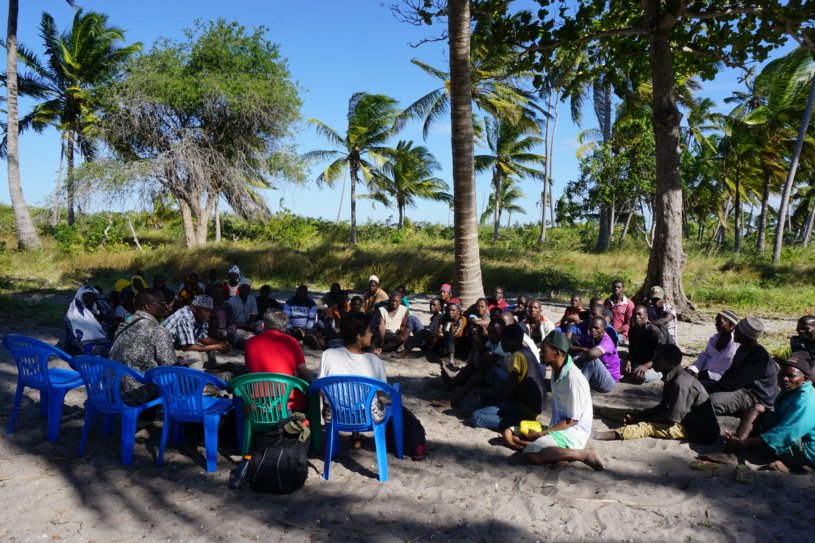
Civil society organisations have been involved in discussions on this project with the ministries and Atradius DSB for several years and have warned from the beginning of the human rights violations, climate damage and economic risks it brings with it. Farmers and fishers have lost access to their fertile land and fishing grounds and have had to leave their homes. The gas extraction has fuelled the unrest and violence in the region. Since 2017, more than 2,600 people have been killed and half a million forced to flee their homes.
"The Dutch state should never have provided insurance for activities that violate human rights, exacerbate the climate crisis and create economic risks in the first place," says Laurie van der Burg of Oil Change International. "Van Oord should never have decided to invest in the project. The local people are left behind with all the destruction it has caused and are receiving help from no one, while Van Oord can now stop relatively easily because it can retrieve its losses from Atradius DSB – in other words, the Dutch state."
Fossil infrastructure is becoming worthless
"Almost a billion euros in export support for a fossil project not only goes completely against the climate goals of the Paris Agreement but also saddles Mozambique with an enormous fossil infrastructure – and the risks it brings with it", says Isabelle Geuskens of Milieudefensie. "With the whole world changing to sustainable energy, Mozambique would benefit much more from sustainable energy projects. There is enormous potential for such projects but this is not being taken advantage of, partly because of fossil investments. It is worrying that the Dutch state is giving priority to the short-term economic interests of Dutch companies at the expense of human rights, climate justice and a sustainable economy in Mozambique.
Such abuses have recently also come to light in other projects insured by Atradius DSB. Civil society organisations therefore call on the ministers and decision-makers involved to give account for this decision, to no longer provide support for fossil energy projects in the future and to come up with a plan to provide as much help as possible to the Mozambican people affected by this project. They are also demanding a plan to ensure that such projects are not provided with support in the future. "In terms of export support, too, the government is in need of new leadership," says Hazekamp. "Transparent, human rights to the fore, and fossil-free."
Read more about this subject
-
 Dossier /
Gas in Mozambique
In 2011 one of the world’s largest gas reserves was found in the coastal province of Cabo Delgado, in the north of Mozambique. A total of 35 billion dollars has been invested to extract the gas. Dozens of multinationals and financiers are involved in these rapid developments. It is very difficult for the people living in Cabo Delgado to exert influence on the plans and activities, while they experience the negative consequences. With the arrival of these companies, they are losing their land.
-
 News / 7 September 2026
Unprecedented criminal conviction in the Mariana disaster case breaks mining industry's cycle of impunity
A Brazilian federal court has, for the first time, criminally convicted a mining company and three of its managers for their role in the 2015 collapse of the Fundão dam, one of the worst environmental disasters in Brazil's history. Our partner Instituto Cordilheira, which represented victims as assistant prosecutors in the case, calls it a historic breakthrough after years of impunity.
-
 News / 3 September 2026
Restoring Land, Restoring Hope: Both ENDS at UNCCD COP17 in Mongolia
From 17 to 28 August, governments gathered in Ulaanbaatar, Mongolia, for COP17 of the UN Convention to Combat Desertification (UNCCD). At stake was more than how the world responds to land degradation and drought. It was also a question of who gets to shape land restoration, whose knowledge counts, and where the money goes.
-
Letter / 14 July 2026
Statement on CAO Cambodia Microfinance Case
The independent complaints mechanism of the International Finance Corporation (IFC) and the World Bank Group found that the IFC violated its own Environmental and Social Sustainability Framework by investing in six banks providing microfinance in Cambodia.
-
 News / 6 July 2026
Strengthening Women's Land Rights Across the Rio Conventions
From 29 June – 2 July 2026, Tamara Mohr, GAGGA coordinator at Both ENDS participated in the 4th convening of the Women's Land Rights Initiative (WLRI) in Nairobi, Kenya.Hosted by the Robert Bosch Stiftung, TMG Research and the Huairou Commission, the event brought together grassroots organisations, (inter)national NGOs, government institutions and donors from around the world.
-
Publication / 3 July 2026
-
 Dossier /
Finance for agroecology
The lion's share of public budgets for climate, agriculture and development still goes to conventional agroindustrial projects that contribute to the current climate, food and biodiversity crises. Both ENDS and our partners are calling for a transition to agroecological practices that are people- and environment-friendly.
-
Publication / 18 June 2026
-
Publication / 12 May 2026
-
 Press release / 12 May 2026
UN report warns of a growing sand crisis - The Dutch dredging sector plays a key role in global sand extraction
GENEVA/UTRECHT, 12 May 2026 – A new report by the United Nations Environment Programme (UNEP), Sand and Sustainability: An Essential Resource for Nature and Development, warns that global demand for sand is exceeding ecological limits. Large-scale extraction of sand from marine and coastal ecosystems is leading to biodiversity loss, damage to coastal communities and increasing risks in an era of climate change. Dutch dredging companies play a prominent role in this as global market leaders in large-scale sand extraction and land reclamation. “Our analyses show that the dredging sector operates globally within a system in which ecological damage and the consequences for coastal communities are systematically underestimated, whilst transparency and effective oversight are often lacking,” says the Dutch environmental and human rights organisation Both ENDS, which contributed to the report.
-
 Dossier /
Rights for People, Rules for Corporations – Stop ISDS!
Indigenous communities in Paraguay saw their attempts to regain their ancestral lands thwarted by German investors. In Indonesia, US-based mining companies succeeded to roll back new laws that were meant to boost the country’s economic development and protect its forests. This is the level of impact that investment treaties can have on social, environmental and economic development and rights. Why? Because of the ‘Investor-to-State Dispute Settlement’ clauses that are included in many such treaties.
-
Publication / 14 April 2026
-
Publication / 10 April 2026
-
 News / 10 April 2026
Both ENDS: strengthened FMO complaints mechanism is a step forward, but major gaps remain
Both ENDS welcomes the strengthened Independent Complaints Mechanism (ICM) of development finance institutions FMO, DEG and Proparco as an important step forward in accountability. Working directly with communities affected by development projects, we see daily how essential it is that people can access justice when they are harmed in the name of development. For many communities, this mechanism is one of the few avenues through which harm can be formally recognised and addressed in relation to these development banks.
-
 News / 9 April 2026
Minister Sjoerdsma hosts roundtable conversations with civil society
This week, Minister Sjoerdsma organized roundtable conversations with civil society organizations – a valuable initiative that brings together Dutch civil society voices to address critical challenges faced by democratic societies.
-
 News / 26 March 2026
New project: Climate Accountability in EU Trade
Through its new project “Climate Accountability in EU Trade: Testing the SEP and DAGs for Climate-Linked FTA Enforcement” Both ENDS, with support from the European Climate Foundation, is exploring how the European complaints mechanism (SEP) and Domestic Advisory Groups (DAGs) can be more effectively used to advance climate accountability. The project runs for 13 months, until end of 2026.
-
 News / 24 March 2026
Statement: Invest in local leadership for tropical forest management and local economies
IUCN-NL, Both ENDS, and 16 other Dutch and international civil society organizations (CSOs), networks, and expert groups are calling on the Dutch government to invest more strongly in locally led forest management and forest-based economies. This should be done within the framework of Dutch international cooperation and its associated policy instruments.
-
 News / 19 March 2026
Winners of the ILED ‘Women Are Educators Award’ announced
Our partner organisation ILED (Indigenous-led Education Network) announced the seven winners of the ILED ‘Women Are Educators Award’ this month. These are women who play extraordinary roles in passing on knowledge, whether in formal or informal educational settings.
-
 Dossier /
Global Alliance for Green and Gender Action (GAGGA)
GAGGA rallies the collective power of the women's rights and environmental justice movements to realize a world where women can and do access their rights to water, food security, and a clean, healthy and safe environment.
-
 News / 27 February 2026
Both ENDS strengthens the resilience of female environmental defenders worldwide thanks to multi-year contribution from the Postcode Lottery
In recent years, Both ENDS has received an additional contribution of €875,000 from the Postcode Lottery for the Autonomy & Resilience Fund (2022–2025), implemented in collaboration with the Global Alliance for Green and Gender Action (GAGGA). This support was essential because female environmental rights defenders around the world are increasingly facing climate change, repression and shrinking civil space. With this contribution, Both ENDS supports female activists and their communities with flexible, trust-based funding, enabling them to develop their own solutions to urgent environmental and climate problems.




