


Who benefits from better protection of our oceans?
The ocean emerged strengthened from the UN Ocean Conference in Nice. More countries are supporting a ban on deep-sea mining, more marine protected areas are being established, and more pledges are being made to fight pollution. The question now is whether countries will follow through on their commitments. Because the ocean movement faces a camp of powerful interests.
This article was originally posted in Dutch on MO*Magazine.
If you listen carefully, Nice splits in two. There is deafening noise and there are voices. For ten days, the city on the Côte d’Azur was engulfed by the third Ocean Conference. On the streets, no one escapes the wailing of sirens and motorcades heading to the Nice harbor. That is where the official conference takes place, in the tightly secured Blue Zone. But here, beneath the concrete arches of the Exhibition Palace, the general public is welcomed.
The palace has been dressed up by an event agency like a trade fair. It’s been named The Whale, to stay on theme. A French bank, deeply entangled in the occupation of Palestine (BNP Paribas), helped fund it. A French shipping company, with the world's third-largest cargo fleet (CMA-CGM), is the main sponsor. It loudly proclaims its reform. By 2050, its ships will no longer run on fuel but on gas. Thus speaks the noise of greenwashers.
But other voices also find cracks in the palace. At the Ocean Base Camp, eight people from three continents sit in a circle. They practice deep listening. “And what I hear,” says Bekaye Sy Samba, “is a beautiful cri du coeur,” a cry from the heart. He advocates for his fishing community in Mauritania, who catch nothing anymore unless they go deep into the ocean.
Blue Fortresses
French President Macron wanted to make a splash with this Ocean Conference. He hoped that at least 60 countries would ratify the 30x30 treaty during the summit week. That would bring the treaty into effect and allow reserves to be designated in international waters. If at least 30% of the oceans are not protected by 2030, the ocean can never recover from current overfishing, pollution, and industrial aggression.
On day one of the conference, the number of ratifying countries jumped to 50. Belgium also ratified the treaty and is even offering to host the new international secretariat for the ocean treaty. However, the goal of 60 countries was not reached at the conference.
The promises made at the top also meet with broad skepticism. Some label the 30x30 agenda bluntly as fortress conservation, where marine reserves are established as blue fortresses that no one may enter. That’s one reason why the World Forum of Fisher Peoples (WFFP) is boycotting the ocean conference.
“We fully support the UN bodies,” says Terence Repelente on behalf of the WFFP, “but we do not participate in UNOC. The conference is driven by big conservation groups and transnational corporations. During consultations, wealthy organizations, including philanthropic foundations, dominate the conversation. We lack those resources and have no access to those consultations.”
Here in Nice, Terence Repelente splits himself in two. He carries a mandate from the WFFP but is also a grassroots worker defending coastal people in his home country, the Philippines, for whom the ocean is both livelihood and life. For them, he does participate in UNOC3.
It’s a paradox, but ocean protection puts these coastal residents at risk. “We are an archipelago,” says Terence. “Our islands have thousands of kilometers of coastline. But under the guise of green development, entire coastal areas are being closed off to us. And private enterprises are taking over the seas in front of our shores.”
In Ilocos Norte, the northern tip of Luzon island, the company BuhaWind is building a wind farm that must generate 2,000 megawatts of electricity. The turbines stretch from close to shore to 18 kilometers out to sea. The fishermen’s organization Pamalakaya strongly opposes the project. It could displace 6,339 registered fishers and their families from at least four locations. But many fishers are unregistered.
Pamalakaya is taking on BuhaWind; a joint venture of the Philippine PetroGreen and Danish Copenhagen Energy and the Philippine government. The wind farm supposedly fits into the policy to reduce greenhouse gas emissions. More offshore wind farms are planned. By 2030, they are expected to generate 28 gigawatts of electricity.
“But we gain nothing from these projects on the contrary,” says Terence. “Around each turbine is a 50-meter no-fishing zone. Green energy is good, but not at the expense of coastal communities.”
Belgian and Dutch Interests
Back to the conference in Nice. Near The Whale, in the community center of Alternatiba, activist groups discuss what they can do for the ocean. One of the key conclusions is naming and shaming: calling out aggressors by name and exposing their connections. That’s how you hurt them and force change.
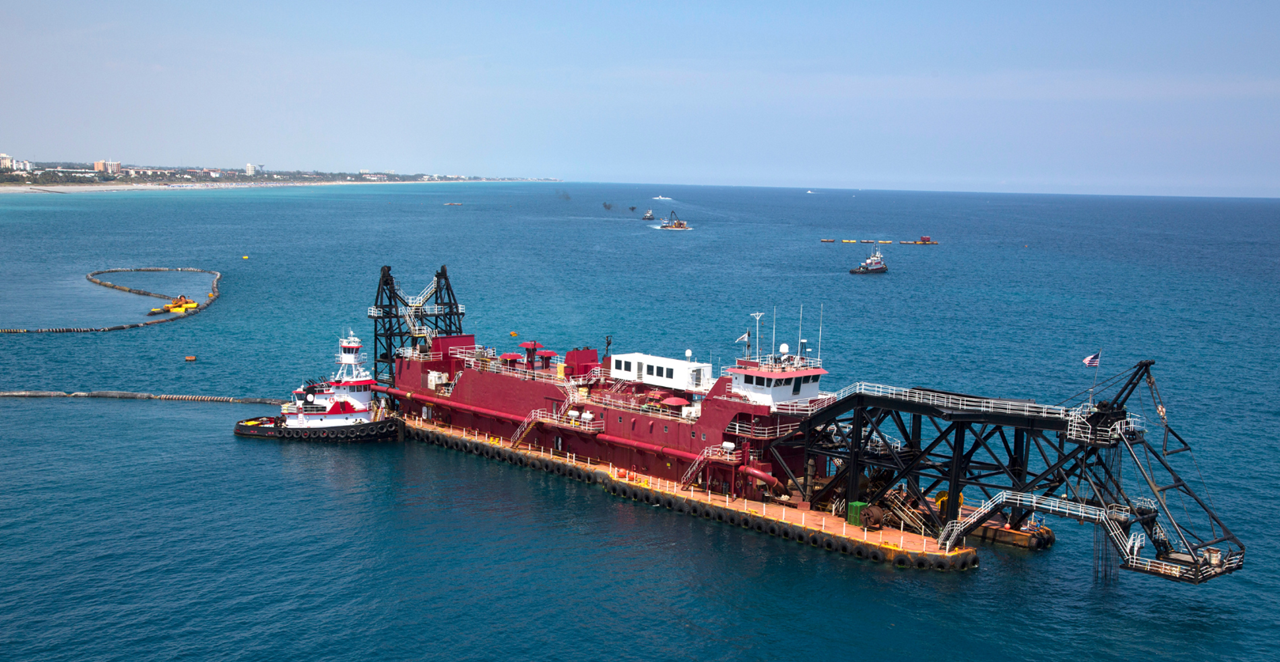
Belgian and Dutch companies also come under scrutiny. The Dutch dredging group Boskalis, for example, is reclaiming land in the bay of the Philippine capital Manila for AeroCity, a new city around a new international airport. Boskalis claims to follow international standards to minimize AeroCity’s social and environmental risks.
But that claim clashes with reality. The Bulacan coastal area in Manila Bay must be strictly protected for its biodiversity, as stated in a Dutch-led master plan. Yet Boskalis is carrying out a massive 1,700-hectare construction there, involving the forced relocation of hundreds of residents and threats to various coastal ecosystems, according to NGO Global Witness. Moreover, Boskalis received the billion-euro contract from San Miguel, a company with a history of human rights violations.
The violations continue, despite all the paper promises and certifications. Activist Jonila Castro of Kalikasan, a Philippine environmental network, only learned four days before the Ocean Conference that she could travel to Nice. That day, a court dismissed a lawsuit filed against her and her colleague Jhed Tamano by the Philippine military leadership.
Jonila and Jhed disappeared in September 2023. They resurfaced during a press conference by the National Task Force to End Local Communist Armed Conflict, the Philippine government’s communist-hunting unit. That task force wanted them to admit they were communist party members. Instead, they revealed they had been kidnapped by the army and interrogated and mentally tortured for 17 days in a military camp.
The military leadership was furious and accused Jonila and Jhed of slander. But now, the court confirmed their version of events and dismissed the charges. The trauma remains. Jonila struggles to talk about the abduction. “But I must testify,” she says. “Activists are still being assassinated, so I have to speak about what I know and do.”
At the time of her arrest, Jonila was collecting information about a new land reclamation project in Bataan, a peninsula next to Manila Bay. The Kalikasan network knows of 239 such projects: large and small, in various stages of implementation.
Jonila Castro: “They’re building casinos, hotels, eco-tourism projects. All for the country’s development, says the government. But development is meant to meet people’s needs, right? Now, mangrove forests are being cut down, there are no more fish, marine life is being wiped out, entire communities are forced to move to the cities. And in the end, even our natural defense against rising sea levels is destroyed, and all our coasts are flooded.”
“The Netherlands bears responsibility,” says Murtah Shannon. He works in the Netherlands for Both ENDS, an organization that supports Filipino activists and practices international solidarity.
Murtah investigated the Dutch connection in this case. “The dredging company Boskalis,” he explains, “received an export credit insurance for Manila Bay from Atradius, an institution under the Dutch Ministry of Foreign Affairs (comparable to Credendo in Belgium). Atradius twisted expert findings and ignored warnings about the risks. That allowed Boskalis to win the contract with a substandard environmental and social impact assessment. I know Belgian competitors are very frustrated about that.”
A Web of Voices
The ocean movement shows that things can be done differently. In the Pacific, island states are working together to protect their seas in their own way. During this UN Ocean Conference, the Solomon Islands and Vanuatu announced the Melanesian Ocean Reserve—the first in the world, they emphasize, to be under indigenous stewardship.
Once completed, it will encompass the seas and islands of Vanuatu, the Solomon Islands, Papua New Guinea, and the French overseas territory of New Caledonia, covering over 6 million square kilometers. Economic activity will be allowed, but with respect for the values rooted in the millennia-old symbiosis between the peoples and the ocean.
One of the drivers of this Melanesian Ocean Reserve is Ralph Regenvanu, a minister in Vanuatu responsible for climate action. Regenvanu also leads the resistance against deep-sea mining; a new industry aiming to extract metals from the ocean floor. Promoters of deep-sea mining, with Belgian dredging group DEME at the forefront, hope to deploy their excavation machines in international waters as soon as possible. That requires an amendment to international maritime law.
In April, the Trump administration said it would ignore that law and unilaterally support deep-sea mining and push for its swift start. If that actually happens, legal experts say the U.S. would be guilty of piracy.
But the American government aligns its stance with the interests of The Metals Company. This Canadian-American firm is developing machines and industrial processes, together with the Dutch company Allseas, to exploit metal-rich rocks from the deep sea. The duo claims they are ready to begin mining soon.
Their disregard for legal norms is backfiring. It’s strengthening the front against deep-sea mining. During the Ocean Conference, four more countries endorsed a moratorium on deep-sea mining: Luxembourg, Lithuania, Slovenia, and Cyprus.
Earlier this year, the Marshall Islands did the same. The moratorium would prohibit deep-sea mining until its impact and mitigation measures are fully understood. The number of countries backing the moratorium now stands at 37. Notably, European Council President Antonio Costa also called for a moratorium in Nice.
Ocean Movement
For all the declarations, it was said at the end of the Ocean Conference, the summit’s impact remains limited. It is not a permanent UN body and cannot enforce anything. Without real action, there will be no progress.
Here, the ocean movement learns from the climate crisis debate, which also began from a recognition of hard facts. Big Oil, Big Finance, and Big Business continue to orchestrate doubt and sabotage a genuine transition to a sustainable society. The same lobbies influence the ocean debate.
A key difference: climate scientists have been building knowledge for a long time, but oceanologists still know very little about the ocean and deep sea. Only a quarter of the ocean floor has been mapped, and researchers know barely 1% of the ecosystems. They can only guess at what they might find.
The next Ocean Conference will take place in 2028, hosted by Chile and South Korea. By then, the movement of voices for the ocean will have grown stronger; the human voices, and the voices of the sea itself. Because those are becoming more urgent too.
For more information
Read more about this subject
-
 Environmentally Just Practice /
A Negotiated Approach for Inclusive Water Governance
A Negotiated Approach envisages the meaningful and long-term participation of communities in all aspects of managing the water and other natural resources on which their lives depend. It seeks to achieve healthy ecosystems and equitable sharing of benefits among all stakeholders within a river basin. This inclusive way of working is an essential precondition for the Transformative Practices that are promoted by Both ENDS and partners.
-
Publication / 3 July 2026
-
Publication / 12 May 2026
-
 Press release / 12 May 2026
UN report warns of a growing sand crisis - The Dutch dredging sector plays a key role in global sand extraction
GENEVA/UTRECHT, 12 May 2026 – A new report by the United Nations Environment Programme (UNEP), Sand and Sustainability: An Essential Resource for Nature and Development, warns that global demand for sand is exceeding ecological limits. Large-scale extraction of sand from marine and coastal ecosystems is leading to biodiversity loss, damage to coastal communities and increasing risks in an era of climate change. Dutch dredging companies play a prominent role in this as global market leaders in large-scale sand extraction and land reclamation. “Our analyses show that the dredging sector operates globally within a system in which ecological damage and the consequences for coastal communities are systematically underestimated, whilst transparency and effective oversight are often lacking,” says the Dutch environmental and human rights organisation Both ENDS, which contributed to the report.
-
 News / 24 March 2026
Statement: Invest in local leadership for tropical forest management and local economies
IUCN-NL, Both ENDS, and 16 other Dutch and international civil society organizations (CSOs), networks, and expert groups are calling on the Dutch government to invest more strongly in locally led forest management and forest-based economies. This should be done within the framework of Dutch international cooperation and its associated policy instruments.
-
 News / 27 February 2026
Both ENDS strengthens the resilience of female environmental defenders worldwide thanks to multi-year contribution from the Postcode Lottery
In recent years, Both ENDS has received an additional contribution of €875,000 from the Postcode Lottery for the Autonomy & Resilience Fund (2022–2025), implemented in collaboration with the Global Alliance for Green and Gender Action (GAGGA). This support was essential because female environmental rights defenders around the world are increasingly facing climate change, repression and shrinking civil space. With this contribution, Both ENDS supports female activists and their communities with flexible, trust-based funding, enabling them to develop their own solutions to urgent environmental and climate problems.
-
 News / 17 February 2026
Civic space at the frontlines: "Build strong coalitions and counter repressive regimes"
Today, we look back on an inspiring event Civic space at the frontlines -
Environmental Defenders and the Role of International Trade and Investment Policy. The panel exist of Michel Forst, UN Special Rapporteur Environmental Defenders under the Aarhus Convention, Suzanne Kröger, Member of Parliament for GroenLinks–PvdA, Dr. Margit van Wessel, Associate Professor at Wageningen University, Anne de Jonghe, policy advisor at Both ENDS, and Jonila Castro, national spokesperson for Kalikasan People's Network for the Environment. With an audience of CSO experts, academics, accountability experts and students we discussed the effects of Dutch economic activity on Environmental Defenders, and what we all can do to support those on the front lines of the fight for the environment and human rights. -
Event / 26 January 2026
Civic space at the frontlines
Environmental Defenders and the Role of International Trade and Investment Policy
Both ENDS invites you to an interactive dialogue with experts from the UN, policy, academia, and civil society on environmental defenders and international trade. Together, we will explore how citizens, policymakers, academics, and activists can defend civic space and support those on the frontlines of environmental and human rights struggles. With a focus on the Netherlands’ role in international trade and investment policy, and drawing on the experiences of activists from the Philippines, the event aims to foster solidarity and identify strategic priorities to better protect environmental defenders amid the global crackdown on civic space
-
 News / 27 November 2025
Communities and International Consortium Present Community-Led Plan for Nature-Based Adaptation to Sea-Level Rise in Coastal Bangladesh
Local communities in the southwestern coastal region of Bangladesh—together with an international consortium including Uttaran, CEGIS, and Both ENDS—have presented a community-led plan to confront climate change and accelerating sea-level rise through nature-based adaptation. The People’s Plan for Upscaling Ecosystem-Based Adaptation outlines a scalable strategy rooted in local ownership and generations of lived experience. At its centre is Community-Based Tidal River Management (CBTRM), a proven approach that reduces waterlogging, raises land elevation, and restores ecological balance by working with natural tidal and sediment dynamics.
-
 Dossier /
Wetlands without Borders
With our Wetlands without Borders program, we work towards environmentally sustainable and socially responsible governance of the wetlands system of the La Plata Basin in South America.
-
Letter / 14 November 2025
Letter: TPAC’s report “Final Judgement Detailed Research MTCS’’
A coalition of Malaysian and international NGOs has released a memorandum in response to the recent TPAC report on the Malaysian Timber Certification Scheme (MTCS). The organisations express serious concerns about the independence, quality, and credibility of the assessment carried out by the Timber Procurement Assessment Committee (TPAC).
-
Publication / 9 October 2025
-
 Dossier /
Amplifying environmentally just practices
Because of the close relationship with their living environment, local communities often have the best ideas for the sustainable and equitable use and governance of land, water and forests. These environmentally just practices and processes successfully protect and restore ecosystems and address climate change. They are essential in the light of the multiple crises the world faces, but are in dire need of financial and policy support.
-
 News / 10 July 2025
Both ENDS and Global Witness condemn harassment of anti-reclamation activists in Manila Bay
Global Witness and Both ENDS strongly condemn the reported of harassment and surveillance by the Armed Forces of the Philippines of environmental activists and fishing communities in Navotas, Philippines. Pamalakaya-Pilipinas, a National Federation of Small Fisherfolk Organisation in the Philippines, has received credible reports that the Armed Forces of the Philippines (AFP) are engaged in “red-tagging” their members.
-
Publication / 1 July 2025
-
 News / 6 June 2025
Both ENDS at the UN Ocean Conference: voicing our environmental justice concerns about the “Blue Economy”
Next week, the United Nations Ocean Conference will take place in Nice, France. This conference is focused on the conservation and sustainable use of coasts, seas and marine resources. Both ENDS colleague Murtah Shannon will be attending. We’ve asked him to explain a bit more about his plans.
-
 Dossier /
Inclusive ways to sustainable and healthy food for all
All around the world small-scale farmers are using sustainable and inclusive methods to produce food. Working together with nature and each other, they provide their families and communities with sufficient and healthy food. But their production methods are under pressure from large-scale agriculture and the globally dominant system of industrial food production. Together with our partners, Both ENDS is trying to turn the tide in favour of sustainable, local practices that are mostly known as 'agro-ecological' or 'nature-inclusive'. Why are we focusing on these methods? Agro-ecological practices are climate-proof and inclusive and increase the opportunities for communities around the world to produce their food sustainably.
-
 News / 21 March 2025
Dutch Royal couple visits Thogoto Forest: a green oasis on the outskirts of Nairobi
This week, King Willem-Alexander and Queen Máxima visited Thogoto Forest as part of their state visit to Kenya. They were able to see the impact of the work of our partner MCDI in the area: a restored forest, clean water and farmers who can earn a living by selling their agro-ecological products.
-
 Blog / 28 January 2025
Sinking promises in Manila
Yesterday, Global Witness published a new report, "Sunk Costs" - in which I had a modest role to play - that comes up with new facts about the disastrous New Manila International Airport project in the Philippines, for which the Dutch dredging multinational Boskalis received Dutch export credit insurance (ekv) of €1.5 billion.
-
Publication / 16 January 2025




