


Trading Away the Future: How the EU-Mercosur deal fails people and the planet - and what needs to be done
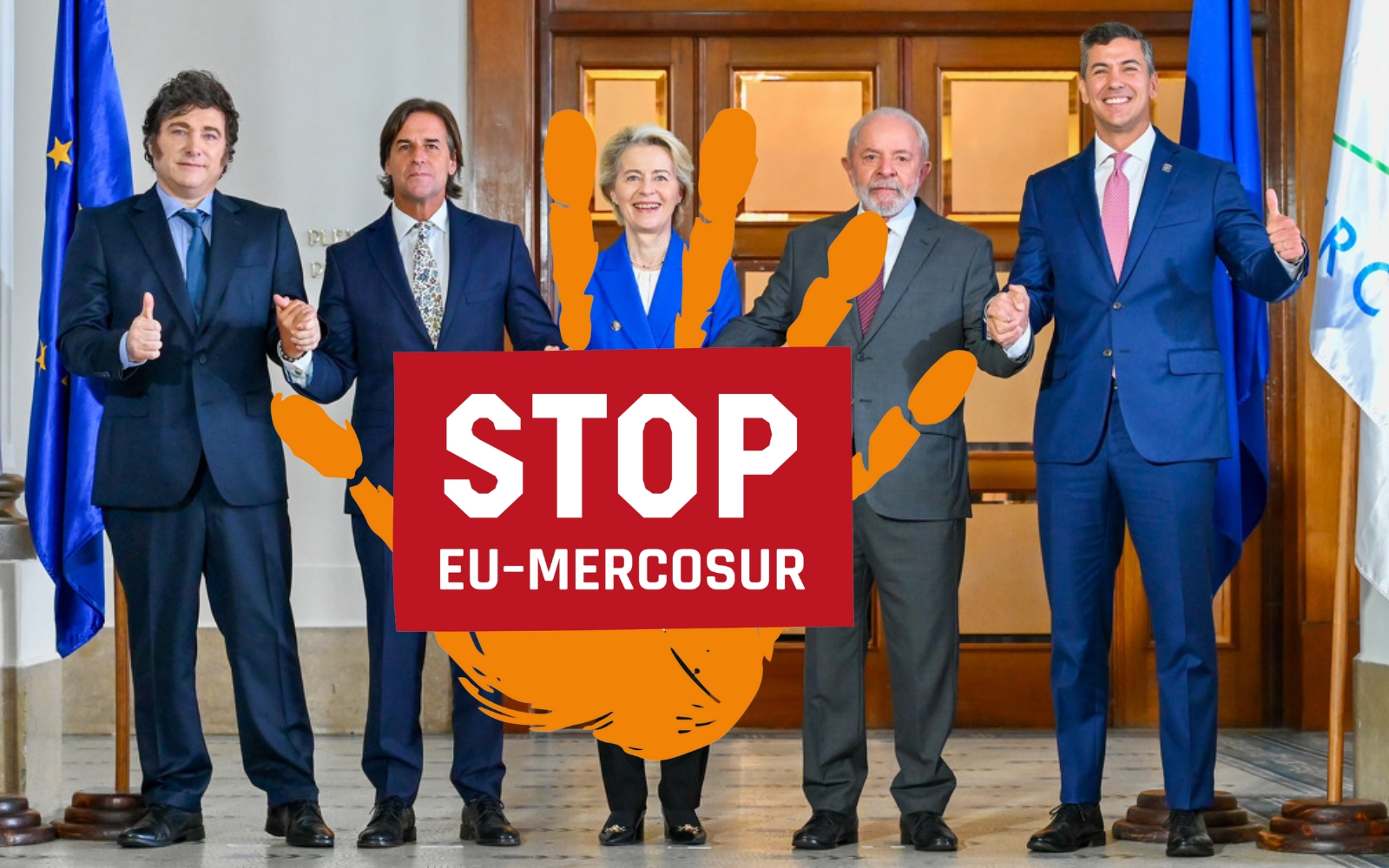
On December 6, the visit of European Commission President Ursula von der Leyen to the Mercosur Summit sealed the agreement on the final text of the EU-Mercosur Association Agreement. Both ENDS condemns this damaging agreement for undermining human rights, the environment, and democracy in Europe, and in Mercosur countries. Should the agreement be ratified as it stands, it will have devastating consequences for the environment, indigenous communities, family farming and small-scale farmers on both sides of the Atlantic.
The EU-Mercosur is a harmful trade agreement for workers, women and consumer health. A neo-colonial agreement which only benefits agribusiness and those most responsible for deforestation and environmental destruction in South America, and severely limits the possibilities for environmental protection, green transition and sustainable development in the European Union and Mercosur countries.
Both ENDS denounces this harmful agreement, which undermines human rights, the environment, and democracy in Europe and in Mercosur countries. Especially in times where the contribution of trade to sustainable development is under increasing scrutinity, we renew our call for a new approach to trade policy. To a trade model that puts social welfare and environmental protection at the centre.
A harmful agreement for Mercosur countries
Economists have denounced that sustainable impacts assessment reports do not show significant positive macroeconomic effects of the EU-Mercosur agreement. And yet, certain sectors -such as the European agro-automobile sector, as well as the extractive and agro-industrial sectors in Mercosur countries- will reap huge benefits through the reduction or elimination of tariffs and export barriers on certain products and commodities. This trade deal will perpetuate the position of primary export economies of the Mercosur countries by stimulating low-productivity, low-wage sectors and limiting the growth of dynamic economic sectors. Industrialisation would benefit Mercosur economies by increasing their manufacturing capabilities, therefore increasing their share in higher added-value markets.
Indigenous peoples will be hit hard by the agreement. As many of the lands they live and work on will be threathened by the expansion of agribusiness, evictions, land rights violations and poverty are expected to increase.
Last-minute deals regarding public procurement provisions will contribute to the privatisation of public services, precluding universal access by the population. Local small and medium-sized enterprises or small agricultural producers and family farming, among other vulnerable sectors, will be severely hit from exclusion to public purchases of goods and services.
Graciela Rodriguez, of the Equit Institute and Coordinator of REBRIP's Working Group on International Economic Architecture has said over the EU-Mercosur agreement:
"A neo-colonial and anachronistic agreement... we've gained nothing of substance and we've only lost... Why sign now?
The EU-Mercosur agreement only strengthens the extractive sector - the agrarian/minority exporter - which has achieved almost nothing, but which has been strengthened in terms of "prestige" and with more "justification" to continue burning to expand the agricultural frontier. And while we're on the subject of prestige, to continue eroding our democracy in its efforts to concentrate land and wealth."
A harmful agreement for the environment
As it stands, this trade agreement will further contribute to deforestation and the loss of biodiversity in areas such as the Amazon or the Gran Chaco biome, due to incentives for the production and export of agricultural raw materials and commodities (such as soy, as a product for animal feed, or sugar) or beef meat.
Far from contributing to the global green transition, this agreement will deepen the extractivist practices of European transnational corporations. Lacking an efficient mechanism to monitor and hold corporations responsible for environmental disasters, we should expect an increase in crimes committed against the environment by mining and extractive projects.
While the European Commission insists that the agreement will increase environmental protection and improve compliance with the Paris Agreement, the truth is that the current text is limited to an exercise in greenwashing. On the one hand, it lacks valid and binding mechanisms to promote implementation and compliance with the Paris Agreement. On the other hand, it does not provide mechanisms to stop deforestation. In fact, the concessions made by the EU, in the form of rebalancing mechanisms due to expected trade distortions, severely limit the scope of the EU Deforestation Regulation and the Carbon Border Adjustment Mechanism.
A harmful agreement for democracy
Negotiated for 25 years behind closed doors, the voices of communities, civil society organisations and peoples on Mercosur countries and Europe have been excluded from this agreement. Farmers and workers have expressed their opposition in the streets.
As we enter the ratification phase, there is every reason to believe that the European Commission will attempt to split the agreement, separating the trade part from the cooperation and political sections, and bypassing the democratic procedure of parliamentary ratification by member states. Through this mechanism, a mere two-thirds vote in the European Council and approval by the European Parliament would suffice to ratify the agreement. This is an anti-democratic measure that harms the right of European citizens to decide.
On several occasions in recent years - most recently on 3 December - the Tweede Kamer voted overwhelmingly against the ratification of the EU-Mercosur agreement. Many voices reclaim that the Dutch government expresses in the European Council the clear and strong opinion of the Dutch people, who want to decide on a trade agreement which will cause profound consequences on the lives of peoples on both sides of the Atlantic.
Another trade policy is possible
As a member of Handel Anders!, the European Trade Justice Coalition and the Stop EU-Mercosur platform, Both ENDS rejects a trade agreement that will be detrimental to the peoples of Mercosur and Europe and harmful to the environment, the economy and democracy.
Instead of ratifying the current agreement, we need a new trade and cooperation framework between the EU and Mercosur countries which benefits the planet and the peoples of both regions.
In order to contribute to climate change goals in line with the Paris Agreement and the European Union Deforestation Regulation, among others, the agreement should include binding commitments and enforceable mechanisms . Furthermore, a new agreement should create the conditions for industrial and productive transformation in Mercosur countries that contribute to sustainable development and green transition. Finally, a new agreement should include the voices of small and family farmers, local communities, women and workers, encouraging sustainable practices such as agroecology and thus supporting the transition towards sustainable local food and agricultural systems.
Stop EU-Mercosur! Reclaim a trade policy for development and the environment!
For more information
Read more about this subject
-
 Dossier /
International trade and investment with respect for people and planet
The network of international trade and investment treaties is large and complex. The Netherlands alone has signed more than 70 bilateral investment treaties (BITs) and is party to the trade and investment agreements concluded by the EU, like the EU-Mercosur and EU-Indonesia trade deals.
-
Publication / 3 July 2026
-
 Dossier /
Trade agreements
International trade agreements often have far-reaching consequences not only for the economy of a country, but also for people and the environment. It is primarily the most vulnerable groups who suffer most from these agreements.
-
Publication / 18 June 2026
-
 News / 14 April 2026
New report: Phasing out ISDS in the Netherlands: a roadmap
Today, Both ENDS and SOMO are publishing the report Phasing out ISDS in the Netherlands: a roadmap. In the report, we highlight the Netherlands’ role in the ISDS system and offer practical guidance on phasing out ISDS.
-
 Dossier /
Rights for People, Rules for Corporations – Stop ISDS!
Indigenous communities in Paraguay saw their attempts to regain their ancestral lands thwarted by German investors. In Indonesia, US-based mining companies succeeded to roll back new laws that were meant to boost the country’s economic development and protect its forests. This is the level of impact that investment treaties can have on social, environmental and economic development and rights. Why? Because of the ‘Investor-to-State Dispute Settlement’ clauses that are included in many such treaties.
-
Publication / 14 April 2026
-
 News / 26 March 2026
New project: Climate Accountability in EU Trade
Through its new project “Climate Accountability in EU Trade: Testing the SEP and DAGs for Climate-Linked FTA Enforcement” Both ENDS, with support from the European Climate Foundation, is exploring how the European complaints mechanism (SEP) and Domestic Advisory Groups (DAGs) can be more effectively used to advance climate accountability. The project runs for 13 months, until end of 2026.
-
 News / 22 January 2026
Shell files new arbitration against the Netherlands over Groningen gas field closure
Shell is suing the Netherlands in yet another attempt to evade its responsibility for decades of gas extraction in Groningen. For years, gas production has triggered earthquakes, damaged over a hundred thousand homes, and left residents living in prolonged insecurity, still waiting for repairs, reinforcement, and justice.
-
 Blog / 25 November 2025
COP30 shows why dismantling ISDS is essential for real climate action
Standing in Belém during COP30, I felt the weight of the moment. We came to the Amazon hoping for decisive progress on phasing out fossil fuels, yet the final outcome fell far short of the ambition science and justice demand. The agreement brought welcome commitments on adaptation finance and global indicators, but it refused to confront the structural forces that make climate action so difficult.
-
 Dossier /
Wetlands without Borders
With our Wetlands without Borders program, we work towards environmentally sustainable and socially responsible governance of the wetlands system of the La Plata Basin in South America.
-
 News / 5 November 2025
Interview: Both ENDS at COP30 for Climate Justice and Systemic Change
Both ENDS is present at COP30 to advocate for genuine access to climate finance for locally led, gender-just climate solutions and the mechanisms that facilitate this, including those for farmer-led restoration. Furthermore, the organisation participates to ensure the crucial connection between the climate negotiations and the trade and investment frameworks that shape them.
Learn more about the Both ENDS team at COP30 below, and find all the activities and side-events in which Both ENDS will participate.
-
Publication / 16 October 2025
-
Publication / 16 October 2025
-
 News / 6 October 2025
From Entebbe to Accra: civil society is rewriting the rules of investment
By Fernando Hernández Espino and Bart-Jaap Verbeek
Almost a year after African civil society gathered in Uganda to adopt the Entebbe Declaration, the call to transform international investment governance continues to gain strength. From the 6th to the 9th of October, over 50 civil society organisations from across West Africa, including from Ghana, Senegal, Nigeria, Côte d’Ivoire, Cameroon, Gambia, Sierra Leone, as well as from Kenya and Latin America, are convening in Accra to deepen and operationalise the Declaration’s vision.
-
 News / 23 September 2025
With the undemocratic splitting of the EU-Mercosur deal, Europe is missing the chance to lead on fair trade
Recently, many newspapers have written about Brussels’ rush to finalize the trade agreement between the EU and the South American Mercosur countries. According to the European Commission, national parliaments do not need to approve it because the trade part and the “political” part have been separated. This “splitting” means that the trade part can be approved as an EU-only decision by the European Council and the European Parliament, while national parliaments are sidelined and the political-cooperation part is postponed. Both ENDS and its partners are deeply concerned and are calling on the Dutch government to vote against this outdated agreement.
-
 News / 22 September 2025
EU-Indonesia Trade Deal Threatens Communities and Environment
On September 23th the European Union and Indonesia concluded their negotiations of the EU-Indonesia Comprehensive Economic Partnership Agreement (CEPA), a free trade agreement between the EU and Indonesia. Both ENDS condemns this agreement for favoring corporate interests over those of local communities and the environment.
-
 News / 11 September 2025
EU-Mercosur: Small GDP Gain, Big Question Marks for Farmers and Democracy
A recent report by Wageningen Economic Research (WER) on the economic consequences of the trade agreement between the EU and Mercosur confirms what civil society organizations, policymakers, and trade unions have been signaling for years: this agreement does not offer a balanced perspective for farmers and the environment. Instead, it increases power inequalities and shifts burdens onto (small-scale) farmers. Moreover, the deal risks reinforcing unsustainable practices that complicate the climate transition and addressing environmental challenges in both the EU and Mercosur countries.
-
 Blog / 12 August 2025
Nickel mining for the energy transition: who is accountable for the damage?
Photo blog - In June, I travelled to Indonesia with our partner organization Puanifesto to research the impacts of nickel mining in East Sulawesi. On July 13th, the news broke that the European Union and Indonesia have reached a political agreement on a free trade agreement that was years in the making, called the Comprehensive Economic Partnership Agreement (CEPA). Nickel from Sulawesi is already being used in European cars. This makes it all the more important that we ensure that human and environmental rights are secured in mining and refining operations in Indonesia, before the road is opened to more extraction and exploitation for the European market. The conversations we have had with communities and workers on East Sulawesi show that more binding regulations are necessary to make this happen and ensure an energy transition that is socially and environmentally just.
-
 Dossier /
Towards a socially and environmentally just energy transition
To address the climate crisis we need to urgently transition away from fossil fuels towards clean, renewable energy. However, this transition is not only about changing energy sources. It requires an inclusive and fair process that tackles systemic inequalities and demanding consumption patterns, prioritizes environmental and social justice, and which does not repeat mistakes from the past.




