


Opinion: "Sustainable land use needs radical policy change"
Today, an op-ed by Nathalie van Haren and Stefan Schüller was published in the Dutch national newspaper De Volkskrant about the IPCC's latest report "Climate Change and Land". Below you find the English translation.
Read the Dutch version on the website of De Volkskrant.
The IPCC's latest report, which was published last Thursday, is dealing with the current dominant model of land use. The Dutch media have managed to quickly simplify the solutions proposed by the report to "We consumers must eat less meat." The IPCC report, however, proposes a range of fundamental solutions that go far beyond eating or not eating meat, and specifies how we should proceed to speed up the transition to sustainable land use.
The report confirms that around the world, there are sustainable land use methods in place that show that food can be grown while taking climate change and healthy soils into account. These production methods are successful because local land users have a central role, so that the methods fit within the social and ecological context. This leads to a diverse range of sustainable, locally-driven initiatives such as agroforestry in Costa Rica, the harvesting of non-timber forest products in India and small-scale rooibos tea from South Africa. Closer to home there are food forests such as Ketelbroek near Groesbeek, about which de Volkskrant recently wrote.
Regreening the Sahel
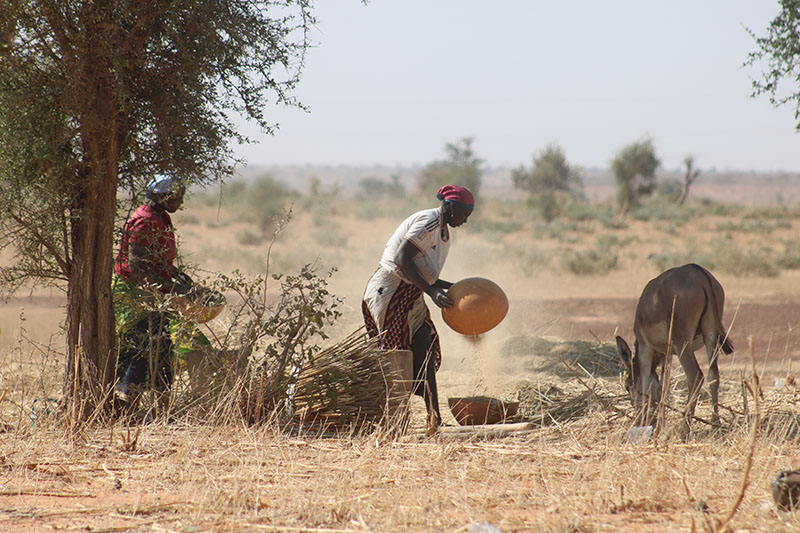
A strong example of sustainable land use that responds to the challenges of climate change is the regreening of the Sahel. Farmers (f / m) and nomadic livestock farmers in Niger, Senegal, Mali and Burkina Faso have shown that by protecting trees and bushes, that spontaneously sprout from the soil, against dangers such as grazing cattle and desert winds, desertification can be turned around and the soil recovers. This way food can be grown again in the dry Sahel. Not only do the trees bear fruit for the farmers' own use or for the market, they also provide shade help manage the groundwater levels, which is good for the yield of the fields between the trees, helps livestock survive and prevents further land degradation.
The core message of the IPCC is that sustainable forms of agriculture focus on local land users. Local support and land rights are crucial. After all, if people have control and certainty over their land use and see that what they do is bearing fruit, they will invest more time and energy in trees and soil fertility.
Negative impacts of Dutch policies
Governments, international companies, banks and investment funds should therefore support these local initiatives instead of investing in large-scale solutions designed and imposed from a head office. And that offers a challenge for the Netherlands, far beyond the simple recommendation to eat less meat. Our agricultural and foreign trade and investment policies currently have a major negative impact on people and the environment around the world. The Netherlands is one of the largest importers of soy (for animal feed) and palm oil (for food, cosmetics and cleaning products) in the world. Its production leads to large-scale deforestation, land degradation and water pollution in countries such as Brazil and Indonesia, and puts great pressure on local communities that manage their land sustainably. In the light of this IPCC report, Dutch diplomatic support for the "soy corridor" in Jair Bolsonaro's Brazil is an incomprehensible choice.
Local land users worldwide, with their various methods of sustainable land use, show us how things can be done differently. With the IPCC report at hand, policymakers inside and outside the Netherlands can feel supported to realise a true transition to fair and sustainable land use, which will keep the earth livable, now and in the future.
For more information
Read more about this subject
-
 Environmentally Just Practice /
Inclusive Land Governance
Both ENDS works with partners around the world to ensure that land is governed fairly and inclusively and managed sustainably with priority for the rights and interests of local communities.
-
 Dossier /
The merits of community-based restoration
Globally, the area that is suffering desertification and land degradation is ever expanding. Unsustainable and often large-scale agricultural practices, including the copious use of pesticides and fertilisers, are a major driver of land degradation, aprocess that is further exacerbated by climate change, causing more erratic rainfall patterns, longer periods of drought and unpredictable growing seasons. This is very problematic not only for the hundreds of millions of people who directly depend on land and water for their livelihoods, but also for life on earth as a whole. It is clear that this process must be stopped and reversed, better sooner than later. But how to go about it?
-
 Dossier /
Communities Regreen the Sahel
In various countries in the Sahel, vast tracts of land have been restored by the local population by nurturing what spontaneously springs from the soil and protecting the sprouts from cattle and hazards.
-
 News / 3 September 2026
Restoring Land, Restoring Hope: Both ENDS at UNCCD COP17 in Mongolia
From 17 to 28 August, governments gathered in Ulaanbaatar, Mongolia, for COP17 of the UN Convention to Combat Desertification (UNCCD). At stake was more than how the world responds to land degradation and drought. It was also a question of who gets to shape land restoration, whose knowledge counts, and where the money goes.
-
 News / 6 July 2026
Strengthening Women's Land Rights Across the Rio Conventions
From 29 June – 2 July 2026, Tamara Mohr, GAGGA coordinator at Both ENDS participated in the 4th convening of the Women's Land Rights Initiative (WLRI) in Nairobi, Kenya.Hosted by the Robert Bosch Stiftung, TMG Research and the Huairou Commission, the event brought together grassroots organisations, (inter)national NGOs, government institutions and donors from around the world.
-
Publication / 3 July 2026
-
 News / 2 July 2026
Land restoration can help mitigate and resolve conflict - but only if everyone has a seat at the table
Can restoring degraded land also help reduce conflict? According to experts from Niger, Ghana, the Netherlands and other regions, the answer is yes - but only when restoration is rooted in inclusive land governance, local ownership and social cohesion.
-
 Dossier /
Gas in Mozambique
In 2011 one of the world’s largest gas reserves was found in the coastal province of Cabo Delgado, in the north of Mozambique. A total of 35 billion dollars has been invested to extract the gas. Dozens of multinationals and financiers are involved in these rapid developments. It is very difficult for the people living in Cabo Delgado to exert influence on the plans and activities, while they experience the negative consequences. With the arrival of these companies, they are losing their land.
-
 Dossier /
Finance for agroecology
The lion's share of public budgets for climate, agriculture and development still goes to conventional agroindustrial projects that contribute to the current climate, food and biodiversity crises. Both ENDS and our partners are calling for a transition to agroecological practices that are people- and environment-friendly.
-
Publication / 12 May 2026
-
 Press release / 12 May 2026
UN report warns of a growing sand crisis - The Dutch dredging sector plays a key role in global sand extraction
GENEVA/UTRECHT, 12 May 2026 – A new report by the United Nations Environment Programme (UNEP), Sand and Sustainability: An Essential Resource for Nature and Development, warns that global demand for sand is exceeding ecological limits. Large-scale extraction of sand from marine and coastal ecosystems is leading to biodiversity loss, damage to coastal communities and increasing risks in an era of climate change. Dutch dredging companies play a prominent role in this as global market leaders in large-scale sand extraction and land reclamation. “Our analyses show that the dredging sector operates globally within a system in which ecological damage and the consequences for coastal communities are systematically underestimated, whilst transparency and effective oversight are often lacking,” says the Dutch environmental and human rights organisation Both ENDS, which contributed to the report.
-
Publication / 14 April 2026
-
 News / 9 April 2026
Minister Sjoerdsma hosts roundtable conversations with civil society
This week, Minister Sjoerdsma organized roundtable conversations with civil society organizations – a valuable initiative that brings together Dutch civil society voices to address critical challenges faced by democratic societies.
-
 News / 24 March 2026
Statement: Invest in local leadership for tropical forest management and local economies
IUCN-NL, Both ENDS, and 16 other Dutch and international civil society organizations (CSOs), networks, and expert groups are calling on the Dutch government to invest more strongly in locally led forest management and forest-based economies. This should be done within the framework of Dutch international cooperation and its associated policy instruments.
-
 News / 19 March 2026
Winners of the ILED ‘Women Are Educators Award’ announced
Our partner organisation ILED (Indigenous-led Education Network) announced the seven winners of the ILED ‘Women Are Educators Award’ this month. These are women who play extraordinary roles in passing on knowledge, whether in formal or informal educational settings.
-
 News / 27 February 2026
Both ENDS strengthens the resilience of female environmental defenders worldwide thanks to multi-year contribution from the Postcode Lottery
In recent years, Both ENDS has received an additional contribution of €875,000 from the Postcode Lottery for the Autonomy & Resilience Fund (2022–2025), implemented in collaboration with the Global Alliance for Green and Gender Action (GAGGA). This support was essential because female environmental rights defenders around the world are increasingly facing climate change, repression and shrinking civil space. With this contribution, Both ENDS supports female activists and their communities with flexible, trust-based funding, enabling them to develop their own solutions to urgent environmental and climate problems.
-
 News / 17 February 2026
Civic space at the frontlines: "Build strong coalitions and counter repressive regimes"
Today, we look back on an inspiring event Civic space at the frontlines -
Environmental Defenders and the Role of International Trade and Investment Policy. The panel exist of Michel Forst, UN Special Rapporteur Environmental Defenders under the Aarhus Convention, Suzanne Kröger, Member of Parliament for GroenLinks–PvdA, Dr. Margit van Wessel, Associate Professor at Wageningen University, Anne de Jonghe, policy advisor at Both ENDS, and Jonila Castro, national spokesperson for Kalikasan People's Network for the Environment. With an audience of CSO experts, academics, accountability experts and students we discussed the effects of Dutch economic activity on Environmental Defenders, and what we all can do to support those on the front lines of the fight for the environment and human rights. -
News / 2 February 2026
Response to the D66-VVD-CDA coalition agreement
Coalition: Repair the damage and dare to go further
At Both ENDS, we see a number of cautious steps in the right direction in this coalition agreement. There is a slight emphasis on green issues, renewed attention to women's rights, recognition of the importance of civil society, and discussion of trade agreements with a focus on mutual interests. However, without structural change in how we trade, invest, and cooperate, fine words remain empty shells.
-
 News / 27 November 2025
Communities and International Consortium Present Community-Led Plan for Nature-Based Adaptation to Sea-Level Rise in Coastal Bangladesh
Local communities in the southwestern coastal region of Bangladesh—together with an international consortium including Uttaran, CEGIS, and Both ENDS—have presented a community-led plan to confront climate change and accelerating sea-level rise through nature-based adaptation. The People’s Plan for Upscaling Ecosystem-Based Adaptation outlines a scalable strategy rooted in local ownership and generations of lived experience. At its centre is Community-Based Tidal River Management (CBTRM), a proven approach that reduces waterlogging, raises land elevation, and restores ecological balance by working with natural tidal and sediment dynamics.
-
 Dossier /
Wetlands without Borders
With our Wetlands without Borders program, we work towards environmentally sustainable and socially responsible governance of the wetlands system of the La Plata Basin in South America.



