


Nicaragua: indigenous consent for canal is false
The supposed consent given by the indigenous population for the controversial canal through their territory is deceptive. Testimonies of the Rama and Kriol population show how the consultation process has been manipulated, and that their consent is invalid.
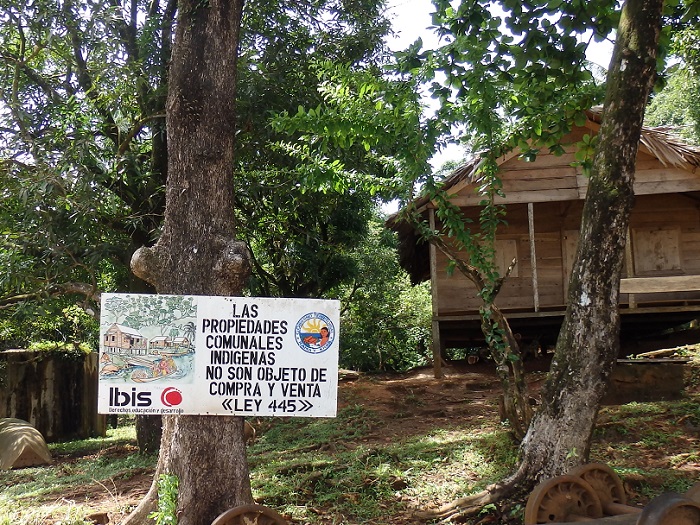
The Rama are a people consisting of about 3,000 members, living on the Southern Caribbean coast of Nicaragua. Along with the Kriol (afro) communities in their territory they have a recognized territory of more than 4000 square kilometers, where they provide their livelihood by small-scale agriculture and fishing.
Consent of the Rama and Kriol?
On May 3, 2016, the president of the Rama-Kriol Territorial Government (GTR-K) signed an agreement with the Nicaraguan government, in which he allows the use of the Rama and Kriol territory for the canal. The president of the GTR-K, however, does not have the authority to do so. That power lays with the village council of each community, which have to determine their position by organizing village meetings. The signature of the president of the GTR-K is therefore not much more than his individual consent with the canal.
Other Rama and Kriol community leaders have therefore set up a Truth Commission to show that the indigenous population was not consulted properly about the canal. With support from Both ENDS, in August 2016 human rights lawyer Maria Luisa Acosta from partner organisation CALPI travelled through the Rama and Kriol-territory. The testimonies collected show that there is much resistance among the population:
- "Once we lose our territory, where we have our history, as an Indian people, we lose everything. We would not be like an indigenous group anymore. Without our land we are nothing." - Lorenzo
- "The animals and the ocean, everything will disappear. We live off the fish, the shrimps, this is how we live. That is why we protest. This is our home. We don't agree with it." - leader from Bangkukuk Taik
FPIC-principles were ignored
There are international rules that must be followed when planning projects in indigenous territories: FPIC (Free, Prior and Informed Consent). FPIC means that local communities have a say in projects conducted in their own territories, without being put under pressure (free), before the project begins (prior) and on the basis of correct information (informed). These principles have not been taken into account in the plans for the canal:
Unfree consent
Several community leaders were paid ($ 600) to travel with a government delegation that came to inform the communities about the canal project. Their presence should give the delegation more legitimacy. Several community leaders told that government officials attempted to bribe them, so that they would give permission for the canal.
Even worse: two brothers, small farmers who own a piece of land exactly where the canal begins, were waterboarded and beaten up by soldiers. Now, persistent health problems forced them to leave their lands.
Unprior consultation
The Rama and Kriol were not consulted in time: neither before the controversial 'Canal Law' was passed, nor before the government issued the concession for the construction of the canal. Even though it's not too late - the construction of the canal has not yet begun - the population has no confidence that the government will listen to them.
- "But anyway, I just hope someone will hear us, try to help us. Before the government just lets us disappear, kills us like animals, takes our land. [...] We're gonna fight until the end. [...] We're gonna die, fighting for our rights." - 'Gutri'
Uninformed consent
Government officials have visited each community once or twice to present the canal project. They told the people that the canal would bring development, jobs and projects. They did not specify what kind of development, jobs and projects they meant. Also, potential negative social or environmental effects have not been mentioned and no concrete offers were made to mitigate or compensate for any of these impacts. Not even the community of Bangkukuk Taik was informed of its impending displacement.
Tell the story to the world
By the end of September, several community leaders and human rights lawyer Acosta presented the results of the study at Both ENDS 'partner organisation Popol Na in the capital Managua. As there is no dialogue possible with the Nicaraguan government, the indigenous leaders will submit their case to the Inter-American Commission on Human Rights, with the support of Popol Na and Both ENDS.
Read more about this subject
-
 News / 4 August 2017
Nicaragua Canal undermines human rights
A report published yesterday by Amnesty Central America shows that the plans for a new canal leads to numerous violations of human rights in Nicaragua. And that's even before the works have started. Many organisations therefore protest against the canal, supported by Both ENDS.
-
 Dossier /
Large-scale infrastructure
Large-scale infrastructural projects have detrimental effects on local people and the environment, while their benefits are felt elsewhere. Both ENDS is working to ensure that local people have a greater say in decision-making and is investigating the way these projects are funded.
-
 News / 28 March 2012
Human rights council of UN recognizes relation human rights and environment
In the final days of March, the human rights council of the United Nations declared they will install an 'Independent Expert on Human Rights and Environment'. The effect of climate change on human lives is becoming more obvious, and by making this decision, the council acknowledges the importance of the relationship between human rights and the environment. This is good news right before the Rio+20 conference in June; Both ENDS and other civil society organisations are advocating incorporation of human rights into sustainable development policy.
-
 News / 26 July 2018
Both ENDS and partners: recognize human rights in French strategy against imported deforestation
Both ENDS together with partners from Indonesia, Malaysia, Democratic Republic of Congo and the United Kingdom, filed a joint submission to the French Government on its draft National Strategy to Combat Imported Deforestation (Strategie Nationale de Lutte Contre la Deforestation Importee – "SNDI").
-
 News / 12 December 2017
Another brave human rights defender shot dead
We are outraged and saddened to hear that Hernán Bedoya, a brave Colombian community leader and human rights defender, has been brutally murdered. After numerous threats to his life and despite all the best efforts of local groups to provide him with protection (such as bullet proof vests, cell phone etc.) he was shot dead by paramilitaries last Friday the 8th of December, while riding home on his horse.
-
 News / 4 October 2017
Reaction to FMOs position statements on human rights, land and gender
On September 20th FMO published its new position statements on human rights, land governance and gender. We appreciate that FMO takes human rights serious and applaud the efforts that have been made to come to an improved position on human rights, land and gender. However, to truly have a positive impact on people and the environment, some important follow up steps are necessary.
-
Publication / 3 November 2017
-
Publication / 3 December 2014
-
Publication / 27 June 2018
-
 News / 3 March 2015
Sengwer people evicted for controversial - World Bank funded - project in Kenya
Under the pretext of a ‘Natural Resource Management Project’ funded by the World Bank, the Kenyan Forest Service has, again, started to forcibly evict the indigenous Sengwer people from their ancestral lands in the Kerangany Hills and to burn down their houses. This was documented on March 2nd, by a fact-finding team that was sent to the ground by the World Bank’s own inspection panel.
-
 Dossier /
Global Alliance for Green and Gender Action (GAGGA)
GAGGA rallies the collective power of the women's rights and environmental justice movements to realize a world where women can and do access their rights to water, food security, and a clean, healthy and safe environment.
-
 News / 2 August 2019
EU unveils 'Action Plan' on Deforestation
The EU is still one of the world’s largest importers of deforestation: EU demand for commodities like soy, palm oil, beef, coffee and cacao requires millions of hectares of tropical rainforest to be cleared. This deforestation has significant biodiversity and climate impacts, and is often linked to human rights violations and violence against local communities and indigenous peoples. Both ENDS and partners have been actively lobbying the EU Commission to adopt a robust action plan to address and prevent human rights violations and deforestation ‘embodied’ in EU imports of agricultural commodities.
-
 News / 14 June 2019
Both ENDS partner TUK presents symbolic tree to Dutch minister Schouten
Last Thursday June 13, Rahmawati Retno Winarni of TUK, an Indonesian partner organisation of Both ENDS, presented a symbolic tree and an appeal to the Dutch Minister of Agriculture Carola Schouten, also on behalf of 10 NGOs. The joint NGOs are pushing the EU, including the Dutch government, for strict EU legislation to prevent the destruction of forests and ecosystems and to protect human rights.
-
 News / 22 April 2013
NEW VIDEO: 'Mapping our Future' for survival of local communities in Indonesia
Between 2010 and 2013, Both ENDS, within an alliance of Indonesian and Dutch organisations and universities, conducted a pilot project to improve the spatial planning in the district of Sanggau in West-Kalimantan, on the island of Borneo, Indonesia, to help local communities with the recognition of their land rights. We can show you a beautiful documentary about one of the villages in this district, Terusan.
-
 News / 1 December 2018
7 suspects of the murder of the Honduran Berta Cáceres were found guilty
On Thursday, November 29, seven suspects of the murder of Berta Cáceres (in March 2016) were found guilty. Members of the indigenous human rights organisation COPINH, of which Cáceres was the leader, and close relatives of Cáceres herself see the ruling as the first step towards justice for her murder and the recognition that the company DESA is co-responsible for this. They also point out, however, that the process was permeated with corruption, intimidation and other abuses from the very beginning, and that the masterminds behind the murder are still walking around freely.
-
 Blog / 18 January 2019
Unambitious and uninspiring: the European Commission’s proposal for stepping-up action on global deforestation
After five years of equivocation the European Commission has proposed a ‘roadmap’ for stepping-up EU action to address its contribution to global deforestation. Despite the escalating impact of EU trade in forest-risk commodities, regardless of repeated calls from the European Parliament for regulatory measures and contrary to the conclusions of the Commission’s own feasibility study in support of legislative intervention, the Commission has ruled-out out any new initiatives, let alone any legislative measures. The Commission’s solution to this complex problem: policy coherence.
-
Publication / 5 December 2012
-
Publication / 12 October 2018
-
Publication / 5 December 2012
-
 News / 9 December 2016
3 Steps to Stand Up for Human Rights in Development!
As we celebrate both the 30th anniversary of the UN Declaration on the Right to Development (December 4th) and Human Rights Day (December 10th), Both ENDS joins with communities and civil society groups around the world to call on development finance institutions, governments, and businesses to take 3 steps to stand up for Human Rights in development.




