




COPINH-leader: “Our communities are terrified”
Last week, Global Witness published 'Honduras: the deadliest place to defend the planet'. This shocking report clearly shows the worrying situation of human rights in Honduras and backs the demand of Both ENDS and partner COPINH: FMO must divest from the Agua Zarca dam.
The report states that since the military coup in 2009, no less than 123 people have been killed who protested against projects like dams, mines, logging orlarge-scale agriculture. One of the examples in the report is the Agua Zarca dam. Since 2013, 6 members of the indigenous organization COPINH, who are opposing the dam, have been murdered. Amongst them their leader Berta Cáceres.
COPINH: fighting against huge financial interests
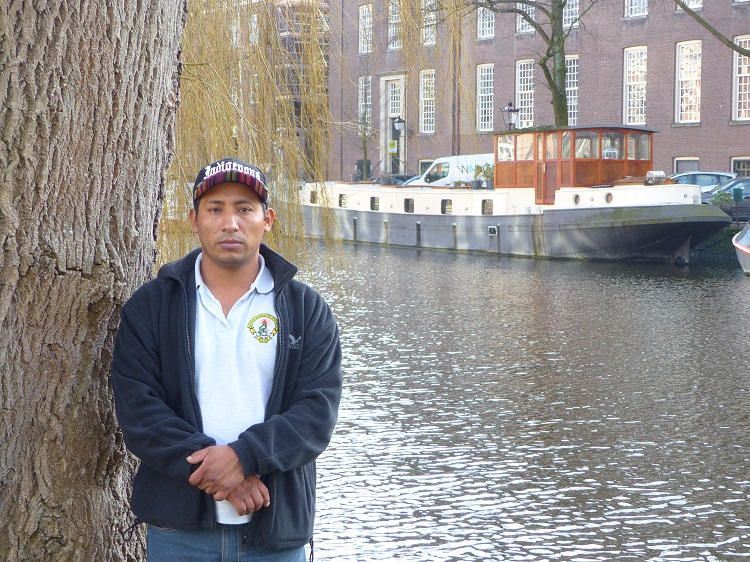
Both ENDS spoke with Tomas Gomez Membreño, Berta's successor, about the current situation of COPINH: "Our situation is very difficult, and has become worse since the murdering of Berta. The government and the company behind Agua Zarca, DESA, are campaigning against us in the media. We are being criminalized and falsely accused of drug trafficking. All this happens to defend the financial interests of politicians and the company."
The Global Witness report uncovers the connections between the threats and the violence against human rights and environment defenders and the Honduran elites. In this context of violence, intimidation and huge financial interests, it is difficult for COPINH to have any influence on what's happening on their lands. Gomez Membreño: "Our politicians don't care about our suggestions for the development of our communities, because they are at the expense of the gains of the private companies. Because these companies pay for the election campaigns of the politicians, the politicians listen only to the demands of the companies."
"Green" energy?
Organisations like COPINH have a totally different vision about what's 'development'. "The politicians and companies think privatising the river is development. They want to redirect the river to generate power. This will kill the animals in the river. Furthermore, the power will be used for activities like mining, that demolish even more nature and accelerate climate change on a global level!
For us, development is: access to water and land, producing our own foods. We defend nature: not only the land, the water and the air, but also our culture, our cosmovision and our identity. We are fighting for the recognition of our claims to our own territory."
Stop the investments in Honduras
Global Witness has a clear recommendation in their report: the Agua Zarca project must be cancelled and international investors have to divest from it. An important investor is the Dutch development bank FMO. COPINH and Both ENDS have been calling FMO to draw back from the project for a year.
Gomez Membreño: "FMO has made a mistake: not only in the Agua Zarca case but for example also in the Barro Blanco project in Panama. They invested in projects where corporate interests are leading, and the wishes and the autonomy of indigenous peoples are not taken into account. Governments should tell the banks to stop their investments in countries with indigenous peoples when the mechanisms for Free, Prior and Informed Consent (FPIC*) are not in place. Our territory is being demolished and the indigenous peoples are being destroyed. Our communities are terrified."
* FPIC is an international standard. It means that local communities have a say in projects conducted in their own territories, without being put under pressure (free), before the projects begin (prior) and on the basis of correct information (informed).
More information:
• Global Witness report: Honduras: the deadliest place to defend the planet
• 30 September 2016: New report: lenders should exit from Agua Zarca project
• 13 May 2016: Arrest of DESA staff member for murder of Berta Cáceres seems last straw for FMO
• 21 April 2016: Honduran Indigenous activists visit Europe to call for action
• 16 March 2016: FMO's suspension of activities in Honduras is just a first step
• 5 March 2016: Brave human rights defender Berta Cáceres murdered
• Also read the story about Barro Blanco in Panama
Read more about this subject
-
 Dossier /
Agua Zarca: indigenous fight against dam costs lives
Indigenous Hondurans are resisting the construction of the Agua Zarca hydrodam. Their fight has cost several lives, including that of Berta Cáceres. After considerable public pressure, Dutch development bank FMO withdrew from the project.
-
 Dossier /
Global Alliance for Green and Gender Action (GAGGA)
GAGGA rallies the collective power of the women's rights and environmental justice movements to realize a world where women can and do access their rights to water, food security, and a clean, healthy and safe environment.
-
 Press release / 13 januari 2026
Investigation: FMO failed to exercise adequate control over project linked to the murder of Berta Cáceres
TEGUCIGALPA/UTRECHT, January 12, 2026 – The murder of indigenous environmental activist Berta Cáceres, which took place almost 10 years ago in Honduras, appears to be the result of an organized criminal operation, in which funds from the Dutch Development Bank FMO were misappropriated to finance illegal activities. This is the conclusion of the investigation report published today by the independent commission set up by the Inter-American Commission on Human Rights, the Honduran state, and the relatives of Berta Cáceres.
For years, FMO was a major financier of the Agua Zarca project. Berta Cáceres, an indigenous leader, fought against this controversial dam and was murdered for that reason in March 2016.
-
 Dossier /
Indigenous communities threatened by Barro Blanco dam in Panama
The Barro Blanco dam project in Panama, which has Dutch financial support, is causing indigenous lands to disappear under water. Both ENDS is working to protect the rights of indigenous communities living near the dam.
-
 Blog / 1 december 2025
The Long Road to Justice for the Ngäbe of Kiad
In October 2025 I travelled to Kiad, the Indigenous Ngäbe community that led the struggle against the FMO-financed Barro Blanco dam, for one last time. I went there to say my goodbyes, both personally and on behalf of Both ENDS, and to catch a first glimpse on how a community program financed by FMO and DEG – the result of a dialogue process that took several years – is giving a new impulse to the dam-affected communities. But how did we get here?
-
 News / 27 oktober 2025
New Step in FMO’s Complaint Policy – Civil Society Organizations Call for Further Strengthening
The updated complaint mechanism of the development banks FMO, DEG, and Proparco marks an important step forward. Organizations that participated in the consultation acknowledge the efforts to improve the mechanism. At the same time, they emphasize that much still needs to be done to make the policy truly effective, transparent, and independent.
-
Publication / 9 oktober 2025
-
 Dossier /
Fair Green and Global Alliance (FGG)
Together with civil society organisations from all over the world, the Fair Green and Global (FGG) Alliance aims for socially just, inclusive and environmentally sustainable societies in the Netherlands and the Global South.
-
 News / 24 juni 2025
Indigenous communities in Panama obtain recognition and partial mitigation measures by Development Banks FMO and DEG in relation to the Barro Blanco dam
Both ENDS and SOMO welcome the signing of the agreement of understanding between four Indigenous Ngäbe communities in Panama and the European development banks FMO and DEG on June 17th 2025. The arrangement includes a community development program that, together with a public statement issued by the banks, aims to recognize and mitigate some of the negative impacts caused by the Barro Blanco hydropower dam. We wish to congratulate the community-based organisation Movimiento 10 de Abril (M10) for its perseverance to seek justice for the affected communities, and we acknowledge the commitment of FMO and DEG to pursue a solution to their long-standing dispute with the communities arising from their partial financing of the hydropower project since 2011.
-
 Dossier /
Advocating for responsible policies of development banks
Development banks should comply with strict environmental and human rights rules to ensure that their projects benefit and do not harm the poorest groups. Both ENDS monitors the banks to make sure they do.
-
 Blog / 11 april 2025
FMO is very pleased with its own success – now the local population still needs to be
The FMO development bank is proud of its results and the opportunities it seizes where commercial banks fail to act. But do the bank's actions really help, ask Anne de Jonghe and Nick Middeldorp.
-
Letter / 3 maart 2025
Input for FMO’s “investment approach to responsibly managed forest plantations”
Both ENDS has been asked by FMO to comment on its draft investment approach to responsibly managed forest plantations. To follow are a number of observations and recommendations, partially informed by Both ENDS long legacy of working in the forest & land arena, in dialogue with international donors, philanthropic foundations, companies, certification bodies and notably with forest dependent communities and other land users.
-
Publication / 16 januari 2025
-
Letter / 22 juli 2024
Joint Call to Action: International Civil Society Demands Justice for Berta Cáceres' Murder Victims in Honduras
This is a joint call to action by international civil society organizations to call upon the Honduran authorities to ensure there is justice for the victims of the murder on Berta Caceres. Eight years and four months have passed since the crime against Berta and the Honduran justice system has not confirmed the sentences of those convicted and has not prosecuted the intellectual authors. We are extremely concerned that independent administration of justice and international agreements on human rights are not being upheld.
-
 News / 13 december 2023
Response from Both ENDS and OxfamNovib to new FMO climate fund
Both ENDS and Oxfam Novib welcome the new SDG Loan Fund launched by FMO. The fund aims to invest more than a billion euros in loans to small and medium-sized enterprises in low- and middle-income countries, in the energy, inclusive financial services and sustainable agriculture sectors. At the same time, both organisations are concerned about the impact of money from the fund on normal people in future recipient countries.
-
 News / 6 november 2023
Response to FMO investments in Nicaragua
On 27 October, RTL Nieuws reported that the Steungroep Nicaragua considers the millions of euros that the Dutch development bank FMO is investing in Nicaragua irresponsible. When asked, FMO stated that 'it had to continue to support its entrepreneurs in difficult times'. Both ENDS believes that the choice to continue to invest in Nicaragua brings substantial risks, which FMO does not take sufficiently into account when deciding on financing. Previous FMO investments have caused harm to people and the environment and, in some cases, even led to violence – with, as its lowest point, the murder of Berta Cáceres in Honduras in 2016.
-
Publication / 15 maart 2023
-
 Dossier /
Finance for agroecology
The lion's share of public budgets for climate, agriculture and development still goes to conventional agroindustrial projects that contribute to the current climate, food and biodiversity crises. Both ENDS and our partners are calling for a transition to agroecological practices that are people- and environment-friendly.
-
 Press release / 5 december 2022
Groups react with dismay to FMO’s position statement on Financial Intermediaries, pointing to outstanding human rights and climate concerns
On October 13th 2022, FMO published the final version of its Position Statement on Impact and ESG for Financial Intermediaries (FI statement). As civil society groups which have engaged with FMO on this topic for more than four years, we are extremely disappointed with the result. In the statement, FMO does not show sufficient commitment to ensuring its investments into financial intermediaries – which represent the bank's largest investment sector* – do not violate human rights or contribute to environmental harms.
-
 Dossier /
Large-scale infrastructure
Large-scale infrastructural projects have detrimental effects on local people and the environment, while their benefits are felt elsewhere. Both ENDS is working to ensure that local people have a greater say in decision-making and is investigating the way these projects are funded.



