


Both ENDS at UNCCD COP13: don’t forget about the people
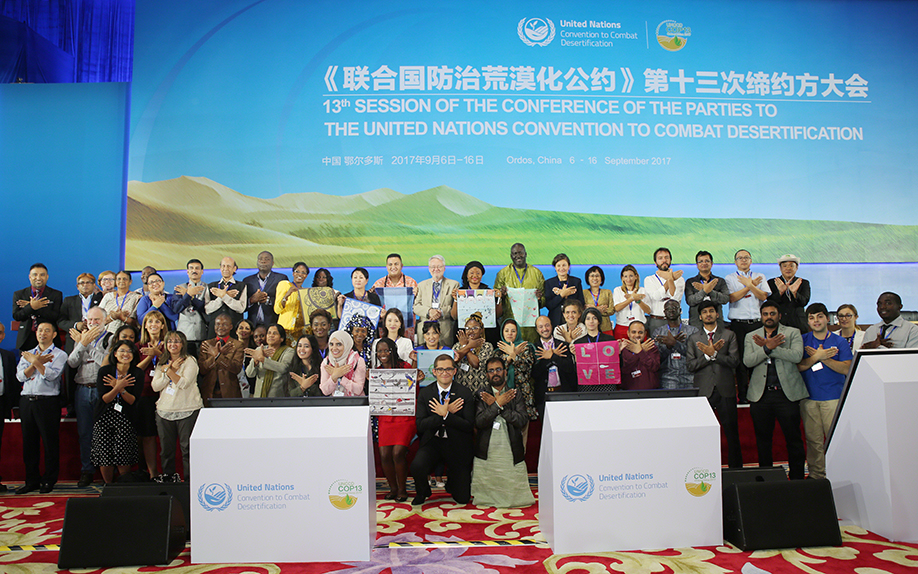
This September, Both ENDS participated at the 13th Conference of the Parties of the UNCCD in Ordos, Inner Mongolia in China. We were part of the Drynet delegation, a network of CSOs, to bring local realities to the international UNCCD discussions.
The UNCCD is the UN Convention to Combat Desertification. At its 13th Conference of the Parties (COP) in Ordos, the Strategic Framework 2018-2030 was discussed, as well as the implementation of SDG target 15.3*. Nathalie van Haren and Karin van Boxtel from Both ENDS have attended the conference to put several themes on the agenda of the delegates of the UNCCD. Together with the Drynet partners, we had formulated a number of goals that we wanted to see included in the Strategic Framework. Key to all our efforts is the message "While combating land degradation, the focus should always be on local people".
CSO participation
One important goal of Drynet was to guarantee meaningful CSO participation in the implementation and monitoring of the UNCCD Strategic Framework 2018 - 2030. Many Drynet members work in close relationship with local communities on sustainable land use and to halt land degradation. In addition, the recognition of the work that CSOs do with communities in official documents gives leverage to many CSOs when engaging with their local and national governments, science and private sector.
Already at the beginning of the COP, it became clear that the International Working Group on the UNCCD Strategic Framework 2018-2030 had forgotten to include CSOs in the strategic plan that will run for the coming 12 years.
Therefore the Drynet network decided to have every intervention accompanied by the ask: "Put CSOs in the Frame". Many parties agreed that this was an omission. However, as the text of the strategic plan was already a consensus text, no party dared to 'open it up' to add CSO inclusion, as this would automatically reopen the whole negotiations and all the work that had been done since COP12 in 2015 would be questioned and jeopardised.
A diplomatic solution had to be found, as the CSO community would not let this one loose, because of the threat to CSOs of being side-lined. In the end, the solution is that CSOs are included in the preamble and the decision about the Strategic Framework 2018-2030.
Linking land and soil quality to land tenure issues
Furthermore, Drynet aims for just, accountable and responsible land governance that recognizes formal and non-formal (including customary) land use and tenure rights. In this context Drynet supports the implementation of the VGGTs* in the UNCCD strategic framework 2018-2030.
The VGGTs focus on land tenure. This is important, because access to, ownership and control over land is inherently part of a successful implementation of sustainable land management and land degradation neutrality (LDN). Sustainability often means investing for the long term, and insecurity withholds land users to do so. This is why the VGGT can be of great value in the fight against desertification.
Due to the efforts of Drynet and many others, the UNCCD Strategic Framework now acknowledges the importance of the VGGTs for responsible land governance. As is stated in the draft decision: "Noting the Voluntary Guidelines on the Responsible Governance of Tenure of Land, Fisheries and Forests in the Context of National Food Security and recognizing their potential contribution to the effective implementation of the UNCCD 2018−2030 Strategic Framework".
Include community initiatives in SDG target 15.3 monitoring
Both ENDS' Nathalie van Haren is CSO-observer in the Science Policy Interface of the UNCCD, where the definition of Land Degradation Neutrality (LDN) and its monitoring methods are determined in the Conceptual Framework on Land Degradation Neutrality. We are glad to have achieved a strong recommendation of the VGGT in this Conceptual Framework, as this means that meaningful participation of local communities and local initiatives of dryland communities are also included in the monitoring of SDG target 15.3 on LDN.
Finance for restoration
Drynet and its members are engaged in numerous initiatives of local land users and communities to restore land and to use the land sustainably. Therefore Drynet would like to look at finance for restoration for local people, communities, institutions and organisations, for example through the Land Degradation Neutrality Fund.
This topic was discussed in our side event 'Small is Beautiful' by Noel Oettle of Drynet member EMG, who works with rooibos farmers in South Africa on sustainable land management, Michael Braack, the deputy director at the department of Environmental Affairs in South Africa working on the national LDN target setting programme, and Gautier Queru, the director of the LDN Fund.
Drynet: a strong network
For Both ENDS, it is good to see that Drynet is such a strong network of very committed member organisations, as strengthening our partners and jointly advocating inclusive sustainable land use is at the heart of what we do. The coming years, together with the other Drynet members, we will continue to make sure the UNCCD works for people living in drylands. We will make sure that their realities are being heard in UN processes. Also, we will follow up on SDG target 15.3 monitoring, focusing on community based contributions to LDN and the national LDN targetting programmes, and engage with and monitor the projects that are considered by the Land Degradation Neutrality Fund.
Based upon the good results and cooperation achieved at UNCCD COP 13 in Ordos, we are sure and confident that Drynet will work with lots of energy to get things moving and done.
*SDG target 15.3: one of the 169 targets of the 17 Sustainable Development Goals (SDGs), a set of goals adopted by the UN. Target 15.3 says: By 2030, combat desertification, restore degraded land and soil, including land affected by desertification, drought and floods, and strive to achieve a land degradation-neutral world. The UNCCD is the custodian of target 15.3 and therefore responsible for monitoring its implementation.
** VGGTs = Voluntary Guidelines on the Responsible Governance of Tenure of Land, Fisheries and Forests in the Context of National Food Security. These guidelines were formulated in 2012 after profound consultations with stakeholder groups and are adopted by the FAO Council and the UN member states as a response to the land (use) rights insecurities of local communities.
For more information
Read more about this subject
-
 Environmentally Just Practice /
Inclusive Land Governance
Both ENDS works with partners around the world to ensure that land is governed fairly and inclusively and managed sustainably with priority for the rights and interests of local communities.
-
 Dossier /
Communities Regreen the Sahel
In various countries in the Sahel, vast tracts of land have been restored by the local population by nurturing what spontaneously springs from the soil and protecting the sprouts from cattle and hazards.
-
 News / 3 September 2026
Restoring Land, Restoring Hope: Both ENDS at UNCCD COP17 in Mongolia
From 17 to 28 August, governments gathered in Ulaanbaatar, Mongolia, for COP17 of the UN Convention to Combat Desertification (UNCCD). At stake was more than how the world responds to land degradation and drought. It was also a question of who gets to shape land restoration, whose knowledge counts, and where the money goes.
-
 News / 6 July 2026
Strengthening Women's Land Rights Across the Rio Conventions
From 29 June – 2 July 2026, Tamara Mohr, GAGGA coordinator at Both ENDS participated in the 4th convening of the Women's Land Rights Initiative (WLRI) in Nairobi, Kenya.Hosted by the Robert Bosch Stiftung, TMG Research and the Huairou Commission, the event brought together grassroots organisations, (inter)national NGOs, government institutions and donors from around the world.
-
Publication / 3 July 2026
-
 News / 2 July 2026
Land restoration can help mitigate and resolve conflict - but only if everyone has a seat at the table
Can restoring degraded land also help reduce conflict? According to experts from Niger, Ghana, the Netherlands and other regions, the answer is yes - but only when restoration is rooted in inclusive land governance, local ownership and social cohesion.
-
 Dossier /
Finance for agroecology
The lion's share of public budgets for climate, agriculture and development still goes to conventional agroindustrial projects that contribute to the current climate, food and biodiversity crises. Both ENDS and our partners are calling for a transition to agroecological practices that are people- and environment-friendly.
-
Publication / 18 June 2026
-
Publication / 12 May 2026
-
 Dossier /
Rights for People, Rules for Corporations – Stop ISDS!
Indigenous communities in Paraguay saw their attempts to regain their ancestral lands thwarted by German investors. In Indonesia, US-based mining companies succeeded to roll back new laws that were meant to boost the country’s economic development and protect its forests. This is the level of impact that investment treaties can have on social, environmental and economic development and rights. Why? Because of the ‘Investor-to-State Dispute Settlement’ clauses that are included in many such treaties.
-
 News / 9 April 2026
Minister Sjoerdsma hosts roundtable conversations with civil society
This week, Minister Sjoerdsma organized roundtable conversations with civil society organizations – a valuable initiative that brings together Dutch civil society voices to address critical challenges faced by democratic societies.
-
 Dossier /
Global Alliance for Green and Gender Action (GAGGA)
GAGGA rallies the collective power of the women's rights and environmental justice movements to realize a world where women can and do access their rights to water, food security, and a clean, healthy and safe environment.
-
 Dossier /
Wetlands without Borders
With our Wetlands without Borders program, we work towards environmentally sustainable and socially responsible governance of the wetlands system of the La Plata Basin in South America.
-
Publication / 17 November 2025
-
 Environmentally Just Practice /
Non-Timber Forest Products (NTFPs)
About one in every six people, particularly women, directly rely on forests for their lives and livelihoods, especially for food. This shows how important non-timber forest products (NTFPs) and forests are to ensure community resilience. Not only as a source of food, water and income, but also because of their cultural and spiritual meaning.
-
 News / 5 November 2025
Interview: Both ENDS at COP30 for Climate Justice and Systemic Change
Both ENDS is present at COP30 to advocate for genuine access to climate finance for locally led, gender-just climate solutions and the mechanisms that facilitate this, including those for farmer-led restoration. Furthermore, the organisation participates to ensure the crucial connection between the climate negotiations and the trade and investment frameworks that shape them.
Learn more about the Both ENDS team at COP30 below, and find all the activities and side-events in which Both ENDS will participate.
-
 News / 5 November 2025
Overview of Both ENDS events at COP30 in Belem, Brazil
Both ENDS is present at COP30 to advocate for genuine access to climate finance for locally led, gender-just climate solutions, and for the mechanisms that make these possible, including those supporting farmer-led restoration. The organisation also engages to highlight the crucial connection between climate negotiations and the trade and investment frameworks that shape them.
Below is an overview of the Both ENDS team at COP30 and a detailed look at the activities and side-events in which Both ENDS will participate.
-
 Dossier /
Amplifying environmentally just practices
Because of the close relationship with their living environment, local communities often have the best ideas for the sustainable and equitable use and governance of land, water and forests. These environmentally just practices and processes successfully protect and restore ecosystems and address climate change. They are essential in the light of the multiple crises the world faces, but are in dire need of financial and policy support.
-
 News / 16 July 2025
Case Study: Women Advocating for Gender and Climate Justice in Burkina Faso
The Women Environmental Programme Burkina Faso (WEP BF or WEP) is leading the way in gender-just climate solutions, putting the power of advocacy directly into the hands of women farmers. “In Burkina Faso, women play a crucial role in food production and natural resource management, yet they continue to face systemic barriers to land ownership,” explains a WEP team member. “Despite legal provisions, deeply ingrained customary norms remain dominant, restricting women’s access to land as user rights only, which need to be mediated through male family members.” Without secure access to land, they face significant obstacles in sustaining their agricultural activities, improving local food security, and fully participating in their communities.
-
 News / 16 July 2025
Case Study: Community Paralegals Defending Land Rights from Extractive Industries and Land Grabs in Mozambique
Across Mozambique, land represents more than just territory. It is the cornerstone of livelihoods, culture, and autonomy for many communities. When companies arrive, claiming large portions for mining, oil exploration or agribusiness, residents face significant challenges in asserting their rights. Mozambique’s Land Law (1997) grants communities user rights, ensuring they can occupy and use land for subsistence and cultural purposes.




