


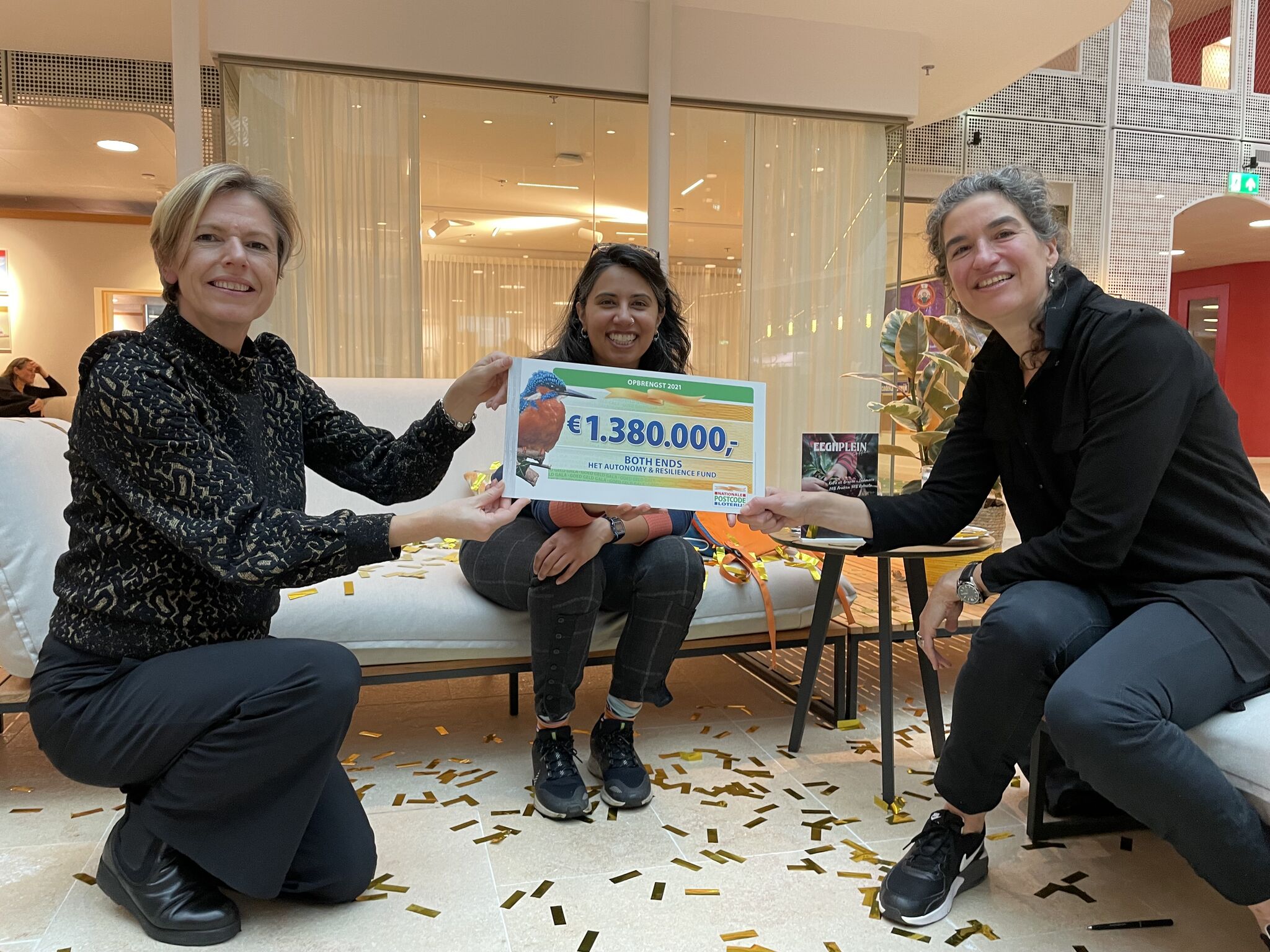
1,380,000 euros from the Dutch Postcode Lottery for local women’s groups
We are delighted that the Dutch Postcode Lottery has approved our proposal to support an extra project to the tune of 1,380,000 euros! The proposal, for an Autonomy and Resilience Fund (ARF), was submitted by the Global Alliance for Green and Gender Action (GAGGA), which comprises the Fondo Centroamericano de Mujeres (FCAM), Mama Cash and Both ENDS. With the ARF, GAGGA works with Small Grants Funds to help local women's groups become resilient in a changing world in which it is increasingly difficult for them to hold their heads above water. The award of this large sum of money means an enormous boost for many women's organisations, and this is badly needed at a time when economic, climate and health crises are constantly putting the resilience of women, their communities and their living environments around the world to the test!
The Autonomy and Resilience Fonds (ARF) was set up in May 2020 in response to the extra needs of women's groups and organisations worldwide resulting from the pandemic. Initially, the ARF mainly provided practical assistance – basic needs and protective equipment against COVID – to partner organisations and women's groups which we had already been working with for many years. Over the course of time, that focus expanded to embrace the slightly longer term and to strengthening women's resilience in a wider variety of areas. The small grants were used, for example, to provide training and meetings on personal safety, solidarity and communication, medical care, education and agro-ecology so that – despite the pandemic, which meant that many of them no longer had an income – women could ensure that they and their families could continue to eat healthily and safely.
Because the ARF works with Small Grants Funds, which in turn have many contacts locally with all kinds of groups and civil society organisations, the money is provided exactly where it is really needed. Moreover, the recipients can spend the money as they best see fit, and it can be paid out quickly because there is no sluggish bureaucracy to hold things up. In May 2020, when the ARF had just been set up, within only six weeks 48 grants with a total value of €254,399 were provided to local environmental and women's groups in 21 countries in Latin America, Africa, Asia and Europe. In the coming years we will use the extra contribution from the Dutch Postcode Lottery to continue to strengthen many more local women's groups in the same flexible way.
Read more about this subject
-
 Dossier /
Global Alliance for Green and Gender Action (GAGGA)
GAGGA rallies the collective power of the women's rights and environmental justice movements to realize a world where women can and do access their rights to water, food security, and a clean, healthy and safe environment.
-
 Dossier /
Small Grants Big Impacts
Small grants funds offer an effective, alternative way to channel big money from large donors and funds to local groups and organisations that are striving for a sustainable and just society everywhere around the world.
-
 Dossier /
Communities Regreen the Sahel
In various countries in the Sahel, vast tracts of land have been restored by the local population by nurturing what spontaneously springs from the soil and protecting the sprouts from cattle and hazards.
-
Letter / 14 July 2026
Statement on CAO Cambodia Microfinance Case
The independent complaints mechanism of the International Finance Corporation (IFC) and the World Bank Group found that the IFC violated its own Environmental and Social Sustainability Framework by investing in six banks providing microfinance in Cambodia.
-
 News / 6 July 2026
Strengthening Women's Land Rights Across the Rio Conventions
From 29 June – 2 July 2026, Tamara Mohr, GAGGA coordinator at Both ENDS participated in the 4th convening of the Women's Land Rights Initiative (WLRI) in Nairobi, Kenya.Hosted by the Robert Bosch Stiftung, TMG Research and the Huairou Commission, the event brought together grassroots organisations, (inter)national NGOs, government institutions and donors from around the world.
-
Publication / 3 July 2026
-
 Dossier /
Finance for agroecology
The lion's share of public budgets for climate, agriculture and development still goes to conventional agroindustrial projects that contribute to the current climate, food and biodiversity crises. Both ENDS and our partners are calling for a transition to agroecological practices that are people- and environment-friendly.
-
 Dossier /
Trade agreements
International trade agreements often have far-reaching consequences not only for the economy of a country, but also for people and the environment. It is primarily the most vulnerable groups who suffer most from these agreements.
-
Publication / 18 June 2026
-
 News / 9 April 2026
Minister Sjoerdsma hosts roundtable conversations with civil society
This week, Minister Sjoerdsma organized roundtable conversations with civil society organizations – a valuable initiative that brings together Dutch civil society voices to address critical challenges faced by democratic societies.
-
 News / 24 March 2026
Statement: Invest in local leadership for tropical forest management and local economies
IUCN-NL, Both ENDS, and 16 other Dutch and international civil society organizations (CSOs), networks, and expert groups are calling on the Dutch government to invest more strongly in locally led forest management and forest-based economies. This should be done within the framework of Dutch international cooperation and its associated policy instruments.
-
 News / 27 February 2026
Both ENDS strengthens the resilience of female environmental defenders worldwide thanks to multi-year contribution from the Postcode Lottery
In recent years, Both ENDS has received an additional contribution of €875,000 from the Postcode Lottery for the Autonomy & Resilience Fund (2022–2025), implemented in collaboration with the Global Alliance for Green and Gender Action (GAGGA). This support was essential because female environmental rights defenders around the world are increasingly facing climate change, repression and shrinking civil space. With this contribution, Both ENDS supports female activists and their communities with flexible, trust-based funding, enabling them to develop their own solutions to urgent environmental and climate problems.
-
News / 2 February 2026
Response to the D66-VVD-CDA coalition agreement
Coalition: Repair the damage and dare to go further
At Both ENDS, we see a number of cautious steps in the right direction in this coalition agreement. There is a slight emphasis on green issues, renewed attention to women's rights, recognition of the importance of civil society, and discussion of trade agreements with a focus on mutual interests. However, without structural change in how we trade, invest, and cooperate, fine words remain empty shells.
-
 Blog / 25 November 2025
COP30 shows why dismantling ISDS is essential for real climate action
Standing in Belém during COP30, I felt the weight of the moment. We came to the Amazon hoping for decisive progress on phasing out fossil fuels, yet the final outcome fell far short of the ambition science and justice demand. The agreement brought welcome commitments on adaptation finance and global indicators, but it refused to confront the structural forces that make climate action so difficult.
-
 Environmentally Just Practice /
Non-Timber Forest Products (NTFPs)
About one in every six people, particularly women, directly rely on forests for their lives and livelihoods, especially for food. This shows how important non-timber forest products (NTFPs) and forests are to ensure community resilience. Not only as a source of food, water and income, but also because of their cultural and spiritual meaning.
-
 News / 5 November 2025
Interview: Both ENDS at COP30 for Climate Justice and Systemic Change
Both ENDS is present at COP30 to advocate for genuine access to climate finance for locally led, gender-just climate solutions and the mechanisms that facilitate this, including those for farmer-led restoration. Furthermore, the organisation participates to ensure the crucial connection between the climate negotiations and the trade and investment frameworks that shape them.
Learn more about the Both ENDS team at COP30 below, and find all the activities and side-events in which Both ENDS will participate.
-
 News / 5 November 2025
Overview of Both ENDS events at COP30 in Belem, Brazil
Both ENDS is present at COP30 to advocate for genuine access to climate finance for locally led, gender-just climate solutions, and for the mechanisms that make these possible, including those supporting farmer-led restoration. The organisation also engages to highlight the crucial connection between climate negotiations and the trade and investment frameworks that shape them.
Below is an overview of the Both ENDS team at COP30 and a detailed look at the activities and side-events in which Both ENDS will participate.
-
 News / 23 October 2025
TotalEnergies financiers beware: EACOP is eating up money, nature and livelihoods
A new analysis shows that the developers of the East African Crude Oil Pipeline, led by France’s TotalEnergies, are being forced to self-finance the project almost entirely. The analysis, part of a new Finance Risk Updatefrom a coalition of African and International civil society organisations, shows that the companies have abandoned plans to raise 60% of the project’s growing costs from bank loans, and are now on the hook for almost 90% of the costs themselves.
-
Publication / 9 October 2025
-
 Dossier /
International trade and investment with respect for people and planet
The network of international trade and investment treaties is large and complex. The Netherlands alone has signed more than 70 bilateral investment treaties (BITs) and is party to the trade and investment agreements concluded by the EU, like the EU-Mercosur and EU-Indonesia trade deals.



