


Encouraging life as farmers - “Your Own Tomatoes Really Are Sweeter”
Encouraging life as farmers - “Your Own Tomatoes Really Are Sweeter”
"My father was 103 years old when he died a year ago. In the countryside, he ate his own healthy fruit and vegetables, and he drank alkaline water from a stream. I know, it's an ideal situation that definitely doesn't exist everywhere, but I want his life to serve as a testimony that living in an unpolluted environment with basic but sufficient facilities offers a certain guarantee that one will live a long and happy life."
But one must match words to deeds and Zenaida (Zen) Delica Willison is exactly this kind of person. She will be retiring this year from the United Nations Development Programme (UNDP). She hopes to establish her own demonstration farm that will feature organic agriculture together with her husband, who also works for the UNDP. They already own 5 hectares of land in Batangas City, about 100 kilometres outside of Manila. "I am fortunate that my husband and I feel the same way." There is already a lifestyle centre for the promotion of a healthy lifestyle, including vegetarianism, called the Talumpok Lifestyle Center. The ground floor is used for lectures, workshops and for enjoying meals. The second floor includes the bedrooms. There is also a church. "In 1986, my life changed radically when I joined the Seventh-day Adventist Church. It is the best thing that ever happened to me."
The idea is that this project will serve as an inspiration for others to get involved. Delica Willison and her husband want to show city dwellers that life outside the city also has its significant advantages and charms. "The way you lead your life can serve as an example to others. There are never any absolute guarantees that what you do will have an impact. But, in your life, you have to do what you can within the realm of possibilities."
The lifestyle they are promoting is patterned after NEWSTART: The N stands for Nutrition. Delica Willison: "You have to eat the right foods in the correct quantities and at the right time. We will teach people how to cook well and with good ingredients." The E stands for Exercise. "We need to be active: move, walk, ride a bicycle, climb, etc. Even in rural areas, people are no longer used to walking far to go to work or school for example: they use scooters or motorbikes." The W stands for Water, which underscores the importance of "drinking a lot of pure alkaline water to help neutralise the acid levels in our bodies. At least eight glasses a day." The S, for Sunshine: a source of vitamin D. The T stands for Trust in God, which Willison says is at the core of a righteous lifestyle. R stands for Rest: we need at least eight hours of sleep every day, Delica Willison claims, plus a full day's rest every week. The last T stands for Temperance. "Do not use anything that is bad for your body, such as alcohol, tobacco or drugs, and don't exaggerate the good things either."
The farm is not yet fully operational. "We are busy planting trees. Fruit trees such as mango, coconut, banana, avocado, papaya, and tamarind. But also mahogany and nara. And there are also vegetable gardens." A lot of people have come to look, especially city dwellers from Manila and Batangas. "They enjoy coming here, to get away from the polluted city and become reinvigorated by the country life. After they establish themselves here they will begin to offer seminars, lectures or visitors can enjoy Zenaida's brother's bonsai garden or his koi carp pond. People will be able to camp here by simply pitching a tent. Guests will not be required to pay, although most visitors donate some money for cleaning. After their stay, visitors return to their urban lifestyles because very few people are willing to get their hands dirty. And farming is not easy, I know from my own experiences. When people are still young, they hear that they have to get good grades in school, that they have to study hard so they can get a nursing job or something equivalent in the United States or Europe, and there attain a luxurious lifestyle. That is the mentality of entire generations of Filipinos: their hope lies in the West. So why should they learn to plant tomatoes and grow fruit?" Yes, a diploma is important, but not at the expense of a holistic lifestyle.
Delica Willison believes that an integrated approach is necessary to make country living appealing again. "This should begin at school, where youngsters could learn how to plant tomatoes in school gardens. They should be taught to appreciate this type of work. Children have to experience how it is to taste the fruits of their own labour - they really do taste sweeter!"
The demonstration farm and the lifestyle centre are seamlessly aligned with her great desire: the revitalisation of agriculture and the revaluation of the countryside. "My perspective has always focused on the local community."
Dreaming Our Own Dreams
As a young student in the early seventies, Delica Willison was actively involved in opposing then-Filipino President and dictator Ferdinand Marcos and his wife Imelda. Delica Willison was eventually arrested in 1974 and received a substantial prison term. She was imprisoned together with her two-year-old daughter. She was eventually released after spending 801 days in prison due to international pressure organised by Amnesty International. "But we have to dream our dreams and be prepared to pay the price to make those dreams come true."
Delica Willison studied nursing, sociology, business administration and public health in the Philippines and development practice including humanitarian and refugee law in England. She is considered an expert in the field of disasters and disaster risk reduction and has built up an impressive track record. "Natural hazards turn into a disaster only when vulnerable people are not able to cope. For example, because they are completely unprepared. This goes for natural disasters such as typhoons, but also manmade disasters. Thus, it is important to design prevention, mitigation, preparedness and emergency response measures. It is my job to point this out to governments, organisations and people in general." She has been based in Bangkok since 2005, where she works as a UNDP advisor in the field of disaster risk reduction.
She admits it was 'pretty tough' putting her ideals into words, "because there are so many problems in my country that are screaming to be addressed all at once: corruption, unemployment, low productivity. But if I had to start somewhere, I would start in the countryside. I want to encourage farming once again."
This desire obviously comes from her dislike of Asia's mega-cities. "Practically all of Asia's cities are terribly congested. There is an utter lack of discipline. Not only is traffic a stinking mess, but it is also next to impossible to walk on a sidewalk or get around easily because of how shops, restaurants and workshops sell their goods. Regulations are not enforced. We are so unhealthy because of the lifestyle that urban living promotes. If the countryside were to be redeveloped, we could encourage people to go and live there."
Magnet
The economic possibilities that cities offer act like a magnet for the rural population, for whom the economic prospects are indeed "very small" and the chances of improvement virtually nonexistent. "Because it is becoming more and more difficult to be a farmer due to the land issues, farmers end up migrating to the city where they often end up joining the growing informal sector. They are then faced with housing, health and safety issues. If something unforeseen happens in their lives, if they suffer a setback, this can quickly turn into a personal catastrophe. Because they have nothing and nobody to fall back on. In the countryside, at least they could still grow their own food."
It won't be easy to convince farmers to remain behind in the rural areas, or to encourage former farmers to return to the countryside, where there is often the threat of political armed conflict. "Militarisation has a negative impact on local farmers, who are subject to various restrictions. This is coupled with the increasing cost of agricultural inputs such as fertilisers and agricultural machinery, and the difficulties in accessing low-interest credit. So, any migration back to rural areas must go hand in hand with various incentives such as the promotion of organic farming, setting up and providing good health care services, and organising the sale of agricultural products. All these things have to occur simultaneously."
The city is attractive for many real reasons: there are more economic opportunities and children have a better chance of getting a good education. "That is true. That is why it's not enough to say that people 'must' return to the countryside. Education in rural areas must improve considerably by, among other things, paying better wages to the teachers so that the good teachers will not abandon rural community schools. Today, the best teachers head to the city, where they can earn more, and the bad ones stay behind. It's also equally important to have a good health care system in place. In rural areas, at present, there are no doctors, not even midwives." This health care doesn't even have to be expensive. "In the cities, health care is about hospitals and expensive medicines. But in rural areas, there is a lot of knowledge about traditional health practices, herbal medicine and preventive care."
Each region needs to utilise its own specific resources and measures. A fishing community is different from a peasant village in the mountains. "If you know that a certain community is unable to grow rice or grains, but it excels in making special handicrafts, then you have to support the latter. Each community produces what best fits that particular community. Make sure that these communities can sell their products to each other, so they can take as much advantage as possible of each other's expertise. This requires a proper transportation system. I don't claim that this is the only solution, but it could be a hopeful step in the right direction."
Delica Willison thinks that the city will continue to be the centre of cultural and intellectual life. "There will always be people going to the cities. That's not a development I want to stop. But I do want to see a balanced approach between urban and rural areas. If you promote resilient cities, you should also promote resilient rural areas. The same goes for safety, health care, education, and tourism: distribute things fairly across the country. I'm not advocating lowering the development of developed areas. But start developing underdeveloped rural areas. We need to correct these skewed kinds of development.
Nurse becomes a disaster expert
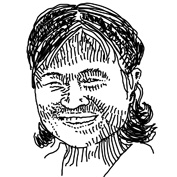
Zenaida Delica Willison (1950) was brought up taking care of others. In her village, her father was a traditional herbalist with informal training who healed people for free using simple means and medicines using bark, leaves, water, and heat. Young Zenaida also wanted to be a doctor, but her parents didn't think that was a good idea. Instead she was encouraged to become a nurse. After two years, she switched to business administration at the Lyceum of Batangas, where, like so many of her generation, she got involved in protests against the dictatorship of President Ferdinand Marcos. She eventually relocated to Manila. After four years of protesting against the dictatorship, she was arrested in 1974 and jailed together with her two year old daughter. Delica Willison studied in the Philippines and in England. She has worked in disaster risk reduction her entire working life and also serves as a consultant for various organisations. Her daughter now works in the same sector as her mother.
Read more about this subject
-
 Dossier /
Dare to Trust: the power of unconditional funding
At Both ENDS we cherish our long-term relationships with partners in our global network. These relationships are based on equality and built on trust. The trust we have in each other has developed from years of strategic cooperation, including joint advocacy around common agendas, knowledge sharing, networking, and mobilising and sharing resources to advance environmental justice.
-
 Dossier /
Global Alliance for Green and Gender Action (GAGGA)
GAGGA rallies the collective power of the women's rights and environmental justice movements to realize a world where women can and do access their rights to water, food security, and a clean, healthy and safe environment.
-
 News / 5 oktober 2026
Rural Women's Assembly wins Right Livelihood Award
We are thrilled to share that our partner the Rural Women's Assembly (RWA) is one of this year's Right Livelihood Laureates! The award, often called the "Alternative Nobel Prize", honours RWA for bringing together more than 178,000 women farmers in eleven Southern African countries. Together, these women stand up for their land, their seeds and their right to make decisions about their own lives and bodies.
-
 News / 29 september 2026
Summary - Both ENDS complaint under the EU-New Zealand trade agreement
On 29 September 2026, Both ENDS lodged the first complaint on climate grounds with the European Commission's Single Entry Point. It asks the Commission to examine whether Aotearoa New Zealand has broken two promises both sides made in the EU-New Zealand Free Trade Agreement: not to weaken or set aside environmental laws in order to encourage trade or investment, and to effectively implement the Paris Agreement.
-
Publication / 29 september 2026
-
Publication / 29 september 2026
-
 News / 29 september 2026
Q&A: New Zealand's climate rollback and the EU trade agreement
On 29 September 2026 / 30 September in Aotearoa New Zealand, Both ENDS lodged a complaint with the European Commission under the EU-New Zealand Free Trade Agreement. These are the questions we are asked most often, and our answers. The complaint summary, the case explainer and the key public sources are linked at the end of this page.
-
 News / 29 september 2026
What happens now? A timeline of the SEP Case
What happens now? On 29 September 2026 / 30 September in Aotearoa New Zealand, Both ENDS lodged a formal complaint with the European Commission. It is the first complaint to the EU's Single Entry Point on environmental and climate grounds. It asks the Commission to hold New Zealand to two promises it made in its trade agreement with the EU: not to weaken environmental protection to encourage trade or investment, and not to undermine the Paris Agreement on climate change.
-
 Press release / 29 september 2026
New Zealand faces its first climate complaint under EU trade rules
UTRECHT / WELLINGTON, 29 September 2026 /30 September in Aotearoa New Zealand
Both ENDS, a Dutch environmental justice organisation, has lodged a formal complaint with the European Commission arguing that New Zealand has broken the climate promises it made in its free trade agreement with the European Union. It is the first complaint on environmental and climate grounds under the Commission's Single Entry Point, the mechanism that lets civil society ask the EU to enforce the sustainability commitments in its trade agreements.
-
 Dossier /
Trade agreements
International trade agreements often have far-reaching consequences not only for the economy of a country, but also for people and the environment. It is primarily the most vulnerable groups who suffer most from these agreements.
-
 News / 10 september 2026
Rutu Foundation receives UNESCO Literacy Prize for multilingual education
Both ENDS’ partner the Rutu Foundation for Intercultural Multilingual Education has been awarded the 2026 UNESCO King Sejong Literacy Prize for its language friendly school programme. This prestigious prize recognises the importance of multilingual education and the right of children to learn in an environment where their home languages are valued.
-
 News / 7 september 2026
Unprecedented criminal conviction in the Mariana disaster case breaks mining industry's cycle of impunity
A Brazilian federal court has, for the first time, criminally convicted a mining company and three of its managers for their role in the 2015 collapse of the Fundão dam, one of the worst environmental disasters in Brazil's history. Our partner Instituto Cordilheira, which represented victims as assistant prosecutors in the case, calls it a historic breakthrough after years of impunity.
-
 Dossier /
Communities Regreen the Sahel
In various countries in the Sahel, vast tracts of land have been restored by the local population by nurturing what spontaneously springs from the soil and protecting the sprouts from cattle and hazards.
-
 News / 3 september 2026
Restoring Land, Restoring Hope: Both ENDS at UNCCD COP17 in Mongolia
From 17 to 28 August, governments gathered in Ulaanbaatar, Mongolia, for COP17 of the UN Convention to Combat Desertification (UNCCD). At stake was more than how the world responds to land degradation and drought. It was also a question of who gets to shape land restoration, whose knowledge counts, and where the money goes.
-
Letter / 14 juli 2026
Statement on CAO Cambodia Microfinance Case
The independent complaints mechanism of the International Finance Corporation (IFC) and the World Bank Group found that the IFC violated its own Environmental and Social Sustainability Framework by investing in six banks providing microfinance in Cambodia.
-
 News / 6 juli 2026
Strengthening Women's Land Rights Across the Rio Conventions
From 29 June – 2 July 2026, Tamara Mohr, GAGGA coordinator at Both ENDS participated in the 4th convening of the Women's Land Rights Initiative (WLRI) in Nairobi, Kenya.Hosted by the Robert Bosch Stiftung, TMG Research and the Huairou Commission, the event brought together grassroots organisations, (inter)national NGOs, government institutions and donors from around the world.
-
Publication / 3 juli 2026
-
 News / 2 juli 2026
Land restoration can help mitigate and resolve conflict - but only if everyone has a seat at the table
Can restoring degraded land also help reduce conflict? According to experts from Niger, Ghana, the Netherlands and other regions, the answer is yes - but only when restoration is rooted in inclusive land governance, local ownership and social cohesion.
-
 Dossier /
Gas in Mozambique
In 2011 one of the world’s largest gas reserves was found in the coastal province of Cabo Delgado, in the north of Mozambique. A total of 35 billion dollars has been invested to extract the gas. Dozens of multinationals and financiers are involved in these rapid developments. It is very difficult for the people living in Cabo Delgado to exert influence on the plans and activities, while they experience the negative consequences. With the arrival of these companies, they are losing their land.
-
 Dossier /
Finance for agroecology
The lion's share of public budgets for climate, agriculture and development still goes to conventional agroindustrial projects that contribute to the current climate, food and biodiversity crises. Both ENDS and our partners are calling for a transition to agroecological practices that are people- and environment-friendly.



