As the Green Climate Fund turns its hopes to the private sector, it must not forget the communities most in need
By
Daan Robben
Over the past few months, I made two trips that capture both the work we do at Both ENDS and what is at stake in today’s debate on climate finance. While large international funds are struggling to deliver on locally led climate action, initiatives Both ENDS is part of, such as the PaPes programme in Senegal and the GAGGA alliance, are showing how it can be done. With the evidence of the funding mechanisms that work, we advocate at international spaces for change.
Green Climate Fund
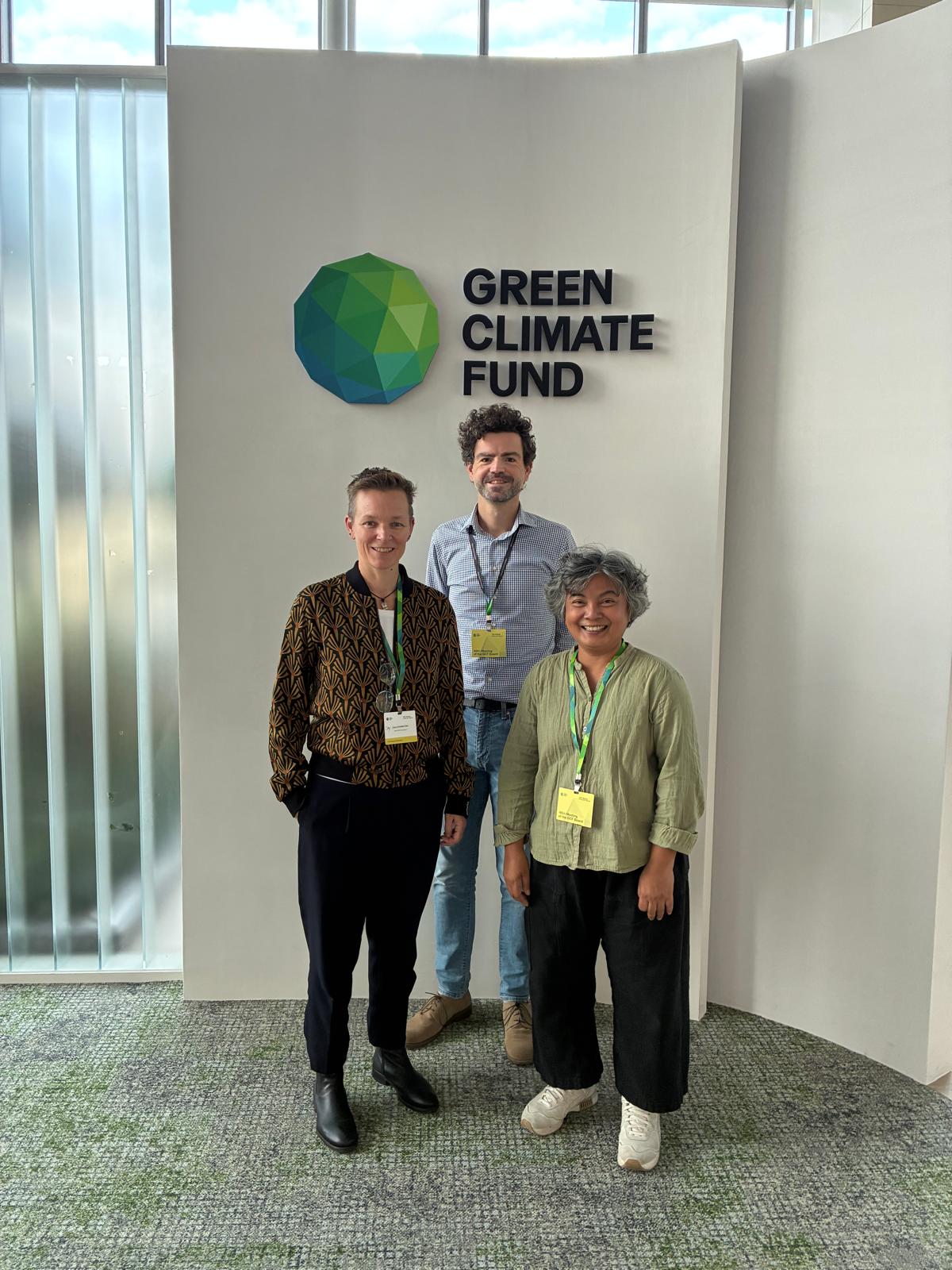
First, my work brought me to the Board Meeting of the Green Climate Fund (GCF) in Songdo, South Korea. The GCF is the largest climate fund set up under the mandate of the UN climate convention (UNFCCC). At this board meeting, the Board approved a new batch of projects with a total value of 2 billion US dollars. After a year and a half away from these meetings, it was good to see with my own eyes how things have evolved: who now sits around the table, and which ideas dominate the conversation. Much has changed, yet the most fundamental problems remain.
Over the last decade, there has been growing recognition that local organisations struggle to access GCF funding. This is especially true for smaller national and local organisations, and for groups that are structurally excluded, such as women and Indigenous Peoples. Both ENDS has advocated for change on this for over 15 years. There are some hopeful signs. The GCF has endorsed the Locally Led Adaptation principles, which say that communities should be centered in climate funding, and there seems to be more interest in turning these into a concrete framework for locally led climate action, though what is on the table now is, in my eyes, not enough. GCF’s Gender Action Plan offers some practical openings to push for better access, especially for women's funds. Yet, we still have to conclude that progress remains slow and difficult: hardly any women's or socio-environmental funds accredited to receive GCF funds directly, and their participation in GCF project remains scarce. And that for a fund who prides itself from having Gender at the heart of the Fund.
At the same time, I sensed an increasingly worrying trend. Large new contributions from donor countries are failing to come in (some pledges have stalled) and the GCF’s next fundraising round (its replenishment) is fast approaching. In this context, the Fund's attention is shifting more and more towards so-called blended private finance: arrangements that use public money to attract private investors who expect financial return. Climate action as a financial product, in other words: something that above all has to be profitable, at least for those willing to invest in it. That may not be inherently bad; for some projects and programmes it can be useful. But it is fair to ask whether the GCF’s scarce public funding is really needed for very large programmes, or whether investors could fund these on their own. I am not a private or blended finance expert, but I would like to draw attention to two points:
First, the Fund's mission is to help the people hit hardest by climate change adapt to a new reality, and, where possible, to reduce impact. The political climate has changed, but that should not stop us from demanding that wealthy countries in the Global North pay their fair share of climate finance, in the form of grants.
Second, many communities do not fit neatly into a shiny financial mechanism, and they are being left out, including women-led communities, Indigenous Peoples and other structurally excluded groups. The GCF’s system was not designed for them, yet they are blamed for not fitting into it. Meanwhile, there are plenty of networks of local funds and community organisations (we can call them ecosystems of funding) ready to be funded. They are built on years of trust and accuntability, move funding flexibly and decision-making power genuinely sits with the communities themselves. Through our work with partners, we see every day that this works.
GAGGA: getting climate finance directly to women-led groups
Through the Global Alliance for Green and Gender Action (GAGGA), we do precisely what the GCF and other climate funds promise but do not organise: getting funds directly to women-led and community-based organisations. GAGGA is an alliance of women's funds and environmental and gender organisations, hosted by FCAM in alliance with Mama Cash and Both ENDS. Since 2016, more than 50 million euros has reached local groups this way, and the results show the model works.
It is not only about funding a large number of local communities. GAGGA also helps these organisations grow stronger, build networks and learn from one another, while influencing the wider decisions that determine how hard communities are hit by climate change. It is exactly that ecosystem of wider support which allows locally led climate action to survive, spread, and change the systems that determine who bears the brunt of the climate crisis.
Many of the local organisations are far too small for large funders like the GCF to work with directly: their procedures and paperwork are simply not built for grants of this size. That gap is structural; it is not a matter of missing good intentions. And here lies precisely the task of international organisations like ours: to create the conditions under which resources do arrive at the right level, instead of continuing to control them ourselves, and to show large funds like the GCF how that can work.
What PAPeS in Senegal shows: funding that starts with communities in mind works
The second journey took me to Senegal, to visit the PAPeS programme on agroecology, farming that works with nature rather than against it. Both ENDS works with IED Afrique, a pioneering action-oriented NGO. There I saw what funding looks like when it is the exact opposite of what I witnessed in the GCF boardroom: small, flexible, and easy to access.
Through the PAPeS Small Grants Fund, money goes directly to grassroots groups that are making the switch to agroecological farming. I visited communities where women's groups grow fruits and vegetables and produce neem oil as natural pesticide, where young people are restoring forests, and where farmers are setting up compost systems and solar-powered irrigation. Small amounts, very little bureaucracy, and trust instead of constant checks.
What stayed with me most was how everything starts from what works for the communities, and how obstacles are tackled from the bottom-up, and how little money it takes to make this possible. These groups are not waiting for the GCF; they are already doing the work, with a fraction of what an average GCF project costs. They are not asking for a mega-project. They are asking for funding sized to them, with conditions that work for them.
IED Afrique created a mechanism of supporting communities I hardly encountered anywhere in the large funding architecture: a local organisation that speaks the language of both the communities and the funders, and that has built enough trust to pass money on without everything getting stuck in layers of checks and controls. This is exactly the kind of partner that large funds like the GCF need if they want their money to reach the ground.
Two lessons for the GCF and other climate funders
With the GCF's next fundraising round approaching and the debate on climate finance heating up at COP31, and beyond, two lessons stand out:
First: local leadership means a shift in power. Asking a community to consult, or having it carry out a project, is not yet local leadership. It is about communities and their organisations having both the resources and the authority to set priorities, decide how funds are spent, and define what success looks like. The PAPeS fund in Senegal shows this is possible when we change our perspective.
Second: fund the support ecosystem, not just individual projects. If we want locally led action at scale, we must invest in the organisations, networks and local intermediaries that make it possible for resources to reach communities, and that, through networking, technical support and advocacy, make the investments sustainable and long-term. For the GCF, that means opening its doors to women's funds, socio-environmental funds and local partners like IED Afrique and GAGGA.
To learn more:
Why Locally Led Adaptation Requires Funding the Whole Ecosystem
Rethinking Dutch intenrational cooperation: How ecosystem funding strengthens local ownership
Read more about this subject
-
 Dossier /
Green Climate Fund: calling for local access to climate finance
Local organisations and groups must be given access to climate finance from the Green Climate Fund. They know exactly what is happening in their local context and what is required for climate adaptation.
-
 Dossier /
The JWH Initiative: supporting young environmental leaders
The JWH Initiative aims to stimulate leadership of young people in environmental organisations by giving small grants to individuals to expand their knowledge, experience and training.
-
 Dossier /
Global Alliance for Green and Gender Action (GAGGA)
GAGGA rallies the collective power of the women's rights and environmental justice movements to realize a world where women can and do access their rights to water, food security, and a clean, healthy and safe environment.
-
 Dossier /
Communities Regreen the Sahel
In various countries in the Sahel, vast tracts of land have been restored by the local population by nurturing what spontaneously springs from the soil and protecting the sprouts from cattle and hazards.
-
Publication / 3 July 2026
-
 Dossier /
Finance for agroecology
The lion's share of public budgets for climate, agriculture and development still goes to conventional agroindustrial projects that contribute to the current climate, food and biodiversity crises. Both ENDS and our partners are calling for a transition to agroecological practices that are people- and environment-friendly.
-
 Dossier /
Wetlands without Borders
With our Wetlands without Borders program, we work towards environmentally sustainable and socially responsible governance of the wetlands system of the La Plata Basin in South America.
-
 Dossier /
Amplifying environmentally just practices
Because of the close relationship with their living environment, local communities often have the best ideas for the sustainable and equitable use and governance of land, water and forests. These environmentally just practices and processes successfully protect and restore ecosystems and address climate change. They are essential in the light of the multiple crises the world faces, but are in dire need of financial and policy support.
-
 Dossier /
Towards a socially and environmentally just energy transition
To address the climate crisis we need to urgently transition away from fossil fuels towards clean, renewable energy. However, this transition is not only about changing energy sources. It requires an inclusive and fair process that tackles systemic inequalities and demanding consumption patterns, prioritizes environmental and social justice, and which does not repeat mistakes from the past.
-
 Dossier /
Fair Green and Global Alliance (FGG)
Together with civil society organisations from all over the world, the Fair Green and Global (FGG) Alliance aims for socially just, inclusive and environmentally sustainable societies in the Netherlands and the Global South.
-
 Blog / 2 July 2025
Women at the frontlines of climate action: local power for global change
By Tamara MohrLast week, GAGGA, the Global Alliance for Green and Gender Action, with Both ENDS as one of the Alliance members, together with FCAM and Mama Cash, organised its Global Meeting in Indonesia. The goal of this meeting was to recognise, celebrate and look ahead at cross-movement and cross-regional connections, to strengthen the collective power of gender, climate and environmental justice movements.
-
Publication / 1 July 2025
-
 Event / 12 December 2024, 13:00 - 14:30
Exploring new avenues of CSO participation in UNCCD processes
Enhancing inclusivity within UNCCD processes and its implementation by strengthening the involvement of civil society organizations (CSOs) and Indigenous Peoples.
-
 Event / 11 December 2024, 13:00 - 14:30
Making strategic impact: Shifting resources and power to women-led initiatives for Land Degradation Neutrality (LDN)
How donors, foundations and other funders can better support women-led initiatives in achieving Land Degradation Neutrality (LDN), focusing on challenges, collaboration, and opportunities for improved matchmaking.
-
 Dossier /
Small Grants Big Impacts
Small grants funds offer an effective, alternative way to channel big money from large donors and funds to local groups and organisations that are striving for a sustainable and just society everywhere around the world.
-
 Event / 4 December 2024, 18:00 - 19:30
Enhancing the role of civil society in the UNCCD to achieve Land Degradation Neutrality (LDN)
Effective local action by land-using communities is at the heart of achieving LDN globally. However, their contributions are often not well recognized or adequately supported by governments and other agencies. Within the UNCCD framework, civil society organisations play a key role in engaging with policymakers in the context of recognizing and supporting these contributions by local communities. The side event will engage participants in a GEF-supported joint Drynet/ IUCN initiative to enhance the capacities of civil society to engage effectively in the achieving Land Degradation Neutrality (LDN) within the UNCCD framework.
-
 Blog / 2 December 2024
COP29: devastating outcomes, but our partners are a beacon of hope
By Daan Robben and Marius TroostWhat to think of the outcomes of this year’s Conference of the Parties (COP29) of the UNFCCC? As it has been so many times, we look back with mixed feelings. On the one hand, the negotiations had very devastating outcomes. On the other hand, working so close together with our many partners and feeling their commitment and energy, also gives a spark of hope.
-
 News / 2 December 2024
Ten recommendations for the UNCCD COP16 to strengthen its efforts in combating desertification, land degradation, and drought
For decades, our local partner organisations have been developing and promoting effective ways to combat land degradation, desertification, and drought. This includes regions like the drylands, as well as forests, and wetlands. Supporting these locally-led actions is essential to reversing negative trends. For COP16, Drynet has developed 10 recommendations to strengthen the implementation of the UNCCD. Success at COP16 would mean turning these recommendations into action, fostering inclusive land governance and sustainable land management practices globally. By enabling locally-led actions—particularly those led by women, youth, pastoralists, and Indigenous Peoples—we can build a more resilient future.
-
 News / 2 December 2024
Advocating for Local Solutions: Both ENDS at UNCCD COP16 to Champion Sustainable Land Management and Gender Equality
As the United Nations Convention to Combat Desertification (UNCCD) celebrates its 30th anniversary, the global community faces an urgent need to address the escalating challenges of land degradation, desertification and drought. At the forefront of these efforts, Both ENDS has long advocated for inclusive, locally-led solutions to these critical issues. In this interview, Nathalie van Haren and Yordanos Mulder, who will represent Both ENDS at the upcoming UNCCD COP16, share insights into the significance of the conference, the key issues on the agenda, and the crucial role of local communities in shaping effective land governance. They discuss Both ENDS' ongoing work to amplify the voices of marginalised groups and emphasise the importance of sustainable land management practices, particularly those driven by women, youth, and Indigenous Peoples.
-
 News / 2 December 2024
Both ENDS at UNCCD COP16
Since 1994, Both ENDS has been advocating for inclusive governance in addressing desertification, land degradation, and drought, ensuring local communities have a strong voice in global discussions. As a member of Drynet, a network of over 20 civil society organisations, we champion the inclusion of women, youth, and Indigenous Peoples in land governance and highlight the importance of locally-led initiatives. Our work promotes gender equality, agroecology, and sustainable land management. This landing page serves as a comprehensive hub for all information and updates related to the UNCCD COP16 and Both ENDS' efforts to drive positive change. Here, you’ll find key resources, initiatives, and insights into how locally-led solutions can shape the future of land governance and environmental sustainability.