Both ENDS




When Both ENDS-colleagues visit partners, they often go on a "field trip" to see how our joint work affects people and communities. This year, we did the same in the Netherlands. Food forestry pioneer Wouter van Eck demonstrates a group of Both ENDS partners how regenerative agriculture can offer solutions to the climate and biodiversity crises.

Just before summer, on June 27th we participated in a panel discussion on inclusive conservation in a learning event organized by WWF Netherlands. Several organizations joined in a discussion on inclusive, decolonial, rights-based, and community-led approaches in conservation. We discussed the barriers, gaps and opportunities in how power is shared, inclusion promoted, and accountability practiced in our work. The question raised was: as Dutch-based organizations, are we doing enough to really work inclusive? In 2023 Both ENDS started an Examination of Power process to research how power is experienced in our partnerships. I share a couple of practical tips and insights that I feel might benefit the greater conversation around Monitoring, Evaluation and Learning (MEL) in our sector.

The global funding landscape for civil society movements is changing, and is increasingly faced with policies that restrict funding streams, limit philanthropic work, and silence critical voices. These are not incidental shifts but part of a broader pattern that erodes the support for those international networks and movements under the guise ‘necessary financial cuts’, ‘aid reform’ or ‘efficiency’.


A broad coalition of Dutch companies, knowledge institutes and civil society organizations wants to work together with the new government to make a real difference in improving global food security. The main focus will lie on supporting farmers and consumers in the Netherlands and beyond, and promoting climate-proof food systems in low- and middle-income countries. The coalition believes that, with our knowledge, expertise, experience and reputation for international cooperation and trade, the Netherlands must adopt an ambitious strategy for making our food systems more sustainable, and so contribute to achieving the targets in the Paris Climate Accord and the Sustainable Development Goals.

"Water is life, water is food" is this year's theme for World Food Day. Our partners around the world know all too well that this is a very true sentence. To celebrate World Food Day 2023 this October 16th, we'd like to show a few examples of how our partners fight for the right to water and this way, contribute to local food sovereignty at the same time.

Water is literally life, the lifeblood of ecosystems, of nature, of humans. However, in many places the distribution and use of water is unjust and unsustainable. Water management is generally focused on short-term economic interests, on maximizing the profit of a well-connected few at the expense of people and nature. This dominant view of water and water management has its origins in the European industrial revolution, which became the global norm through colonialism and globalization. But according to Melvin van der Veen and Murtah Shannon, water experts at Both ENDS, this view will have to give way to equitable, sustainable and inclusive water management. Both ENDS cooperates with and supports communities and organisations worldwide who are working to this end.

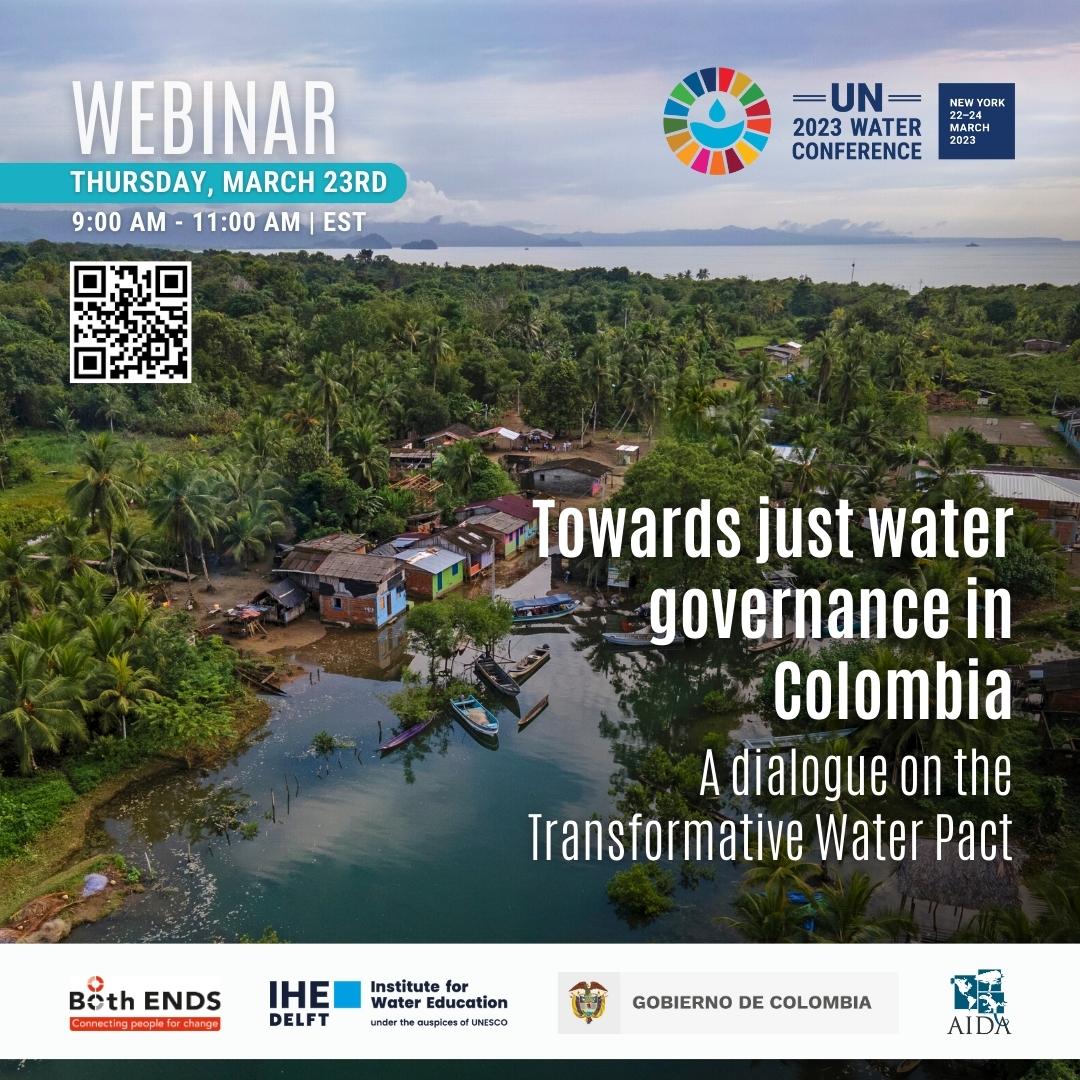
This event will present The Transformative Water Pact (TWP), an innovative framework for water governance that has been developed by environmental justice experts from around the world. The TWP will serve as a starting point for dialogue between representatives of the government of Colombia, academia, regional and international NGOs in relation to Colombia's current ambitions in multi-scalar water governance.