Both ENDS




Because of the close relationship with their living environment, local communities often have the best ideas for the sustainable and equitable use and governance of land, water and forests. These environmentally just practices and processes successfully protect and restore ecosystems and address climate change. They are essential in the light of the multiple crises the world faces, but are in dire need of financial and policy support.

For generations, the people of Bangladesh’ flood-prone deltas have shaped their natural environment to support agricultural production. They used temporary embankments to keep tidal waters out of the floodplains for most of the year and let the rivers flow freely during monsoon season, allowing the sediment to settle on the floodplains as an important part of the delta formation process.

Water is literally life, the lifeblood of ecosystems, of nature, of humans. However, in many places the distribution and use of water is unjust and unsustainable. Water management is generally focused on short-term economic interests, on maximizing the profit of a well-connected few at the expense of people and nature. This dominant view of water and water management has its origins in the European industrial revolution, which became the global norm through colonialism and globalization. But according to Melvin van der Veen and Murtah Shannon, water experts at Both ENDS, this view will have to give way to equitable, sustainable and inclusive water management. Both ENDS cooperates with and supports communities and organisations worldwide who are working to this end.

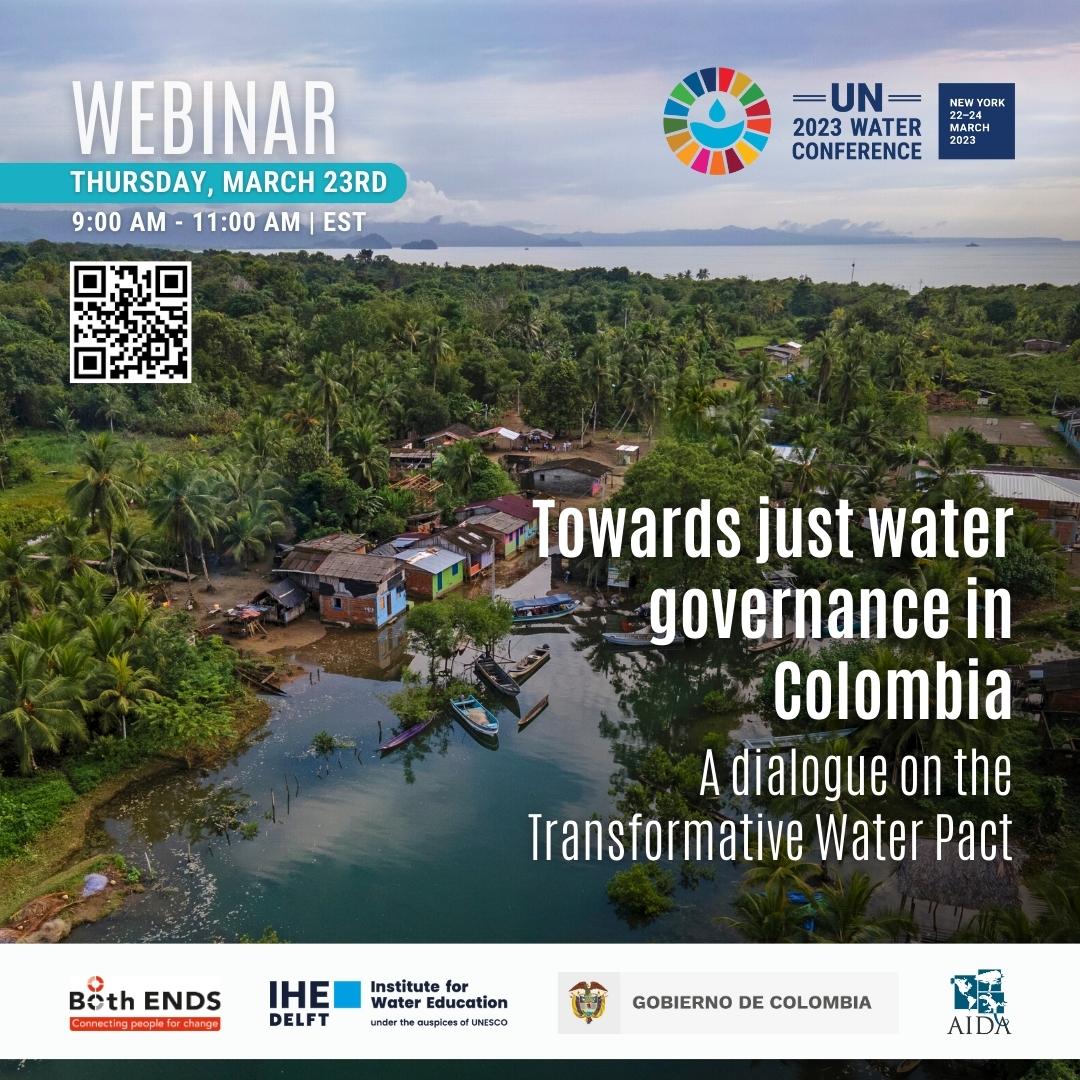
This event will present The Transformative Water Pact (TWP), an innovative framework for water governance that has been developed by environmental justice experts from around the world. The TWP will serve as a starting point for dialogue between representatives of the government of Colombia, academia, regional and international NGOs in relation to Colombia's current ambitions in multi-scalar water governance.

These past weeks we have been joining the #WeWomenAreWater campaign to put the spotlights on just climate solutions of and for women, girls, trans, intersex and non-binary people around the world. The campaign started on International Women's Day (March 8th) and ends today, on World Water Day. Just climate solutions already exist but these initiatives are grossly underfunded, and the people implementing them are also those most impacted by climate change and climate-related water scarcity. Therefore, we would like to highlight, especially today on World Water Day, some of these solutions below. And we also have a special message from the colleagues at Both ENDS working on inclusive water governance.
The Athi River Community Network is made up of communities who live along the Athi River watershed. Members of the Athi River Community Network promised to join forces with the Friends of Ondiri Wetland to ensure that this critical wetland is restored and conserved for the sake of current and future generations.

Through pollution and water scarcity, communities along the Kenyan Athi River have learnt the hard way that upstream and downstream communities are inevitably connected. In response to indiscriminate impacts on the environment and people's livelihoods, civil society organisations within the Athi River Basin formed the Athi River Community Network (ARCN).

Manila Bay is crucial site for biodiversity and home to over 23 million people, but their wellbeing is at risk due to reclamation projects, which are part of a large-scale top-down masterplan for the bay. It is estimated that more than 11 million people are threatened with displacement due to land reclamations and related disaster risks. As an alternative, Kalikasan is developing a People's Plan.

