


What have we learned from the UN Convention to Combat Desertification?
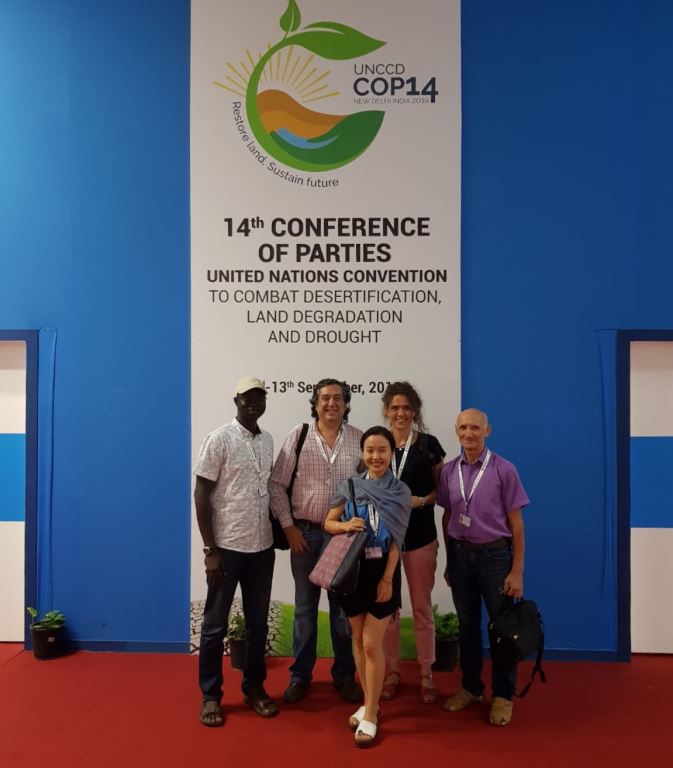
The second United Nations Convention to Combat Desertification (UNCCD) was held from 2 to 14 September in New Delhi, India. Our colleague Nathalie has been working together with many civil society organisations for several years to show the UNCCD that large numbers of local communities around the world are working on sustainable land use and on combating desertification and land degradation, and that land-use security is essential.
If people have the certainty that they can use their land for a longer period, they can invest in it for the long term. That makes it easier for them to use sustainable methods, plant trees and improve soil health. Nathalie set off for the conference full of great expectations, including the hope that the conference would help better embed land-use security for farmers and cattle herders in national legislation. Now the dust has settled we asked her to what extent her expectations were fulfilled and what she learned from the conference.
Broad perspective on soil and land
“A number of good things happened at the conference. First of all, a decision was taken on ‘responsible land management’. That may sound a little vague, but it’s actually very important. The UNCCD has traditionally had a quite narrow 'biophysical' perspective on land and soil. We, the civil society organisations, want discussions within the context of the UNCCD also to look at the social and political aspects of land and soil. By seeking answers to questions like ‘what impact does it have on soil, land use and land recovery if farmers and herders have the security of long-term land rights?’ and ‘how can local governments support people in their activities aimed at healthy soil, sustainable land use and land recovery?’ You can only find sustainable solutions for desertification, land degradation and the effects of drought on land by taking account of all aspects of soil and land.”
Taking account of the SDGs
“The decision itself consists of a number of points. The UNCCD member states (all the countries of the world) now officially recognise the importance of responsible management of land (use) rights for sustainable land use and soil recovery. The UNCCD secretariat is therefore going to take active steps to raise awareness on this issue.
It was also agreed that the UNCCD reporting process will take account of the Sustainable Development Goals (SDGs). The two relevant goals are SDG 1 (End poverty in all its forms everywhere) and SDG 5 (Achieve gender equality and empower all women and girls) which in particular addresses land rights for women. When reporting on desertification, land degradation and drought, countries are therefore now also going to report on land rights.
In addition, the UNCCD is going to work with the UN Food and Agriculture Organization (FAO) to expand knowledge on the ‘Voluntary guidelines on the responsible governance of tenure of land, fisheries and forests in the context of national food security’ (VGGTs) in policy processes that are relevant for UNCCD. All of these issues are irrevocably linked to land degradation and desertification, or offer solutions to these problems. It’s therefore very positive that, from now on, the UNCCD is going to look at the bigger picture.”
Gender awareness at the UNCCD
“Another success is that there was a lot of enthusiasm to devote greater attention to gender. A number of negotiators who had committed themselves to the issue of gender came together during the talks to look at the documents through ‘gender spectacles’. That gave the COP decisions a better gender focus. It is really good to see that the UNCCD is becoming aware of the fact that drought, for example, can affect women completely differently than men.”
Representative of civil society
“There were around a hundred representatives of all kinds of CSOs at the conference. As a group we made 34 interventions – statements and presentations – based on five priorities that we agreed on together and which we drew attention to as much as possible in each intervention. I think it helped a great deal that we, as civil society organisations, had a clear, recognisable and consistent message that really enabled us to spotlight the points we wanted to make.
My term as a UNCCD CSO panel member comes to a close at the end of December. That’s a pity because I’ve learned a lot and met fantastically motivated people who I’ve worked with very closely in the past two years. On the other hand, it’s good to have fresh blood every two years. Of course, I’ll help my replacement on the panel to learn the ropes. In addition, Both ENDS is a member of Drynet and we work with a lot of organisations in drought areas. That way, we’ll naturally stay involved in the UNCCD.”
For more information
Read more about this subject
-
 Dossier /
Fair Green and Global Alliance (FGG)
Together with civil society organisations from all over the world, the Fair Green and Global (FGG) Alliance aims for socially just, inclusive and environmentally sustainable societies in the Netherlands and the Global South.
-
 News / 25 October 2026
Meet Sarah Adongo: “The soil remembers those who cry and defend it”
By Sarah Adongo, Lawyer, Witness Radio, Uganda
Sarah Adongo is one of the three winners of the 2026 Irene Dankelman Young Ecofeminist Award, presented on 21 October at the UN Biodiversity Conference (CBD COP17) in Yerevan, Armenia. A lawyer working with Witness Radio Uganda, Sarah works with women affected by gender-based violence and communities affected by land dispossession and large-scale investments. In this piece, she shares what the award means to her and why gender and environmental justice must go hand in hand.
-
 Dossier /
Rights for People, Rules for Corporations – Stop ISDS!
Indigenous communities in Paraguay saw their attempts to regain their ancestral lands thwarted by German investors. In Indonesia, US-based mining companies succeeded to roll back new laws that were meant to boost the country’s economic development and protect its forests. This is the level of impact that investment treaties can have on social, environmental and economic development and rights. Why? Because of the ‘Investor-to-State Dispute Settlement’ clauses that are included in many such treaties.
-
 Dossier /
Global Alliance for Green and Gender Action (GAGGA)
GAGGA rallies the collective power of the women's rights and environmental justice movements to realize a world where women can and do access their rights to water, food security, and a clean, healthy and safe environment.
-
 Dossier /
Communities Regreen the Sahel
In various countries in the Sahel, vast tracts of land have been restored by the local population by nurturing what spontaneously springs from the soil and protecting the sprouts from cattle and hazards.
-
 News / 3 September 2026
Restoring Land, Restoring Hope: Both ENDS at UNCCD COP17 in Mongolia
From 17 to 28 August, governments gathered in Ulaanbaatar, Mongolia, for COP17 of the UN Convention to Combat Desertification (UNCCD). At stake was more than how the world responds to land degradation and drought. It was also a question of who gets to shape land restoration, whose knowledge counts, and where the money goes.
-
 News / 6 July 2026
Strengthening Women's Land Rights Across the Rio Conventions
From 29 June – 2 July 2026, Tamara Mohr, GAGGA coordinator at Both ENDS participated in the 4th convening of the Women's Land Rights Initiative (WLRI) in Nairobi, Kenya.Hosted by the Robert Bosch Stiftung, TMG Research and the Huairou Commission, the event brought together grassroots organisations, (inter)national NGOs, government institutions and donors from around the world.
-
Publication / 3 July 2026
-
 News / 2 July 2026
Land restoration can help mitigate and resolve conflict - but only if everyone has a seat at the table
Can restoring degraded land also help reduce conflict? According to experts from Niger, Ghana, the Netherlands and other regions, the answer is yes - but only when restoration is rooted in inclusive land governance, local ownership and social cohesion.
-
 Dossier /
Finance for agroecology
The lion's share of public budgets for climate, agriculture and development still goes to conventional agroindustrial projects that contribute to the current climate, food and biodiversity crises. Both ENDS and our partners are calling for a transition to agroecological practices that are people- and environment-friendly.
-
Publication / 12 May 2026
-
Publication / 17 November 2025
-
 Environmentally Just Practice /
Non-Timber Forest Products (NTFPs)
About one in every six people, particularly women, directly rely on forests for their lives and livelihoods, especially for food. This shows how important non-timber forest products (NTFPs) and forests are to ensure community resilience. Not only as a source of food, water and income, but also because of their cultural and spiritual meaning.
-
 News / 5 November 2025
Interview: Both ENDS at COP30 for Climate Justice and Systemic Change
Both ENDS is present at COP30 to advocate for genuine access to climate finance for locally led, gender-just climate solutions and the mechanisms that facilitate this, including those for farmer-led restoration. Furthermore, the organisation participates to ensure the crucial connection between the climate negotiations and the trade and investment frameworks that shape them.
Learn more about the Both ENDS team at COP30 below, and find all the activities and side-events in which Both ENDS will participate.
-
 News / 5 November 2025
Overview of Both ENDS events at COP30 in Belem, Brazil
Both ENDS is present at COP30 to advocate for genuine access to climate finance for locally led, gender-just climate solutions, and for the mechanisms that make these possible, including those supporting farmer-led restoration. The organisation also engages to highlight the crucial connection between climate negotiations and the trade and investment frameworks that shape them.
Below is an overview of the Both ENDS team at COP30 and a detailed look at the activities and side-events in which Both ENDS will participate.
-
 News / 14 October 2025
Communities regreening the Sahel: strengthening resilience from the ground up
How can communities in the Sahel strengthen their food systems in the face of climate change and other shocks? Through the ARFSA Programme, Both ENDS and its partners SPONG (Burkina Faso), CRESA/INRAN (Niger) and IED Afrique (Senegal) are working together to show that locally led landscape restoration works. -
 News / 16 July 2025
Case Study: Women Advocating for Gender and Climate Justice in Burkina Faso
The Women Environmental Programme Burkina Faso (WEP BF or WEP) is leading the way in gender-just climate solutions, putting the power of advocacy directly into the hands of women farmers. “In Burkina Faso, women play a crucial role in food production and natural resource management, yet they continue to face systemic barriers to land ownership,” explains a WEP team member. “Despite legal provisions, deeply ingrained customary norms remain dominant, restricting women’s access to land as user rights only, which need to be mediated through male family members.” Without secure access to land, they face significant obstacles in sustaining their agricultural activities, improving local food security, and fully participating in their communities.
-
 News / 16 July 2025
Case Study: Community Paralegals Defending Land Rights from Extractive Industries and Land Grabs in Mozambique
Across Mozambique, land represents more than just territory. It is the cornerstone of livelihoods, culture, and autonomy for many communities. When companies arrive, claiming large portions for mining, oil exploration or agribusiness, residents face significant challenges in asserting their rights. Mozambique’s Land Law (1997) grants communities user rights, ensuring they can occupy and use land for subsistence and cultural purposes.
-
 News / 16 July 2025
The challenges of climate change, gender inequality, and conflict
This FCDO-supported project, part of the GAGGA programme, brought together 6 women-led community-based organisations from around the world to explore how they navigate the combined challenges of climate change, gender inequality, and conflict. Through a Feminist Participatory Action Research approach, the organisations documented strategies ranging from land rights advocacy to climate-resilient agriculture, highlighting how extractive industries, militarisation, and patriarchal systems drive exclusion and insecurity. Their findings are now informing donors and policymakers on the need to support grassroots women’s leadership. In the following interview, the project lead shares more about the research, key insights, and its broader impact.
-
 News / 10 July 2025
Both ENDS and Global Witness condemn harassment of anti-reclamation activists in Manila Bay
Global Witness and Both ENDS strongly condemn the reported of harassment and surveillance by the Armed Forces of the Philippines of environmental activists and fishing communities in Navotas, Philippines. Pamalakaya-Pilipinas, a National Federation of Small Fisherfolk Organisation in the Philippines, has received credible reports that the Armed Forces of the Philippines (AFP) are engaged in “red-tagging” their members.



