


NTFP-EP supports grassroots women’s organisations with Dare to Trust-grants
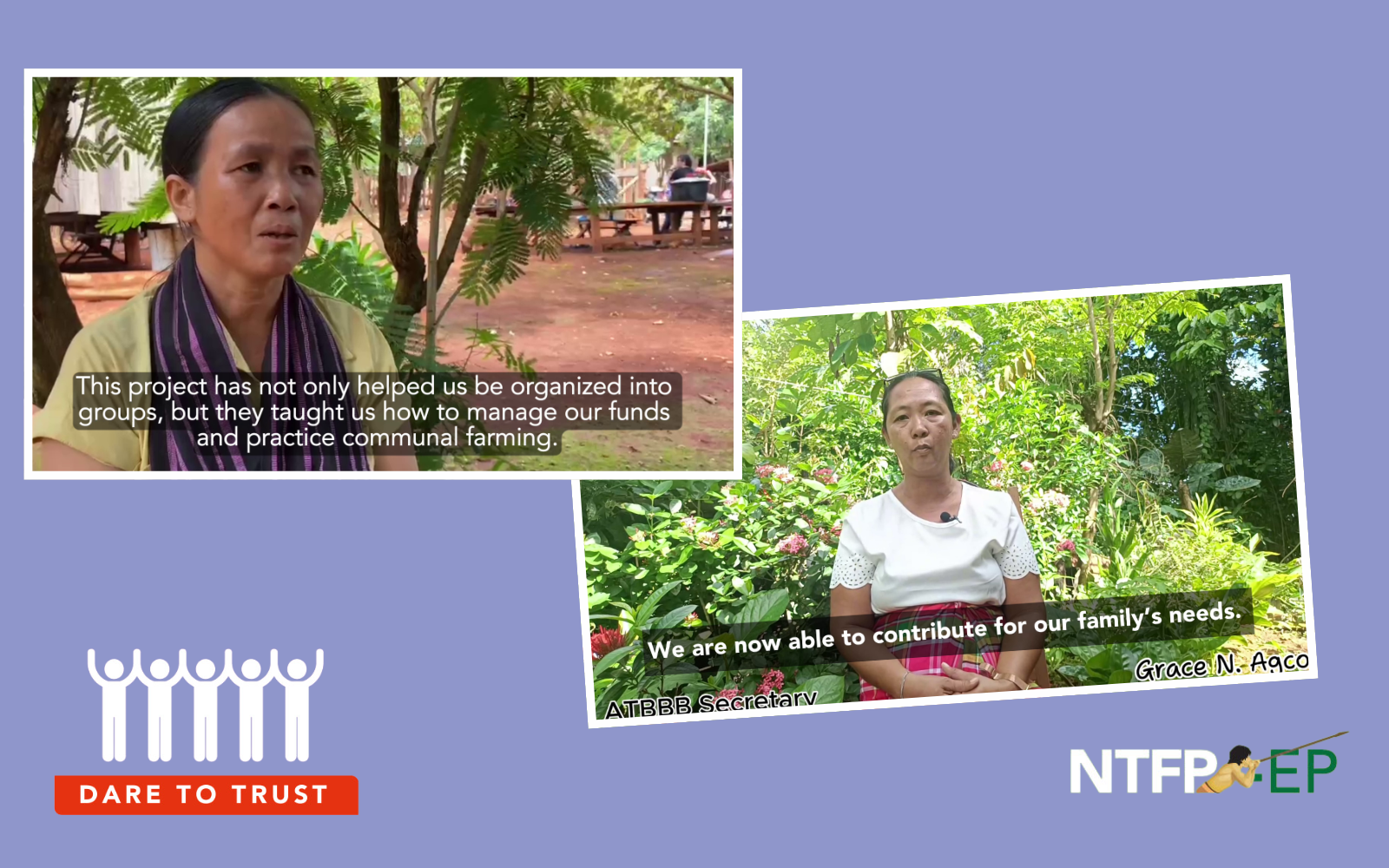
The pilot of Dare to Trust, facilitated by NTFP-EP, was implemented in two grassroots women’s organisations in the Philippines and Cambodia. The Dare to Trust project provided them with the independence to utilize the resources they have and thus handed to them the agency for more grounded and better judgment. By giving more liberty to the communities we are moving them away from bureaucratic processes and power structures, and towards more empowered decision making capabilities.
Asosasyon sang Tumandok-Bukidnon sa Banangaray Balicotoc (ATBBB), Philippines
The organisation "Asosasyon sang Tumandok-Bukidnon sa Barangay Balicotoc" (ATBBB, Association of Tumandok-Bukidnon of Balicotoc village) is mainly composed of indigenous Tumandok women in Ilog, Negros Occidental, Philippines. The community has faced several development-related aggressions in the form of immense land conversions of forest areas into agricultural and settlement areas. The community has recognized how detrimental these developments are to the forest and biodiversity, their water table, and the health of their ecosystem. The main livelihood of community members is now linked to livestock, poultry raising, and farming agricultural crops. Before this, the community, and especially the women, partook in handicraft production using natural non-timber materials sourced from their forests. Due to years of denudation and plunder, which threatens their ecosystem, the communities have stopped their craft-making. The resources that the ATBBB hoped to utilize for their Dare to Trust-project development were lemongrass, turmeric and sambong, but the community found these to be ineffective and time consuming. Based on their own judgment of the accessibility and availability of resources, therefore, they decided to move forward with growing, processing and selling what they have at their disposal: coffee. They created a production center for their community based enterprise.
Taing Se Malu, Cambodia
The Taing Se Malu village in Cambodia, home to Jarai indigenous groups, has historically faced a set of threats since the 1960s and struggled to retain their resilience amid multiple crises during the recent decades. Logging concessionaires and mining companies entered the community in the guise of development, but ultimately became an adversary to their beliefs that is woven in the spiritual forest mountains. Today, years later, the community finds themselves more capable of farming and cultivating fruit-bearing trees, such as cashew and root crops (e.g. cassava), collecting non-timber forest products such as bamboo shoots, mushrooms, and wild vegetables. While the women of the community are participating in the livelihood activities of raising livestock, buffalo, poultry and pigs, they are still the ones expected to maintain their domestic life. This shows that the Taing Se Malu village still has ingrained and archaic gender dynamics, such as women being unable to represent themselves, being less informed of managing economic life and being disempowered to step outside of their village. With the Dare to Trust-grant, they were able to explore more about traditional agricultural practices and other livelihood knowledge. The Taing Se Malu organization decided to purchase pigs that can be raised and increased in quantities by the women members of their organization. More importantly, through the grant, they formed a women’s group and a youth group to empower them in their pursuit of a more gender-just community.
Thean, president of the Jarai women’s group: “The project has been effective in empowering and encouraging us women to be brave and strong. We truly hope this project wouldn’t end. For me I really want to transmit to our youth and women to discuss with each other. We must work together, encourage one another and strengthen our group together.”
Sharing knowledge with the next generation
The young generation have been recognized by both Taing Se Malu and ATBBB to be entitled with the preservation for their communities knowledge. This is why it is believed that the youth should be capacitated and equipped with adequate knowledge to play a significant role in generational knowledge transfer. Through the video storytelling workshops that were conducted by NTFP-EP Asia, the Taing Se Malu and the ATBBB were able to produce a video for each of their communities. The process of making a storytelling video is a process that yields results not only in the form of having the youth participate, but also in terms of them becoming more well-informed about their own communities.
Lyn Gie Barato, Youth President Tumandok Women: “We, the youth, work with our elders for our cultural work, and others for our economy, environment and about our rights. We dream that through engaging with other support groups, we are able to protect our ancestral territory, as well as our identity.”
For more information
Read more about this subject
-
 Environmentally Just Practice /
Non-Timber Forest Products (NTFPs)
About one in every six people, particularly women, directly rely on forests for their lives and livelihoods, especially for food. This shows how important non-timber forest products (NTFPs) and forests are to ensure community resilience. Not only as a source of food, water and income, but also because of their cultural and spiritual meaning.
-
 Dossier /
Dare to Trust: the power of unconditional funding
At Both ENDS we cherish our long-term relationships with partners in our global network. These relationships are based on equality and built on trust. The trust we have in each other has developed from years of strategic cooperation, including joint advocacy around common agendas, knowledge sharing, networking, and mobilising and sharing resources to advance environmental justice.
-
 Dossier /
Communities Regreen the Sahel
In various countries in the Sahel, vast tracts of land have been restored by the local population by nurturing what spontaneously springs from the soil and protecting the sprouts from cattle and hazards.
-
Letter / 14 juli 2026
Statement on CAO Cambodia Microfinance Case
The independent complaints mechanism of the International Finance Corporation (IFC) and the World Bank Group found that the IFC violated its own Environmental and Social Sustainability Framework by investing in six banks providing microfinance in Cambodia.
-
Publication / 3 juli 2026
-
 Dossier /
Finance for agroecology
The lion's share of public budgets for climate, agriculture and development still goes to conventional agroindustrial projects that contribute to the current climate, food and biodiversity crises. Both ENDS and our partners are calling for a transition to agroecological practices that are people- and environment-friendly.
-
 News / 24 maart 2026
Statement: Invest in local leadership for tropical forest management and local economies
IUCN-NL, Both ENDS, and 16 other Dutch and international civil society organizations (CSOs), networks, and expert groups are calling on the Dutch government to invest more strongly in locally led forest management and forest-based economies. This should be done within the framework of Dutch international cooperation and its associated policy instruments.
-
 Dossier /
Global Alliance for Green and Gender Action (GAGGA)
GAGGA rallies the collective power of the women's rights and environmental justice movements to realize a world where women can and do access their rights to water, food security, and a clean, healthy and safe environment.
-
 News / 27 februari 2026
Both ENDS strengthens the resilience of female environmental defenders worldwide thanks to multi-year contribution from the Postcode Lottery
In recent years, Both ENDS has received an additional contribution of €875,000 from the Postcode Lottery for the Autonomy & Resilience Fund (2022–2025), implemented in collaboration with the Global Alliance for Green and Gender Action (GAGGA). This support was essential because female environmental rights defenders around the world are increasingly facing climate change, repression and shrinking civil space. With this contribution, Both ENDS supports female activists and their communities with flexible, trust-based funding, enabling them to develop their own solutions to urgent environmental and climate problems.
-
 News / 17 februari 2026
Civic space at the frontlines: "Build strong coalitions and counter repressive regimes"
Today, we look back on an inspiring event Civic space at the frontlines -
Environmental Defenders and the Role of International Trade and Investment Policy. The panel exist of Michel Forst, UN Special Rapporteur Environmental Defenders under the Aarhus Convention, Suzanne Kröger, Member of Parliament for GroenLinks–PvdA, Dr. Margit van Wessel, Associate Professor at Wageningen University, Anne de Jonghe, policy advisor at Both ENDS, and Jonila Castro, national spokesperson for Kalikasan People's Network for the Environment. With an audience of CSO experts, academics, accountability experts and students we discussed the effects of Dutch economic activity on Environmental Defenders, and what we all can do to support those on the front lines of the fight for the environment and human rights. -
 Environmentally Just Practice /
A Negotiated Approach for Inclusive Water Governance
A Negotiated Approach envisages the meaningful and long-term participation of communities in all aspects of managing the water and other natural resources on which their lives depend. It seeks to achieve healthy ecosystems and equitable sharing of benefits among all stakeholders within a river basin. This inclusive way of working is an essential precondition for the Transformative Practices that are promoted by Both ENDS and partners.
-
Letter / 14 november 2025
Letter: TPAC’s report “Final Judgement Detailed Research MTCS’’
A coalition of Malaysian and international NGOs has released a memorandum in response to the recent TPAC report on the Malaysian Timber Certification Scheme (MTCS). The organisations express serious concerns about the independence, quality, and credibility of the assessment carried out by the Timber Procurement Assessment Committee (TPAC).
-
 Press release / 13 november 2025
Global Alliance Urges Dutch Government to Reconsider Endorsement of Controversial Timber Certification Scheme
A coalition of Malaysian and international NGOs has released a memorandum in response to the recent TPAC report on the Malaysian Timber Certification Scheme (MTCS). The organizations express serious concerns about the independence, quality, and credibility of the assessment carried out by the Timber Procurement Assessment Committee (TPAC).
-
 Dossier /
Amplifying environmentally just practices
Because of the close relationship with their living environment, local communities often have the best ideas for the sustainable and equitable use and governance of land, water and forests. These environmentally just practices and processes successfully protect and restore ecosystems and address climate change. They are essential in the light of the multiple crises the world faces, but are in dire need of financial and policy support.
-
 News / 10 juli 2025
Both ENDS and Global Witness condemn harassment of anti-reclamation activists in Manila Bay
Global Witness and Both ENDS strongly condemn the reported of harassment and surveillance by the Armed Forces of the Philippines of environmental activists and fishing communities in Navotas, Philippines. Pamalakaya-Pilipinas, a National Federation of Small Fisherfolk Organisation in the Philippines, has received credible reports that the Armed Forces of the Philippines (AFP) are engaged in “red-tagging” their members.
-
Publication / 1 juli 2025
-
 News / 23 juni 2025
Who benefits from better protection of our oceans?
The ocean emerged strengthened from the UN Ocean Conference in Nice. More countries are supporting a ban on deep-sea mining, more marine protected areas are being established, and more pledges are being made to fight pollution. The question now is whether countries will follow through on their commitments. Because the ocean movement faces a camp of powerful interests.
This article was originally posted in Dutch on MO*Magazine.
-
 Environmentally Just Practice /
Analog Forestry
Analog forestry is a transformative approach to the ecological restoration of degraded lands. Natural forests are used as guides to create ecologically sustainable landscapes, which support the social and economical needs of local communities.
-
 Blog / 3 juni 2025
A food forest as an inspiring oasis between monoculture fields
Recently, we visited food forest Ketelbroek with a group of colleagues. This project was initiated by food forest pioneer Wouter van Eck and our own Pieter Jansen. What a beautiful place! Located between monocrop fields of ryegrass, beetroot and potatoes, the food forest is a green oasis. Birdsong fills the air and there is a constant buzz and fluttering all around. Hares, badgers, foxes and wild boars are regular visitors. And let's not forget the beavers.
-
 Environmentally Just Practice /
Agroecology
Agroecology is a diverse set of agricultural practices, a field of science and a social movement. It aims to transform food systems towards greater ecological sustainability, social justice, and resilience. Both ENDS and CSO-partners around the world support farmers and pastoralists practising agroecology, both on the ground and in gathering political and financial support.


