


Dare to Trust: LSD supports women to speak up after losing their houses
Lumière Synergie pour Développement (LSD) has helped 63 individual women who all have had problems due to the development of a controversial train project (TER) in Senegal and a recent big earthquake. These communities are displaced by the train project, involuntarily resettled, their property has been destroyed and they have been harassed. Moreover, they have never been consulted and are still waiting to receive fair compensation.
LSD has selected 63 most vulnerable women whose life due to the project and the big Dakar earthquake had spiraled down in a negative way. Their problems were critical, with debts to pay rent, food, no possibility to get medical aid or education for their children. LSD's support gave them the chance to kickstart their own businesses selling food, as a restaurant etc.
The women also had additional training on regenerative farming and the benefits of sustainable produced food. This has provided them with the skills for a more self-sustainable livelihood. They teamed-up and now have the opportunity to demonstrate together; for they want compensation for their lost houses.
Creative report: newspaper article and video
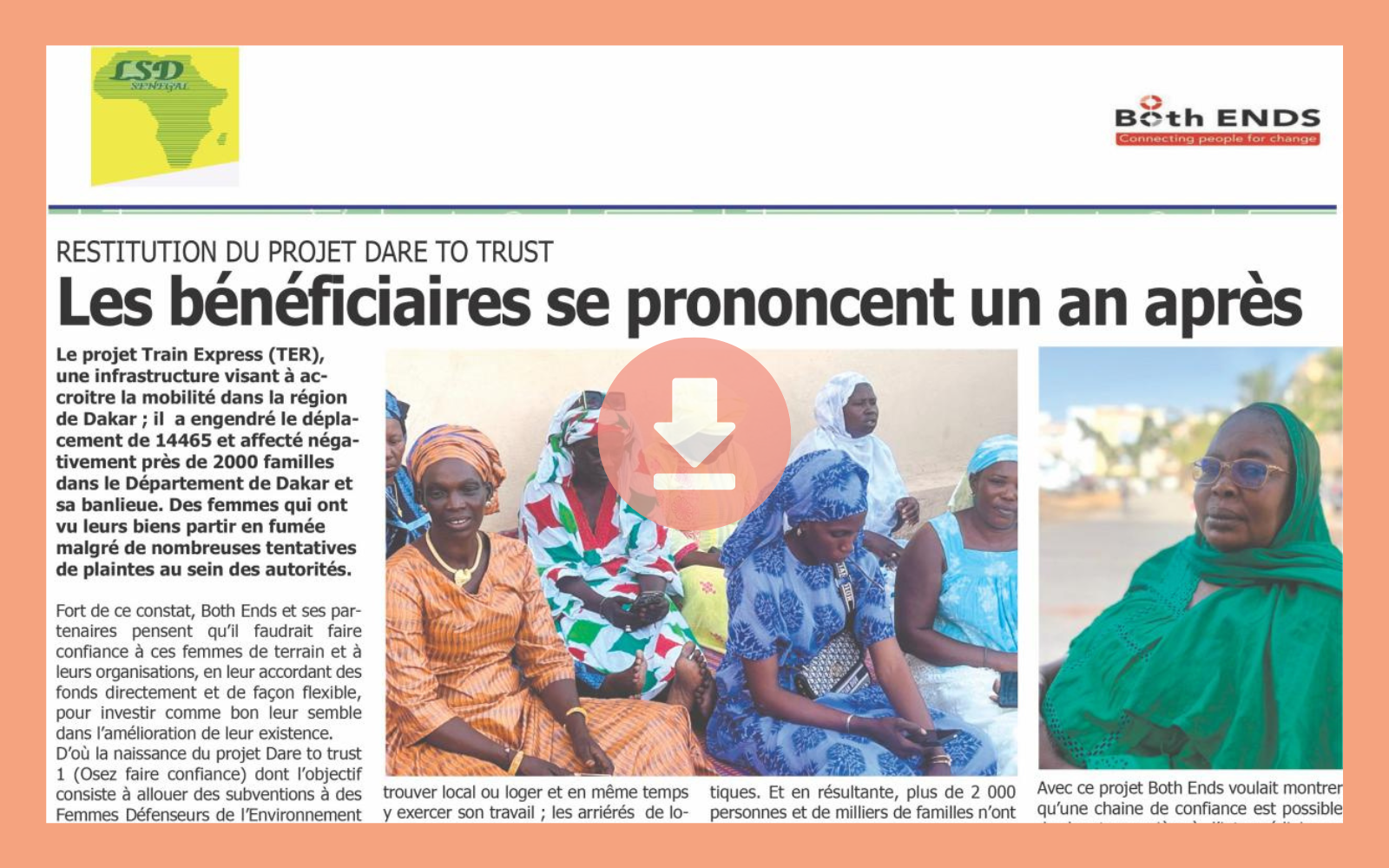
The support to the women was made possible within our Dare to Trust-project, a no-strings-attached way of funding. The only administrative duty was to send a creative report about the activities. LSD has written a newspaper-style article to report back on the results of the women and how they spend their grants:
In an additional video, some of the women themselves tell how the grant has helped them regain control over their lives:
For more information
Read more about this subject
-
 Dossier /
Dare to Trust: the power of unconditional funding
At Both ENDS we cherish our long-term relationships with partners in our global network. These relationships are based on equality and built on trust. The trust we have in each other has developed from years of strategic cooperation, including joint advocacy around common agendas, knowledge sharing, networking, and mobilising and sharing resources to advance environmental justice.
-
Publication / 3 juli 2026
-
 Dossier /
Communities Regreen the Sahel
In various countries in the Sahel, vast tracts of land have been restored by the local population by nurturing what spontaneously springs from the soil and protecting the sprouts from cattle and hazards.
-
 Dossier /
Finance for agroecology
The lion's share of public budgets for climate, agriculture and development still goes to conventional agroindustrial projects that contribute to the current climate, food and biodiversity crises. Both ENDS and our partners are calling for a transition to agroecological practices that are people- and environment-friendly.
-
 Dossier /
Global Alliance for Green and Gender Action (GAGGA)
GAGGA rallies the collective power of the women's rights and environmental justice movements to realize a world where women can and do access their rights to water, food security, and a clean, healthy and safe environment.
-
 News / 27 februari 2026
Both ENDS strengthens the resilience of female environmental defenders worldwide thanks to multi-year contribution from the Postcode Lottery
In recent years, Both ENDS has received an additional contribution of €875,000 from the Postcode Lottery for the Autonomy & Resilience Fund (2022–2025), implemented in collaboration with the Global Alliance for Green and Gender Action (GAGGA). This support was essential because female environmental rights defenders around the world are increasingly facing climate change, repression and shrinking civil space. With this contribution, Both ENDS supports female activists and their communities with flexible, trust-based funding, enabling them to develop their own solutions to urgent environmental and climate problems.
-
 Environmentally Just Practice /
Non-Timber Forest Products (NTFPs)
About one in every six people, particularly women, directly rely on forests for their lives and livelihoods, especially for food. This shows how important non-timber forest products (NTFPs) and forests are to ensure community resilience. Not only as a source of food, water and income, but also because of their cultural and spiritual meaning.
-
 News / 14 oktober 2025
Communities regreening the Sahel: strengthening resilience from the ground up
How can communities in the Sahel strengthen their food systems in the face of climate change and other shocks? Through the ARFSA Programme, Both ENDS and its partners SPONG (Burkina Faso), CRESA/INRAN (Niger) and IED Afrique (Senegal) are working together to show that locally led landscape restoration works. -
 Dossier /
Fair Green and Global Alliance (FGG)
Together with civil society organisations from all over the world, the Fair Green and Global (FGG) Alliance aims for socially just, inclusive and environmentally sustainable societies in the Netherlands and the Global South.
-
Publication / 1 juli 2025
-
 Environmentally Just Practice /
Analog Forestry
Analog forestry is a transformative approach to the ecological restoration of degraded lands. Natural forests are used as guides to create ecologically sustainable landscapes, which support the social and economical needs of local communities.
-
 Environmentally Just Practice /
Agroecology
Agroecology is a diverse set of agricultural practices, a field of science and a social movement. It aims to transform food systems towards greater ecological sustainability, social justice, and resilience. Both ENDS and CSO-partners around the world support farmers and pastoralists practising agroecology, both on the ground and in gathering political and financial support.
-
 External link / 29 april 2025
 -
 Blog / 23 april 2025
The power of trust
Trust builds trust. That is what I have learned from how Both ENDS works - within our team, with partners in joint strategies and advocacy, and in our relationships with partners as a funder. Trust is the foundation. It is what allows compassion to grow, what gives rise to hope, and what fuels real solidarity. This is especially powerful in contrast to the prevailing global trend of political and international leaders who prioritize hard measures and self-interest, ignoring relations of trust. It is even more reason for us to share what we have experienced when we put trust first.
-
 Dossier /
Inclusive ways to sustainable and healthy food for all
All around the world small-scale farmers are using sustainable and inclusive methods to produce food. Working together with nature and each other, they provide their families and communities with sufficient and healthy food. But their production methods are under pressure from large-scale agriculture and the globally dominant system of industrial food production. Together with our partners, Both ENDS is trying to turn the tide in favour of sustainable, local practices that are mostly known as 'agro-ecological' or 'nature-inclusive'. Why are we focusing on these methods? Agro-ecological practices are climate-proof and inclusive and increase the opportunities for communities around the world to produce their food sustainably.
-
Publication / 1 april 2025
-
 Environmentally Just Practice /
Farmer Managed Natural Regeneration
In various countries in the Sahel, vast tracts of degraded land have been restored by the local population by nurturing what spontaneously springs from the soil. They do this using a method called 'Farmer Managed Natural Regeneration (FMNR)'.
-
 News / 13 januari 2025
New partnership with Netherlands Enterprise Agency for resilient food systems in Sahel
The situation in Africa's Sahel is the world's fastest-growing humanitarian crisis. Over 3 million people are fleeing violence. They are ravaged by hunger, disease and increasing drought caused by climate change. Both ENDS and its partners are successfully working on accelerating the resilience of local food systems and communities in the Sahel, based on ‘Farmer Managed Natural Regeneration’ (FMNR). The project, funded by DOB Ecology, will end in mid-2026, but has already been followed up thanks to a new collaboration with the Netherlands Enterprise Agency (RVO).
-
 News / 24 december 2024
LILAK's Dare to Trust projects: Dreams transformed into actions
LILAK has worked alongside indigenous women communities for over a decade, focusing on building capacity and advocating for rights to land, the environment, and bodily autonomy. Despite gaining recognition and trust from allies, the journey was challenging. Starting with limited resources, LILAK faced resistance, particularly from patriarchal leaders and the state, which often labeled them as adversaries. Nevertheless, they adapted and continued their work, grounded in solidarity and sisterhood.
-
 News / 24 december 2024
Dare to Trust: a journey of culture, renewal, and empowerment of Sengwer women
Historically, the Sengwer community has lived in harmony with their environment, relying on forest resources for sustenance and integrating conservation into their daily lives. However, recent government policies aimed at forest protection have limited their access to these ancestral lands. Although these regulations intend to protect the environment, they often disregard the traditional conservation practices of indigenous communities like the Sengwer, who have been natural stewards of these lands for generations. Faced with these restrictions, the Segerger Women’s Conservation Group intensified their conservation efforts, viewing it as both a cultural duty and a means to safeguard their heritage.



