


Restoring forests, “free supermarkets” for Cameroon’s inhabitants
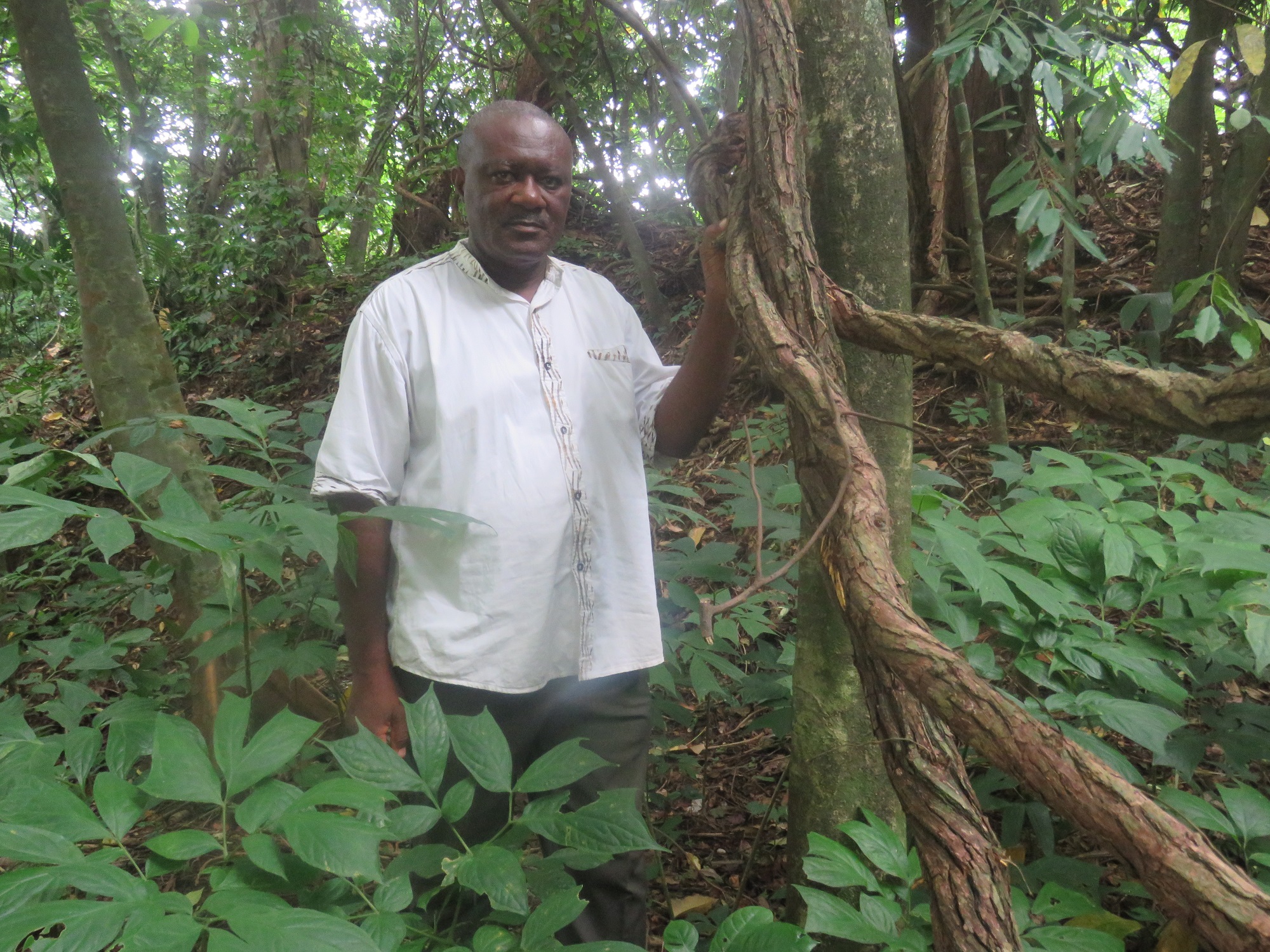
To Eric Wirsiy, director of CENDEP, the importance of forests is clear: not only do they function as a "free supermarket", providing foods and other things to local communities, but they are crucial to make landscapes resilient to climate change and other impacts.
CENDEP is a Cameroonian organisation promoting analog forestry. In partnership with Both ENDS they provide trainings on analog forestry in Cameroon and other African countries to rural communities. Analog Forestry is a method to transform degraded lands into productive food forests, which is beneficial to both ecosystems and communities, explains director Eric Wirsiy:
"Forests serve as a "free supermarket" providing different types of food, both of plant and animal origin, medicines, timber etc to the rural and urban dwellers. In addition it supplies many essential services such as filtering water, cycling and storing nutrients, and regulating climate. Forests provide the equilibrium that is essential for resilient landscapes."
Forests under threat
The world's forested area, however, is diminishing rapidly: "Man's greed has resulted in unquenchable needs that now lead to large scale deforestation. It is important that this be halted and the 31% forest land area of the world maintained through forest restoration and promotion of non-extractive forest use such as tourism and rational exploitation, a component of sustainable forest management."
Much of this deforestation is caused by the consumption pattern of the European Union. Export of palm oil, cotton, coffee, cacao and other goods for the European market leads to forest destruction in Cameroon and elsewhere.
European Commission wants to stop deforestation
The good news is that the European Commission acknowledges this problem and is now designing measures to address the deforestation around the world connected with EU supply chains and consumption. They have set up a consultation about it.
We've developed an easy way for you to give your input. Just fill in your details below and hit the 'ACT NOW' button, and a clear message in your name will be sent automatically to the European Commission.
Read more about this subject
-
 Environmentally Just Practice /
Analog Forestry
Analog forestry is a transformative approach to the ecological restoration of degraded lands. Natural forests are used as guides to create ecologically sustainable landscapes, which support the social and economical needs of local communities.
-
 Press release / 29 september 2026
New Zealand faces its first climate complaint under EU trade rules
UTRECHT / WELLINGTON, 29 September 2026 /30 September in Aotearoa New Zealand
Both ENDS, a Dutch environmental justice organisation, has lodged a formal complaint with the European Commission arguing that New Zealand has broken the climate promises it made in its free trade agreement with the European Union. It is the first complaint on environmental and climate grounds under the Commission's Single Entry Point, the mechanism that lets civil society ask the EU to enforce the sustainability commitments in its trade agreements.
-
 Dossier /
Trade agreements
International trade agreements often have far-reaching consequences not only for the economy of a country, but also for people and the environment. It is primarily the most vulnerable groups who suffer most from these agreements.
-
 Dossier /
Communities Regreen the Sahel
In various countries in the Sahel, vast tracts of land have been restored by the local population by nurturing what spontaneously springs from the soil and protecting the sprouts from cattle and hazards.
-
Publication / 3 juli 2026
-
 Dossier /
Finance for agroecology
The lion's share of public budgets for climate, agriculture and development still goes to conventional agroindustrial projects that contribute to the current climate, food and biodiversity crises. Both ENDS and our partners are calling for a transition to agroecological practices that are people- and environment-friendly.
-
Publication / 18 juni 2026
-
Publication / 12 mei 2026
-
 News / 26 maart 2026
New project: Climate Accountability in EU Trade
Through its new project “Climate Accountability in EU Trade: Testing the SEP and DAGs for Climate-Linked FTA Enforcement” Both ENDS, with support from the European Climate Foundation, is exploring how the European complaints mechanism (SEP) and Domestic Advisory Groups (DAGs) can be more effectively used to advance climate accountability. The project runs for 13 months, until end of 2026.
-
 News / 24 maart 2026
Statement: Invest in local leadership for tropical forest management and local economies
IUCN-NL, Both ENDS, and 16 other Dutch and international civil society organizations (CSOs), networks, and expert groups are calling on the Dutch government to invest more strongly in locally led forest management and forest-based economies. This should be done within the framework of Dutch international cooperation and its associated policy instruments.
-
 Dossier /
Wetlands without Borders
With our Wetlands without Borders program, we work towards environmentally sustainable and socially responsible governance of the wetlands system of the La Plata Basin in South America.
-
Publication / 17 november 2025
-
 Environmentally Just Practice /
Non-Timber Forest Products (NTFPs)
About one in every six people, particularly women, directly rely on forests for their lives and livelihoods, especially for food. This shows how important non-timber forest products (NTFPs) and forests are to ensure community resilience. Not only as a source of food, water and income, but also because of their cultural and spiritual meaning.
-
 Press release / 13 november 2025
Global Alliance Urges Dutch Government to Reconsider Endorsement of Controversial Timber Certification Scheme
A coalition of Malaysian and international NGOs has released a memorandum in response to the recent TPAC report on the Malaysian Timber Certification Scheme (MTCS). The organizations express serious concerns about the independence, quality, and credibility of the assessment carried out by the Timber Procurement Assessment Committee (TPAC).
-
 News / 5 november 2025
Overview of Both ENDS events at COP30 in Belem, Brazil
Both ENDS is present at COP30 to advocate for genuine access to climate finance for locally led, gender-just climate solutions, and for the mechanisms that make these possible, including those supporting farmer-led restoration. The organisation also engages to highlight the crucial connection between climate negotiations and the trade and investment frameworks that shape them.
Below is an overview of the Both ENDS team at COP30 and a detailed look at the activities and side-events in which Both ENDS will participate.
-
Publication / 16 oktober 2025
-
Publication / 16 oktober 2025
-
Publication / 9 oktober 2025
-
 Dossier /
International trade and investment with respect for people and planet
The network of international trade and investment treaties is large and complex. The Netherlands alone has signed more than 70 bilateral investment treaties (BITs) and is party to the trade and investment agreements concluded by the EU, like the EU-Mercosur and EU-Indonesia trade deals.
-
 Dossier /
Amplifying environmentally just practices
Because of the close relationship with their living environment, local communities often have the best ideas for the sustainable and equitable use and governance of land, water and forests. These environmentally just practices and processes successfully protect and restore ecosystems and address climate change. They are essential in the light of the multiple crises the world faces, but are in dire need of financial and policy support.




