


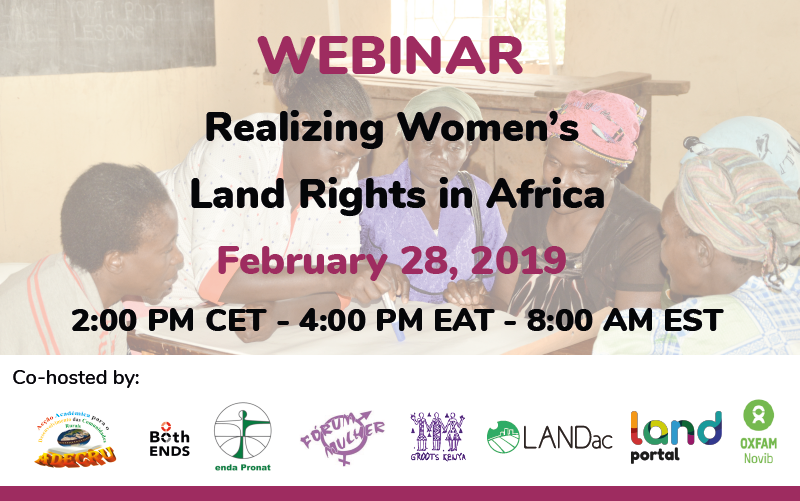
Webinar: Realizing women’s land rights in Africa
This webinar will feature experiences from several grassroots initiatives and highlight how they fight for women's improved access to and control over land and other natural resources and to scale up women's land rights.
In October 2016, women farmers from 22 countries across Africa climbed the peak of Mount Kilimanjaro to claim women's rights for access to and control over land and natural resources. This event coincided with the launch of a campaign of the African Land Policy Centre (ALPC) to reach the target of having 30 percent of all registered land in the name of women by 2025 and to embed women's land rights into the targets of the Sustainable Development Goals (SDGs).
In line with these initiatives, there has been increased attention for women's land rights by grassroots movements, local governments, civil society organisations, academics, and international organisations. Nonetheless, despite progressive policies, legal frameworks, and strong civil society engagement in many countries, there is still a lot to be done to feel a real impact on the ground.
The webinar is co-hosted by Acção Académica Para O Desenvolvimento Das Comunidades Rurai (ADECRU) (Mozambique), Both ENDS, ENDA Pronat (Senegal), Fórum Mulher (Mozambique), GROOTS Kenya, LANDac, the Land Portal Foundation and OXFAM Novib.
Register Now (link is external)
Panelists will address the following questions:
- Why do women's land rights remain an issue with so much attention focusing on it? What went wrong?
- What are good practices in achieving success towards women's land rights and what – according to your own perspective – made these initiatives and strategies successful?
- What is needed next to scale up these approaches and to move the women's land rights agenda forward?
- What is the message to policy makers to scale up these approaches?
Moderator:
- Griet Steel (Utrecht University and LANDac, the Netherlands).
Panelists:
- Nzira Razão Deus (Fórum Mulher, Mozambique)
- El Hadji Faye (Enda Pronat, Senegal)
- Fridah Githuku (Groots Kenya)
- Sreetama Gupta Bhaya (Oxfam Novib, India)
For more information
-
 Blog / 8 maart 2019
Women lead struggle for land rights for the Avá Guaraní
By Tamara MohrTogether with five women from the Platform Suace Pyvyvõhára, I travel to Mingã Pora in the east of Paraguay. Around 45 families from the indigenous Tekohá Suace community settled here in 2016. In Guaraní, Tekohá means 'the place where we are what we are'. They reside in tents - self-made out of waste materials - on a small strip of land with a soy field on one side and a nature reserve owned by the Itaipu company on the other.
-
 Event / 22 september 2022, 13:00 - 14:30
Showcasing transformative approaches for women’s land rights
Both ENDS and the Land Portal Foundation invite you to the third webinar in the Whose Land? Inclusive Pathways to Land Governance series. This third Whose Land? webinar will showcase gender transformative approaches on women's land rights. Gender transformative approaches are defined by women acting as agents of change, transforming structural barriers and redefining gender norms. These approaches facilitate the participation of women in land governance decision-making processes, but require closing the land data gender gap.
Register here
-
 News / 6 juli 2026
Strengthening Women's Land Rights Across the Rio Conventions
From 29 June – 2 July 2026, Tamara Mohr, GAGGA coordinator at Both ENDS participated in the 4th convening of the Women's Land Rights Initiative (WLRI) in Nairobi, Kenya.Hosted by the Robert Bosch Stiftung, TMG Research and the Huairou Commission, the event brought together grassroots organisations, (inter)national NGOs, government institutions and donors from around the world.
-
Publication / 1 september 2017
-
 Event / 7 maart 2018, 15:00 - 16:30
Women's Rights & Climate Finance Webinar: getting the money to the people
Join us for the third session of this five-part series on women's rights and climate finance, aimed at building knowledge and power to ensure finance flows benefit local women's groups, respond to community needs and respect human rights.
-
 Video / 31 mei 2016
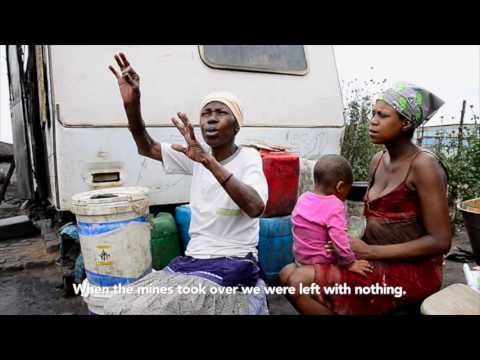
Women's rights undermined in South Africa
The population of the informal settlement Masakhane, South Africa is highly affected by the pollution and environmental damage caused by the the coal-fired Duvha power station. Before the mining and power station developments, families had access to and control over the land, even if they did not own it. Farming used to be the main source of livelihood. Today, mining companies and investors own most of the land, and as a direct consequence people have lost a lot of their farming and grazing land. This video shows testimonies of victims and their efforts to turn the tide.
-
 Dossier /
Global Alliance for Green and Gender Action (GAGGA)
GAGGA rallies the collective power of the women's rights and environmental justice movements to realize a world where women can and do access their rights to water, food security, and a clean, healthy and safe environment.
-
Publication / 8 januari 2021
-
 Event / 15 maart 2022, 11:00 - 12:30
CSW66 Side Event: Feminist solutions for the environmental and climate crisis
Join us at the 66st UN Commission on the Status of Women (CSW66) for a critical conversation about the intersections of climate, gender and sustainable development. Land defenders and gender rights advocates will join ministry representatives from Sweden, Chile and the Netherlands in a discussion about feminist leadership in protecting land, promoting climate solutions and supporting truly sustainable development strategies. In this session, we aim to explore how governments and feminist climate movements can best work together to tackle the root causes of the climate crisis.
Register here!
-
Publication / 1 september 2017
-
 News / 28 september 2017
Both ENDS at UNCCD COP13: don’t forget about the people
This September, Both ENDS participated at the 13th Conference of the Parties of the UNCCD in Ordos, Inner Mongolia in China. We were part of the Drynet delegation, a network of CSOs, to bring local realities to the international UNCCD discussions.
-
Publication / 10 december 2018
-
 External link / 20 juli 2021
Women’s rights and Non-Timber Forest Products (Annual Report 2020)
As a source of food, water and income, and for their cultural and spiritual meaning, forests and Non-Timber Forest Products (NTFPs) help ensure community resilience. Both ENDS has a long history of collaboration with partners such as the Non-Timber Forest Products Exchange Programme (NTFP-EP) and Keystone Foundation, which support forest communities in promoting the NTFP concept for forest conservation and livelihood enhancement.
-
 News / 2 juli 2019
Indonesia: Women’s Right to Water
The water quality of East Java's largest river, the Brantas River, is increasingly deteriorating due to a combination of industrial and household waste. This environmental pollution has a disproportionate impact on women. Yet, their participation in decision-making remains lacking. ECOTON is working to improve the situation.
-
 External link / 24 juni 2023
Women’s land rights in Mozambique (Annual Report 2022)
In Mozambique, few women can rest assured that their right to use and enjoy land is guaranteed. Forum Mulher, a network of Mozambican women's rights organisations, raised public awareness and mobilised rural women to effectively make their voices heard during the government's formal review of the legislative framework for land governance. As a result, the revised National Land Policy of Mozambique now emphasises the importance of prioritising and valuing rural peasant women in land policy and law.
-
Publication / 26 november 2020
-
Letter / 19 oktober 2022
Both ENDS' input to the 'Consultation Feminist Foreign Policy' of Ministry of Foreign AffairsZa
In May 2022, Minister Hoekstra of Foreign Affairs and Minister Schreinemacher for International Trade and Development Cooperation announced that also The Netherlands will work towards implementing a Feminist Foreign Policy (FFP). This means that within its Foreign Policy, the Netherlands will pay more attention to inclusivity in general and specifically to women's rights and gender equality, including LGBTIQ+. This feminist lens will be central to all aspects of foreign policy; security, trade, diplomacy and international cooperation.
To foster an inclusive process and acquire insights in what a Dutch FFP should look like, the Ministry of Foreign Affairs opened an internet consultation. Both ENDS welcomes the FFP and therefore gladly shares its input and suggestions.
-
 News / 8 maart 2017
International Women's day is still urgently needed
Today is International Women's Day. A day originating from women's strikes against poor working conditions in the textile industry, some 100 years ago. Since then, a lot has improved for women but, unfortunately, men and women obviously still don’t have equal rights. In 1949, Simone de Beauvoir already warned that ‘women’s rights will never be vested. You have to stay vigilant your whole life’. Recent developments such as the tightening of abortion laws in some countries confirm this view and show that even in the ‘free West’ women’s rights are still far from self-evident.
-
Publication / 21 februari 2018
-
Publication / 3 november 2017




