




A land without trees is like a People without hope
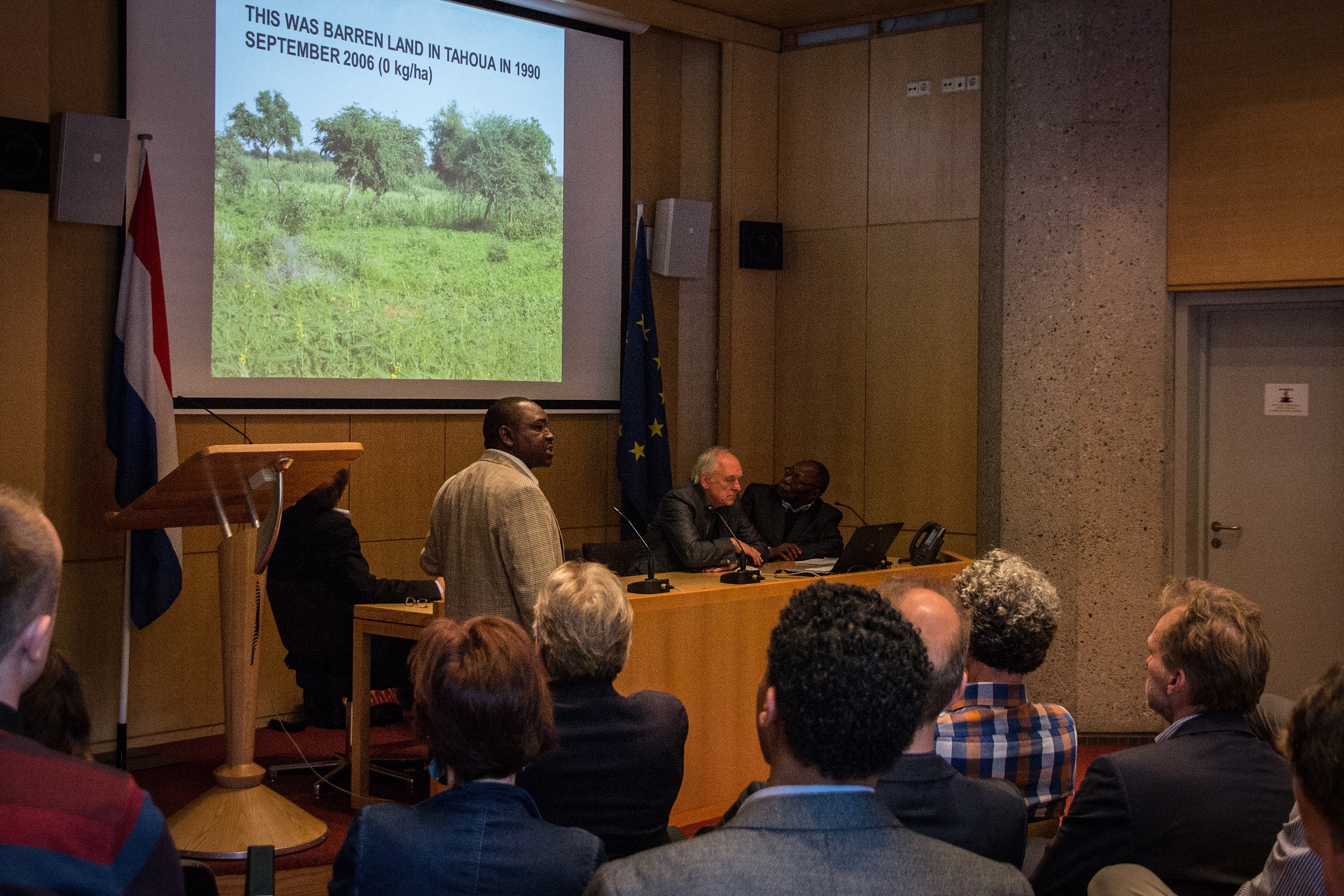
“5 million hectares in the Niger desert has been transformed into a lush landscape, where trees flourish, crops prosper and livestock thrives!” dr.Abasse Tougiane exclaims enthusiastically. “This is an area larger than the Netherlands!” We are present at the lecture about the successful initiative to regreen Niger, given by Abasse and his colleague Toudou Adam at the Ministry of Foreign Affairs. The room is almost completely full; obviously not only officials of Foreign Affairs, but also scientists, delegates from NGO’s and representatives from the private sector are interested in the subject. The question on everyone’s mind is: ‘how can this be so successful where an initiative such as the Great Green Wall so sadly failed?
Dr. Abasse and prof. Toudou work at the 'Centre Régional d'Enseignement Spécialisé en Agriculture' (CRESA) in Niger, which is a government affiliated scientific and agricultural institute. Since the early 90s they have been devoting themselves to implementing and researching a traditional farming technique that has been re-introduced by farmers in Niger. The idea was to use this traditional method, which was later named ‘Farmer Managed Natural Regeneration’ (FMNR), to push back the encroaching desert in Niger.
Self-initiative is rewarded
In the past it has always been common for farmers in Niger to use young tree shoots to feed their livestock or burn them for kindle wood. Trees are inedible, so there was no point in growing them on plots and common lands. Over time, the soil became more and more dry, barren and infertile. As a result a few farmers decided to change tack. They started protecting the young trees on their land from cattle and other threats to give them a chance to grow. Full-grown trees provided shade and windbreaks for annual crops and livestock, the leaves provided nutrients for the soil and served as feed for the animals. Additionally, the new vegetation helped increase ground water. Trees produce perennial products, fruits, nuts, leaves, wood – for various purposes: medicinal, firewood, timber for own use and for sale etc. The successes of these pioneers inspired many other farmers to adopt these agro-forestry techniques.
Great Green Wall
Of course, there have been countless re-greening efforts throughout the years in attempts to revitalise desert areas. The most ambitious of these plans was The Great Green Wall. This plan, initiated by the African Union, aimed at creating an entirely green strip from the East to West of Africa crossing through the driest areas. “One of the principal reasons that the project failed was because of a choice to planting of foreign tree species, i.e. trees which were not at all accustomed to the drought and conditions of the desert”, says Dr. Abasse. “And this is the heart of the matter. By using ‘FMNR we make use, instead, of the ‘forest’ of already existing roots and seeds that lays beneath the soil. The only thing one has to do is to cherish and protect the vegetation sprouting from it and take good care of it after it has grown.”
Sustainable solutions for the future
This specific project came forth through a collaboration between CRESA and Both ENDS in cooperation with WRI, and has been supported by the Turing Foundation for the past 5 years. Research was conducted, farmers were trained and special village committees were formed so that every voice could be heard and local people have a stake in these institutions. Because this method has been proven to be so successful and could even provide a solution to the growing ecological and food crisis in African Sahel, it is about time that these promising results from Niger are brought to the attention of Dutch policy makers. “At FMNR the farmers and the land users are the starting point”, says Karin van Boxtel from Both ENDS, who is involved in the project and organised the lecture. “The farmers themselves are in control, they decide how the communal land is managed and used.”
Participation and ‘ownership’
This is another reason why this approach differs so greatly from initiatives such as The Great Green Wall, which was constructed top-down by people out of touch from the local realities, without including the local population. “People will eagerly take on the responsibility of creating their own success, however in order to do so they must first be given this responsibility”, says Karin. “It is therefore very important that the Dutch food security and climate policies give their special attention to this promising re-greening technique, where farmers are really in control of their livelihoods.” During his presentation dr. Abasse presents a photo depicting a beautiful lush landscape in Niger. “This land was infertile in 1990, and look at it now. There are trees and plants, and it has become entirely green.” He concludes his lecture with saying: “A land without trees is like a People without hope.”
For more information:
Read more about this subject
-
Letter / 14 July 2026
Statement on CAO Cambodia Microfinance Case
The independent complaints mechanism of the International Finance Corporation (IFC) and the World Bank Group found that the IFC violated its own Environmental and Social Sustainability Framework by investing in six banks providing microfinance in Cambodia.
-
 News / 6 July 2026
Strengthening Women's Land Rights Across the Rio Conventions
From 29 June – 2 July 2026, Tamara Mohr, GAGGA coordinator at Both ENDS participated in the 4th convening of the Women's Land Rights Initiative (WLRI) in Nairobi, Kenya.Hosted by the Robert Bosch Stiftung, TMG Research and the Huairou Commission, the event brought together grassroots organisations, (inter)national NGOs, government institutions and donors from around the world.
-
Publication / 3 July 2026
-
 Dossier /
Communities Regreen the Sahel
In various countries in the Sahel, vast tracts of land have been restored by the local population by nurturing what spontaneously springs from the soil and protecting the sprouts from cattle and hazards.
-
 News / 2 July 2026
Land restoration can help mitigate and resolve conflict - but only if everyone has a seat at the table
Can restoring degraded land also help reduce conflict? According to experts from Niger, Ghana, the Netherlands and other regions, the answer is yes - but only when restoration is rooted in inclusive land governance, local ownership and social cohesion.
-
 Dossier /
Gas in Mozambique
In 2011 one of the world’s largest gas reserves was found in the coastal province of Cabo Delgado, in the north of Mozambique. A total of 35 billion dollars has been invested to extract the gas. Dozens of multinationals and financiers are involved in these rapid developments. It is very difficult for the people living in Cabo Delgado to exert influence on the plans and activities, while they experience the negative consequences. With the arrival of these companies, they are losing their land.
-
 Dossier /
Finance for agroecology
The lion's share of public budgets for climate, agriculture and development still goes to conventional agroindustrial projects that contribute to the current climate, food and biodiversity crises. Both ENDS and our partners are calling for a transition to agroecological practices that are people- and environment-friendly.
-
 Dossier /
Trade agreements
International trade agreements often have far-reaching consequences not only for the economy of a country, but also for people and the environment. It is primarily the most vulnerable groups who suffer most from these agreements.
-
Publication / 18 June 2026
-
Publication / 12 May 2026
-
 Press release / 12 May 2026
UN report warns of a growing sand crisis - The Dutch dredging sector plays a key role in global sand extraction
GENEVA/UTRECHT, 12 May 2026 – A new report by the United Nations Environment Programme (UNEP), Sand and Sustainability: An Essential Resource for Nature and Development, warns that global demand for sand is exceeding ecological limits. Large-scale extraction of sand from marine and coastal ecosystems is leading to biodiversity loss, damage to coastal communities and increasing risks in an era of climate change. Dutch dredging companies play a prominent role in this as global market leaders in large-scale sand extraction and land reclamation. “Our analyses show that the dredging sector operates globally within a system in which ecological damage and the consequences for coastal communities are systematically underestimated, whilst transparency and effective oversight are often lacking,” says the Dutch environmental and human rights organisation Both ENDS, which contributed to the report.
-
 News / 14 April 2026
New report: Phasing out ISDS in the Netherlands: a roadmap
Today, Both ENDS and SOMO are publishing the report Phasing out ISDS in the Netherlands: a roadmap. In the report, we highlight the Netherlands’ role in the ISDS system and offer practical guidance on phasing out ISDS.
-
 Dossier /
Rights for People, Rules for Corporations – Stop ISDS!
Indigenous communities in Paraguay saw their attempts to regain their ancestral lands thwarted by German investors. In Indonesia, US-based mining companies succeeded to roll back new laws that were meant to boost the country’s economic development and protect its forests. This is the level of impact that investment treaties can have on social, environmental and economic development and rights. Why? Because of the ‘Investor-to-State Dispute Settlement’ clauses that are included in many such treaties.
-
Publication / 14 April 2026
-
Publication / 10 April 2026
-
 News / 10 April 2026
Both ENDS: strengthened FMO complaints mechanism is a step forward, but major gaps remain
Both ENDS welcomes the strengthened Independent Complaints Mechanism (ICM) of development finance institutions FMO, DEG and Proparco as an important step forward in accountability. Working directly with communities affected by development projects, we see daily how essential it is that people can access justice when they are harmed in the name of development. For many communities, this mechanism is one of the few avenues through which harm can be formally recognised and addressed in relation to these development banks.
-
 News / 9 April 2026
Minister Sjoerdsma hosts roundtable conversations with civil society
This week, Minister Sjoerdsma organized roundtable conversations with civil society organizations – a valuable initiative that brings together Dutch civil society voices to address critical challenges faced by democratic societies.
-
 News / 26 March 2026
New project: Climate Accountability in EU Trade
Through its new project “Climate Accountability in EU Trade: Testing the SEP and DAGs for Climate-Linked FTA Enforcement” Both ENDS, with support from the European Climate Foundation, is exploring how the European complaints mechanism (SEP) and Domestic Advisory Groups (DAGs) can be more effectively used to advance climate accountability. The project runs for 13 months, until end of 2026.
-
 News / 24 March 2026
Statement: Invest in local leadership for tropical forest management and local economies
IUCN-NL, Both ENDS, and 16 other Dutch and international civil society organizations (CSOs), networks, and expert groups are calling on the Dutch government to invest more strongly in locally led forest management and forest-based economies. This should be done within the framework of Dutch international cooperation and its associated policy instruments.
-
 News / 19 March 2026
Winners of the ILED ‘Women Are Educators Award’ announced
Our partner organisation ILED (Indigenous-led Education Network) announced the seven winners of the ILED ‘Women Are Educators Award’ this month. These are women who play extraordinary roles in passing on knowledge, whether in formal or informal educational settings.




