Both ENDS





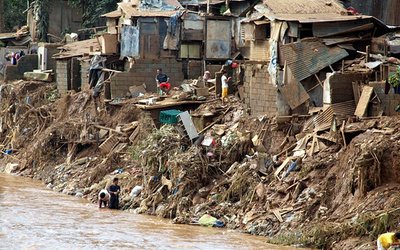
The Asian Development Bank (ADB) and the World Bank will donate $23 million to the Philippines, but will also provide a loan of $500 million to this country for the reconstruction of the areas damaged by the storm. According to ‘NGO Forum on ADB,’ Both ENDS’ partner organisation, these banks abuse this crisis. The debt will have to be repaid with interest and Philippine society will end up paying the price.
Political Cafe in the Bank We Trust: Testing the water
How can the right to water and sanitation enhance the World Bank's policy and practice in the sector?
Thursday October 9th, 2008 / 5 pm to 6.45 pm
Overflow room for Preston Auditorium, World Bank, 1818 H Street NW Washington D.C
Countries could be facing a wave of cases from transnational corporations suing governments over actions taken to respond to the Covid pandemic using a system known as investor-state dispute settlement, or ISDS. 630 organisations from across the world, representing hundreds of millions of people, are calling on governments in an open letter to urgently take action to shut down this threat.
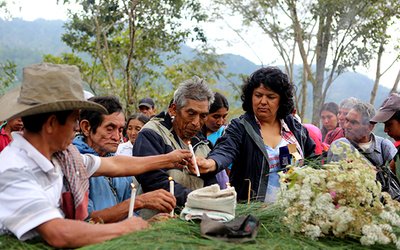
After the second shocking murder of an indigenous rights activist in Honduras in less than two weeks the Dutch development bank, FMO, and the Finish development bank, FinnFund, announced a suspension of all their operations in Honduras. They declare that they will no longer engage in new projects or disbursements in the country, including in new disbursements in the Agua Zarca Project.
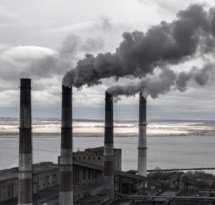
The Netherlands is well on its way with the energy transition at home, but our country continues to encourage Dutch investments in fossil projects elsewhere. This is obviously not in line with the climate goals and, moreover, these kinds of projects cause major problems in the countries where they take place. What can a new cabinet do to reduce the Dutch footprint abroad? Ellen Mangnus discussed this with several experts: today part 2.
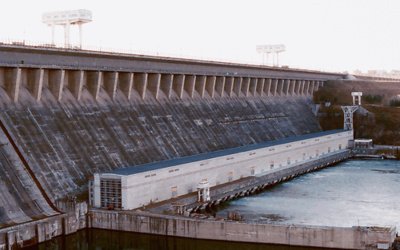
Infrastructure has become a buzzword of the current development debate. But will the recent infrastructure strategies of the World Bank and the G20, which favour large centralized projects, address the needs of the poor? This is the central question in International Rivers' report "Infrastructure for whom?". Strategic infrastructure projects such as large dams and transport corridors promoted by the World Bank and G20 are funded with public money. In order to make these projects attractive to private investors, they are supported by public guarantee schemes. One of the examples mentioned in the report is the Grand Inga Dam in the Congo River (DRC) which - if ever realised - would be the largest dam in the world.
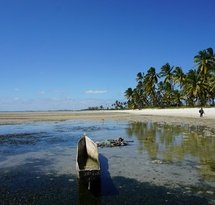
In 2011 one of the world’s largest gas reserves was found in the coastal province of Cabo Delgado, in the north of Mozambique. A total of 35 billion dollars has been invested to extract the gas. Dozens of multinationals and financiers are involved in these rapid developments. It is very difficult for the people living in Cabo Delgado to exert influence on the plans and activities, while they experience the negative consequences. With the arrival of these companies, they are losing their land.
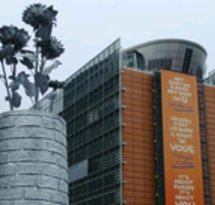
For a moment it appeared that the European Investment Bank (EIB) decided to stop investments in coal fired power plants. The bank even seemed to have issued a press release on the matter. But, unfortunately, the message was not real. During the annual press conference of the bank the activists, who were the source of the fake press release, stroke again. In the name of ‘the citizens of Europe’, EIB president Werner Hoyer was awarded with the ‘World Coal Down Award’. Hoyer, who was confused for a second, did not accept the award. The EIB fiercely denied the rumors surrounding the investment stop on coal with the term 'pure nonsense'.
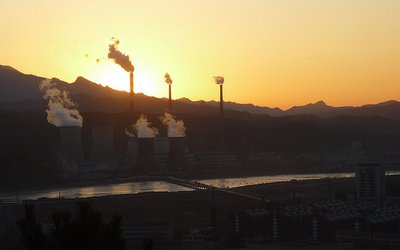
‘The polluter pays’ is a good principle, but what about the institutions that financially support polluting companies and projects? Shouldn’t banks, that are often major investors in unsustainable activities, take their responsibility and pay as well? In the end, these banks also cash in. Pieter Jansen of Both ENDS contributed to research about the ‘Green Credit Policy’ of Chines banks, executed by the Chinese NGO ‘Green Watershed’. Pieter Jansen of Both ENDS and Chen Yu of Green Watershed have launched the report 'Green Credit Footprints of Chinese Banks'.